Ever clicked on a coin that promises to change online gaming and payments, only to find conflicting data everywhere? That is exactly what happens when you look up Fasttoken. It is not just another speculative asset; it is the native fuel for the Bahamut network and the operational backbone of the Fastex ecosystem. If you are trying to figure out if this project has real utility or if it is just hype wrapped in a whitepaper, you need to understand who built it and how it actually works.
Here is the bottom line: Fasttoken is backed by a massive existing tech company, not a faceless anonymous team. But with prices swinging wildly between $0.15 and over $9 in recent years, and market caps ranging from $69 million to nearly $2 billion depending on where you look, you need a clear picture before you touch your wallet. Let’s break down what FTN actually does, why it exists, and what you should watch out for.
Key Takeaways
- Fasttoken (FTN) is the native currency of the Bahamut blockchain, a layer-1 network using Proof of Stake and Activity (PoSA).
- The project is developed by SoftConstruct, an Armenian IT group with ~7,000 employees and ~1 million active users across its platforms.
- FTN serves as a utility token for payments, staking, and governance within the Fastex ecosystem, which includes an exchange, NFT marketplace, and payment gateway.
- Market data is highly fragmented, with reported prices varying significantly across different exchanges and dates between 2024 and 2026.
- The token started as an ERC-20 on Ethereum but now functions as the gas token for its own EVM-compatible chain.
Who Built Fasttoken and Why?
You might wonder why a new blockchain needs a specific corporate backing. Well, Fasttoken didn’t emerge from a garage hackathon. It comes from SoftConstruct, a large technology conglomerate based in Armenia. This isn't a small startup; they claim around 7,000 employees and hundreds of partners. Their main business revolves around online gaming, betting, and digital entertainment. Think of them as the infrastructure provider behind many of the games and platforms you might have played or heard of.
The creation of FTN was driven by a desire to integrate Web3 directly into these existing products. Instead of launching a generic blockchain for DeFi farmers, they wanted a tool that could handle payments and assets for their current user base of roughly one million people. The whitepaper, first updated in late 2022, outlines FTN as the bridge between traditional fiat transactions in their games and a decentralized future. This vertical integration is their biggest selling point: they aren't asking you to imagine a use case; they already have the users and the platforms ready to accept the token.
How the Bahamut Blockchain Works
To understand the coin, you have to understand the chain. Bahamut is a public, layer-1 network. It is EVM-compatible, which means if you know how to build on Ethereum, you can build on Bahamut using the same tools. You don't need to learn a new programming language from scratch. The smart contracts run on the Ethereum Virtual Machine standard, making it easier for developers to migrate their apps over.
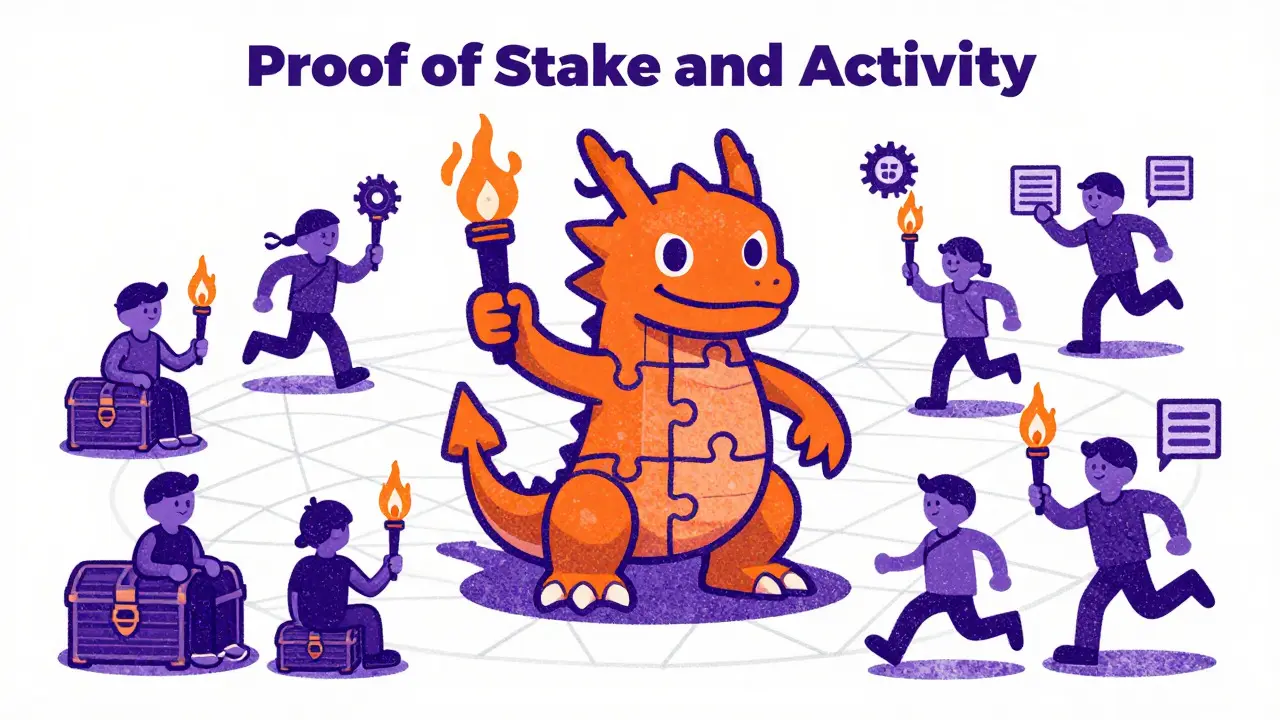
What makes Bahamut unique is its consensus mechanism: Proof of Stake and Activity (PoSA). Standard Proof of Stake relies heavily on validators holding tokens. PoSA adds a twist by incorporating activity-based incentives. This suggests that validators and participants are rewarded not just for locking up capital, but for keeping the network active and processing transactions efficiently. For you, the user, this translates to FTN being used to pay transaction fees, stake to secure the network, and earn rewards as a validator. It’s the gas that keeps the engine running.
Tokenomics: Supply, Distribution, and Volatility
Let’s talk numbers, because this is where things get confusing. The maximum supply of FTN is capped at 1,000,000,000 tokens. However, the total supply currently in existence is often cited as 880,000,000 FTN. This gap implies that some tokens are reserved for future incentives, team allocations, or ecosystem growth.
Circulating supply figures vary wildly depending on who you ask. Some data providers report around 300 million FTN in circulation, while others list closer to 430 million or even 470 million. This discrepancy is common in newer projects where tokens unlock over time or where different exchanges count liquidity differently. Because of this, calculating the exact market cap is tricky. In early 2026, some platforms valued the entire market at under $70 million, ranking it around #380, while other snapshots showed valuations near $1.9 billion. Always check multiple sources before making a move, as the "true" price depends heavily on which exchange you are looking at.
| Data Source Type | Reported Price (USD) | Market Cap Estimate | Ranking | Date Context |
|---|---|---|---|---|
| Major Global Exchange | $1.08 - $1.09 | ~$474 Million | Varies | Feb-Mar 2026 |
| Regional Analytics Site | $0.15 - $0.16 | ~$69 Million | #381 | May 2026 |
| European Data Provider | €3.83 (~$4.45) | ~€1.67 Billion | ~#50 | June 2025 |
| Aggregator Snapshot | $4.19 | Not Specified | #6,260 | Aug 2026 |
Real-World Use Cases Beyond Speculation
If you strip away the chart watching, what can you actually do with FTN? First, it powers the Fastex Exchange, allowing you to trade crypto pairs like FTN/USDT. Second, it is the native currency for ftNFT, the ecosystem's NFT marketplace. If you buy a digital collectible there, you likely pay in FTN.
But the most interesting part is Fastex Pay. This is a payment solution integrated into more than 10 payment providers. Imagine playing an online game developed by a SoftConstruct partner and paying for in-game items directly with FTN instead of credit cards. This removes banking delays and fees. For businesses, it offers a way to settle accounts globally without traditional wire transfer headaches. For gamers, it turns their playtime into potential asset ownership. It’s a direct link between the entertainment product and the financial instrument.

Risks and Things to Watch Out For
No investment is risk-free, and FTN has some specific red flags you should consider. First, centralization. Since SoftConstruct controls the ecosystem, the development roadmap, and much of the adoption, you are relying heavily on one corporate entity. If the company shifts strategy, FTN’s value could drop regardless of how good the technology is.
Second, regulatory exposure. Because FTN is deeply tied to online gaming and betting, it falls under stricter scrutiny in many jurisdictions. Changes in gambling laws or digital payment regulations could impact how widely FTN can be used. Finally, the lack of independent academic audits for the PoSA consensus mechanism means we don't have peer-reviewed proof of its security against extreme attacks. While it works today, the long-term resilience is still being tested in the wild.
Getting Started with Fasttoken
If you decide to explore FTN, here is how you typically begin. You can buy it on major centralized exchanges where it is listed against stablecoins like USDT. Once purchased, you can keep it on the exchange for trading or withdraw it to a compatible wallet. Since Bahamut is EVM-compatible, many standard Ethereum wallets support it, though you may need to add the custom network parameters for Bahamut to interact with dApps natively. Keep in mind that transaction fees will be paid in FTN, so you always need a small balance for gas.
Frequently Asked Questions
Is Fasttoken a safe investment?
Like all mid-cap cryptocurrencies, it carries volatility risk. Its safety profile is bolstered by the backing of SoftConstruct, a large established company, but it remains exposed to regulatory changes in the gaming sector and the technical risks of its proprietary PoSA consensus mechanism.
What is the difference between FTN on Ethereum and FTN on Bahamut?
Initially, FTN existed only as an ERC-20 token on the Ethereum network. Now, it also functions as the native gas token on the Bahamut layer-1 chain. The two are bridged, allowing cross-chain transfers, but the native version on Bahamut is used for local staking and transaction fees on that specific network.
Can I stake Fasttoken to earn rewards?
Yes, FTN is used for staking to secure the Bahamut network via the PoSA mechanism. Validators and participants earn rewards for processing transactions and maintaining network integrity, though specific yield rates and lock-up periods depend on the current protocol settings.
Where can I buy Fasttoken (FTN)?
FTN is traded on several centralized exchanges, including major global platforms and regional markets. You can typically find trading pairs such as FTN/USDT or FTN/USD. Always verify the liquidity and spread on your chosen exchange before executing a trade.
Who is SoftConstruct?
SoftConstruct is an Armenian technology group that develops online gaming, betting, and digital entertainment platforms. They have approximately 7,000 employees and serve around one million active users, providing the foundational user base for the Fastex and Bahamut ecosystems.

Ellie Brooks
August 27, 2026 AT 19:48Okay so I just finished reading this whole thing and honestly it is such a relief to finally see someone actually break down the numbers instead of just hyping up the next big thing because we all know how much noise there is out there right now with every new project claiming they are going to save the world. The part about SoftConstruct having like seven thousand employees really stood out to me because usually when we hear about blockchain projects it is just some anonymous team in a hoodie but here we have actual infrastructure which makes me feel a lot more confident that this isn't just a pump and dump scheme waiting to happen. I also loved that they mentioned the EVM compatibility because as someone who has been trying to learn smart contract development for the last year, knowing that I don't need to start from scratch with a completely new language is a huge deal for my learning curve. It just feels like they are building something real rather than chasing trends and that is exactly what I have been looking for in the space lately.
Dave Worth
August 28, 2026 AT 10:58Typical corporate play 🤡 They call it 'decentralized' but it's just one company holding all the cards. You think 7,000 employees means security? No, it means 7,000 people whose jobs depend on FTN not crashing. The PoSA mechanism is just a fancy name for 'we decide who gets paid'. Watch closely: when the gaming sector regulation tightens (and it will), this whole ecosystem becomes a liability. Don't be the exit liquidity. 💸
Matt Reckdenwald
August 29, 2026 AT 22:25There is a profound tension here between the promise of decentralization and the reality of corporate stewardship that we rarely discuss in these forums. While the skepticism regarding centralization is understandable, it overlooks the fact that many successful technological shifts began with centralized entities before opening up their ecosystems. The Bahamut network might be viewed through a lens of suspicion by purists, yet its integration into existing user bases suggests a pragmatic approach to adoption that could ultimately serve the broader community better than isolated DeFi experiments. We must consider whether the 'purity' of a fully decentralized launch is worth the cost of irrelevance in the face of established giants who are willing to adapt.
Melanie Armijo
August 30, 2026 AT 14:47In a sense, Fasttoken represents the inevitable collision of the old economic order with the new digital frontier. It forces us to ask if utility is truly derived from scarcity or from the sheer volume of hands that hold it. If a million people use it to buy in-game items, does it matter if the consensus mechanism is slightly opaque? Perhaps the philosophical question is not 'is it safe?' but 'is it useful enough to survive?'
Ashwin Bhandurge
August 31, 2026 AT 11:14This is a fantastic breakdown! I love seeing projects that focus on real-world utility rather than just speculative trading. The integration with payment providers is a game-changer for gamers who want seamless transactions without high fees. Keep an eye on the staking rewards; early adopters often benefit the most from network growth. Let's build together! 🚀
Paul Needham
September 1, 2026 AT 19:40So basically a casino token with extra steps. Who needs transparency when you can just trust the guys in suits in Armenia? Great job writing this article, definitely convinced me to ignore it.
Ashwini Chaskar
September 1, 2026 AT 23:58You always rush to judge without understanding the nuance of cross-border tech integration. It is so easy to dismiss innovation when it comes from outside your usual bubble. Just look at the actual user base numbers before you post your little conspiracy theories again.
Jane yuan
September 3, 2026 AT 04:58American users should be wary of foreign-controlled chains. Why rely on Armenian IT groups when we have our own strong tech sectors? This feels like another way for non-US standards to dictate our financial future. Stay vigilant.
Steve Sulley
September 5, 2026 AT 00:37actually the whole concept of 'native coin' is a myth created by marketing teams to sell shill. look at the price action in the table... it is pure chaos. no one knows the real value. i bet the devs are dumping on retail while you argue about philosophy. lol