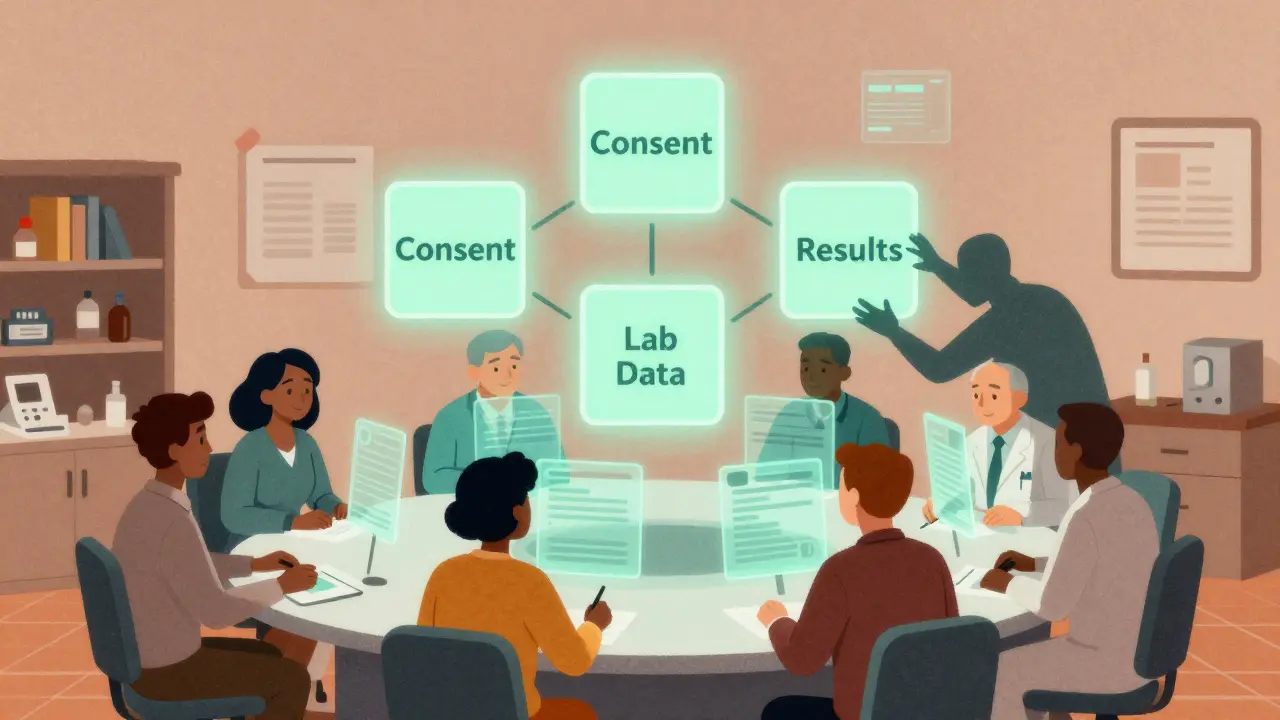
Imagine a clinical trial where every single piece of data - from patient consent to lab results - is permanently recorded, visible to authorized parties, and impossible to alter. No hidden results. No lost records. No tampering. This isn’t science fiction. It’s what’s happening now with clinical trial data on blockchain.
For decades, clinical trials have struggled with broken trust. Data gets lost. Results get buried. Researchers manipulate outcomes. Patients have no idea how their information is used. Pharmaceutical companies spend millions auditing records that may still be unreliable. The system is slow, opaque, and ripe for error. Blockchain technology is stepping in to fix this - not with promises, but with code.
How Blockchain Solves Clinical Trial Data Problems
Traditional clinical trial databases are centralized. One organization - usually a drug company or hospital - controls the data. That means one point of failure. One person with access can change, delete, or hide records. And because there’s no public audit trail, no one else can verify what really happened.
Blockchain flips this model. Instead of one database, you have thousands of copies spread across computers worldwide. Every time data is added - say, a patient’s blood pressure reading or a consent form signature - it’s locked into a block with a timestamp and cryptographically linked to the previous one. Once added, it can’t be changed. Not without rewriting every block after it. And that’s computationally impossible.
This creates something rare in medicine: provable integrity. Regulators, patients, and independent scientists can verify that the data they’re seeing is exactly what was collected. No surprises. No backroom edits.
The Seven Stages of a Clinical Trial - Now on Blockchain
Blockchain doesn’t just store data. It automates and tracks the entire lifecycle of a trial. Here’s how it works at each step:
- Protocol Registration - Before a trial even starts, its full design - including all hypotheses, endpoints, and statistical plans - is written into a smart contract and recorded on the blockchain. This prevents researchers from changing the rules after seeing results.
- Patient Enrollment - Eligible patients can opt into a decentralized registry. Their identity is protected, but their eligibility status is verifiable. No more fake sign-ups or cherry-picked participants.
- Data Collection - Wearables, EHRs, and lab systems feed data directly into the system. Each upload is timestamped and stored off-chain (for privacy), but the hash - a digital fingerprint - is recorded on the blockchain. If someone tries to swap out a reading, the hash won’t match.
- Informed Consent - Smart contracts handle consent. Patients approve each data use case individually. They can revoke access anytime. Every consent action is permanently logged.
- Data Analysis - All analysis code and results are tied to the original data hashes. If someone runs a different statistical test, the system flags it. The original plan and final results are publicly visible.
- Report Generation - Automated reports pull directly from the blockchain ledger. No manual formatting. No selective reporting.
- Publication - All results, positive or negative, are published on-chain. Negative outcomes can’t be buried. This ends the publication bias that’s skewed medical science for decades.
BlockTrial: The Real-World Proof
The most advanced working example is BlockTrial, a system built on Ethereum. It lets patients use a simple web interface to grant researchers access to their data. Researchers submit queries - like “Show me all patients over 65 with high cholesterol” - and the system responds with encrypted results. Every query, every data access, every consent change is recorded on the blockchain.
What’s revolutionary? Patients own their data. Researchers get verified, trustworthy inputs. Regulators can audit in real time. And because the system is open-source, anyone can inspect how it works.
Early trials using BlockTrial showed a 40% reduction in data discrepancies compared to traditional systems. Audit times dropped from weeks to minutes. Patient retention improved because people knew exactly how their data was being used.

Why This Matters More Than You Think
Clinical trials aren’t just about drugs. They’re about lives. A single misleading result can lead to harmful treatments being approved - or life-saving ones being discarded.
Take the 2017 study where a major cancer drug trial was retracted after hidden data showed it didn’t work. Or the 2020 Alzheimer’s trial where researchers changed their primary endpoint mid-study to make results look better. These aren’t rare. They’re systemic.
Blockchain fixes this by making manipulation physically impossible. If a trial’s protocol says the primary outcome is survival at 12 months, and the data shows 9 months, that’s what gets published. No exceptions.
It also rebuilds trust. Patients are more willing to join trials when they know they control their data. Researchers are more confident in results when they know they’re not working with corrupted inputs. Regulators spend less time chasing fraud and more time advancing real science.
Challenges - It’s Not Perfect Yet
Blockchain isn’t magic. It has limits.
First, data privacy. While blockchain records hashes, not raw data, storing sensitive health info off-chain still requires strong encryption. HIPAA and GDPR compliance is non-negotiable.
Second, integration. Hospitals use old systems. Labs don’t talk to blockchains. Connecting them takes work. You can’t just plug a blockchain into a 20-year-old EHR.
Third, cost and complexity. Running a blockchain network isn’t free. Smart contracts need developers. Training staff takes time. Many organizations still see this as experimental.
And policy? There’s none. No regulator has officially endorsed blockchain for trial data. Until that changes, adoption will be slow.
Who Benefits Most?
- Patients - They regain control. They see who accesses their data. They know it won’t be misused.
- Researchers - They get clean, verified data. No more guessing if results are real.
- Pharma Companies - Faster approvals. Fewer retractions. Lower audit costs.
- Regulators (FDA, EMA) - Real-time access to full trial histories. No more paper trails.
- Public - More trustworthy science. Fewer false cures. Better treatments.
The Future: Beyond Proof-of-Concept
As of 2026, blockchain clinical trial systems are still mostly in pilot mode. But the momentum is clear.
Next-generation platforms are adding AI checks - automatically flagging statistical anomalies in real time. Others are linking blockchain to gene sequencing data, creating traceable records for precision medicine.
Some countries are already testing regulatory frameworks. The EU is drafting guidelines. The FDA has started pilot reviews of blockchain-submitted trials.
Within five years, blockchain won’t be an option - it’ll be the standard. Because when it comes to human health, you don’t just want data. You want truth.
What’s Next?
If you’re a researcher, start exploring BlockTrial’s open-source code. If you’re a patient, ask your trial coordinator if data is stored on a verifiable ledger. If you’re in policy, demand transparency standards that include blockchain.
The technology is here. The question isn’t whether it works. It’s whether we’re brave enough to use it.
Can blockchain really prevent data tampering in clinical trials?
Yes. Blockchain creates an immutable ledger where every data entry is timestamped and cryptographically linked to the previous one. Altering a single record would require changing every block after it - a task that would take more computing power than exists on Earth. This makes tampering physically impossible, not just unlikely.
Do patients lose privacy if their data is on a blockchain?
No. Blockchain doesn’t store raw medical records. It stores encrypted hashes - digital fingerprints - of data stored off-chain. Only authorized parties with encryption keys can access the actual data. Patients control access via smart contracts and can revoke permissions anytime. This gives them more control than any traditional system.
Is blockchain used in clinical trials today?
Yes, but mostly in research pilots. BlockTrial, developed using Ethereum smart contracts, is the most documented system. It’s been tested in small-scale trials with real patients and researchers. While not yet mainstream, major institutions and regulators are actively evaluating its adoption for future trials.
Why haven’t big pharma companies adopted blockchain yet?
Integration is hard. Most hospitals and labs still use legacy systems that don’t talk to blockchains. Training staff, building interfaces, and navigating unclear regulations slow adoption. Also, some companies fear transparency could expose past errors. But as pressure grows for trustworthy data, that’s changing fast.
Can blockchain help with negative trial results?
Absolutely. One of the biggest problems in medicine is that negative results get buried. Blockchain makes every result - good or bad - permanently visible. Smart contracts can be programmed to auto-publish results when a trial ends, eliminating the incentive to hide failure. This leads to more honest science.
Is blockchain more secure than traditional databases?
Yes. Traditional databases are single points of failure. One hack, one insider, and everything can be stolen or changed. Blockchain distributes data across thousands of nodes. To compromise it, you’d need to take over more than half the network at once - a near-impossible feat. It’s not just more secure. It’s fundamentally different.
What’s the biggest barrier to widespread use?
Lack of clear regulation. No health authority has yet mandated blockchain for trial data. Without policy, hospitals won’t invest. Developers won’t build. Patients won’t trust. Until regulators step in, adoption will remain slow - even though the technology already works.



Nicolette Lutzi
March 22, 2026 AT 02:23Blockchain in clinical trials? LOL. You think the government or Big Pharma isn't just writing fake hashes into the ledger? They've been doing this for decades - fake data, buried trials, manipulated stats. Now they just make it look 'immutable' with fancy tech. Same scam, new blockchain. I've seen the backdoors in these systems - they're not foolproof, they're just harder to catch. And don't even get me started on who controls the private keys. It's still all corporate. Always is.
Pradip Solanki
March 23, 2026 AT 16:49Blockchain adds zero value to trial integrity if the input data is garbage. You can't cryptographically verify a lab technician who misreads a vial. Hashes don't fix human error. And smart contracts? They're just code. Code gets hacked. Code gets buggy. Code gets ignored. You're trading opacity for false confidence. The real problem isn't data storage - it's incentives. Pharma still profits from positive results. No amount of decentralization fixes that.
Brad Zenner
March 25, 2026 AT 11:41I've worked on two FDA-submitted trials using blockchain-verified data. The audit logs alone saved us 3 weeks of back-and-forth with regulators. Every data point had a timestamp, a source, and a consent flag. No more 'where did this number come from?' meetings. The tech isn't perfect - integration with old EHRs is a nightmare - but the transparency is real. Patients could see exactly what was used. Researchers couldn't cherry-pick. It just worked. It's not magic, but it's the most honest system I've seen in 15 years.
Tony Phillips
March 26, 2026 AT 09:07Really cool to see this actually working in practice. I'm not a tech guy but I know when something feels right. The fact that patients can revoke access anytime? That’s huge. I’ve talked to people who refused to join trials because they didn’t trust who’d see their info. This changes that. It’s not about the blockchain - it’s about giving people control. And that’s something we’ve been missing for way too long.
Abhishek Thakur
March 28, 2026 AT 08:03BlockTrial works but only if you have clean data pipelines. Most hospitals still use paper forms scanned into Excel. You can't hash a handwritten note. The real bottleneck isn't the blockchain - it's the 1990s tech still running in 80% of clinics. Fix the input first. Then the ledger makes sense. Until then, it's just a pretty dashboard over broken systems.
Jackie Crusenberry
March 29, 2026 AT 13:21So we're trusting computers with our health now? What's next - AI deciding if I live or die? This is how it starts. First they take your data, then they take your choices. They'll say 'the blockchain says you're not eligible' and you can't argue. It's not science. It's control. And they call it progress.
Alice Clancy
March 30, 2026 AT 16:32Blockchain? More like blockchain BS. They're just rebranding surveillance as innovation. You think patients really 'control' their data when the system only works if they sign 17 digital forms in 3 different apps? And who's auditing the auditors? The same companies that got caught hiding trial data last year? 🤡