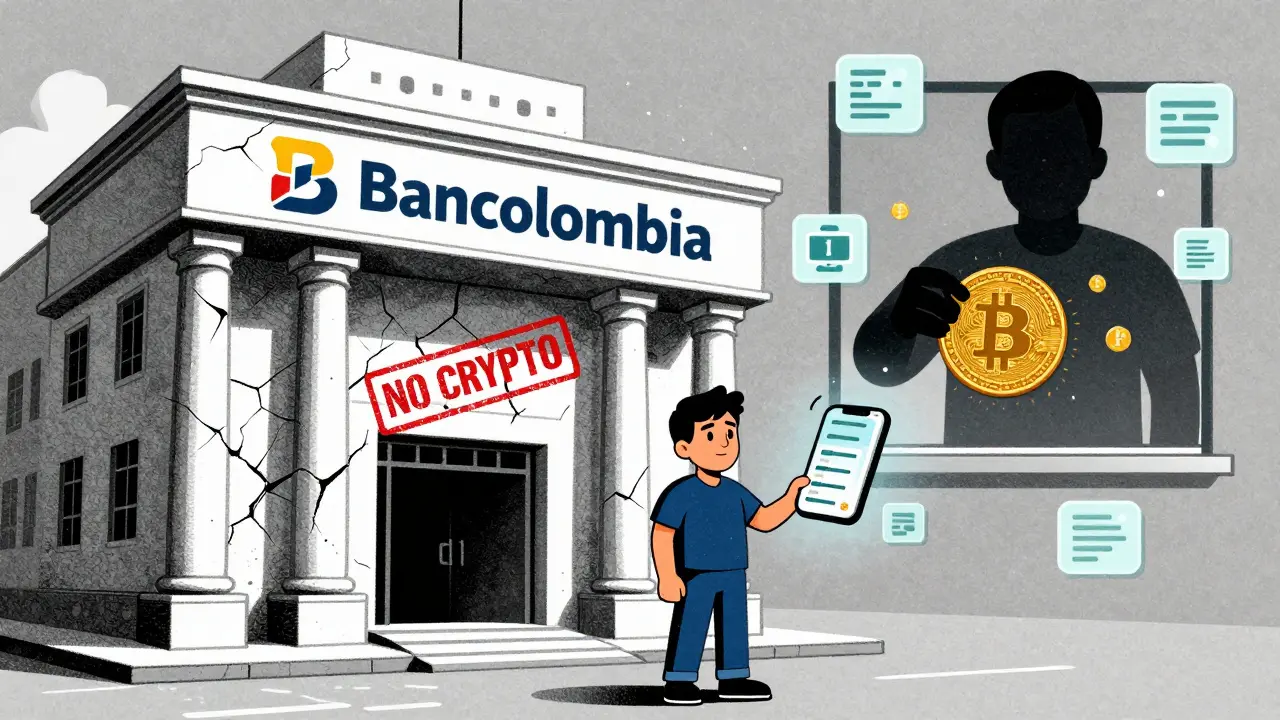
Colombia doesn’t ban cryptocurrency. But if you try to use your bank account to buy, sell, or hold crypto, you’ll hit a wall. That’s the reality for millions of Colombians who want to engage with digital assets - and it’s not because the government says crypto is illegal. It’s because Colombia’s banking system is legally barred from touching it.
What the Ban Actually Covers
The Financial Superintendency of Colombia (SFC) issued a clear directive in 2022: supervised financial institutions - that means banks, credit unions, and major fintechs - cannot hold, invest in, or facilitate any crypto transactions. This isn’t a vague guideline. It’s a hard stop. Your Bancolombia account can’t buy Bitcoin. Your Davivienda debit card can’t pay for Ethereum. Your digital wallet can’t link to a Colombian bank for deposits or withdrawals. The ban goes beyond simple transfers. It blocks custody services. It prohibits offering crypto-based investment products. Even payment platforms that process crypto transactions must avoid any direct integration with traditional banking infrastructure. If a Colombian bank processes a payment for a crypto exchange, it’s a violation. The reasoning? Risk. The SFC points to money laundering, terrorist financing, and asset concealment as primary concerns. They argue that the anonymity and decentralization of crypto make it harder to track than traditional financial flows. So instead of regulating crypto itself, they cut off its lifeline: the banking system.How the Rules Work in Practice
Here’s what this looks like on the ground:- If you send $200 in USDT to a Colombian friend, their bank will likely freeze the incoming transaction - not because it’s illegal, but because the bank has no legal way to verify or accept it.
- If you run a small business that accepts Bitcoin, you can’t deposit those earnings into your business checking account. You’ll need to use peer-to-peer platforms or cash deposits - which carry their own risks.
- If you’re a crypto trader, you can’t use your bank’s app to convert COP to USDC. You have to find an exchange that accepts P2P transfers, often through mobile wallets or cash deposits.
The Legal Gray Area
Here’s the twist: crypto itself isn’t illegal in Colombia. You can buy, sell, and hold Bitcoin, Ethereum, or Solana without breaking any law. The problem is that the financial system refuses to interact with it. This creates a legal gray zone where crypto exists - but only in the shadows. The government doesn’t tax crypto as a currency. Instead, it treats it as an intangible asset. If you sell Bitcoin for a profit, you pay capital gains tax under existing income tax rules. If you run a crypto business, you report it as corporate income. But without bank records, proving your transactions to tax authorities becomes a nightmare. Legal experts call this a "regulatory limbo." There’s no law that says crypto is forbidden. But there’s a rule that says banks can’t touch it. That leaves users, businesses, and even regulators stuck in uncertainty.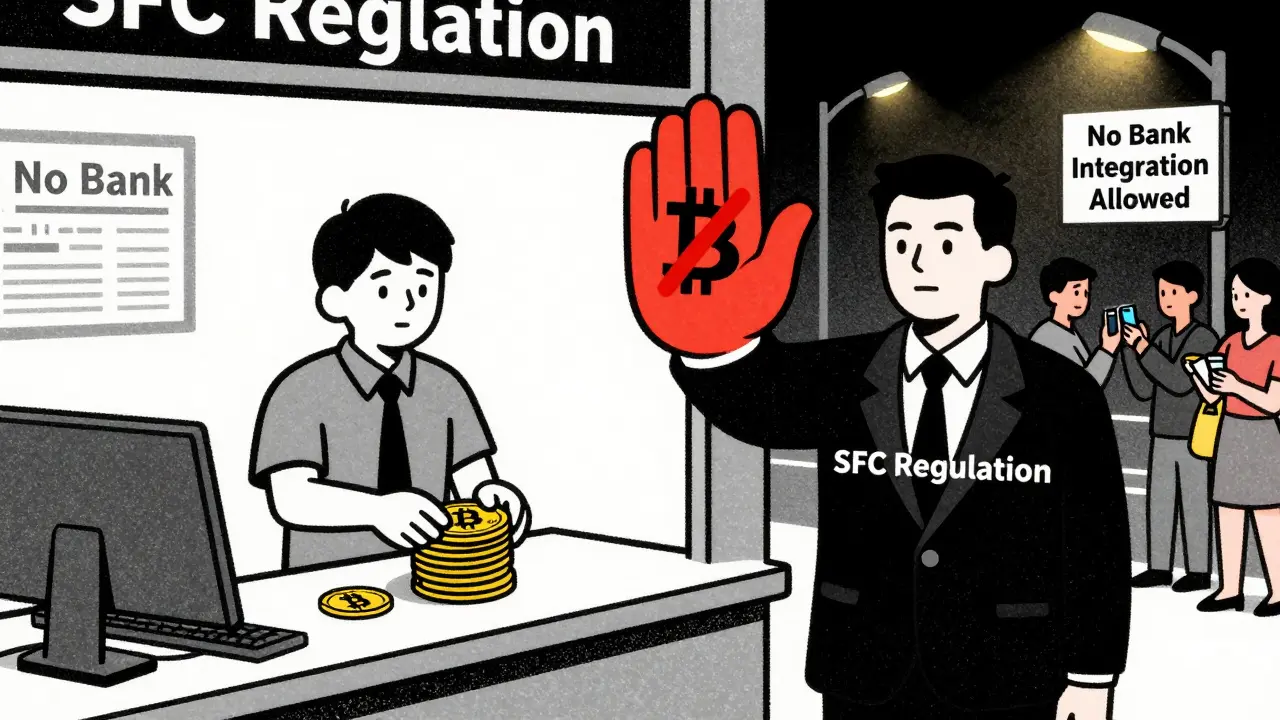
Who’s Still Operating? The Institutional Exceptions
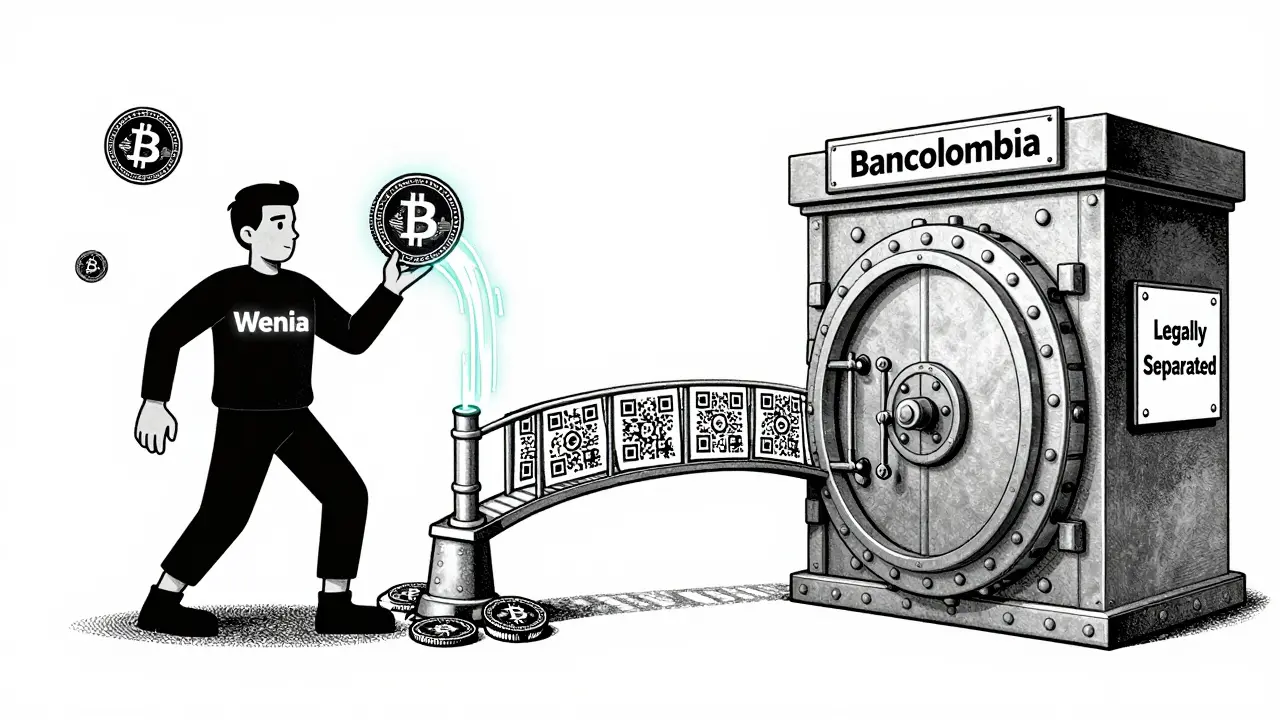
Despite the ban, some major players are finding ways in. Bancolombia, Colombia’s largest bank, launched Wenia - a crypto exchange - in 2024. It also created COPW, a peso-backed stablecoin. How? Because Wenia operates as a separate legal entity outside the banking system. It doesn’t use Bancolombia’s accounts. It doesn’t process bank transfers. It uses P2P channels and crypto-only wallets. This is the workaround: separate the crypto business from the bank. The bank stays clean. The crypto arm operates independently. Other institutions are following suit. Grupo Aval, another financial giant, is testing similar models. These moves show that big players aren’t rejecting crypto - they’re just avoiding the SFC’s banking restrictions. They’re building parallel systems. And they’re doing it because demand is too strong to ignore.How Colombia Compares to Its Neighbors
Colombia’s approach stands out in Latin America:- Brazil passed crypto tax laws in 2024 - now mandatory reporting for all transactions over $1,000.
- Argentina allows Bitcoin to be used in international trade contracts.
- Chile approved three licensed crypto custodians in early 2025.
- Mexico expanded its Fintech Law to include crypto custody and asset management.
- Peru launched a blockchain pilot for government bonds.
The Human Cost
For everyday users, the ban creates real problems:- People sending remittances to family in Colombia can’t use crypto to avoid high fees - banks block the deposits.
- Freelancers who get paid in USDC can’t cash out easily. They rely on risky P2P trades with strangers.
- Small businesses lose out on global customers who prefer crypto payments.
What’s Next? The Road to Regulation
The SFC’s original regulatory sandbox for stablecoins expired in December 2023. No replacement has been announced. That’s left startups in limbo. Some are relocating to Panama or Uruguay. But pressure is building. Finance Minister Ricardo Bonilla said in June 2023: "Cryptocurrencies are a reality." He added that regulation is inevitable - but must protect the Central Bank’s monopoly on currency issuance. That’s the key: Colombia doesn’t want to lose control of its money. It doesn’t want private stablecoins to replace the peso. Experts believe the next step is a comprehensive crypto law - not a ban. One that defines clear rules for custody, taxation, licensing, and banking access. The Bre-B payment platform, backed by the Central Bank, could be the bridge. If it allows crypto-linked payments without involving traditional banks, it might pave the way for regulated integration. For now, the system is stuck. Crypto thrives in the gaps. Banks stay out. Users pay the price.What Users Should Do Right Now
If you’re in Colombia and want to use crypto:- Use non-bank platforms: Stick to exchanges that operate P2P - like LocalBitcoins, Paxful, or Wenia.
- Keep records: Save all transaction IDs, wallet addresses, and screenshots. You’ll need them for taxes.
- Avoid bank deposits: Don’t try to deposit crypto earnings into your checking account. It will trigger freezes.
- Use KYC-compliant services: Choose platforms that require ID verification. It reduces your risk of being flagged.
- Watch for updates: The SFC is reviewing its stance. A new framework could arrive in 2026.
FAQ
Is it illegal to own Bitcoin in Colombia?
No, owning Bitcoin or any cryptocurrency is not illegal in Colombia. You can buy, sell, and hold digital assets without breaking the law. The restriction only applies to banks and financial institutions - not individuals.
Can I use my Colombian bank account to buy crypto?
No. Colombian banks are legally prohibited from facilitating any crypto transactions. Even if you try to send money to a crypto exchange, the bank will likely block the transfer. You must use P2P platforms or cash-based methods instead.
Do I have to pay taxes on crypto in Colombia?
Yes. The Colombian tax authority treats crypto as an intangible asset. If you sell it for a profit, you owe capital gains tax. If you run a crypto business, you must report income under corporate or personal income tax rules. But without bank records, proving your transactions is harder.
Why can’t Bancolombia offer crypto services through its main bank?
Because the Financial Superintendency of Colombia (SFC) bans all supervised financial institutions from holding, investing in, or processing crypto. Bancolombia created Wenia as a separate legal entity to bypass this rule - so the bank itself stays compliant while its crypto arm operates independently.
Is Colombia planning to lift the crypto ban on banks?
Not in the near term. The SFC has not signaled any move to relax the ban. However, Finance Minister Ricardo Bonilla has acknowledged crypto as a reality and hinted at future regulation. A comprehensive crypto law - not a ban lift - is the most likely path forward.
What happens if a Colombian bank processes a crypto transaction?
The bank could face heavy fines, regulatory sanctions, or even loss of its operating license. The SFC enforces the ban strictly. Banks caught violating the rule have been fined millions, and executives have been held personally accountable.
Can I use a foreign bank to buy crypto for use in Colombia?
Yes, but with risks. You can use a foreign bank or crypto exchange to purchase crypto and then transfer it to a Colombian wallet. However, bringing those funds back into Colombia via bank deposit will likely trigger a freeze or investigation. The restriction applies to Colombian financial institutions - not your foreign ones.



James Harris
February 7, 2026 AT 21:24Alex Garnett
February 8, 2026 AT 16:31aryan danial
February 10, 2026 AT 13:22Ryan Chandler
February 12, 2026 AT 07:19Ajay Singh
February 13, 2026 AT 00:11Oliver James Scarth
February 14, 2026 AT 19:02Danica Cheney
February 16, 2026 AT 11:17Matthew Ryan
February 17, 2026 AT 05:33Nathaniel Okubule
February 17, 2026 AT 21:08