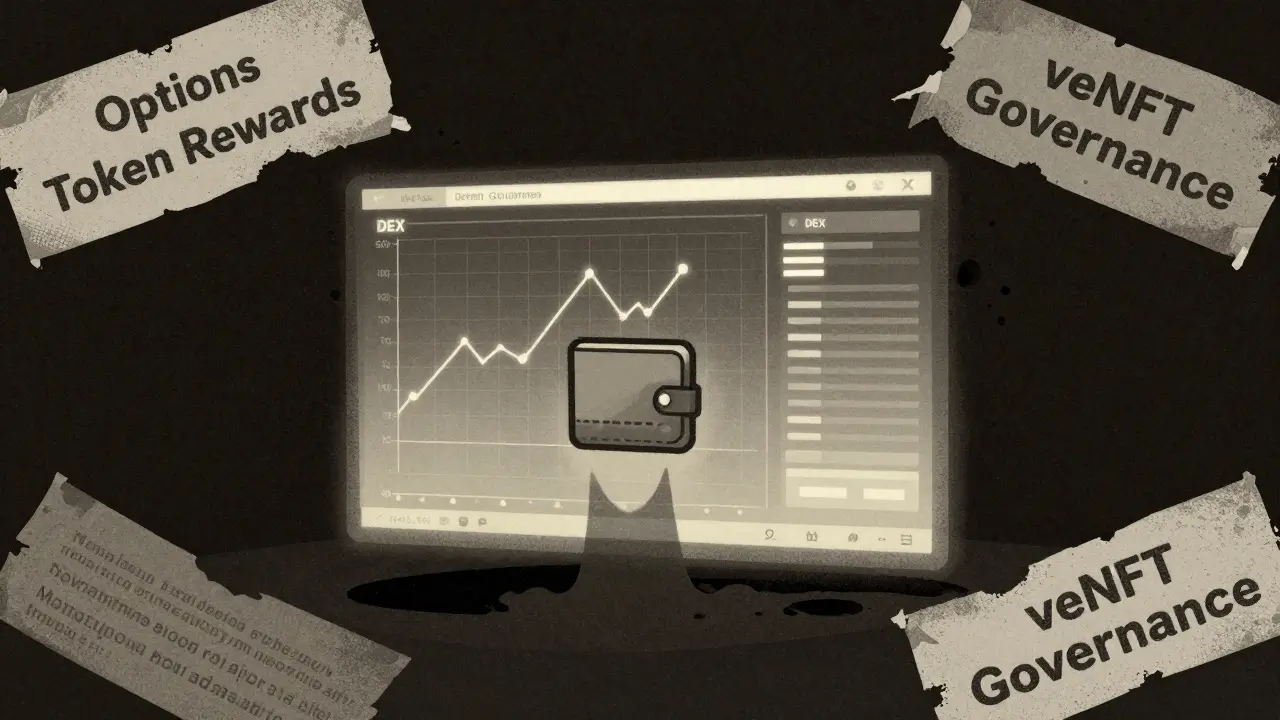
When you hear about a new crypto exchange promising "next-generation DeFi" and "options token rewards," it’s easy to get excited. But if no one is actually trading on it, what’s the point? That’s the reality with Velocimeter is a decentralized exchange (DEX) launched in 2023 that markets itself as a high-yield DeFi platform with veNFT governance and automated staking. Yet, as of late 2025, Velocimeter has zero daily trades across its main versions. It’s not just quiet - it’s dead in the water.
What Velocimeter Claims to Offer
Velocimeter’s website and promotional materials paint a picture of innovation. It says it’s built for liquidity providers who want more than just trading fees. The platform touts three main hooks:
- Options token rewards - Instead of just earning trading fees as an LP, you get additional tokens tied to time-locked positions.
- veNFT governance - Your voting power in protocol decisions is locked into an NFT that grows with time and stake.
- Automated staking and zapping - One-click tools to move funds between pools, stake, and claim rewards without manual steps.
These features sound smart, even advanced. But here’s the catch: none of them matter if no one is using the platform. You can have the most elegant smart contract ever written, but if no one deposits funds, it’s just code sitting on a blockchain - useless.
The Numbers Don’t Lie: Zero Activity, Zero Trust
Let’s look at the facts from CoinGecko data as of September 2025:
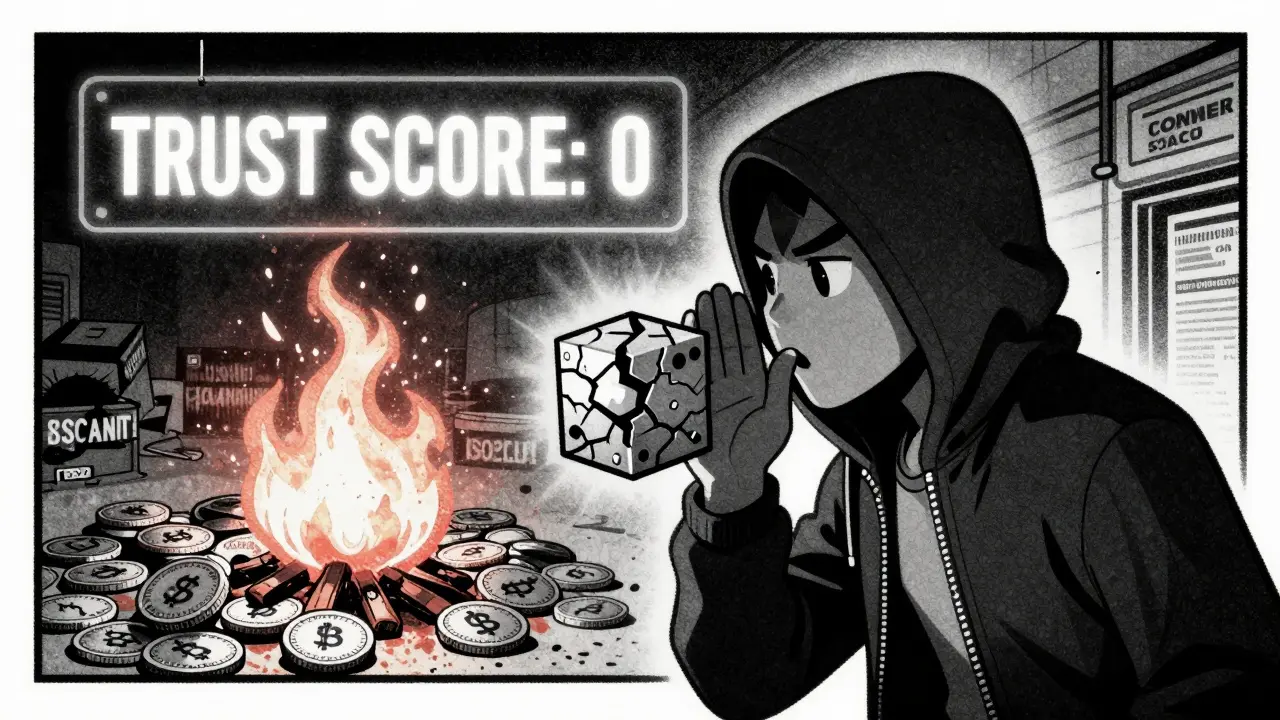
- Velocimeter V3: Lists 1 cryptocurrency (CANTO/SCANTO). No trades in the last 30 days. Trust score: 0.
- Velocimeter Base: Lists 6 cryptocurrencies, including BMX--2/WBLT. Also zero trades in 30 days. Trust score: 0.
A trust score of 0 on CoinGecko is the lowest possible. It means the platform fails every metric they use: no volume, no liquidity depth, no user activity, no external validation. For comparison, Uniswap processes over $1 billion in daily volume. PancakeSwap handles tens of millions. Velocimeter? Nothing. Not even a single trade.
This isn’t a startup in its early days. This is a platform that launched over two years ago and still hasn’t attracted enough users to make one trade. That’s not a bug - it’s a death sentence.
Who’s Behind Velocimeter? No One Knows
Most legitimate DeFi projects publish their team, have LinkedIn profiles, or at least have GitHub commits showing active development. Velocimeter? No public team. No founder names. No development history. No blog updates. No roadmap.
There’s no evidence of audits from firms like CertiK, Hacken, or PeckShield. No security reports. No insurance fund disclosures. No bug bounty program. In crypto, this isn’t just a red flag - it’s a whole billboard flashing "DANGER."
When you can’t find out who built something, or how they protect your money, you’re not investing - you’re gambling.

Where Is the Community?
Look at any thriving crypto project: Reddit threads buzzing with opinions, Twitter/X accounts with thousands of replies, Discord servers with hundreds of active users. Velocimeter has none of that.
Search Reddit for "Velocimeter" - zero meaningful threads. Check Twitter - no viral posts, no user testimonials, no complaints. Even the Telegram link on their site leads to a dead or inactive group. In a space where people talk endlessly about every new token, the silence around Velocimeter is deafening.
If no one’s talking about it, no one’s using it. And if no one’s using it, it’s not a platform - it’s a ghost.
Is It Even Legit? The Regulatory Void
There’s no record of Velocimeter registering with any financial authority - not the SEC, not the FCA, not even a small offshore regulator. No KYC. No AML policy. No terms of service that mention legal jurisdiction.
That’s not "decentralized freedom." That’s legal recklessness. If your funds disappear, you have no recourse. No customer support. No legal obligation to return your money. In the crypto world, this is called a "rug pull waiting to happen."
Why Does This Matter? Real Risks, Real Losses
You might think: "But I’ve seen people make money on obscure DEXs." That’s true - sometimes. But those platforms had volume. They had liquidity. They had users who could exit when things got sketchy.
Velocimeter offers none of that. If you deposit funds into a pool here, you’re not earning yield - you’re locking your assets into a black hole. Even if the smart contract technically works, there’s no market to sell your tokens. No one to trade with. No liquidity to pull out.
Worse, if the team abandons the project (and all signs point to that), your tokens become worthless. You won’t even get a warning. The site could vanish overnight, and your funds go with it.
What Should You Do Instead?
There are dozens of well-established DEXs with proven track records:
- Uniswap (Ethereum) - The most trusted DEX, with billions in daily volume and transparent governance.
- PancakeSwap (BSC) - High liquidity, low fees, active community, and frequent audits.
- Curve Finance - Best for stablecoin swaps, with deep pools and minimal slippage.
- Swap (Solana) - Fast, cheap, and growing fast with strong developer support.
All of these have public teams, audit reports, active communities, and real trading volume. They’re not perfect - but they’re real. Velocimeter? It’s a mirage.
Final Verdict: Avoid at All Costs
Velocimeter isn’t a failed experiment. It’s a warning sign. A platform with zero trading activity, zero trust score, zero transparency, and zero community isn’t trying to build something - it’s trying to disappear.
If you’re looking to earn yield, trade crypto, or participate in DeFi, there are hundreds of better options. Don’t risk your funds on a platform that doesn’t even have enough users to make one trade. The silence isn’t peaceful - it’s ominous.
Is Velocimeter a scam?
There’s no official proof it’s a scam, but every red flag points that way. Zero trading activity, no team, no audits, no community, and a trust score of 0 are classic signs of a project that either abandoned development or was designed to lure deposits before vanishing. Treat it as high-risk - not because it’s necessarily fraudulent, but because it’s completely unviable.
Can I still use Velocimeter to trade crypto?
Technically, yes - you can connect your wallet and view the interface. But there are no active trading pairs with liquidity. Even if you try to swap, you’ll get an error or see no price. There’s no market. No buyers. No sellers. It’s like walking into a store that’s closed - the doors are open, but nothing’s inside.
Why does CoinGecko give Velocimeter a trust score of 0?
CoinGecko’s trust score is based on five factors: trading volume, liquidity, exchange activity, public transparency, and community engagement. Velocimeter scores zero on all five. No volume, no liquidity, no public team, no community, and no updates. It’s the lowest possible rating because it fails every basic standard of a functioning exchange.
Are the options token rewards real?
The reward mechanism might work on paper - but without trading volume, there’s no fee income to fund those rewards. The tokens you earn could be worthless if the protocol stops emitting them. Plus, with no audit, there’s no guarantee the smart contract doesn’t have a hidden flaw that drains your funds when you try to claim.
What should I do if I already deposited funds into Velocimeter?
Withdraw immediately if possible. If you can’t, don’t add more. Monitor the platform for any signs of activity - but assume your funds are at risk. There’s no customer service, no recovery process, and no legal recourse. The best-case scenario is you lose everything. The second-best is you get lucky and the team wakes up - but that’s not a strategy.


Kaz Selbie
February 15, 2026 AT 01:34Alex Garnett
February 15, 2026 AT 18:23Ajay Singh
February 17, 2026 AT 05:43Ace Crystal
February 18, 2026 AT 03:46Brittany Meadows
February 19, 2026 AT 09:36Gaurav Mathur
February 20, 2026 AT 19:38