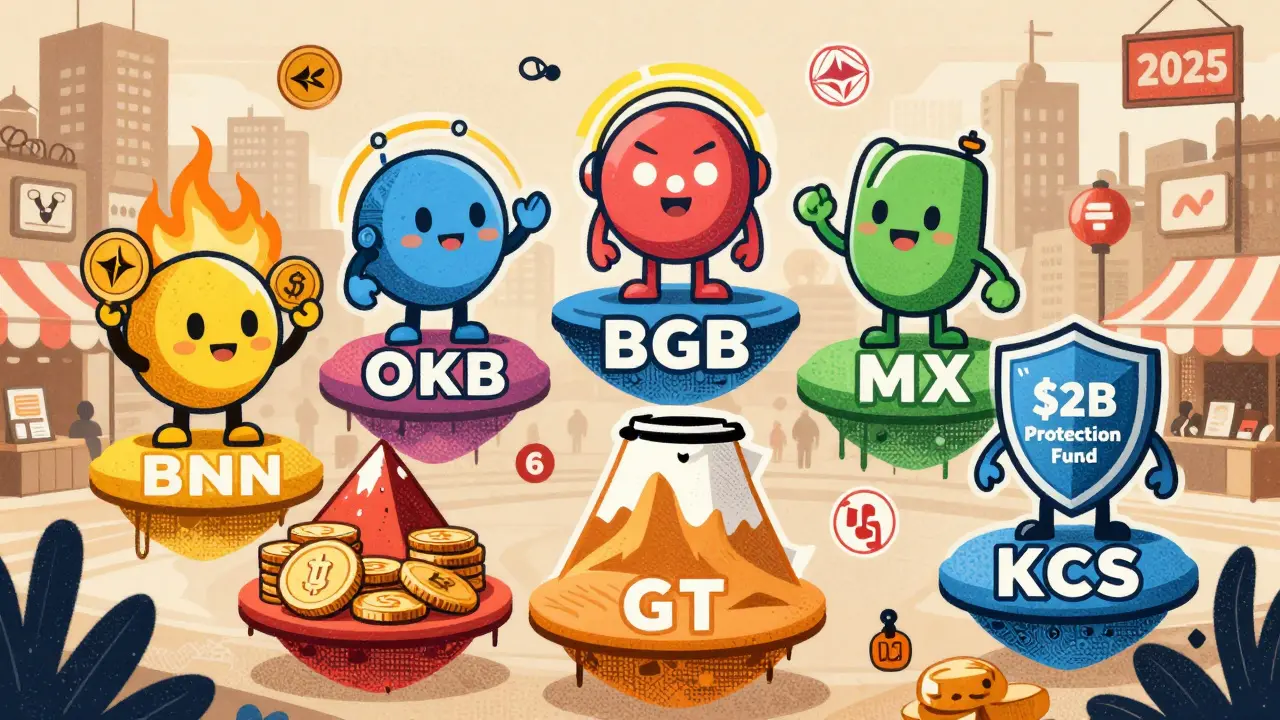
Exchange tokens aren’t just another crypto asset. They’re the backbone of centralized exchanges - and if you trade crypto regularly, they can save you money, boost your returns, and even give you a say in how the platform evolves. By 2025, six tokens dominate this space: BNB, OKB, BGB, MX, GT, and KCS. Each one works differently, targets different users, and carries unique risks. So which one actually makes sense for you?
What Exactly Is an Exchange Token?
An exchange token is a cryptocurrency issued by a centralized crypto exchange. It’s not just a marketing gimmick - it’s a functional tool built into the platform. Holders get discounts on trading fees, access to staking rewards, early access to new listings, and sometimes voting rights. The idea started with Binance’s BNB in 2017, and now these tokens make up nearly 9% of the entire crypto market. That’s over $120 billion in combined value.
But not all exchange tokens are the same. Some burn tokens regularly to reduce supply. Others lock up revenue to buy back tokens. Some are tied to complex ecosystems. And a few are still trying to prove they’re more than just fee discounts.
BNB: The Dominant Player
BNB still leads the pack. It holds 45.2% of the entire exchange token market cap and powers Binance, the world’s biggest exchange by volume. If you trade on Binance, you’re probably already using BNB - 87.3% of users do, mostly for the 25% discount on trading fees.
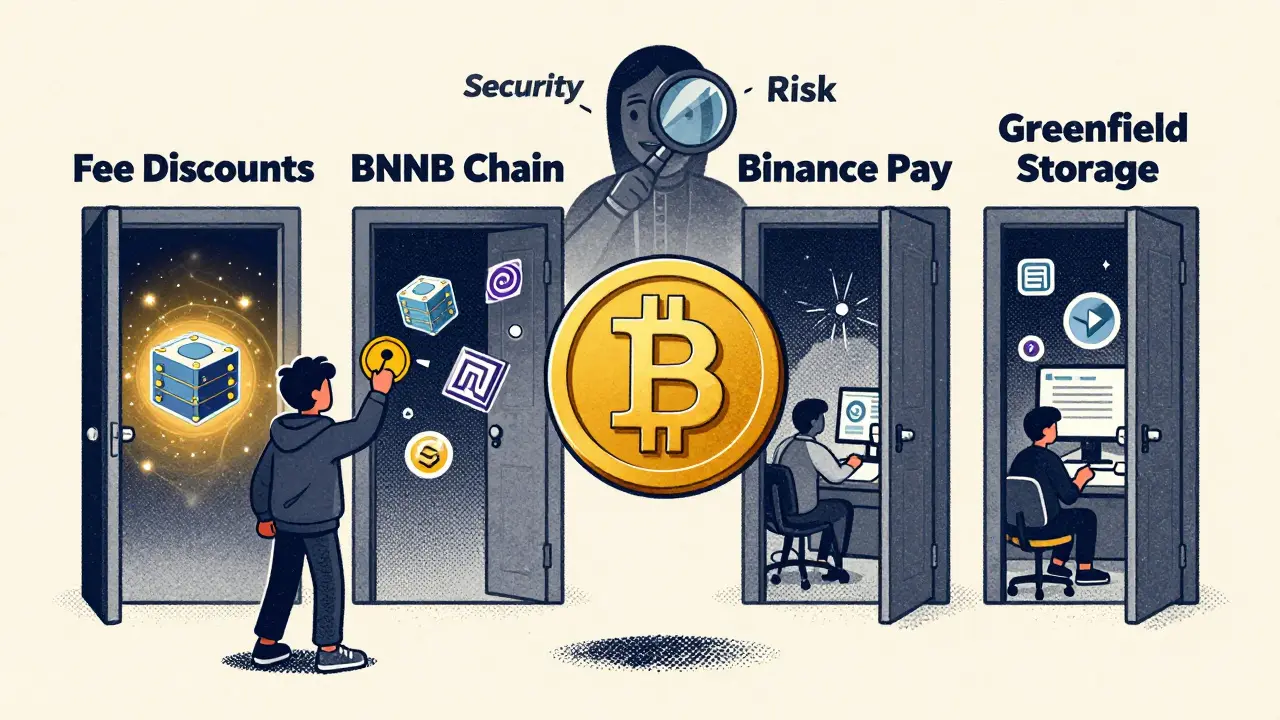
But BNB’s real strength is its ecosystem. It runs on BNB Chain, which handles 3.2 million transactions daily. You can stake it for up to 15% APY, use it to pay for Binance Pay, or even buy NFTs on Binance NFT. In late 2025, Binance launched BNB Greenfield, a decentralized storage network that already has 1.2 million users.
Here’s the catch: BNB’s supply isn’t fixed. Binance burns 20% of its quarterly profits to destroy BNB tokens. As of Q3 2025, 45.6% of the original 200 million supply has been burned. That’s a strong deflationary engine. But BNB faces regulatory headwinds. After Binance settled with U.S. regulators in November 2024, some investors worry the token could be classified as a security. Reddit users are split - 82% love the utility, but 37% are nervous about the legal risks.
OKB: Scarcity and Ecosystem Depth
OKB, from OKX, takes a different approach. It has a fixed supply of 21 million tokens - no more will ever be created. That makes it more like Bitcoin than BNB. OKX uses 30% of its profits to buy back and burn OKB, reducing the circulating supply by 12.3% since 2023.
OKB gives you up to 40% fee discounts and access to OKX Earn, where average staking yields sit at 8.5%. But its real edge is the OKC (OKX Chain) ecosystem. Over 412 decentralized apps run on it, including lending platforms and DeFi protocols. Total value locked in OKC-based apps hit $1.7 billion in just three months after OKB lending pools launched in September 2025.
Experts like Dr. Garrick Hileman from Blockchain.com say OKB’s fixed supply gives it better long-term scarcity than BNB’s burn model. But OKB isn’t everywhere. Due to MiCA compliance rules in Europe, it’s restricted in some countries. Still, Trustpilot users give it a 4.6/5 rating, praising its reliable staking and customer support.
BGB: The Copy-Trading Powerhouse
BGB, from Bitget, is the dark horse. It didn’t start as a giant, but it’s growing fast - now holding 8.6% of the exchange token market. Its rise is tied to one thing: copy-trading. Bitget is the go-to platform for traders who want to automatically copy the moves of top performers. And BGB is the fuel.
Bitget uses 50% of its revenue to burn BGB tokens. Over 2.5 billion have been destroyed since launch. Holders get 20% fee discounts and staking rewards up to 12% APY. In November 2025, Bitget launched the Morph blockchain, which now supports 42 dApps with $847 million in total value locked.
BGB’s biggest advantage? It’s huge in Asia. In Southeast Asia, it controls 63.2% of the exchange token market. Asian users love it - 78% of reviews on BitKan call it the best for copy-trading. But English-speaking users complain the interface is clunky and documentation is thin. If you’re into social trading or live in Asia, BGB is worth a close look.
MX: The Altcoin King
MEXC’s MX token is built for traders who want the widest selection of coins. MEXC offers 2,690 spot trading pairs - more than any other exchange. And MX holders get the highest fee discount: 50% off trading fees.
MX has a capped supply of 100 million tokens. MEXC uses 50% of its revenue to buy back and burn MX. Since launch, they’ve spent $487 million on buybacks. That’s massive. And in December 2025, they launched an MX-powered NFT marketplace, tying the token directly to their trading volume.
MX dominates in Latin America with 51.4% market share. Users on CoinGecko give it a 4.3/5 rating, mainly for the huge altcoin selection and aggressive discounts. But there’s a trade-off: MEXC’s platform is complex. New users report it takes 8-12 hours just to get comfortable. If you’re an advanced trader hunting for obscure tokens, MX is unbeatable. If you’re new? You might feel lost.
GT: The Middle East Specialist
Gate.io’s GT token is quietly powerful. It offers 20% fee discounts and is backed by GateChain, a custom blockchain that enables cross-chain swaps for 18 major cryptocurrencies. GT’s burn mechanism uses 20% of platform revenue - 1.8 billion tokens have been destroyed since 2018.
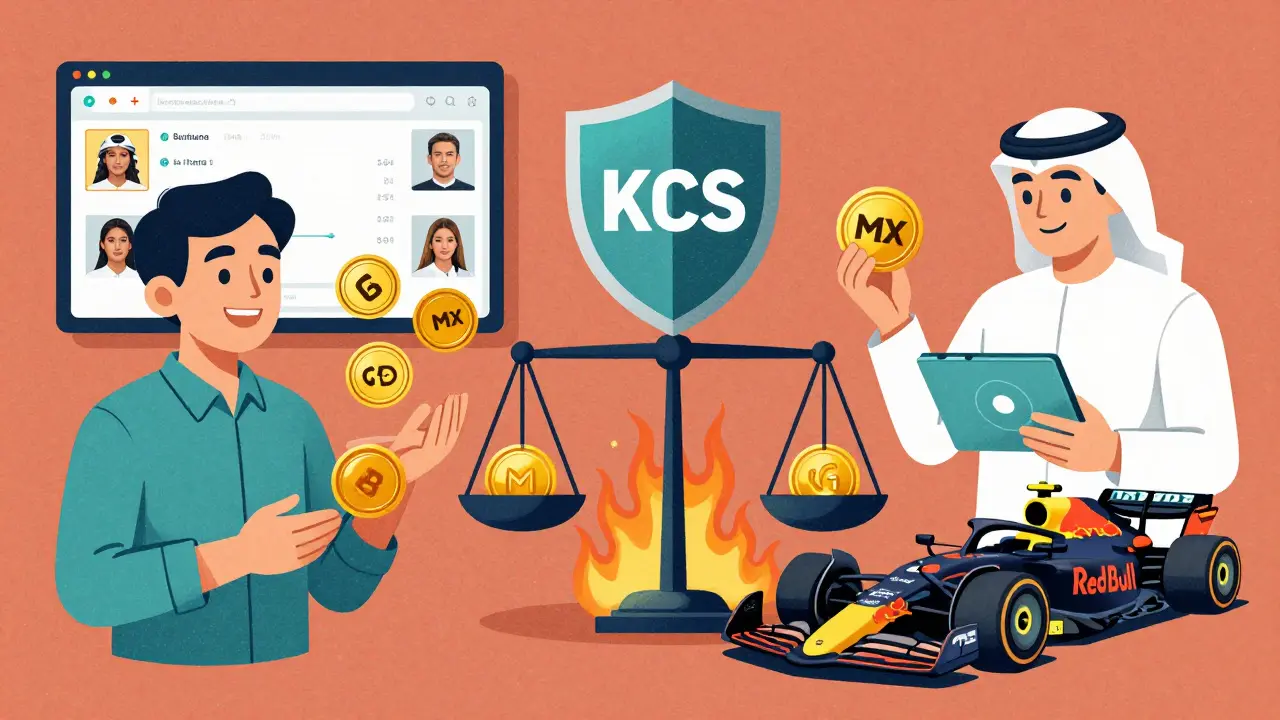
What sets GT apart? Geography. Gate.io has a strong presence in the Middle East, with a VARA license in Dubai. That’s rare. And in 2025, they partnered with Oracle Red Bull Racing in Formula 1. CoinGape found that sponsorship boosted GT’s visibility by 37% in just six months.
Users on Gate.io’s forum give GT a 89% positive rating. Non-Asian users appreciate the clean interface - setup takes only 3-4 hours. But the English documentation is lacking. If you’re in the Middle East or care about brand credibility, GT is a solid, low-risk option.
KCS: The Protection Fund Leader
KuCoin’s KCS token is unique because of its $2 billion protection fund. If something goes wrong - like the February 2025 service outage - this fund covers user losses. That’s a huge psychological safety net.
KCS uses a proportional burn: 50% of daily trading fees are used to destroy tokens. By December 2025, 387 million KCS had been burned. It gives 20% fee discounts and powers KuCoin’s AI trading bots and Apple Pay integration for KuCard.
But KCS has a vulnerability: it’s tied to one exchange. When KuCoin went down for 14 hours in February 2025, KCS dropped 22% in a day. Sentiment on Reddit fell 42%. It recovered by April, but the event exposed a weakness. KCS is great if you value security over innovation. But if you want ecosystem growth, it’s behind BNB and OKB.
Who Should Use Which Token?
Let’s cut through the noise. Here’s who wins with each token:
- BNB - Best for serious traders who use Binance daily and want the most integrated ecosystem. If you’re in the U.S. or Europe, this is your default - but keep an eye on regulation.
- OKB - Best for long-term holders who believe in scarcity. If you like DeFi and want a fixed supply, OKB is your best bet. Avoid if you’re in restricted jurisdictions.
- BGB - Best for copy-traders and users in Southeast Asia. If you’re not copying trades, you’re missing its real value.
- MX - Best for altcoin hunters. If you trade obscure tokens, MX’s 50% discount and 2,690 pairs make it unbeatable. Not for beginners.
- GT - Best for Middle East users or those who want a clean, low-risk option. Solid utility, no flashy gimmicks.
- KCS - Best for risk-averse traders who want insurance. If you’ve been burned by exchange hacks before, KCS’s protection fund is worth the 20% discount.
The Bigger Picture: Risks and Future
Exchange tokens are powerful - but they’re not without danger. The SEC’s November 2025 guidance warned that tokens with weak utility could be classified as securities. That could affect up to 40% of current exchange tokens. Only those with verifiable burns (BNB, OKB, KCS) have outperformed others by 23.7% over the last 18 months.
Regulation is tightening. Since January 2025, 89% of major exchanges publish monthly proof-of-reserves - a requirement under MiCA in Europe. Transparency is no longer optional.
Looking ahead, 68% of exchanges plan to move toward DAO-style governance by 2027. That means token holders could vote on platform changes, fee structures, and even new features. The next phase isn’t just about discounts - it’s about ownership.
For now, the rule is simple: use the token that matches your trading habits. Don’t buy one because it’s popular. Buy one because it saves you money, gives you access to tools you actually use, and aligns with your risk tolerance.
Are exchange tokens a good investment?
They’re not pure investments - they’re utility tools. BNB, OKB, and KCS have shown strong price performance because of their burn mechanisms and ecosystem growth. But if the exchange fails, the token loses value. Only hold them if you use the platform regularly. Don’t buy them just because you think they’ll go up.
Can I stake exchange tokens for passive income?
Yes, and it’s one of their biggest benefits. BNB offers up to 15% APY, OKB averages 8.5%, and BGB goes up to 12%. KCS and GT offer lower yields, around 5-7%. But remember: staking locks your tokens. If the exchange gets hacked or shuts down, you could lose access. Only stake what you’re comfortable losing.
Do I need to hold these tokens long-term?
No. Many traders buy tokens just to get a fee discount for a few trades, then sell. But if you trade often, holding long-term makes sense. The more you trade, the more you save. And with token burns reducing supply, long-term holders benefit from scarcity. Think of it like a loyalty card that gets more valuable over time.
Why do some exchange tokens have higher discounts than others?
It’s a competition for users. MEXC offers 50% because it’s trying to steal traders from bigger exchanges with its massive altcoin selection. Bitget offers high staking yields to attract copy-traders. Binance keeps its discount at 25% because it doesn’t need to compete - it’s the biggest. The discount is a tool to lock in users, not a gift.
What happens if an exchange gets hacked?
If the exchange has a protection fund - like KuCoin’s $2 billion fund - your assets are covered. But your token’s value might crash temporarily. After KuCoin’s February 2025 outage, KCS dropped 22% in one day. The fund protected users’ funds, but not the token’s market price. Always check if the exchange has insurance before holding its token.
Are exchange tokens regulated?
They’re in a gray area. In Europe, MiCA requires exchanges to prove they hold reserves. In the U.S., the SEC is watching closely. If a token acts like a security - offering profits based on the exchange’s efforts - it could be classified as one. That’s why BNB and OKB are under scrutiny. Always check if your exchange complies with local laws before holding their token.

Matthew Kelly
January 25, 2026 AT 06:44BNB is still the king, no doubt. I use it daily and the fee discounts add up fast. BNB Chain is wild too - 3.2M tx/day? Insane. Just hope they don’t get slapped with a security label 😅
Barbara Rousseau-Osborn
January 26, 2026 AT 16:18Wow. So you’re just gonna ignore the fact that BNB is literally a security? The SEC already said tokens with utility tied to exchange profits = securities. BNB, OKB, KCS - all ticking time bombs. You people are so naive. 🙄
steven sun
January 27, 2026 AT 10:24MX is the real MVP fr. 50% off fees?? and 2690 pairs?? i found 12 coins on mexc no one else has. my portfolio’s been on fire. also the burn is insane. no cap = no cap 😤
Sara Delgado Rivero
January 28, 2026 AT 05:33GT is underrated. I live in Dubai and their VARA license means they’re legit. No drama. No hype. Just clean trading. Why are people chasing BNB when GT has lower risk and same discounts? 🤷♀️
Athena Mantle
January 29, 2026 AT 11:27Okay but have you considered the *philosophical* weight of tokenomics? 🌌 BNB is the ego of centralized finance - a digital monarch ruling over 45% of the market. OKB? A stoic monk with a fixed supply, whispering scarcity into the void. KCS? The gentle guardian with a $2B shield. We’re not just trading tokens… we’re choosing our spiritual crypto path. ✨
carol johnson
January 31, 2026 AT 10:49Ugh I can’t believe people still use BGB. The interface is a nightmare. I tried copy-trading for 2 days and cried into my matcha latte. Why does it feel like I’m using a 2018 Android app?? 😭
Paru Somashekar
February 2, 2026 AT 03:37Kindly note that the burn mechanisms of BNB, OKB, and MX are statistically significant in terms of supply reduction. Historical data from Q3 2025 shows that tokens with >40% revenue allocation to burns outperformed others by 23.7%. Further, the regulatory compliance under MiCA and VARA should be prioritized before any investment decision. Thank you.
Steve Fennell
February 3, 2026 AT 11:07Just want to say - if you're not using your exchange token regularly, don't hold it. It's not an investment, it's a tool. Like a loyalty card that only works at one store. Buy it to save on fees, use it, then reassess. Don't FOMO into it because someone on Reddit said it's 'the future.' 🙏
Chidimma Catherine
February 4, 2026 AT 09:06From Nigeria, I can confirm MX is the best for altcoins. I trade 3-4 times a week and save over $100/month on fees. The platform is complex but worth it. Also, the burn is real - I check the wallet every month. Thank you for this guide, it helped me choose wisely.