
Blockchain isn’t magic. It doesn’t solve every problem. But when it’s used right, it changes how trust works in digital systems. You don’t need a bank, a government, or a middleman to verify a transaction. Instead, a network of computers agrees on what’s true - and once it’s recorded, it can’t be erased or changed. That’s the core idea. And it’s already being used in places you might not expect: shipping medicine across continents, tracking food safety, sending aid to refugees, and even settling cross-border payments in seconds instead of days.
What Blockchain Actually Does
At its simplest, blockchain is a digital ledger. But it’s not like the Excel sheet your accountant uses. It’s distributed - meaning hundreds or thousands of computers around the world each hold a copy. Every time a new transaction happens - say, someone sends 0.5 Bitcoin or logs that a shipment of insulin left a warehouse - it’s bundled with other transactions into a block. That block gets locked with a cryptographic hash, then added to the chain of previous blocks. Change one letter in one block? The whole chain breaks. That’s why people say blockchain is “immutable.” It’s not just secure. It’s permanently verifiable.
This system removes the need for reconciliation. In traditional finance, banks spend weeks matching records across systems. With blockchain, everyone sees the same data in real time. A 2023 IBM study found this alone could save financial institutions $8-12 billion a year. That’s not theoretical. It’s happening now.
Real-World Benefits You Can See
Let’s look at where blockchain actually makes a difference.
- Supply chains: MediLedger, a blockchain network for pharmaceuticals, cut counterfeit drugs by 37% in a 2023 pilot. Every pill’s journey - from factory to pharmacy - is tracked on an open ledger. No more fake insulin or expired vaccines slipping through.
- Cross-border payments: Santander started using Ripple’s xCurrent system in 2023. What used to take 3-5 days now settles in under 4 seconds. No more waiting for wire transfers to clear.
- Humanitarian aid: UNICEF sent $1.2 million in aid to Kenya using a stablecoin on blockchain. Recipients reported 98% satisfaction. No intermediaries. No fees. No delays.
- Health records: Patients can control who accesses their medical history. Hospitals don’t have to share siloed data. A 2023 NIH review confirmed blockchain’s potential here - though adoption is still under 12%.
These aren’t experiments. They’re live systems. And they’re working because they solve real pain points: fraud, delays, lack of transparency.
The Hard Truth About Limitations
But here’s the catch: blockchain isn’t a magic bullet. It has serious trade-offs.
First, speed. Bitcoin handles 7 transactions per second. Ethereum manages about 30. Visa? 24,000. That’s not a glitch - it’s built into the design. Every node must verify every transaction. That’s why blockchains are slow. For high-frequency trading, stock markets, or online gaming? Forget it. Traditional databases still win.
Second, cost and complexity. One Reddit user, u/CryptoVeteran88, spent 14 months deploying a blockchain for their logistics company. They hired three developers at $150,000 each per year. The result? A 63% drop in invoice disputes. But was it worth it? Only if you’re dealing with high-value, high-risk transactions. For a small business tracking office supplies? Overkill.
Third, key management. If you lose your private key - the password that controls your blockchain wallet - your money is gone forever. Deloitte’s 2024 survey found 22% of users lost access to funds because they mismanaged keys. No customer service. No reset button. Just silence.
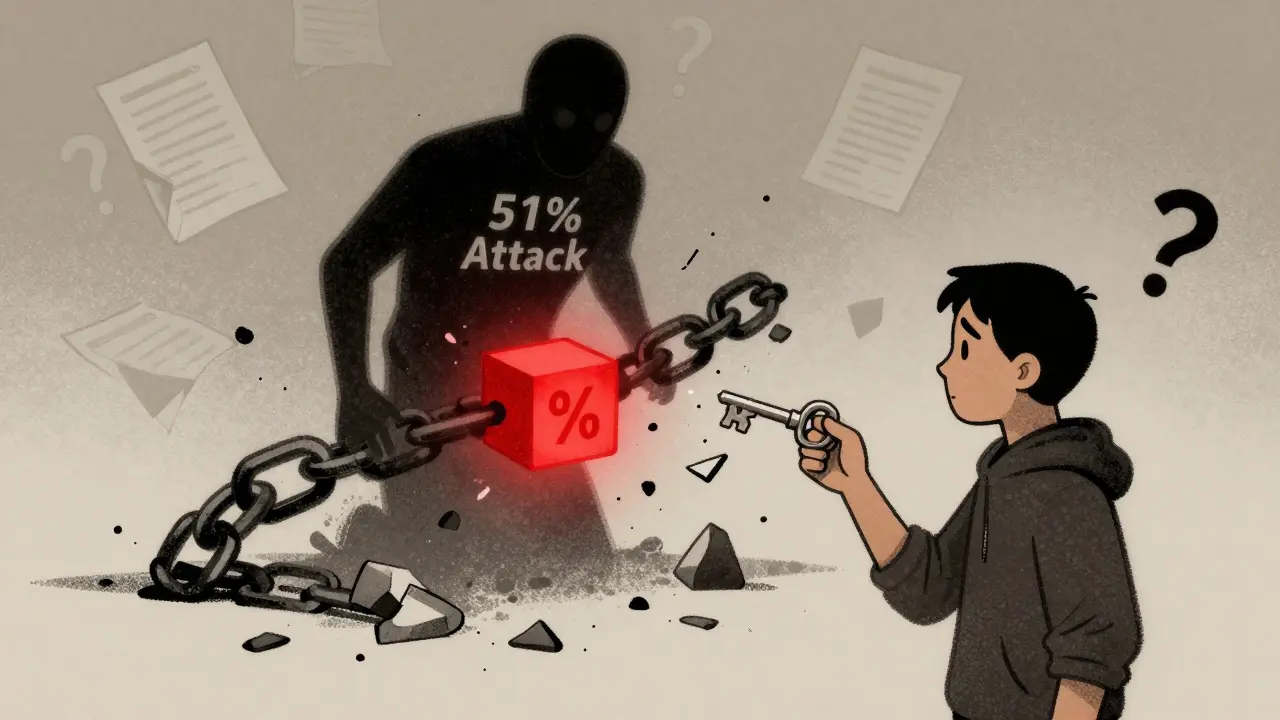
And then there’s the 51% attack. If one entity controls more than half the computing power on a blockchain, they can rewrite history. There have been 58 confirmed attacks since 2016, totaling over $2.1 billion in losses, according to CipherTrace. It’s rare on big networks like Bitcoin - but common on smaller chains. That’s why enterprise platforms like Hyperledger Fabric use permissioned networks. But then you lose decentralization - one of blockchain’s biggest selling points.

Scalability: The Biggest Bottleneck
Scalability is the elephant in the room. Ethereum’s base network can’t handle millions of users. That’s why Layer-2 solutions like Polygon and zkEVM exist. They process transactions off-chain and settle the final result on Ethereum. In 2024, Polygon’s zkEVM hit 2,000 transactions per second - 60x faster than Ethereum’s base layer. But even that’s still 12x slower than Visa.
The March 2024 “Dencun” upgrade cut Layer-2 fees by 90%. That’s huge for users. But it doesn’t fix the underlying problem: every transaction still needs to be verified by hundreds of nodes. That’s slow. That’s expensive. That’s energy-intensive.
Some experts, like MIT’s Digital Currency Initiative, believe blockchain will never replace traditional databases. It’s too heavy. Too slow. Too complex. It’s a tool for specific jobs - not a universal fix.
Who’s Using It? Who’s Not?
By 2024, 87 of the Fortune 100 companies had blockchain pilots. But only 22% had moved beyond testing. Why? Integration. Most companies still run on legacy systems from the 1990s. Connecting those to a blockchain? That’s like trying to plug a USB-C charger into a dial-up modem. IDC’s 2023 report says 68% of enterprises call this their biggest hurdle.
Regulation is another wall. The EU’s MiCA law, effective June 2024, created clear rules. The U.S.? 50 different state laws. Financial institutions are stuck in legal limbo. That’s why adoption is slow - not because the tech doesn’t work, but because no one knows who’s in charge.
Meanwhile, the market is exploding. The global blockchain market hit $17.1 billion in 2023 and is projected to hit $163.8 billion by 2029. That’s a 39.4% annual growth rate. But most of that growth is in enterprise solutions - not Bitcoin speculation. Hyperledger, R3 Corda, and Quorum are the real players now. Ethereum leads with 34.7% market share. Bitcoin is second at 28.3%. But together, they only make up 63% of the enterprise middleware market. The rest? Traditional databases still own 82% of the data management space.
Future Outlook: Specialized, Not Universal
Will blockchain be everywhere by 2035? Maybe. But not like the internet. It won’t be in your phone’s camera app or your smart fridge. It’ll be behind the scenes - in supply chains, land registries, medical records, and cross-border payments.
Emerging tech like zero-knowledge proofs helps. They let you prove something is true without revealing the data. But they add 400-600ms of latency per transaction. That’s fine for verifying a drug’s origin. Not fine for a stock trade.
And then there’s quantum computing. NIST’s 2024 report says current cryptographic standards could be broken in 15-20 years. That’s not tomorrow. But it’s coming. The industry is already working on quantum-resistant algorithms. But it’s a race against time.
Blockchain’s real strength? It forces accountability. When every step is recorded and visible, it’s harder to lie. That’s why it works in high-stakes environments. But for low-risk, high-speed, everyday tasks? It’s over-engineered.
Final Takeaway
Blockchain isn’t about replacing banks. It’s about replacing the trust gap. If you need proof that something happened - and you can’t rely on a single authority - then blockchain is powerful. If you need to process 10,000 payments a second? Look elsewhere.
Use it for audit trails. Use it for supply chains. Use it for secure record-sharing. Don’t use it for Instagram likes or TikTok ads.
The technology works. The limitations are real. The key isn’t to hype it. It’s to understand where it fits - and where it doesn’t.
Can blockchain be hacked?
Yes - but not the way people think. You can’t hack the blockchain itself. The data is cryptographically locked and distributed. What you can hack are the edges: smart contracts, wallet keys, or exchanges. The 2022 Wormhole bridge hack lost $320 million because of a flawed smart contract - not because the blockchain was broken. The same goes for the 51% attacks: they target small networks where one entity controls most of the computing power. Bitcoin and Ethereum are too large to be hacked this way. But smaller chains? Vulnerable.
Why is blockchain so slow?
Because every transaction has to be verified by every node in the network. Bitcoin and Ethereum use proof-of-work, which requires miners to solve complex math puzzles before adding a block. That takes time. Even newer systems like proof-of-stake still require consensus across hundreds of computers. That’s why Visa, which uses centralized servers, can process 24,000 transactions per second - while Ethereum maxes out at 30. Speed comes at the cost of decentralization.
Is blockchain energy-intensive?
Yes - but it’s getting better. Bitcoin’s energy use is still high because of proof-of-work mining. Ethereum switched to proof-of-stake in 2022 and cut its energy consumption by 99.95%. Now, it uses less electricity than a single data center. Newer blockchains like Solana and Polygon are even more efficient. The real issue isn’t blockchain itself - it’s the consensus method. Proof-of-work is outdated. Proof-of-stake is the future.
Do I need to be a developer to use blockchain?
No - but organizations do. As a user, you can send crypto, track a shipment, or access health records without writing code. But if you’re a company trying to build a blockchain system? You need cryptography experts, smart contract developers, and integration specialists. The average blockchain developer in the U.S. earns $147,000 a year. That’s why most companies start small - with pilots - before scaling.
What’s the difference between public and private blockchain?
Public blockchains - like Bitcoin and Ethereum - are open to anyone. Anyone can join, verify transactions, and see the ledger. Private blockchains - like Hyperledger Fabric or R3 Corda - are restricted. Only approved participants can join. They’re faster, more scalable, and easier to regulate. But they sacrifice decentralization. Most enterprises use private blockchains because they need control. Public blockchains are for trustless, open systems - like cryptocurrency.
Will blockchain replace banks?
Not anytime soon. Banks aren’t just transaction processors - they’re risk managers, lenders, and regulators. Blockchain can make payments faster and cheaper, but it can’t underwrite a mortgage or assess credit risk. Some banks are using blockchain internally to streamline back-office operations - like JPMorgan’s Onyx network. But they’re not replacing themselves. They’re upgrading.
What industries benefit most from blockchain?
Supply chain, healthcare, finance, and government. Supply chains need transparency to fight fraud. Healthcare needs secure, shareable records. Finance needs faster settlements. Government needs tamper-proof land registries and voting systems. These are all areas where trust is broken - and blockchain rebuilds it without intermediaries. Other industries? It’s often unnecessary.
Is blockchain the future of data storage?
Not for most data. Blockchain is terrible at storing large files - like videos or medical images. It’s designed for small, critical records: transactions, hashes, timestamps. Storing a 10MB file on-chain would cost thousands of dollars and slow the network. The future is hybrid: store data off-chain (like on cloud servers), and put a cryptographic hash on the blockchain to prove it hasn’t been changed. That’s what most companies are doing now.
How long does it take to implement blockchain?
Typically 6 to 18 months. Gartner’s 2024 survey found most enterprises need at least a year to go from pilot to production. Why? Integration with legacy systems, training staff, legal compliance, and finding skilled developers. Even big companies like Maersk took over a year to deploy their blockchain-based shipping platform. It’s not a plug-and-play solution. It’s a major infrastructure overhaul.
What’s the biggest mistake companies make with blockchain?
Trying to use it for everything. Many companies see blockchain as a silver bullet - and try to force it into processes that don’t need it. If you don’t have multiple parties who don’t trust each other? You don’t need blockchain. If your data doesn’t need to be immutable? Use a database. The biggest failures happen when people confuse technology with solution. Blockchain solves trust. Not speed. Not storage. Not automation. Just trust.
Blockchain isn’t about hype. It’s about precision. Use it where it adds real value - and leave it alone where it doesn’t.

Shawn Warren
March 8, 2026 AT 05:44Blockchain isn't magic but it's not some dusty relic either
People act like if you don't use it you're backwards but the truth is most businesses don't need it
I've seen startups burn millions trying to force blockchain into simple invoicing systems
Meanwhile real problems like supply chain fraud get solved with simple QR codes and cloud logs
The hype cycle is real and it's hurting actual innovation
Stop treating every problem like a nail just because you have a blockchain hammer
Use the right tool for the job not the trendiest one
That's not anti tech that's common sense
And yes I've worked on both sides of this
Blockchain has its place but so does Excel
Leah Dallaire
March 8, 2026 AT 17:01They say blockchain is immutable but what about the 51% attacks
What about the secret backdoors in enterprise chains
Who really controls the nodes
I've seen internal audits where the "decentralized" ledger was hosted on three servers in one data center
And the keys
Do you really think the average user knows what a private key is
Or that governments aren't quietly building surveillance chains
It's not about trustless systems
It's about replacing one central authority with a thousand invisible ones
They're selling you freedom while building a new cage
Every time someone says "trustless" I hear "unregulated"
And unregulated means vulnerable
Just wait until the first major quantum hack
They'll blame the users
Not the system
Cerissa Kimball
March 9, 2026 AT 10:56Just wanted to clarify something from the post
Ethereum's 30 tps is outdated info
With Layer 2s like zkSync and StarkNet combined we're seeing over 2000 tps consistently
And the Dencun upgrade made fees negligible for small transfers
Also the 22% key loss stat from Deloitte
That's mostly from early adopters who didn't use hardware wallets
Today's wallets like Phantom and Trust Wallet have recovery built in
Plus most enterprise chains don't even use public keys
They use role-based access
So the key loss thing doesn't even apply
And scalability
Yes base layer is slow
But no one builds on base layer anymore
It's like complaining about dial-up while using fiber
The tech is evolving fast
Just not in the way media shows
Basil Bacor
March 11, 2026 AT 01:59blockchain is just a fancy word for a database that no one can fix when it breaks
you wanna know what real innovation looks like
its when a small business uses google sheets and a whatsapp group to track shipments
no crypto no nodes no 18 month rollout
just people talking
the whole thing is a scam designed to sell overpriced dev jobs
and dont get me started on the energy waste
we got real climate problems and this is what we spend money on
pathetic
Emily Pegg
March 11, 2026 AT 22:22OMG I just had to respond
I work in healthcare and we rolled out blockchain for patient records last year
It changed EVERYTHING
Patients finally control their data
No more calling 5 hospitals to get your records
One click and its there
And no more lost files
My grandma finally got her 2019 MRI results
She cried
And yes we had a few hiccups
But the ROI was insane
Staff time saved
Errors cut by 70%
And patients trust us more
It's not perfect
But it's real
And it's working
Stop hating on tech that actually helps people
❤️
Ethan Grace
March 12, 2026 AT 02:13There's a deeper truth here
Blockchain doesn't just change how we verify transactions
It changes how we think about truth itself
In a world of deepfakes and AI-generated news
Immutable records aren't just convenient
They're a lifeline
We're not talking about money or logistics
We're talking about the foundation of reality
When every vote every contract every medical record is permanently anchored
We begin to rebuild trust in a world that has forgotten what it means
Yes it's slow
Yes it's complex
But so was the printing press
And look where that got us
The question isn't whether blockchain works
It's whether we have the courage to let it change us