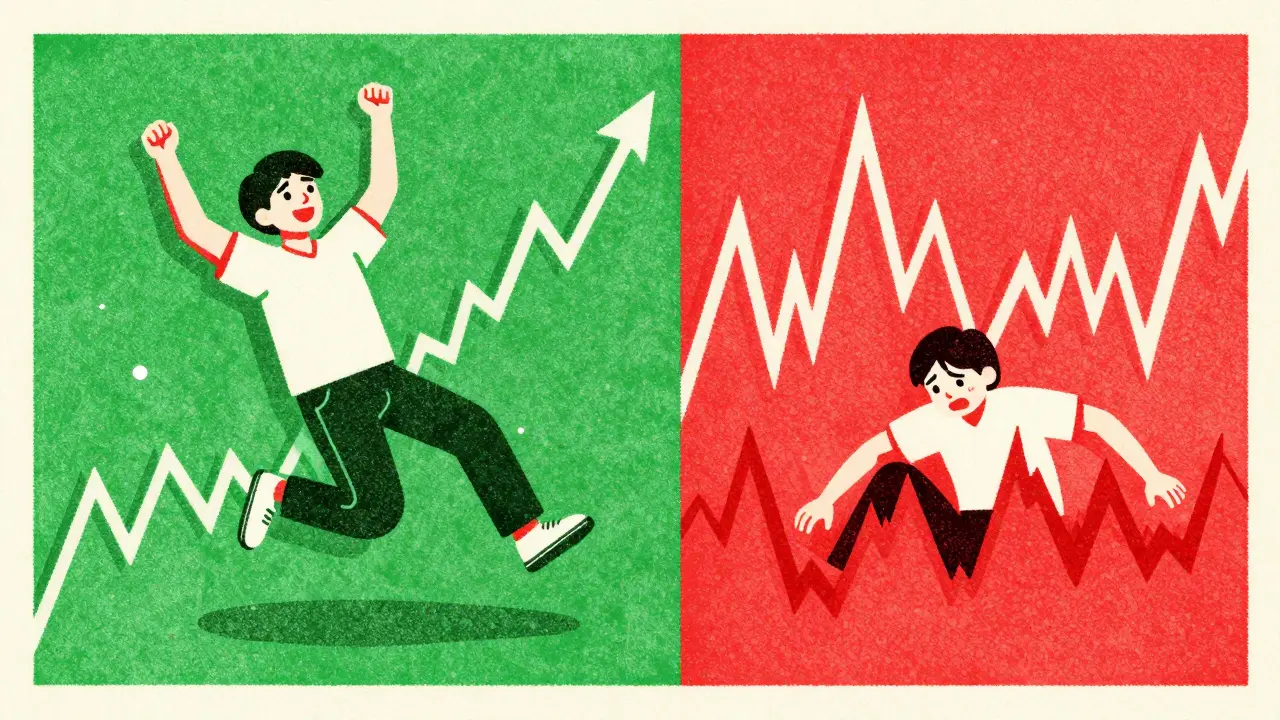
Imagine waking up to find your portfolio has surged 20% overnight. You're thrilled. Now, imagine the opposite: a sudden 30% crash that makes you question every life choice that led you to buy that specific coin. This emotional rollercoaster is why choosing between DCA is a strategy where you invest fixed amounts of money at regular intervals regardless of the asset's price. Also known as Dollar-Cost Averaging, it's designed to smooth out the volatile swings of the crypto market and a lump sum approach is so stressful for many investors.
The debate usually boils down to a clash between math and psychology. If you look at the raw numbers, putting all your money in at once often wins. But if you look at the people actually doing it, many find it nearly impossible to stick to their plan when the market turns red. Which one is right for you depends on your nerves, your budget, and how much you trust the current market price.
The Quick Breakdown: DCA vs Lump Sum
Before getting into the weeds, let's look at the basic mechanics. If you have $5,000 to invest in Bitcoin, a lump sum move means buying $5,000 worth today. You're fully exposed to the market instantly. A DCA approach means you might buy $100 every week for nearly a year. You don't worry about whether today is the "perfect" day to buy because you're buying every day.
| Feature | DCA (Dollar-Cost Averaging) | Lump Sum Investment |
|---|---|---|
| Risk Level | Lower (spreads the risk) | Higher (all-in at one price) |
| Psychological Stress | Minimal; "set and forget" | High during market dips |
| Potential Returns | Lower in strong bull markets | Higher in strong bull markets |
| Transaction Fees | Higher (multiple trades) | Lower (one single trade) |
| Market Timing | Irrelevant | Critical |
When the Math Favors the Big Leap
If we're being honest, the math often favors the bold. Data from analysts like Dan Hunt of Morgan Stanley suggests that lump sum investing outperforms DCA about 68% of the time in traditional markets, and a similar pattern holds true for crypto. Why? Because the crypto market tends to trend upward over long periods. If you invest everything at the start of a bull run, you capture the maximum growth on your entire capital.
Take a real-world scenario: if you had dumped $24,000 into the market in April 2021 and held through to 2024, your gains would have been significantly higher than if you had slowly dripped that money in over the same period. When prices are climbing, every day you wait to invest via DCA is a day you're buying at a higher price, essentially "averaging up" and reducing your total accumulation of coins.
There is also a technical advantage to the lump sum. Most Cryptocurrency Exchanges charge fees per transaction. If you use a platform like Coinbase, paying one flat fee for a $10,000 purchase is far cheaper than paying ten separate fees for $1,000 purchases. Over a year, those small fees add up and eat into your principal investment.
The Psychological Safety Net of DCA
If lump sum is mathematically superior, why do 59% of crypto investors still prefer DCA? Because humans aren't calculators. We feel the pain of a loss twice as much as the joy of a gain. Buying $5,000 of a coin only to see it drop 20% the next morning can lead to panic selling. This is where Risk Management becomes more important than raw profit.
DCA removes the "timing anxiety." You don't have to spend hours staring at charts trying to find the bottom. If the price drops, you're actually happy because your next scheduled buy gets you more coins for the same amount of money. For example, a retail investor might set up a recurring buy of $100 a week. If Bitcoin is $60k, they get a small amount. If it crashes to $30k, they get double the amount for the same $100. Over time, this naturally lowers the average cost per coin.
This approach is especially powerful during bear markets or periods of extreme uncertainty. In a crashing market, a lump sum investor is staring at a shrinking balance, while a DCA investor is systematically lowering their break-even point. It transforms market volatility from a threat into an opportunity.
Avoiding the "All-In" Trap
The biggest danger of the lump sum approach is the emotional toll. We've all seen the stories on Reddit where someone "went all in" at the peak, watched their portfolio drop 50%, and then sold everything in a panic just before the recovery. That is a failure of emotional discipline, not a failure of the strategy itself. However, not everyone has the iron will to hold through a 30% drawdown.
DCA acts as a hedge. It restricts your absolute maximum upside, but it also prevents the catastrophic psychological collapse that leads to selling at the bottom. For beginners, the learning curve for a lump sum entry is steep-it requires an understanding of market cycles and a very high tolerance for risk. DCA, on the other hand, is essentially a "set and forget" system that requires almost no technical expertise.
The Hybrid Strategy: A Middle Ground
You don't actually have to choose one or the other. A growing number of investors are using a hybrid approach to balance the two. A common method is the "50/50 Split": you deploy 50% of your capital as a lump sum to ensure you have a baseline position in the market, and then you DCA the remaining 50% over the next six to twelve months.
This way, if the market moons tomorrow, you're already in with half your money. If the market crashes, you still have a huge reserve of cash to buy the dip through your scheduled DCA payments. It's a compromise that satisfies both the mathematical desire for growth and the human need for security.
Practical Implementation: How to Start
If you've decided that DCA is your path, don't do it manually. Manually buying crypto every week is a chore, and you'll eventually forget or, worse, let your emotions stop you from buying when prices are low. Use the automated tools provided by major platforms:
- Binance offers a "Recurring Buy" feature that handles the timing for you.
- Coinbase has a similar system that allows you to link your bank account for daily, weekly, or monthly purchases.
- Kraken and other major exchanges provide automated options to simplify the process.
If you're leaning toward a lump sum, the key is to actually be okay with the money being gone. Treat it as a long-term lock-up. If you can't handle the thought of that money dropping by 40% in a week, you aren't a lump sum investor; you're a gambler. In that case, switch back to DCA.
Is DCA better for beginners?
Yes, generally. DCA is highly recommended for beginners because it removes the need to time the market and reduces the emotional stress of volatility. It allows new investors to build a position slowly and learn how the market moves without risking their entire capital on a single, potentially poorly timed entry.
Does lump sum always beat DCA?
Not always, but it does mathematically more often in rising markets. If you invest a lump sum at the bottom of a bear market right before a bull run, you will far outperform any DCA strategy. However, if you invest a lump sum at the top of a peak, you could face significant losses that a DCA strategy would have mitigated.
How does DCA affect my fees?
DCA typically results in higher cumulative fees because you are making many small transactions instead of one large one. Since many exchanges charge a base fee per trade, the total cost of 52 weekly buys is often higher than one single buy. It is worth checking your exchange's fee structure to see if this is a significant factor for your budget.
What is the best time to use a lump sum strategy?
Lump sum is most effective during clear recovery phases or at the very beginning of a documented bull market cycle. It is best for investors who have a high risk tolerance, a long-term time horizon (several years), and the emotional discipline to ignore short-term price crashes.
Can I change my strategy midway?
Absolutely. Many investors start with DCA and then switch to a lump sum "buy the dip" approach when prices hit a specific target they find attractive. Conversely, some who go all-in may decide to move new monthly savings into a DCA plan to continue growing their portfolio.
What to Do Now
If you're feeling overwhelmed by the options, start small. Set up a weekly DCA with an amount that feels insignificant to you-even $10 or $20. This gets you skin in the game and lets you feel the market's volatility without the risk of a total meltdown. Once you're comfortable with the swings, you can decide if you want to accelerate your entries with larger lump sums or keep the steady pace of DCA.


Tony Gurley-Ward
April 23, 2026 AT 04:59The whole dichotomy of math versus mood is just a fancy way of saying we're all gambling in a digital casino. Why follow the herd with a DCA plan when you can just dance on the edge of the volcano and hope for the best
It's a glorious chaos that makes the numbers feel like mere suggestions rather than laws
Hannah Rubia
April 23, 2026 AT 13:13It is imperative to recognize that individual risk tolerance should be the primary determinant of one's strategy. For those who possess a lower appetite for volatility, the systematic nature of dollar-cost averaging provides a structured approach that mitigates the psychological burden of market fluctuations. Furthermore, it is advisable to maintain a diversified portfolio to ensure that one's financial well-being is not tethered to a single asset class, regardless of the entry method chosen.
Benjamin Forg
April 24, 2026 AT 09:22math is a lie pushed by the elites to keep you in a loop of small payments while they dump on you
you think a weekly buy protects you but the algorithm already knows your patterns and the house always wins in the end
Lisa Camp
April 24, 2026 AT 11:18STOP OVERTHINKING AND JUST GET YOUR MONEY IN THE GAME! If you're too scared to go all-in, you'll never hit the kind of gains that actually change your life! Fortune favors the bold, not the people who spend six months dripping $100 into a coin like they're feeding a baby bird! CRUSH THE MARKET OR GET CRUSHED!
Liz Ariza
April 25, 2026 AT 13:05Totally agree that the mental game is everything here! 🚀 Finding that sweet spot where you can sleep at night is the real victory 🌈 It's all about building that steady momentum without letting the stress burn you out ✨ Keep grinding and stay focused on the long haul! 💎
Mary Tawfall
April 26, 2026 AT 09:18This is such a helpful way to look at the options. I think many people will find the hybrid approach very comforting because it allows for a little bit of both worlds without feeling like they missed out entirely.
Mike Word
April 27, 2026 AT 02:29I've noticed that in different global markets, the approach to saving varies wildly. Some cultures are naturally more inclined toward the steady accumulation of DCA while others embrace the high-risk nature of lump sums. It's interesting how our cultural backgrounds shape our appetite for financial risk in the crypto space.