Five years ago, sending a simple ETH transfer could cost you $50. Today, it’s under $1 - and sometimes less than 10 cents. That’s not magic. It’s the result of a quiet revolution: Layer 2 solutions took the weight off Ethereum’s shoulders and made blockchain usable for regular people.
Why Gas Fees Used to Be a Nightmare
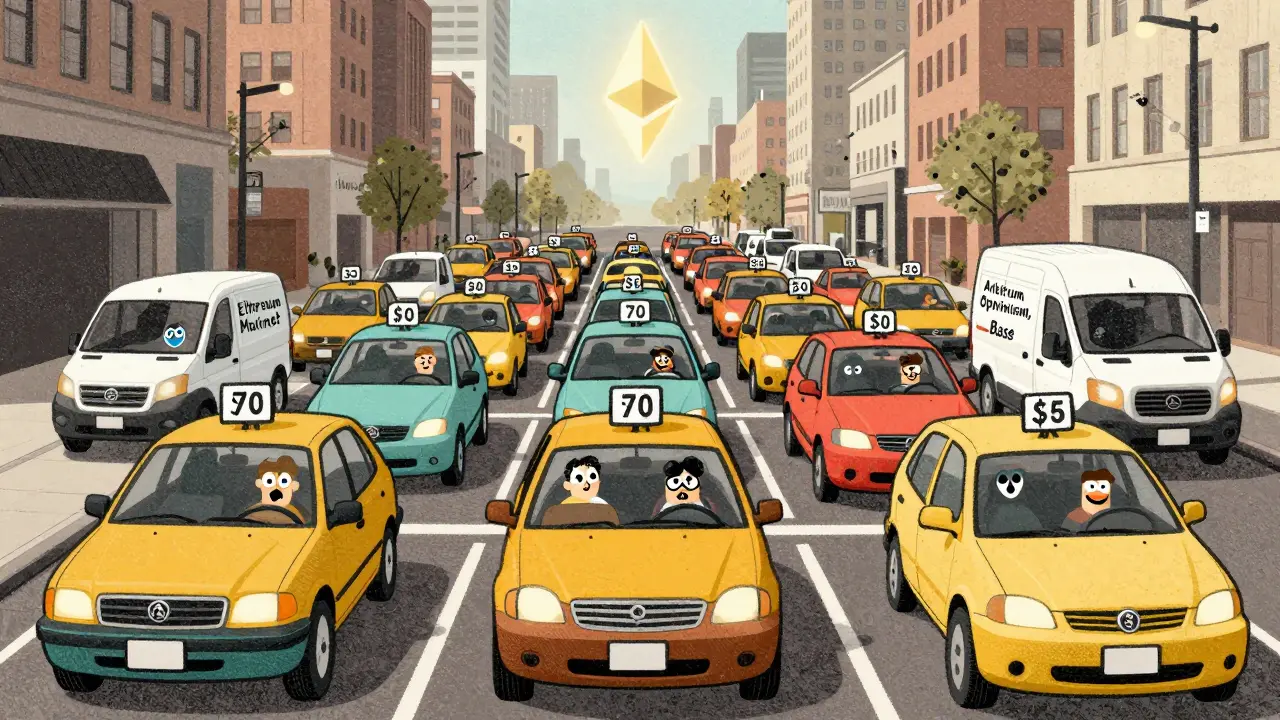
Back in 2023, Ethereum was a traffic jam. Every time someone traded an NFT, swapped tokens, or joined a new DeFi protocol, they had to compete for space on the main chain. Miners prioritized transactions with the highest fees. During peak NFT drops or token launches, gas prices spiked to $70 per transaction. That wasn’t just expensive - it was exclusionary. If you wanted to stake $100 in a yield farm, $50 in fees meant you’d lose half your money before you even started. The problem wasn’t just cost. It was unpredictability. You’d open your wallet, plan a trade, and suddenly the network was congested. You’d pay $15 to send $20 worth of USDC. No wonder new users gave up.How Layer 2 Solutions Changed Everything
Layer 2 solutions like Arbitrum, Optimism, and Base didn’t fix Ethereum. They bypassed it - smartly. Instead of processing every transaction on Ethereum’s main chain, these networks bundle hundreds or thousands of transactions off-chain, then submit one compressed proof back to Ethereum. Think of it like carpooling: instead of 1,000 cars driving downtown, you put 50 people in 20 vans and send them all at once. The city (Ethereum) only needs to verify the vans arrived, not count every person. The result? Transaction fees on Arbitrum and Optimism are about 99% cheaper than Ethereum mainnet. A swap that cost $15 on Ethereum now costs $0.05 on Arbitrum. A simple token transfer? As low as $0.01. By early 2025, average Ethereum gas fees had dropped to $0.41 - the lowest in four years. Daily gas fees fell from $23 million to $7.5 million. That’s a 70% drop in network-wide costs, and nearly all of it came from users moving to Layer 2s.Who’s Using Layer 2s - And Why
It’s not just traders. Retail users, small DeFi protocols, and even NFT marketplaces are switching. Why?- **Daily users** now do multiple transactions a day - sending crypto to friends, claiming rewards, minting collectibles - without worrying about fees eating their balance.
- **DeFi platforms** built on Layer 2s like Base and zkSync are seeing 5x more active users than their Ethereum-only counterparts.
- **New projects** skip Ethereum mainnet entirely. Why pay $10 to launch a token when you can launch on Optimism for $0.10 and still inherit Ethereum’s security?
It’s Not Perfect - Yet
Layer 2s aren’t magic bullets. There are still pain points. First, you have to bridge your assets. Moving ETH or USDC from Ethereum to Arbitrum costs a one-time fee - sometimes $5 to $10. That’s fine if you’re moving $1,000. Not so great if you’re moving $50. Second, managing multiple chains adds complexity. You need to track balances across Ethereum, Arbitrum, Optimism, and maybe zkSync. Wallets like MetaMask now support multi-chain views, but it’s still not seamless. And then there’s congestion. On February 19, 2025, a single DeFi flash loan event spiked Ethereum gas fees to $50 per swap. Layer 2s stayed cheap, but the mainnet still had its moments. The lesson? Layer 2s handle the daily load, but Ethereum still needs to stay stable during spikes.The New Tools Making Fees Even Smarter
Gas fees aren’t just cheaper - they’re smarter. AI-powered tools like GasNow and DeFi Saver now predict the best time to send transactions. They watch network traffic, analyze historical patterns, and suggest when to act - like waiting until Sunday morning when fees are lowest. Some even auto-route your transaction through the cheapest Layer 2 based on your destination. Cross-chain bridges are getting faster and safer. Instead of moving assets manually, apps like Synapse and Across let you swap between chains in one click. You pick your destination network, and the system handles the bridge, the fee, and the timing. Developers are also building fee estimation into every app. If you’re using a DEX on Optimism, the interface now shows: “This swap will cost $0.03. Wait 10 minutes and it could drop to $0.01.” That kind of transparency builds trust.What’s Next? The Road to $0.01 Transactions
The next big leap isn’t just about more Layer 2s. It’s about better integration. Ethereum’s shift to Proof of Stake in 2022 cut energy use by 99% and changed how fees are distributed. Now, fees go to stakers - not miners. That made the network more sustainable and aligned incentives. In 2025, we’re seeing the rise of “fee abstraction.” Imagine a wallet that pays your gas fees in stablecoins - not ETH. Or an app that covers your fees as part of its service. Some startups are already testing this with subscription models: pay $5/month, and all your crypto transactions are free. Layer 3s - networks built on top of Layer 2s - are starting to appear. These are specialized chains for gaming, social media, or enterprise use. They’re even cheaper and faster, with fees under $0.001. They won’t replace Ethereum or Arbitrum. But they’ll handle the tiny, high-volume tasks that don’t need full blockchain security.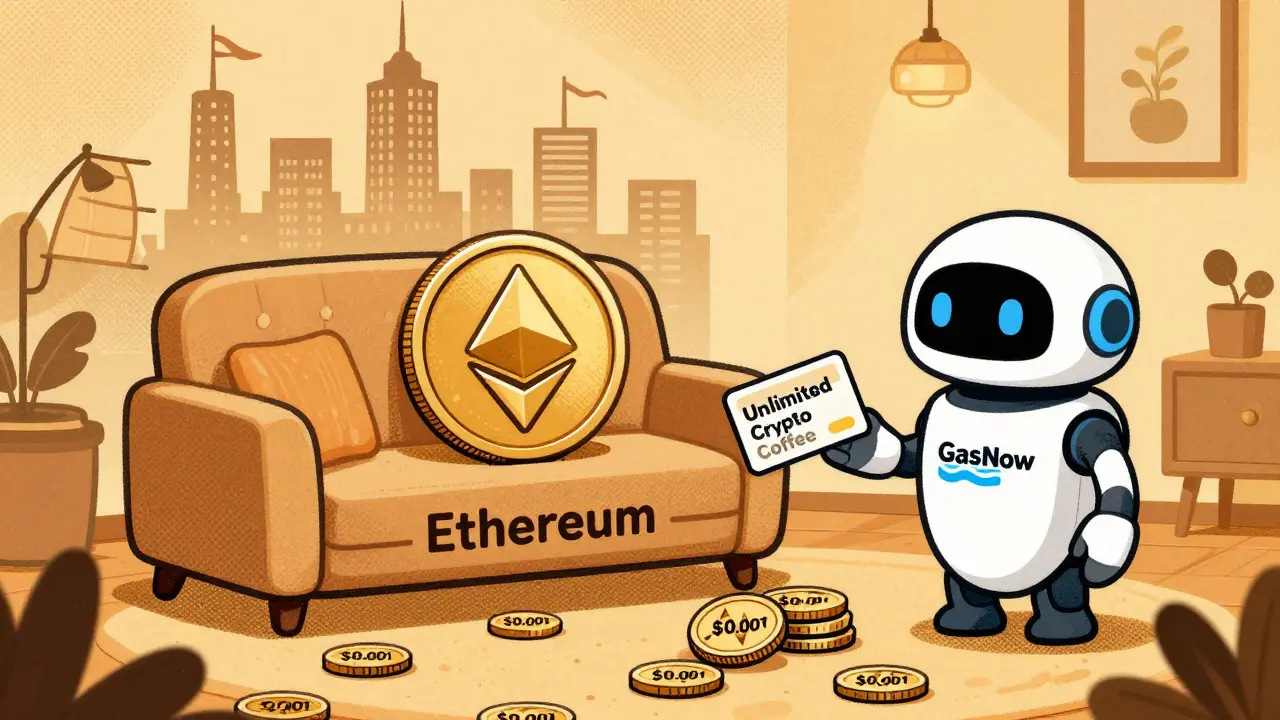
What This Means for You
If you’re still doing everything on Ethereum mainnet, you’re paying too much. Here’s what to do:- **Use a Layer 2 for daily activity** - Arbitrum and Optimism are the safest bets right now. Base is great if you use Coinbase.
- **Bridge only what you need** - Don’t move your whole portfolio. Just enough for weekly trades.
- **Use fee trackers** - Etherscan’s Gas Tracker or Dune Analytics show real-time trends. Avoid weekends if you’re doing big swaps - they’re usually cheaper.
- **Check your wallet settings** - Make sure you’re not accidentally using Ethereum mainnet when your app defaults to a Layer 2.
Is Ethereum Still Necessary?
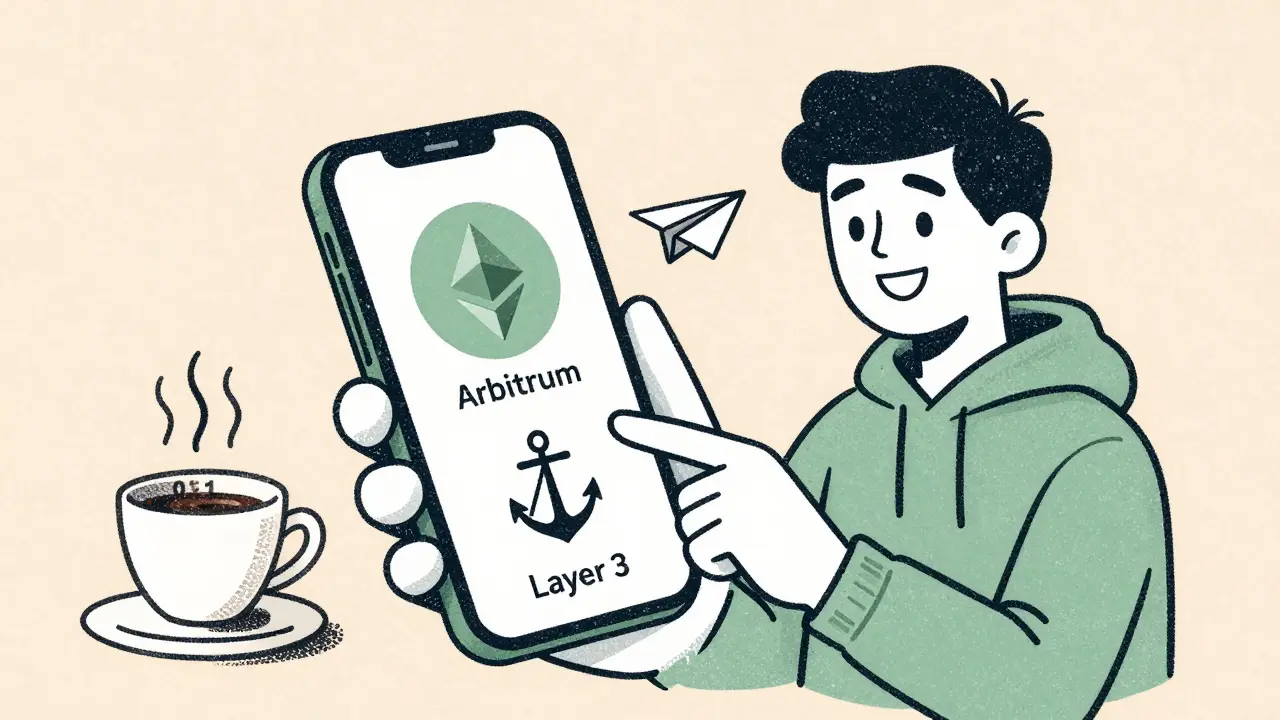
Yes. Layer 2s need Ethereum. They rely on its security, decentralization, and brand trust. Ethereum is the anchor. Layer 2s are the sails. If Ethereum goes down, Layer 2s can’t operate. But if Layer 2s fail, Ethereum would drown in its own fees. They’re not rivals. They’re partners. BNB Chain and Solana are pushing hard to undercut Ethereum on price. But they don’t offer the same level of security or developer adoption. Ethereum’s Layer 2 ecosystem is unmatched. That’s why institutional money is flowing in - not because ETH is the cheapest, but because it’s the most reliable.Final Thought: The Real Win Isn’t Lower Fees - It’s Access
The biggest change isn’t the numbers. It’s who can participate now. In 2023, a college student in Nigeria couldn’t afford to try DeFi. In 2025, they can swap tokens, earn yield, and send money home for less than the cost of a text message. That’s the future. Not just cheaper gas. A blockchain that works for everyone.Are Layer 2 solutions safe?
Yes, the major ones - Arbitrum, Optimism, and Base - are built on Ethereum’s security model. They use fraud proofs or zero-knowledge proofs to verify transactions before they’re finalized on Ethereum. While no system is 100% hack-proof, these networks have withstood years of scrutiny and billions in locked value. The biggest risk isn’t the tech - it’s using untrusted bridges or falling for phishing scams.
Do I need ETH to use Layer 2s?
You need ETH to bridge assets from Ethereum mainnet to a Layer 2. Once you’re on the Layer 2, you can use native tokens like ARB or OP to pay for gas on some networks. But most still require ETH for final settlement. Always keep a small amount of ETH in your wallet for bridge fees and emergencies.
Which Layer 2 should I use?
For most users, Arbitrum and Optimism are the best choices. They’re the most established, have the largest ecosystems, and support nearly all major DeFi apps. If you use Coinbase, Base is the easiest option. zkSync and StarkNet are promising for advanced users but have fewer apps. Stick with Arbitrum or Optimism until you’re comfortable.
Can I still use Ethereum mainnet after switching to Layer 2?
Yes, but you shouldn’t unless you have to. Mainnet is for moving large amounts, settling final positions, or interacting with protocols that haven’t moved to Layer 2 yet. For everyday use - swaps, staking, NFTs - Layer 2s are faster and cheaper. Think of mainnet as your bank vault and Layer 2s as your checking account.
Will gas fees ever hit $0?
Not technically. Every transaction requires computational work, and someone has to pay for it. But fees can get so low - under $0.01 - that they become negligible. Some apps are already absorbing those costs as part of their business model. In practice, yes: you’ll experience $0 gas fees, even if the network still charges a tiny amount behind the scenes.


Callan Burdett
January 18, 2026 AT 02:49Bro, I just did a swap on Optimism for $0.02 and cried a little. Five years ago I’d have lost my rent money to gas fees. This isn’t tech progress - it’s liberation. 🥹
ASHISH SINGH
January 19, 2026 AT 09:11Layer 2s are just a distraction. The real power grab is happening behind the scenes - centralized entities controlling the bridges, the sequencers, the fee structures. They made it cheap so you’d stop asking questions. Wake up. This isn’t decentralization. It’s velvet handcuffs.
Vinod Dalavai
January 20, 2026 AT 16:30Y’all are overthinking it. I use Arbitrum, send $10 to my cousin in Kerala, he cashes out via UPI, we both laugh. No drama. No fees. Just vibes. ✌️
Patricia Chakeres
January 21, 2026 AT 00:40Oh wow, so now we’re supposed to believe this is ‘democratization’? Please. The same venture capitalists who funded the NFT bubble are now funding the Layer 2 oligopoly. Arbitrum’s sequencer is run by a VC-backed firm. Optimism’s OP token distribution? Rigged. You think you’re saving money? You’re just being groomed for the next phase of extraction. This isn’t progress - it’s rebranding. The system always wins. And you’re still paying, just in trust.
Andre Suico
January 21, 2026 AT 01:12While the cost reductions are undeniable and the technical architecture of Layer 2s is sound, it is worth noting that the long-term sustainability of fee abstraction models remains untested. The assumption that third parties will consistently subsidize transaction costs lacks empirical precedent at scale. Furthermore, the fragmentation of liquidity across multiple chains introduces systemic risks that are not yet fully quantified. A cautious, phased migration remains prudent for users with significant holdings.
Chidimma Okafor
January 22, 2026 AT 14:53As a young woman from Lagos, I used to stare at my phone wondering if I could afford to send $5 to my sister. Now? I send her $50, she gets $49.98, and we both smile. This isn’t just about gas fees - it’s about dignity. It’s about dignity in a world that told us we didn’t belong in this space. Thank you for writing this. I’m not just using Layer 2s - I’m living them.
Nishakar Rath
January 22, 2026 AT 17:34Layer 2s are just a bandaid on a corpse. Ethereum is dead they just haven’t buried it yet. All this ‘security’ talk is just marketing. You think zkSync is safer? LOL. The real security is in not using crypto at all. I’m going to buy gold and hide it under my mattress. At least it doesn’t need a wallet password or a bridge or some smart contract that could get hacked tomorrow. And don’t even get me started on the AI gas trackers - they’re just more bots manipulating you
Bill Sloan
January 23, 2026 AT 23:25Wait wait wait - so if Layer 2s are so cheap, why does my wallet still show $3 in ETH for ‘bridge fees’? 😅 I just tried to move $20 and got charged $5 to get there. That’s not $0.01, that’s a scam. Can someone explain this? 🤔