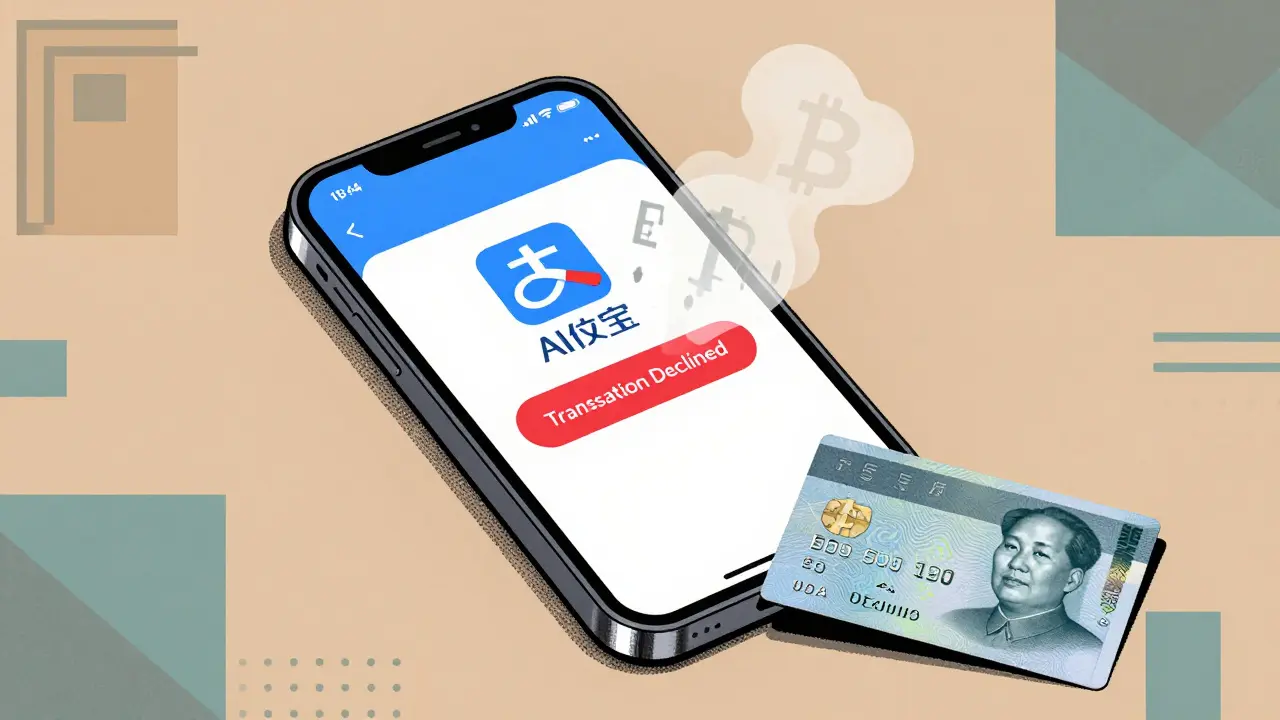
China doesn’t just ban cryptocurrency-it blocks it. And the tools doing the blocking aren’t government servers or police raids. They’re your phone’s payment apps: Alipay is a digital payment platform operated by Ant Group, used by over 700 million Chinese consumers for everyday transactions, from groceries to utility bills and WeChat Pay is a payment feature inside Tencent’s WeChat messaging app, handling nearly 80% of mobile payments in China and serving as a lifeline for small businesses and individuals alike.
Since 2021, the People’s Bank of China (PBOC) has made it clear: no crypto trading, no mining, no stablecoin use, no peer-to-peer crypto payments. But enforcement? That’s where things get real. The government didn’t build a new agency. It didn’t shut down exchanges overnight. Instead, it turned Alipay and WeChat Pay into the front line of enforcement. These apps now do the heavy lifting-automatically, silently, and at scale.
How the Ban Actually Works
It’s not about blocking websites. It’s about blocking payments.
When you try to send money to a crypto exchange-whether it’s Binance, OKX, or a local OTC trader-Alipay and WeChat Pay don’t just say no. They stop it cold. Their systems scan every transaction in real time. If a payment goes to a known crypto-related merchant, wallet address, or even a merchant code flagged as crypto-linked, the transaction is blocked before it even leaves your phone. No warning. No explanation. Just a red error message: "Transaction declined."
Behind the scenes, these platforms use advanced Know Your Transaction (KYT) is a real-time monitoring system that analyzes payment patterns, recipient identities, and behavioral signals to detect crypto-related activity tools. These aren’t simple keyword filters. They track things like: how often you send money to the same recipient, whether that recipient has ever been flagged before, whether the amount matches typical crypto OTC ranges (like 5,000 or 10,000 RMB), and even whether you’ve recently visited a crypto-related website on your phone.
It’s not just about direct payments. If you try to buy a gift card from a site that turns around and sells Bitcoin, the system catches it. If you pay a "freelancer" who turns out to be a crypto OTC dealer, your account gets flagged. And if you do it three times? Your account may be frozen for review.
Why Alipay and WeChat Pay Are So Effective
Think about this: in China, almost no one uses cash anymore. Not for coffee, not for rent, not for paying your kid’s tuition. Alipay and WeChat Pay handle over 95% of all digital payments. That means if you want to move money in China, you need these apps. There’s no real alternative.
That’s the choke point. The government didn’t need to ban mining rigs or shut down crypto websites. It just had to make sure no one could pay for them. And because these platforms are tied to real-name bank accounts-verified by the government through ID cards, biometrics, and mobile numbers-there’s no anonymity. You can’t create a fake identity. You can’t use a VPN to bypass the system. Your phone is your identity.
State-owned banks like ICBC and China Construction Bank work hand-in-hand with these platforms. If Alipay flags you, your bank account gets reviewed. If your bank freezes your account, Alipay blocks your payments. It’s a loop. One system backs the other. And because the PBOC, the Cyberspace Administration of China (CAC), and the Ministry of Public Security (MPS) all have direct oversight, enforcement isn’t optional-it’s mandatory.
The WeChat Pay Loophole
But here’s the twist: WeChat Pay isn’t just a payment tool. It’s also a messaging app. And that’s where the cracks appear.
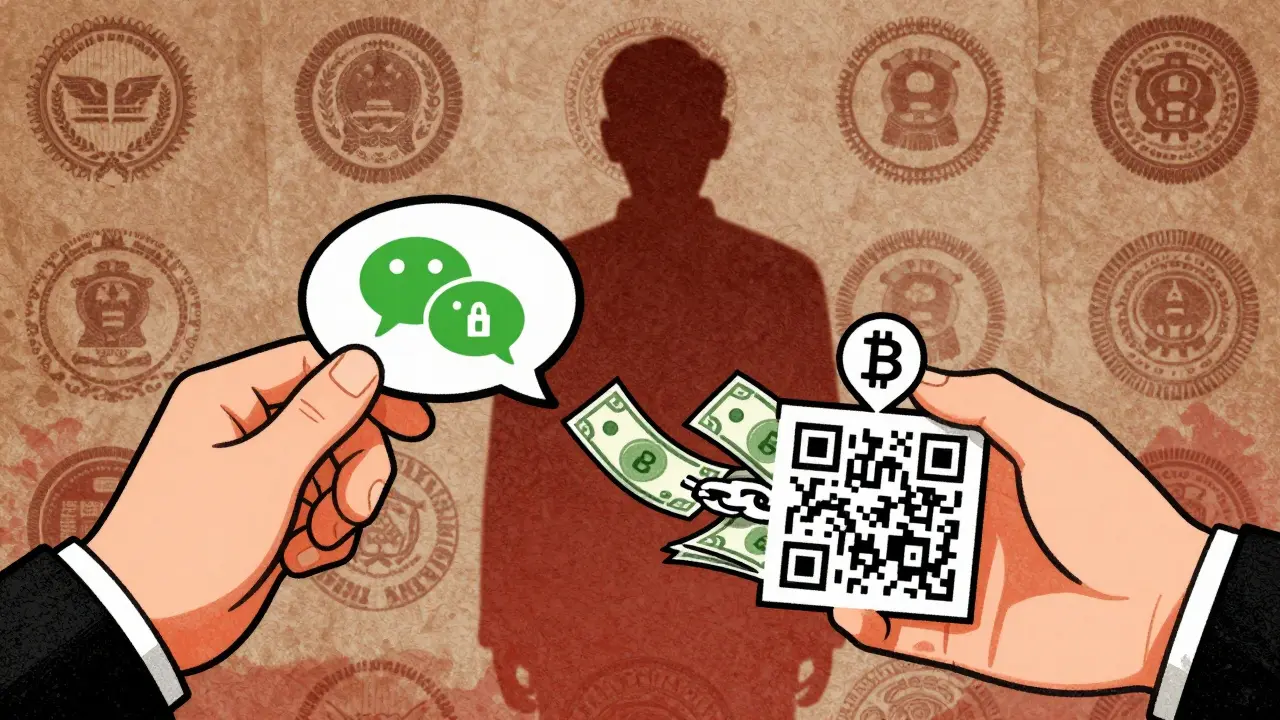
While Alipay is clean, simple, and focused on payments, WeChat Pay lives inside WeChat-the app where people chat, share photos, make group calls, and send红包 (red envelopes). Criminals didn’t wait for a workaround. They built one.
Now, you’ll find crypto traders in WeChat groups. They’ll send you a QR code labeled "payment for services"-but the money goes to a bank account linked to a crypto OTC dealer. They’ll text you a wallet address, then ask you to send 5,000 RMB to a "friend." The payment goes through WeChat Pay. The crypto transfer happens on a foreign exchange. No direct link. No transaction record.
Because WeChat encrypts messages end-to-end, Chinese authorities can’t read them. Even if they wanted to, Tencent doesn’t hand over chat logs to foreign governments. That means while the payment system blocks direct crypto payments, the messaging system lets traders coordinate in the dark.
Experts call this "off-chain coordination." It’s not illegal to text someone. It’s not illegal to send money to a friend. But when you do both to buy Bitcoin? That’s where the law steps in. Authorities have started arresting people for "illegal fund transfers" and "underground banking" based on these patterns. In 2025, Shanghai authorities reported over 2,300 cases tied to WeChat-based crypto coordination.
How It Compares to Other Countries
Compare this to Singapore, where you can legally trade Bitcoin on licensed exchanges. Or Hong Kong, where retail crypto trading is allowed under strict licensing. In those places, regulators want oversight-they want to know who’s trading, how much, and where the money goes.
China doesn’t want oversight. It wants elimination. No sandbox. No licenses. No exceptions. Even stablecoins like USDT are banned, except in a few government-controlled pilot programs for cross-border trade.
That’s why the mBridge project-China’s CBDC experiment with Hong Kong, Thailand, and the UAE-is so telling. It’s not about blockchain. It’s about control. The e-CNY, China’s digital yuan, runs on a centralized ledger. The government sees every transaction. It can freeze accounts. It can restrict spending. It can track where money goes. And Alipay and WeChat Pay? They’re now being used to distribute the e-CNY. Not Bitcoin. Not Ethereum. Just the state’s money.

What Users Experience
If you’re just paying bills, ordering food, or sending money to family, you probably never notice the ban. Your life goes on. But if you’ve ever tried to buy crypto through these apps? You’ve felt it.
Users report:
- Transactions being blocked without explanation
- Accounts frozen after sending money to a crypto-related merchant
- Difficulty transferring funds out of China for any reason
- Being asked to provide proof of income when trying to send over 50,000 RMB
Some users have turned to offshore platforms-like using a friend’s overseas bank account or a foreign crypto exchange that accepts bank transfers. But that’s risky. The State Administration of Foreign Exchange (SAFE) treats unauthorized cross-border capital movement as a serious violation. Penalties can include fines, account freezes, or even criminal charges under China’s financial crime laws.
There’s no gray area. If you’re caught using WeChat to coordinate crypto trades, you’re not a tech-savvy investor. You’re an illegal fund transfer operator.
What’s Next?
Will China ever lift the ban? Don’t count on it.
The government’s stance isn’t about fear of crypto. It’s about control. Private cryptocurrencies threaten capital controls. They let money leave the country. They let people bypass the banking system. And they undermine the e-CNY, which is China’s answer to digital money: fully trackable, fully controllable, fully state-owned.
Alipay and WeChat Pay aren’t going to change. They’re becoming even more powerful. In 2025, they started blocking payments linked to gaming platforms that offer crypto rewards. They started flagging QR codes from NFT marketplaces. They started monitoring transfers to foreign exchanges that accept Chinese bank accounts.
The tools are getting smarter. The rules are getting tighter. And the message is clear: if you want to use crypto in China, you’ll have to do it outside the system. And if you do? You’re on your own.
Can I still buy Bitcoin in China using Alipay or WeChat Pay?
No. Both platforms actively block any transaction linked to cryptocurrency exchanges, OTC dealers, or crypto-related merchants. If you try to send money to a known crypto address or service, the payment will be automatically rejected. Attempts to bypass this through indirect methods (like paying a "freelancer") carry high legal risk and can lead to account freezes or criminal investigation.
Why does WeChat Pay have more crypto-related issues than Alipay?
WeChat Pay is embedded inside WeChat, a messaging app with encrypted chats. Criminals use WeChat groups to coordinate crypto trades-sending wallet addresses, QR codes, and payment instructions-without ever using the payment feature for direct crypto transfers. This "off-chain" coordination is hard to detect because the messages are encrypted and not shared with authorities. Alipay, being purely a payment platform, has no messaging layer, making enforcement simpler.
Is the e-CNY the same as Bitcoin or other cryptocurrencies?
No. The e-CNY (digital yuan) is China’s central bank digital currency, fully controlled by the People’s Bank of China. Unlike Bitcoin, it’s not decentralized, not based on blockchain in the public sense, and not anonymous. Every transaction is tracked by the government. Alipay and WeChat Pay are just distribution channels for the e-CNY-they’re not used to trade private cryptocurrencies.
Can I use a VPN or foreign bank account to bypass the ban?
Using a VPN won’t help with Alipay or WeChat Pay-they’re tied to your Chinese phone number and ID. Even if you use a foreign exchange, transferring money out of China without approval violates SAFE regulations. The government monitors cross-border flows closely. If you’re caught moving large sums to crypto exchanges, you could face fines, asset seizures, or criminal charges for illegal capital outflow.
Are there any legal ways to hold crypto in China?
No. China bans all private cryptocurrency activities for individuals and businesses. This includes holding, trading, mining, and using crypto as payment. The only exception is the e-CNY, which is not a cryptocurrency-it’s a government-controlled digital currency. Any crypto holdings, even if stored offline, are not legally recognized and carry regulatory risk.



Josh Moorcroft-Jones
March 4, 2026 AT 21:04Look, I get it-China’s got this whole surveillance capitalism thing down to a science, right? Alipay and WeChat Pay aren’t just apps, they’re digital handcuffs with a side of convenience. But here’s the kicker: this isn’t about crypto. It’s about control. The second you tie every transaction to your ID, your phone number, your face scan, your bank account, and your social graph-you don’t just ban crypto, you erase financial autonomy. And honestly? It’s terrifying. I’ve used WeChat Pay when I was in Shanghai. One time I tried to send 8,000 RMB to a friend for concert tickets, and it got flagged because his account had once paid a guy who sold gaming skins. No warning. No appeal. Just… blocked. And that’s the point. It’s not about legality. It’s about obedience. They don’t care if you’re buying Bitcoin or just helping your cousin pay rent. If it looks weird? You’re guilty until proven innocent. And guess what? You can’t prove anything. There’s no transparency. No appeals process. No audit trail. Just silence. And that’s how totalitarianism wins-not with tanks, but with a red error message on your phone screen.
Rachel Rowland
March 4, 2026 AT 22:29It’s wild how people think this is unique to China when every country is moving toward financial surveillance-just quieter. The U.S. doesn’t block crypto payments outright, but banks freeze accounts for ‘suspicious activity’ all the time. The EU’s DLT pilot programs? Same thing. China just made it more visible. And honestly? Maybe that’s better. At least we know what we’re up against. In the West, we’re being slowly stripped of financial privacy while being told it’s for our own safety. Here? They just say ‘no’ and move on. No sugarcoating. No PR spin. Just cold, hard enforcement. I’m not saying I agree with the ban-but I respect the clarity. We need to stop pretending our systems are more free. They’re just more polite about the surveillance.
Bonnie Jenkins-Hodges
March 5, 2026 AT 01:43China is RIGHT 💪🇺🇸. Crypto is for criminals and losers. Real money is dollars and yuan. If you’re trying to buy Bitcoin in China, you’re either a spy or a scammer. Alipay and WeChat Pay are doing GOD’S WORK. No more chaos. No more scams. No more people losing their life savings to some guy on Telegram. I’m so proud of China for having the guts to say NO. We need this in America. Stop letting weirdos trade digital junk. 💯
Melissa Ritz
March 6, 2026 AT 13:04It’s ironic, really. The same people who scream about privacy in the U.S. are the ones who use Venmo and Zelle without a second thought. China just made the trade-off explicit. You want convenience? Fine. But you give up anonymity. No one’s forcing you to use Alipay. You can still use cash… if you can find someone who accepts it. The real horror story isn’t the ban-it’s how willingly people surrendered their financial autonomy for a 10% discount on groceries. And now we’re supposed to be shocked when the state uses that data to monitor, restrict, and punish? Please. This isn’t dystopia. It’s capitalism with Chinese characteristics. And honestly? It’s working. For them. Not for you.
Megan Lutz
March 8, 2026 AT 09:11What’s fascinating isn’t the technical enforcement-it’s the philosophical shift. China isn’t banning crypto because it’s volatile or risky. It’s banning it because it’s decentralized. And decentralization is the ultimate threat to state authority. Money is power. Power is information. Information is control. By monopolizing payment infrastructure and tying it to identity, the state doesn’t just regulate finance-it redefines the social contract. The e-CNY isn’t a currency; it’s a governance tool. And Alipay and WeChat Pay? They’re not platforms anymore. They’re administrative arms of the state. The real question isn’t whether the ban works-it’s whether we’re willing to accept this model elsewhere. Because if we are, then privacy, freedom, and autonomy were never real to begin with.
jonathan swift
March 10, 2026 AT 00:49ALIEXPRESS IS A CIA FRONT. WECHAT PAY IS A BACKDOOR FOR THE CCP TO TRACK EVERY PENNY YOU SPEND. THEY’RE USING AI TO SCAN YOUR TEXTS, YOUR LOCATION, YOUR TAP PATTERNS. THE ‘RED ERROR’? THAT’S NOT A SYSTEM ERROR. THAT’S A WARNING FROM THE GOVERNMENT. THEY’RE WATCHING YOU RIGHT NOW. I KNOW THIS BECAUSE MY FRIEND’S COUSIN’S NEIGHBOR WORKED AT ANT GROUP AND SAID THEY’RE TRAINING THE AI TO PREDICT WHO’S GOING TO BUY BITCOIN BEFORE THEY EVEN SEARCH FOR IT. YOU THINK THIS IS ABOUT CRYPTO? NO. IT’S ABOUT FUTURE REBELLION. THEY WANT TO PREVENT A SINGLE PERSON FROM EVER MOVING MONEY OUTSIDE THEIR CONTROL. AND IF YOU THINK THAT’S NOT A THREAT TO FREEDOM… YOU’RE ALREADY IN THE SYSTEM.
Datta Yadav
March 10, 2026 AT 19:25Oh please. You think China’s the only one doing this? Let me tell you something-India’s UPI system tracks every rupee you send, and if you transfer to a crypto wallet, even indirectly, your account gets flagged. The EU’s MiCA regulations? They’re just putting a pretty label on the same thing. The U.S.? Banks are already using AI to auto-flag transactions over $500 to crypto exchanges. The difference? China doesn’t pretend. It doesn’t have 20-page white papers and compliance teams. It just says: ‘This is how it is.’ And you know what? That’s refreshing. No hypocrisy. No ‘we’re protecting you’ nonsense. Just raw, unapologetic control. And honestly? It’s more honest than the Western model where they take your money, then charge you $12 for a receipt. The real story here isn’t China’s ban-it’s that the rest of the world is quietly following suit, but with more bureaucracy and less courage. We’re all living in the same surveillance economy. China just turned the lights on.