
Imagine trying to agree on the time with a group of generals scattered across different cities. Some might be lying. Some might be asleep. Others might just have broken watches. This is the essence of the Byzantine Generals Problem, a classic distributed computing challenge that asks how independent parties can reach a reliable agreement when some participants may be faulty or malicious. In the world of cryptocurrency, this isn't just a theoretical puzzle-it’s the daily reality of every blockchain network.
Byzantine Fault Tolerance (BFT) is the ability of a distributed system to continue operating correctly even if some nodes fail or behave unpredictably. Without BFT, a blockchain could easily be tricked into accepting fake transactions, double-spending coins, or halting entirely. It is the invisible shield that allows strangers to trust each other without a central bank or authority standing in the middle. But how does it actually work in practice? And why do some blockchains handle faults better than others?
The Core Mechanism: How BFT Protects Decentralized Networks
To understand BFT in crypto, you first need to grasp the threshold rule. A traditional BFT algorithm can tolerate up to one-third of the nodes being faulty or malicious. If you have 100 nodes, and 33 act up, the network still functions. If 34 act up, the consensus breaks. This mathematical limit is non-negotiable for pure BFT protocols like Practical Byzantine Fault Tolerance (PBFT) is a specific consensus algorithm designed for permissioned systems that requires three rounds of message exchange to achieve agreement.
In real-world crypto networks, however, we rarely see pure PBFT used alone for public chains because it doesn’t scale well. Instead, we see hybrid approaches. Let’s look at how major networks implement these principles.
- Bitcoin (Proof of Work): Bitcoin achieves a form of probabilistic BFT through energy expenditure. Miners compete to solve complex math problems. To attack the network, a bad actor needs more than 51% of the total computing power. This makes attacks economically prohibitive but not technically impossible.
- Ethereum (Proof of Stake): Ethereum uses a variant called Casper FFG combined with LMD-GHOST. Validators stake ETH as collateral. If they lie or go offline, they lose their stake (slashing). This economic penalty creates a disincentive for Byzantine behavior.
- Hyperledger Fabric: This enterprise platform often uses Raft or PBFT directly because it operates in a "permissioned" environment where all nodes are known entities, allowing for faster finality without the heavy overhead of public mining.
Real-World Scenarios: Where BFT Saves the Day
BFT isn't just code; it's the reason your transaction goes through even when half the internet is acting weird. Here are concrete examples of BFT in action.
1. Preventing Double-Spending Attacks
Double-spending is the digital equivalent of photocopying a dollar bill and spending both copies. In a centralized system, a database simply checks if the money exists. In a decentralized system, nodes must agree on the state of the ledger. When a user sends Bitcoin, the network broadcasts this transaction. Nodes verify it against previous blocks. If a malicious node tries to claim those same coins were sent elsewhere, the honest majority rejects the conflicting data. The BFT mechanism ensures that once a block is buried under several others, reversing it becomes computationally or economically irrational.
2. Resilience Against Node Failures
Not all faults are malicious. Sometimes servers crash. Internet connections drop. Hardware fails. In a non-BFT system, a single point of failure can stop everything. In a BFT-enabled blockchain, if 10% of validators go offline during a storm in Boulder, the remaining 90% continue to validate blocks. The network remains live. This is crucial for financial infrastructure that needs to run 24/7/365.
3. Enterprise Supply Chain Integrity
Consider a supply chain tracking system built on Hyperledger Fabric. Multiple companies-manufacturers, shippers, retailers-share a ledger. One company’s server might be compromised by malware (a Byzantine fault). Because the network uses BFT consensus, the corrupted data from that single node is rejected by the other honest participants. The shipment record remains accurate, preventing fraud and errors in inventory management.
| Network | Consensus Type | BFT Approach | Fault Threshold | Key Limitation |
|---|---|---|---|---|
| Bitcoin | Proof of Work | Probabilistic Finality | < 51% Attack Power | High Energy Use, Slow Confirmation |
| Ethereum | Proof of Stake | Economic Slashing | < 33% Staked Tokens | Complexity, Validator Centralization Risk |
| Hyperledger Fabric | PBFT / Raft | Deterministic Finality | < 33% Nodes | Permissioned Only, Limited Scalability |
| Tendermint Chains | BFT Consensus | Immediate Finality | < 33% Voting Power | Validator Set Size Limits |

The Dark Side: Vulnerabilities and Attacks
No system is perfect. While BFT provides robustness, it has specific weaknesses that attackers exploit. Understanding these helps you evaluate which networks are truly secure.
The 51% Attack Reality
While pure BFT tolerates 33% faults, PoW systems theoretically break at 51%. We’ve seen this happen. In 2020, Ethereum Classic suffered a 51% attack where hackers rewrote history to double-spend millions in ETC. Similarly, Bitcoin SV faced repeated attacks. These events prove that small, less-decentralized networks are vulnerable despite having BFT characteristics. The lesson? Network size matters. Larger hash rates or stake distributions make attacks too expensive to attempt.
Sybil Attacks
A Sybil attack occurs when one entity creates thousands of fake identities (nodes) to gain disproportionate influence. In a pure IP-based voting system, this is easy. BFT protocols counter this by tying identity to something costly: either electricity (PoW) or capital (PoS). However, if a few large entities control most of the stake or hashing power, the "decentralization" is an illusion. This leads to the next major challenge.
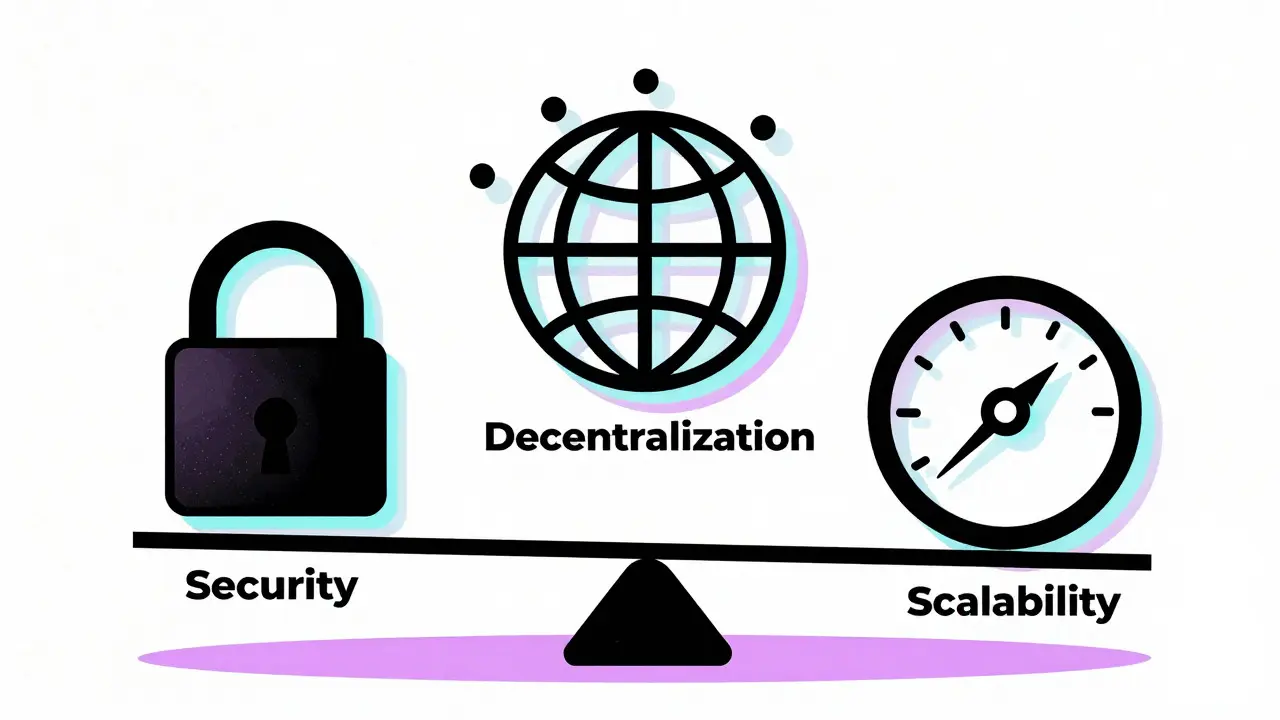
The Blockchain Trilemma: Security vs. Scalability
You want security (BFT), decentralization (many nodes), and scalability (fast transactions). You can usually only pick two. This is the famous Blockchain Trilemma.
Strict BFT algorithms like PBFT require every node to talk to every other node. As the number of nodes grows, the communication overhead explodes. If you have 1,000 validators, the number of messages increases exponentially. This causes congestion, higher fees, and slower speeds. That’s why public blockchains often sacrifice strict BFT for probabilistic models (like Bitcoin) or layer solutions (like Lightning Network) to improve throughput.
Recent developments, such as Hyperledger Fabric v3 aims to introduce smart contract capabilities alongside improved BFT consensus mechanisms for enterprise use, show efforts to bridge this gap. By optimizing message passing and using channel-based architectures, developers try to maintain high security while handling more transactions per second.
Future Outlook: Adaptive BFT
The future of BFT lies in adaptability. Static rules don’t work in a dynamic market. New research focuses on:
- Dynamic Validator Sets: Allowing nodes to join and leave seamlessly without breaking consensus.
- Cross-Chain BFT: Enabling different blockchains to verify each other’s states securely.
- Lightweight Clients: Allowing mobile devices to verify BFT proofs without downloading the entire blockchain.
As crypto matures, BFT will become less of a buzzword and more of a standard utility, like SSL certificates for websites. It’s the bedrock of trust in a trustless world.
What is the difference between BFT and Proof of Work?
BFT is a broad category of algorithms that ensure consensus despite faulty nodes, often requiring direct communication between known validators. Proof of Work (PoW) is a specific method used by Bitcoin that achieves similar security goals through computational puzzles rather than direct voting. PoW is probabilistic (you wait for confirmations), while many BFT algorithms offer immediate finality.
Can a BFT network be hacked?
Yes, if attackers control more than one-third (for pure BFT) or one-half (for PoW/PoS variants) of the network's power or stake. Additionally, software bugs in the implementation can create vulnerabilities even if the underlying theory is sound. Small networks are particularly susceptible to 51% attacks.
Why doesn't Bitcoin use PBFT?
PBFT does not scale well to thousands of anonymous participants. It requires significant bandwidth and CPU resources for message exchanges. Bitcoin prioritizes decentralization and censorship resistance over speed, making its slower, energy-intensive PoW model a better fit for its open, permissionless nature.
What is a Sybil attack in the context of BFT?
A Sybil attack happens when a single attacker creates multiple fake identities to gain majority control. BFT systems mitigate this by requiring "skin in the game," such as staking tokens or expending electricity, making it costly to create many fake nodes.
Is Ethereum fully Byzantine Fault Tolerant?
Ethereum uses a hybrid approach. Its Proof of Stake mechanism includes slashing conditions that penalize malicious behavior, providing strong economic incentives for honesty. While it exhibits BFT properties, it relies on economic assumptions rather than pure cryptographic guarantees for all scenarios, making it resilient but not immune to coordinated collusion among large stakeholders.



Heather Austin
July 23, 2026 AT 19:41look i know everyone loves to throw around the term byzantine fault tolerance like it is some magic shield but honestly you are missing the forest for the trees here. the real issue is not whether the math works because the math is fine if you read the original lamport papers from the eighties. the issue is that in a permissionless system nobody actually knows who the other nodes are so you are relying on economic incentives rather than cryptographic certainty which is a huge distinction. when ethereum moved to proof of stake they basically admitted that pure bft is too expensive for thousands of nodes so they compromised on decentralization to get speed and finality. this means that if a few large validators collude they can effectively censor transactions or delay blocks without technically breaking the consensus rules. it is not a bug it is a feature of trying to scale a decentralized network. we need to stop pretending that code alone solves human coordination problems.
Lisa Chong
July 24, 2026 AT 12:37TheYAreWatchingUs! This whole concept of trustless systems is a lie designed to keep us docile while the elite harvest our data. You think PBFT protects you? It only protects the banks and corporations who control the permissioned ledgers like Hyperledger Fabric. They want you to believe that blockchain is freedom but it is just another layer of surveillance wrapped in mathematical jargon. The Byzantine Generals problem is not about generals it is about controlling the narrative. When they say one-third can be faulty they mean one-third of the truth can be suppressed. Wake up sheeple. The timestamps are manipulated and the nodes are all connected to the same central server in Virginia. Do not trust the ledger trust your gut. They are coming for your privacy next. 🕵️♀️👁️
Ran Tao
July 25, 2026 AT 07:00Oh please, spare me the techno-utopian drivel 🙄. You people act like BFT is some holy grail when really it is just a fancy way of saying 'we still need to trust someone.' Bitcoin is slow as molasses and eats more energy than small countries just to move money around. Ethereum is a casino run by venture capitalists who slash your ETH if you blink wrong. And don't even get me started on these 'enterprise' solutions that are nothing more than centralized databases with extra steps. The trilemma is real because you cannot have your cake and eat it too. Most of you are just holding bags hoping for a miracle while the insiders cash out. Drama much? 💅🔥
Drew M
July 26, 2026 AT 06:29Ran Tao makes a valid point about the centralization risks, though his tone is unnecessarily abrasive 😂. However, I must correct the notion that PoS is merely a casino. The slashing conditions are precisely what make it a robust BFT mechanism. By putting skin in the game, validators are economically incentivized to behave honestly. It is not perfect, but it is far superior to the wastefulness of PoW. The future lies in adaptive BFT where validator sets can change dynamically. We are seeing this with Tendermint chains and Cosmos. The technology is maturing faster than most critics realize. Just look at the throughput improvements in recent upgrades. It is exciting times for those who understand the underlying mechanics 🚀✨.
Deep Rahman
July 26, 2026 AT 19:38I have been thinking about this for a long time and it seems to me that the problem is not just technical but philosophical. What does it mean to agree on something when we are all isolated in our own digital bubbles? The Byzantine Generals Problem assumes that there is an objective truth that can be agreed upon but in reality truth is often subjective. When we use algorithms to force agreement we are removing the human element of negotiation and compromise. This might be good for sending coins but it is bad for society. We lose the ability to understand why someone disagrees with us. We just see them as a faulty node to be ignored or slashed. This creates a rigid world where flexibility is punished. Perhaps we should slow down and ask if we really need instant finality for everything. Some things should take time to resolve so that we can reflect on them properly. The rush for speed is making us forget the value of patience and deliberation in our collective decision making processes.
Melissa Beckwith
July 28, 2026 AT 04:27It is interesting to note that while the article focuses heavily on the theoretical underpinnings of BFT it largely ignores the practical implementation flaws that plague most current networks. For instance, the assumption that validators will always be online is naive given the hardware failures and internet outages that occur regularly. Furthermore, the reliance on economic penalties assumes that validators have sufficient capital to absorb losses which leads to centralization among wealthy entities. Small validators are often forced to delegate their stakes to large pools thereby reducing the effective number of independent participants. This undermines the very decentralization that BFT is supposed to protect. Additionally, the complexity of smart contract code introduces new attack vectors that are not covered by traditional BFT models. Reentrancy attacks and oracle manipulations show that securing the consensus layer is only half the battle. We need a holistic approach that considers both the consensus mechanism and the application layer security simultaneously otherwise we are just building castles on sand.