Imagine buying a coffee without handing your card to a barista or waiting for a bank to clear the transaction. You just tap, and it’s done. That is the core promise of a Decentralized Exchange, or DEX. It is a peer-to-peer marketplace where you trade digital assets directly through blockchain transactions without needing a custodian, broker, or centralized company holding your funds. Instead of trusting a third party, you trust code. Specifically, you trust smart contracts that execute trades automatically based on pre-set rules.
This structure eliminates the "middleman" risk that plagued traditional finance and even early crypto exchanges. When FTX collapsed in November 2022, billions vanished because users had handed over their private keys to a central authority. In a DEX environment, your wallet remains under your control. You sign the transaction, the contract executes it, and the assets move from your wallet to the counterparty’s (or into a liquidity pool) instantly. This isn't just a technicality; it is a fundamental shift in how value is exchanged, moving from a permissioned system to a permissionless one.
The Core Mechanism: Automated Market Makers
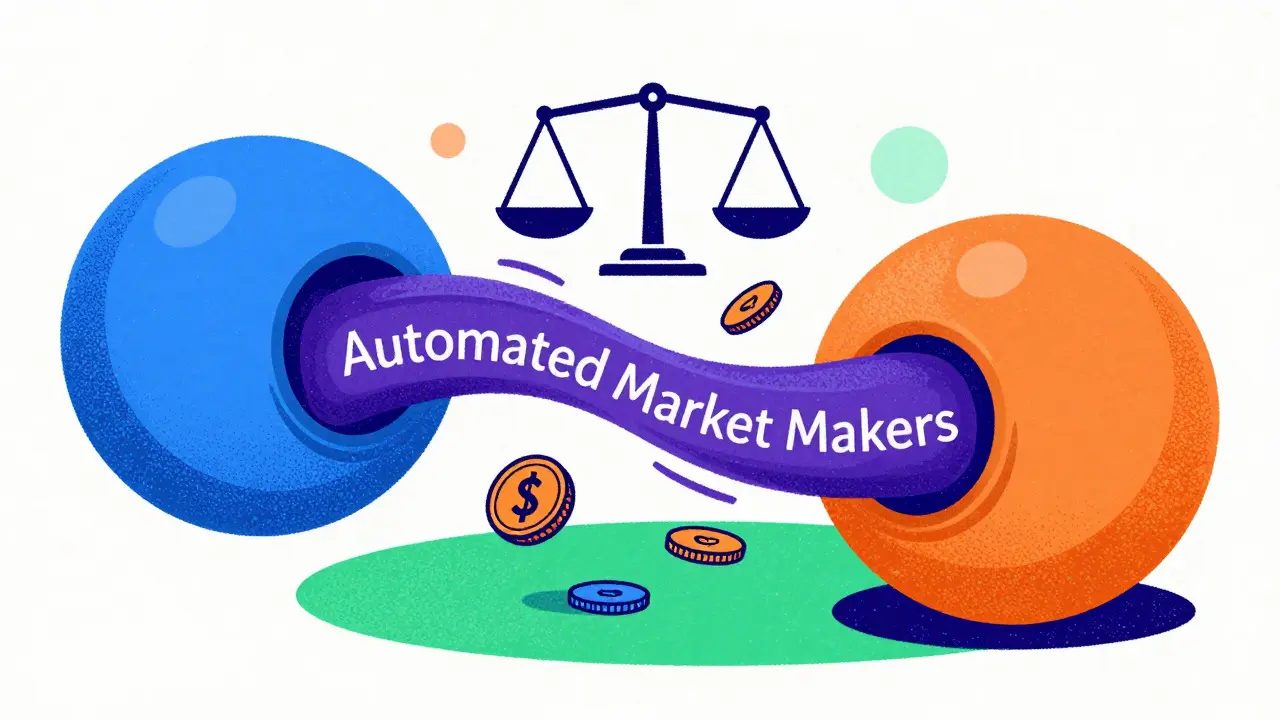
Most people think trading requires two people wanting to swap at the same price. Traditional stock markets use an order book-a list of buy and sell orders matching buyers and sellers. DEXs mostly ditch this model in favor of something more efficient: the Automated Market Maker, or AMM. As of recent data, AMMs handle about 85% of all DEX volume. How does this work? There is no order book. Instead, there are liquidity pools.
A liquidity pool is simply a smart contract holding pairs of tokens, like ETH and USDC. Anyone can add to this pool, becoming a Liquidity Provider (LP). In return, they earn a share of the trading fees. The magic happens in the pricing formula. The most common is the constant product formula, expressed as x * y = k. Here, x is the amount of Token A, y is the amount of Token B, and k is a constant. If you want to buy more Token A, you deposit Token B. The ratio changes, but the product (k) stays the same, which mathematically determines the new price. This means the price adjusts instantly based on supply and demand within the pool, without waiting for a specific buyer to show up.
Uniswap popularized this model with its V2 release in 2020. Later, Uniswap V3 introduced concentrated liquidity, allowing providers to allocate capital only within specific price ranges. This boosted capital efficiency significantly, meaning LPs don’t have to spread their funds thin across all possible prices. For you as a trader, this translates to tighter spreads and lower slippage, especially for major asset pairs.
Alternative Models: Order Books and Aggregators
While AMMs dominate, not all DEXs work this way. Some prefer the familiar order book structure. These are known as Order Book DEXs. They mirror traditional exchange mechanics but settle trades on-chain via smart contracts. A prime example is dYdX, which matches orders off-chain for speed but settles them on-chain for security. This hybrid approach tries to capture the speed of centralized systems while retaining the non-custodial nature of decentralized ones.
Then there are DEX Aggregators, such as 1inch. Think of these as travel booking sites for crypto. Instead of forcing you to trade on a single platform, aggregators scan multiple DEXs and liquidity sources to find the best rate for your specific trade. If you are swapping a large amount of a volatile token, using an aggregator can reduce slippage by finding the deepest liquidity across different protocols. This layer adds another level of efficiency, ensuring you aren't stuck with the worst price available on a single isolated pool.
| Feature | AMM DEX (e.g., Uniswap) | Order Book DEX (e.g., dYdX) | Centralized Exchange (e.g., Coinbase) |
|---|---|---|---|
| Custody | User-controlled (Non-custodial) | User-controlled (Non-custodial) | Exchange-controlled (Custodial) |
| Pricing Mechanism | Liquidity Pools (x*y=k) | Order Matching Engine | Order Matching Engine |
| Asset Availability | High (Permissionless listing) | Moderate | Limited (Curated list) |
| Slippage Risk | Higher for low-liquidity pairs | Lower for high-volume pairs | Lowest |
| Counterparty Risk | Smart Contract Risk | Smart Contract Risk | Platform Insolvency/Hack Risk |
Why Remove the Middleman?
You might wonder why anyone would give up the convenience of a customer support line and a simple login page. The answer lies in security and sovereignty. Between 2011 and 2022, approximately $3.8 billion in cryptocurrency was lost to hacks on centralized exchanges. In the DEX world, the risk profile changes. You don't lose funds because a company went bankrupt; you lose them if the smart contract has a bug or if you make a mistake signing a malicious transaction. While smart contract bugs happen, the sheer scale of losses is far smaller than centralized exchange failures.
Another massive advantage is censorship resistance. On a centralized exchange, your account can be frozen, your withdrawals paused, or a token delisted overnight due to regulatory pressure or internal policy. On a DEX, if a pool exists, you can trade it. During the Terra/Luna collapse in 2022, many centralized exchanges halted trading to prevent chaos. Uniswap kept running, allowing users to exit positions when they wanted, albeit at volatile prices. This operational continuity is critical during market stress.
Furthermore, DEXs offer access to long-tail assets. Major centralized exchanges typically list only a few hundred or thousand pairs. Uniswap supports over 140,000 token pairs. If you hold a small-cap token that hasn't made it to Binance yet, a DEX is likely the only place you can swap it for a stablecoin.
The Trade-offs: Slippage, Gas, and UX
Nothing is free, and DEXs have their own set of friction points. The biggest complaint among users is slippage. Because prices are determined by pool depth rather than an order book, trading large amounts can push the price unfavorably. On Uniswap, average slippage is around 0.45%, compared to 0.05% on Coinbase. For day traders making hundreds of trades a day, this adds up. However, for buy-and-hold investors or those trading mid-sized assets, this difference is often negligible.
Gas fees are another hurdle. Every interaction with a smart contract costs gas. On Ethereum Mainnet, this can be expensive during congestion. However, the rise of Layer-2 solutions like Arbitrum and Optimism has drastically reduced these costs. A trade that cost $15 on Mainnet might cost $1.20 on Arbitrum. Always check the network you are connected to before executing a trade.
User experience (UX) remains the weakest link. Connecting a wallet like MetaMask, checking the correct network, and setting slippage tolerance settings can be intimidating for beginners. Studies suggest a significant drop-off rate for new users at the wallet connection stage. To mitigate this, start with stablecoin pairs (like USDC to DAI) where price volatility is minimal, and use a DEX aggregator to ensure you get the best execution.
Getting Started Safely
If you are ready to try a DEX, follow these steps to minimize risk:
- Set Up a Wallet: Install a reputable wallet like MetaMask or Rabby. Write down your seed phrase offline. Never share it.
- Add Funds: Buy ETH or the native token of the chain you want to use (e.g., MATIC for Polygon, SOL for Solana) to cover gas fees.
- Connect Correctly: Ensure your wallet is connected to the right network. 37% of beginner errors involve connecting to the wrong RPC endpoint.
- Use Aggregators: Start with platforms like 1inch or Matcha to compare rates across multiple DEXs.
- Check Slippage: Set a reasonable slippage tolerance. 0.5-1% is standard for stablecoins; 1-2% for volatile assets.
- Verify Contracts: Before approving a token, double-check the contract address on Etherscan or the official project site to avoid phishing scams.
Frequently Asked Questions
Do I need KYC to use a DEX?
No. Most DEXs are permissionless, meaning you only need a crypto wallet to trade. There is no identity verification process unless you are bridging from a centralized exchange or using a fiat on-ramp.
What is impermanent loss?
Impermanent loss occurs when you provide liquidity to an AMM pool and the relative price of the two tokens changes. If one token rises significantly against the other, you end up with less value than if you had just held the tokens in your wallet. It is called "impermanent" because if prices revert, the loss disappears.
Are DEXs safer than centralized exchanges?
Generally, yes, regarding custody risk. Since you hold your own keys, you aren't exposed to exchange insolvency or internal theft. However, you are exposed to smart contract bugs and user error (like signing a phishing transaction), which are risks present in both models but manifest differently.
Which DEX should I use for beginners?
Uniswap is widely considered the gold standard due to its deep liquidity and extensive documentation. For lower gas fees, consider DEXs on Layer-2 networks like Arbitrum (GMX, Camelot) or Polygon (QuickSwap).
Can I trade any token on a DEX?
You can trade any token that has a liquidity pool created for it. Unlike centralized exchanges that curate listings, DEXs allow anyone to create a pool for any ERC-20 compatible token, making them ideal for trading newer or smaller projects.