You place a trade perfectly. You set your stop-loss right below support. Suddenly, the price crashes, hits your stop, and then rockets back up within minutes. It feels like the market was rigged just to take your money. Most likely, it wasn't a glitch; it was a Whale Manipulation is deliberate market distortion by large institutional traders to influence asset prices. Also known as Market Manipulation by Whales, this tactic relies on massive capital dominance to trigger retail losses. If you've ever watched a chart move strangely without news, you've seen a whale at work.
The crypto market isn't a fair playground. Large holders, often called Whales are entities holding substantial capital positions capable of influencing market price, typically controlling millions of dollars in assets. These players can dictate movement. According to CoinGecko data from 2024, just 100 wallets control nearly 15% of Bitcoin's supply. When they move, the whole ocean follows. Understanding how they operate helps you protect your portfolio.
Understanding the Mechanics of Market Distortion
Many traders think big moves come from FOMO or breaking news. Often, they come from coordinated engineering. Whales use their size to create false signals. They want you to sell low so they can buy low. They achieve this through specific patterns.
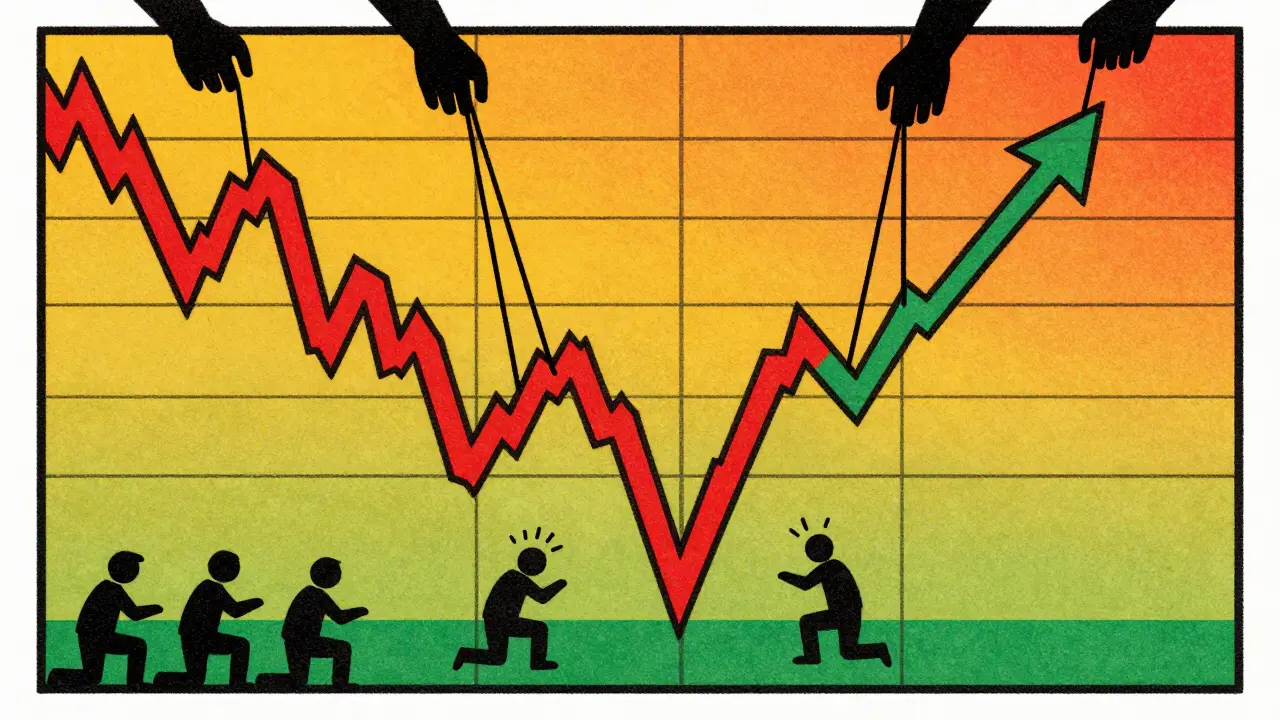
One common method is Stop Hunting is a technique where prices are pushed temporarily to trigger retail stop-loss orders. Also known as Liquidity Sweeps. Imagine a wall of buyers sits at $50,000. Traders put stop-losses just below it at $49,500. A whale sees this cluster. They dump enough volume to push the price down to $49,400. Your sell order triggers. Now there's extra sell pressure from your stop, making the drop look real. Once the liquidation dust settles, the whale buys back your coins cheaper and pushes the price back to $50,500 instantly.
Another trick involves the order book itself. This is called Spoofing is placing fake large orders with no intention of executing them to create artificial supply demand impressions. Defined in financial threat catalogs like MITRE AADAPT. A whale places a massive sell wall at $40,000. Retail traders see this fear. They think the price will crash, so they sell now. The whale then cancels their wall the moment the selling starts. They bought nothing, yet they forced everyone else to lower their prices.
| Tactic Name | Objective | Visual Signal |
|---|---|---|
| Sell to Buy (STB) | Clear buyers out via stops | Sudden spike down followed by quick recovery |
| Liquidity Wall | Suppress price artificially | Huge sell limit order visible on chart |
| Pump and Dump | Generate hype then exit | Viral social media posts + rapid volume increase |
Detection Tools Every Trader Needs
Catching a whale requires better eyes than a standard candlestick chart. You need to look under the hood. The most critical tool is the Order Book is a real-time electronic display of buy and sell orders in a security. It shows pending orders. If you see a sudden disappearance of large orders near a price level, someone cancelled them deliberately.
Volume analysis is equally vital. Look for divergence. If price goes up but volume drops, the move might lack conviction. TradingView is a popular charting platform providing advanced indicators for market analysis. Their heatmap features visualize where abnormal order concentrations sit. Professional traders spend 20 minutes daily scanning cumulative delta here.
On-chain data offers another layer of truth. Chainalysis provides software used for cryptocurrency transaction monitoring and reporting. Its crime reports track abnormal wallet movements. If you see large addresses moving funds to an exchange, a dump might be imminent. Glassnode tracks this supply concentration. When the top 10,000 wallets hold over 90% of circulating supply, vulnerability spikes.
Surviving the Psychological Trap
Manipulation works on emotion. Whales know exactly what makes a trader panic. The moment you get stopped out, they get filled. You feel helpless because your strategy relies on technical levels they deliberately target.
To fight back, change your entry habits. Never use market orders during high volatility. Use limit orders instead. This lets you enter at the price you want rather than accepting the current chaotic price. Binance Academy recommends educational resources focusing on cryptocurrency trading strategies and risk management. Their guidelines suggest keeping position sizes below 2% of your total capital.
Avoid leverage during low-liquidity periods. The Asian session often has thinner order books. A small amount of sell pressure creates wild swings. High leverage like 50x multiplies this risk. A 2% drop wipes your account. Stick to lower leverage or spot trading when uncertainty is high.
Regulatory Responses and Market Maturity
The landscape is changing. Regulators realize the old west days are ending. The U.S. Commodity Futures Trading Commission, known as the CFTC is an independent agency that regulates commodity futures and options markets. filed 17 enforcement actions against manipulators in 2023 alone.
Europe took steps with the MiCA framework. It requires exchanges to install real-time surveillance for spoofing. In 2024, major platforms began rolling out anti-whale algorithms. Binance announced systems to neutralize spoofing orders representing 0.8% of spot volume. While helpful, technology arms races continue. As markets mature, manipulation becomes harder to spot visually but still happens beneath the surface.
Practical Checklist for Daily Safety
Before clicking buy, run through this mental checklist. It takes seconds but saves thousands.
- Check the liquidity heat map for nearby large clusters.
- Verify if a sudden volume spike matches any news headlines.
- Look at funding rates; extreme positive values signal overcrowding.
- Assess social sentiment on Twitter/X for coordinated hype.
- Review the order book depth for thin zones above/below price.
If three red flags appear, wait. You do not lose money watching. You lose money acting impulsively on noise.
Can whale manipulation happen in traditional stocks?
Yes, but less frequently due to stricter regulations. Forex markets see institutional banks executing similar large-order strategies, though crypto markets show more blatant manipulation due to fragmented oversight and 24/7 trading hours.
What is the most reliable indicator of whale activity?
Price action around key technical levels where stop-loss clusters reside is the strongest signal. James Stafford of TradingView notes that observing behavior at these levels reveals whether large players are clearing out retail positions intentionally.
How much of market volatility is caused by whales?
Industry analysts estimate approximately 65% of abnormal volatility events in altcoin markets during low-liquidity periods result from deliberate whale manipulation tactics rather than organic fundamental changes.
Are there tools specifically designed to catch spoofing?
Exchange platforms are integrating machine learning algorithms to detect layering activities. For example, MITRE AADAPT identified 'Whale Wall Spoofing' as a specific threat vector requiring specialized surveillance software installed by compliant exchanges.
Is avoiding manipulation completely possible?
It is difficult to avoid entirely in open markets, but strict risk management reduces impact. Using limit orders, capping leverage, and waiting for confirmed breakouts instead of anticipating moves minimizes exposure to engineered sweeps.

Trish Swanson
April 2, 2026 AT 14:17The fake sell walls vanish in milliseconds!
Bruce Micciulla Agency
April 4, 2026 AT 10:50you think retail knows anything about liquidity clusters
. the data shows whales move supply
. institutions hide their tracks better now
. glassnode tracking helps but lag exists
. market makers profit from your panic stops
. stop losses become fuel for their fills
. you cannot trust support levels without checking volume
. price action confirms the trap setup often
. if volume diverges from price movement something is wrong
. institutional algorithms detect weak hands quickly
. they sweep stops before reversing direction
. retail traders lose consistency because of this behavior
. fear sells while greed buys high repeatedly
. understanding chain data is essential for survival
. most people ignore on-chain metrics completely
. this negligence leads to account liquidation eventually
Arlen Medina
April 4, 2026 AT 19:15listen bro i told you whales control everything basically you cant beat smart money unless you have insider info stop losing bags and trade smaller positions
June Coleman
April 6, 2026 AT 10:29oh sure just blame the whales for being broke nice excuse for bad risk management honestly maybe try using limit orders instead of crying
JERRY ORTEGA
April 6, 2026 AT 10:55yeah that makes sense but nobody wants to read long explanations most people just want to buy the dip and pray
shubhu patel
April 8, 2026 AT 07:17It is really important to look at the broader picture when analyzing market movements and how institutional players operate in the background without much visibility to the average participant who might not have access to premium tools yet
Suzanne Robitaille
April 9, 2026 AT 12:27There is a deeper meaning to these market mechanics reflecting human nature itself perhaps we are all part of the game board in some way
Emily 2231
April 10, 2026 AT 04:43no periods lowercase sometimes government watching us via exchanges they know where you hold assets whales work with regulators sometimes dont trust the charts fully
sekhar reddy
April 11, 2026 AT 22:17OMG THIS IS SO SCARY! my portfolio almost died yesterday!!! why do they hate small investors so much!!! i cry every time i see a red candle
Brooke Herold
April 12, 2026 AT 07:25In many emerging markets regulations differ wildly so what works in usa might not apply elsewhere globally speaking always check local rules