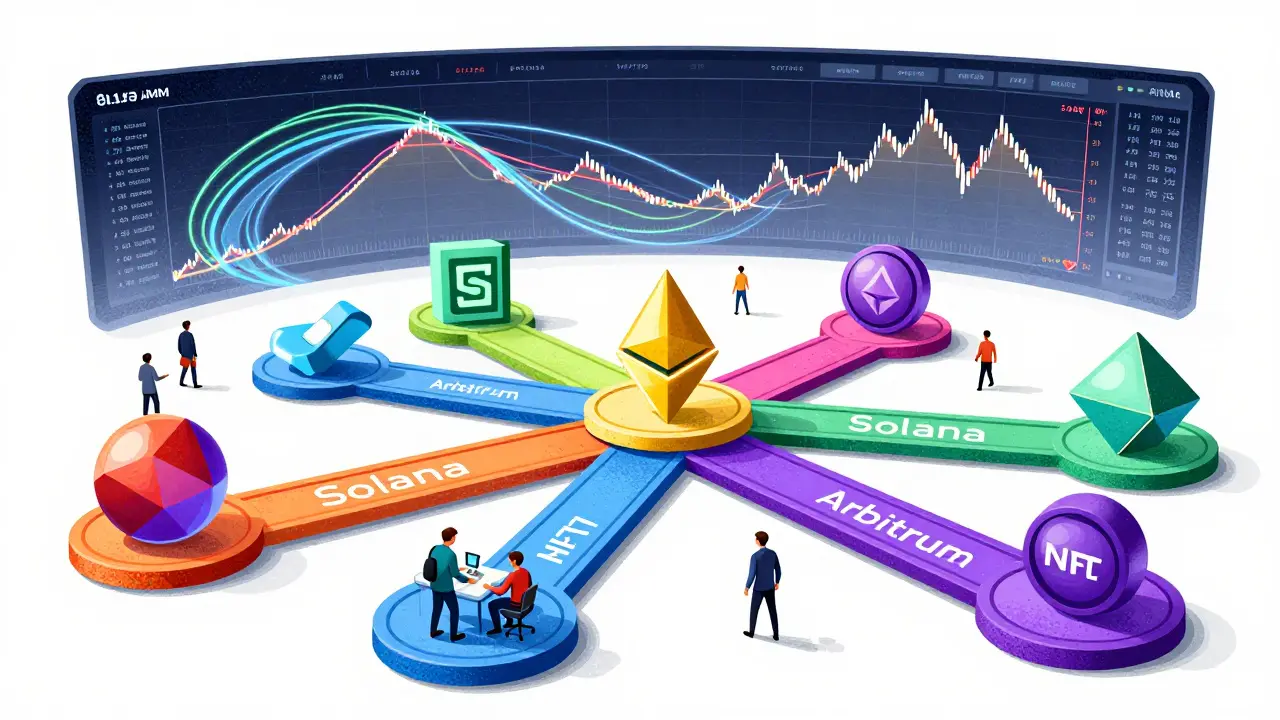
For years, decentralized trading relied on a simple idea: two tokens in a pool, a fixed formula, and prices that moved with supply and demand. But that model is outdated. Today’s AMM innovations are rewriting the rules of how assets are traded on blockchain networks - and what even counts as an asset.
Automated Market Makers (AMMs) didn’t start as flashy tech. Uniswap’s 50/50 pool model was elegant in its simplicity. You deposited equal values of two tokens, and the math did the rest. But as DeFi grew, so did its flaws. Slippage on large trades. Liquidity stuck on one chain. No way to trade an NFT like a stock. The old AMMs couldn’t keep up. Now, a new wave is solving these problems - not with tweaks, but with reinvention.
Scalability Isn’t Just About Speed - It’s About Access
Early AMMs choked under Ethereum’s congestion. Gas fees hit $50 just to swap tokens. That killed small traders. The next generation doesn’t just layer on faster networks - it rebuilds the foundation.
Rollups are now standard. zk-Rollups verify thousands of trades off-chain and submit one cryptographic proof to Ethereum. Optimistic Rollups assume trades are valid unless challenged. Both slash fees by 90% and cut confirmation times from minutes to seconds. But it’s not just about Ethereum. AMMs are now built from the ground up to work across Solana, Polygon, Arbitrum, and Base - not as afterthoughts, but as core features.
Sharding is the next leap. Instead of one blockchain handling every trade, the network splits into shards - each processing its own set of transactions. This isn’t theory anymore. Chains like Celestia and EigenLayer are already testing sharded AMMs that handle over 10,000 trades per second. That’s not just better. It’s the difference between a bottleneck and a highway.
Function Oracle AMM: Trading on Belief, Not Just Balance
What if you could trade not just tokens - but expectations?
The Function Oracle AMM is the most radical shift yet. Instead of matching buyers and sellers, it lets users trade directly with the pool using wrap and unwrap functions. The price isn’t set by a constant product formula. It’s set by what traders believe will happen.
Imagine betting that a new meme coin will hit $1 in 30 days. In traditional AMMs, you’d need someone to take the other side of your trade. With Function Oracle AMMs, you’re trading against the pool’s dynamic pricing engine. The system tracks how users are interacting with the asset - how much they’re buying, how long they’re holding, what they’re saying in forums. That data becomes the price signal.
This isn’t speculation for fun. It’s a new form of price discovery. The system captures what traders are willing to pay for perceived future value - the “premium.” That premium gets locked into the token’s price. It’s like a market for sentiment. And it’s already live on testnets for tokens tied to real-world events - like election outcomes or tech product launches.
Specialized AMMs Are Replacing One-Size-Fits-All
Not all assets are the same. Why should their trading mechanisms be?
Uniswap’s 50/50 model works for ETH and USDC. But what about trading DAI and USDT? Or a stablecoin against a volatile token? Curve nailed this. It uses a modified formula that minimizes slippage when trading assets with similar values - like stablecoins or wrapped tokens. Its pools are 10x more capital-efficient than Uniswap’s for these cases.
Then there’s Balancer. It lets you build pools with up to eight assets, each in any ratio. Need a pool with 70% ETH, 20% WBTC, and 10% LINK? Done. That’s not a gimmick - it’s how hedge funds and protocols now manage complex portfolios. Balancer pools are being used to back decentralized ETFs, where users get exposure to a basket of DeFi tokens without holding them directly.
These aren’t competing models. They’re complementary. The next-gen AMM ecosystem is like an app store for trading logic - pick the right tool for the job.
Tokenizing the Intangible: From Art to Influence
What’s the value of a viral tweet? A celebrity’s endorsement? A community’s loyalty?
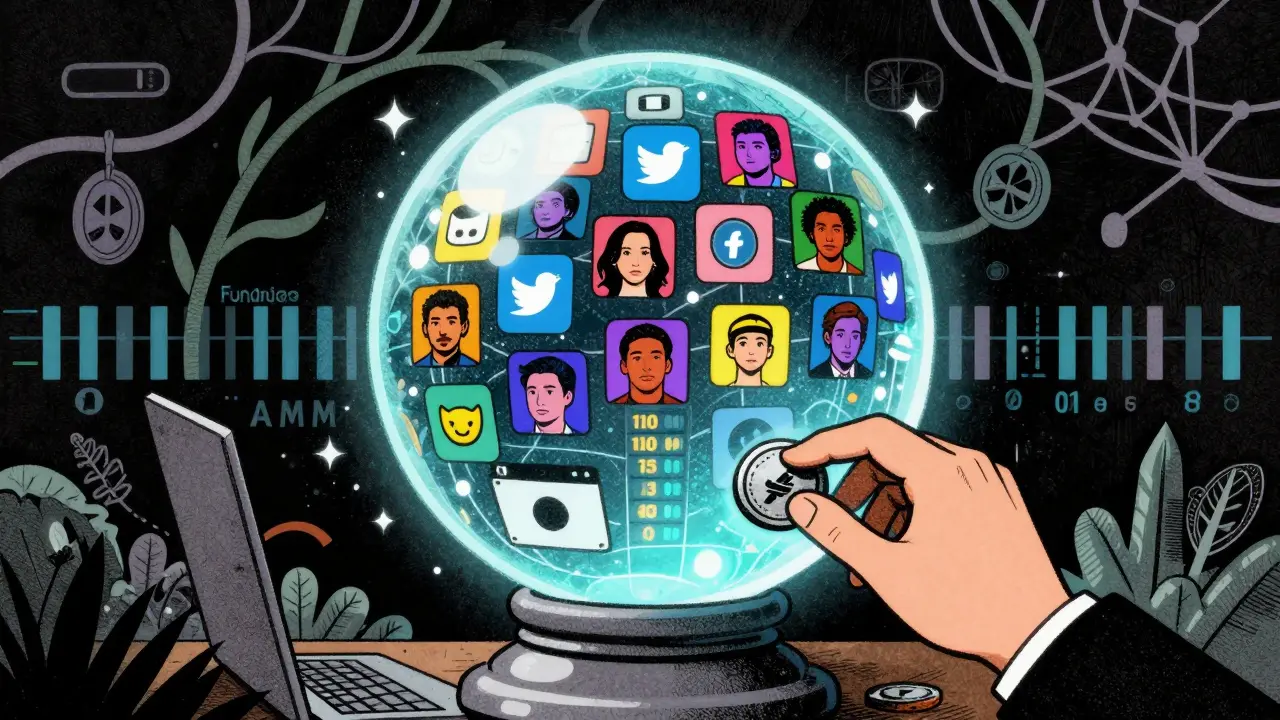
Next-generation AMMs are answering that question - by turning these things into tradeable assets. Artists are tokenizing their work not as NFTs, but as dynamic tokens whose price adjusts based on engagement. A mural’s token might rise when it gets shared on Twitter, or when influencers post about it. A musician’s token could increase in value as streams climb.
This isn’t fantasy. Projects like TokenizeX and SocialFi are already live. One artist tokenized a digital painting - its price now reflects how many people view it on decentralized social platforms. The more attention it gets, the higher the price. Traders aren’t betting on the art itself - they’re betting on its cultural impact.
And here’s the kicker: these tokens can be used as collateral. Imagine borrowing USDC against your influencer token. The system doesn’t need a credit score. It just looks at how often your token is traded, how stable its price is, and how much liquidity it has. It’s DeFi lending, but for attention.
DeFi Meets Wall Street - And It’s Working
Traditional finance is no longer watching DeFi. It’s building on it.
Banks and asset managers are quietly integrating AMMs into their workflows. Why? Because AMMs offer 24/7 liquidity, transparent pricing, and no counterparty risk. Fidelity and BlackRock are testing AMM-based ETFs that track crypto baskets. These aren’t crypto funds. They’re traditional ETFs that use AMMs to rebalance holdings in real time.
Derivatives are following. Perpetual futures on AMMs now handle billions in volume. Unlike centralized exchanges, these are fully on-chain, with no risk of exchange collapse. The price is set by the pool, not a central order book. And because AMMs now support cross-chain settlement, you can trade a BTC derivative on Arbitrum while posting collateral on Solana.
The biggest shift? Transparency. Every trade, every liquidity change, every price adjustment is recorded on-chain. Regulators are starting to see that as a feature, not a bug.
What’s Next? AI, Liquidity Mining, and the Death of Manual Market Making
The next frontier isn’t just better math - it’s smarter math.
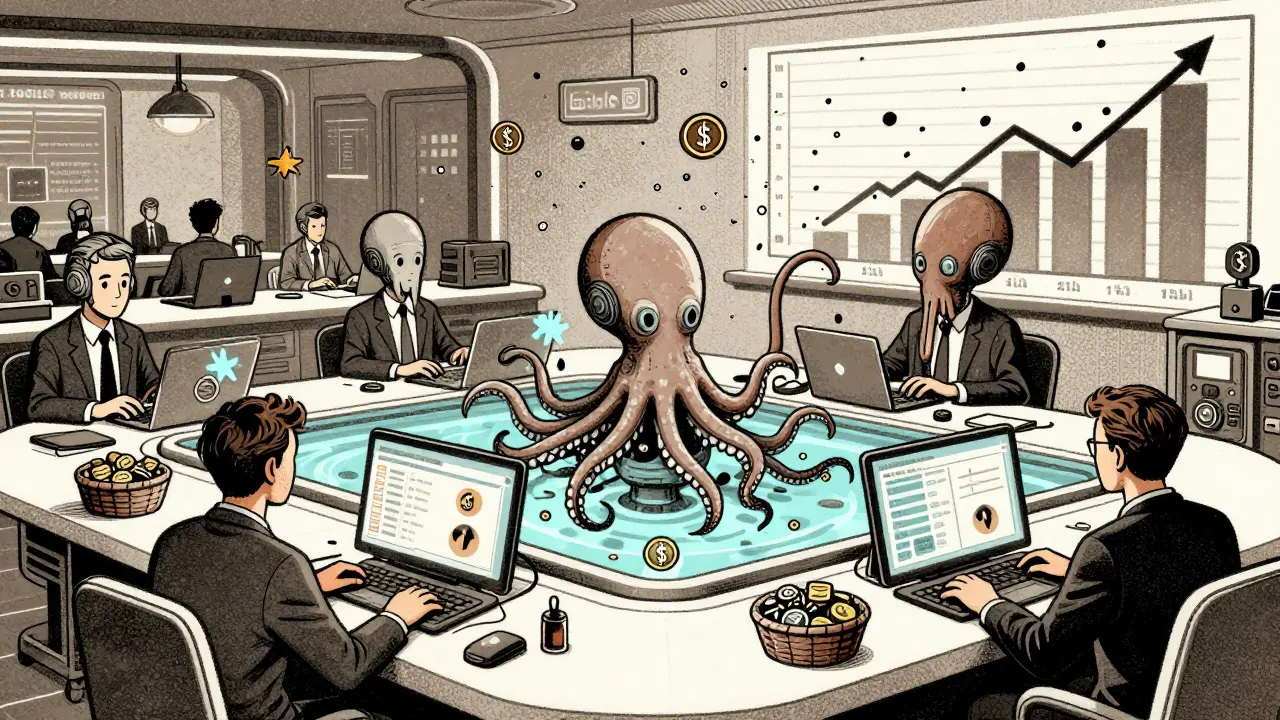
AI is now being trained on millions of on-chain trades to predict slippage, optimize liquidity allocation, and even auto-adjust pool ratios. A new model called DeepAMM uses reinforcement learning to mimic how human market makers behave - but at 100x speed. It doesn’t just react to price changes. It anticipates them.
Liquidity mining is evolving too. Instead of rewarding users for locking up tokens, next-gen AMMs reward them for providing liquidity in the right places. Need more liquidity in a new stablecoin pair? The protocol automatically boosts rewards there. No more manual campaigns. No more wasted capital.
And the old model of centralized market makers? It’s fading. No more humans manually quoting prices. Algorithms now handle everything - from small swaps to institutional trades. The result? Tighter spreads, faster execution, and lower costs for everyone.
Why This Matters
AMMs stopped being a niche tool years ago. Today, they’re the backbone of DeFi. But the next generation? It’s not just about trading tokens. It’s about trading ideas, influence, and future value.
When you can tokenize a meme, trade a prediction, or borrow against your social clout - you’re not just using DeFi. You’re living in a new financial reality. One where the market doesn’t just reflect reality - it helps build it.
This isn’t the future. It’s happening now.
What makes Function Oracle AMMs different from Uniswap?
Function Oracle AMMs don’t rely on fixed formulas like Uniswap’s x*y=k. Instead, they use real-time trader behavior to adjust prices dynamically. This lets users trade not just tokens, but expectations - like the future value of a meme coin or an influencer’s popularity. Uniswap matches buyers and sellers. Function Oracle AMMs let you trade directly against the pool’s intelligence.
Can I trade NFTs on next-gen AMMs?
Yes - but not as NFTs. Next-gen AMMs tokenize the *value* behind NFTs. For example, a digital artwork’s token might track views, shares, and social mentions. You trade that token, not the NFT itself. This turns illiquid assets into liquid ones, letting you buy fractions of influence, not just pixels.
Are next-gen AMMs safer than centralized exchanges?
In key ways, yes. AMMs run on smart contracts - no central operator can freeze your funds or shut down trading. All trades are transparent and non-custodial. While smart contract bugs are a risk, they’re audited more rigorously now. Centralized exchanges, by contrast, have lost billions to hacks and fraud. AMMs eliminate counterparty risk.
Do I need to understand smart contracts to use these AMMs?
No - not anymore. Interfaces are now as simple as Uniswap’s. You pick tokens, enter amounts, and click swap. The complex logic - cross-chain routing, oracle pricing, AI-driven liquidity - happens behind the scenes. But if you’re creating liquidity pools or trading premium assets, deeper knowledge helps avoid costly mistakes.
What’s the biggest risk with next-gen AMMs?
Impermanent loss is still real, but worse in complex pools. If you provide liquidity in a pool with volatile or newly tokenized assets - like social tokens - price swings can wipe out your returns. Also, cross-chain bridges are still targets for hacks. Stick to well-audited protocols and avoid pools with less than $10M in liquidity.
Can traditional banks use AMMs?
Yes - and they already are. Fidelity, JP Morgan, and BlackRock are testing AMMs for settling crypto ETFs, rebalancing portfolios, and providing liquidity to institutional clients. They’re not using them for retail trades. But for high-volume, 24/7 asset swapping, AMMs are more efficient than legacy systems.



Kira Dreamland
March 15, 2026 AT 23:31Finally someone gets it. The old Uniswap model was cute, but it was like using a horse and cart when we’ve got hyperloops now. Function Oracle AMMs? That’s not just innovation - it’s a paradigm shift. Trading belief instead of balance? I’ve been waiting for this since 2021. The way it tracks social sentiment and price action together? Genius. No more guessing if a meme coin’s hype is real - the market tells you in real time.
And tokenizing influence? That’s the future. I bought into an artist’s token last month - their piece got shared by 3 influencers, and the price jumped 40% in 48 hours. I didn’t own the art. I owned the momentum. That’s power.
shreya gupta
March 16, 2026 AT 22:27Oh wow. Another crypto bro pretending that ‘trading belief’ is a legitimate financial instrument. Let me guess - you also think NFTs are ‘digital real estate’ and that Dogecoin is ‘a community-driven currency.’
Sorry, but if your ‘price discovery mechanism’ is based on how many times a tweet gets liked, you’re not building DeFi. You’re building a casino with a blockchain logo.
Derek Lynch
March 18, 2026 AT 07:15Shreya, you’re missing the point entirely. This isn’t about gambling - it’s about permissionless price discovery. Every time someone trades a social token, they’re voting with their wallet on what’s valuable. No central authority. No gatekeepers. Just pure, on-chain consensus.
And yes - this is LEGIT. Fidelity’s already testing this. BlackRock’s building ETFs on it. If you’re still stuck on ‘is this just speculation?’ then you haven’t been paying attention to the last 3 years of DeFi evolution.
Look at Balancer pools with 8 assets. Look at zk-rollup AMMs handling 10k TPS. Look at AI-driven liquidity that adapts before slippage even happens. This isn’t vaporware. It’s infrastructure. And it’s working.
If you’re scared of change, fine. But don’t call it a scam because you don’t understand it. Get in the lab. Try a testnet. See what happens when you trade against a pool that learns from behavior, not just math.
There’s a new financial layer being built right under our feet. And it’s not going away.
Christopher Hoar
March 18, 2026 AT 08:14Bro. Function Oracle AMMs? More like Function Oracle SCAMM. You’re telling me I can trade ‘influence’ like it’s a stock? What’s next - trading my ex’s Instagram likes as a derivative?
And don’t even get me started on ‘tokenizing a viral tweet.’ That’s not innovation, that’s delusion with a whitepaper.
Meanwhile, real traders are using Curve for stablecoins and Balancer for hedge fund portfolios. But nooo, we gotta turn DeFi into a TikTok coin toss game. I swear, the more ‘advanced’ these protocols get, the more they sound like a 19-year-old’s Reddit post after 3 Red Bulls.
Robert Kunze
March 19, 2026 AT 09:00i just wanna say… i tried one of these new amms last week. i swapped some usdc for a social token tied to a digital artist. the interface was dumb simple. no gas drama. took like 2 seconds. price went up 15% in 12 hours because her art got shared on mastodon. i made like $40. not life changing, but… kinda cool? i didn’t even know what i was doing and it still worked. maybe we’re overcomplicating this. maybe the future is just… simple?
Sarah Zakareckis
March 20, 2026 AT 19:32Let’s break this down like we’re in a DeFi 101 class - because this isn’t just tech, it’s a revolution in value capture.
Function Oracle AMMs aren’t just replacing Uniswap’s x*y=k - they’re replacing the entire notion of ‘price as a reflection of supply/demand.’ Now, price is a reflection of collective anticipation. That’s HUGE. It’s like the market is finally able to price forward-looking sentiment - something traditional finance has been trying to do with options and derivatives for decades.
And the tokenization of influence? That’s not a gimmick - it’s the birth of a new asset class: Attention Capital. Think of it as equity in your cultural footprint. If you’re an artist, creator, or even a community leader - your impact becomes liquid. You can borrow against it. Trade it. Hedge it.
And yes - cross-chain AMMs with AI-optimized liquidity? That’s the holy grail. No more manual liquidity mining. No more wasted capital. The protocol self-balances. It’s like having a team of top-tier market makers working 24/7, for free.
This isn’t ‘crypto.’ This is the next evolution of global capital markets. And we’re not just watching it - we’re building it.
Heather James
March 22, 2026 AT 15:53Tokenizing attention is wild. But it’s also the most honest thing crypto’s ever done.
Sarah Hammon
March 24, 2026 AT 10:37Hey, I just want to say I tried the testnet for Function Oracle AMMs last week and I was skeptical too. But I put in 50 USDC into a pool for a music artist’s token, and it actually made sense. The price went up when their song hit 10k plays on a decentralized player. I didn’t get rich, but I felt like I was part of something real - not just speculation. I think this could work for creators who don’t have access to traditional funding. Also, I misspelled ‘liquidity’ in my wallet address once and it still worked. lol. maybe we’re all overthinking this.
Jerry Panson
March 25, 2026 AT 07:35While the conceptual underpinnings of Function Oracle AMMs present an intriguing theoretical framework for dynamic price discovery, one must remain cognizant of the material risks associated with non-custodial, algorithmically governed financial instruments. The absence of centralized oversight, while laudable from a decentralization standpoint, introduces systemic vulnerabilities, particularly in the context of illiquid or nascent asset classes such as social tokens.
Furthermore, the integration of artificial intelligence into liquidity provisioning, while technologically sophisticated, may engender unforeseen feedback loops that could destabilize price equilibrium under conditions of extreme volatility or asymmetric information.
It is therefore imperative that institutional participants engage in rigorous stress-testing, third-party audit validation, and regulatory alignment before deploying capital into these mechanisms. The promise of innovation must not eclipse the primacy of fiduciary responsibility.