For years, trading crypto in the U.S. felt like playing a game where the rules changed every time you blinked. One day Bitcoin was a commodity; the next, it might be a security. Then came 2025. The Investment and Securities Act framework, driven by the GENIUS Act and the proposed CLARITY Act, finally drew lines in the sand. If you trade digital assets, these laws are not just background noise-they dictate where you can buy, how your money is stored, and what fees you pay.
We are now in August 2026. The dust has settled enough to see the real impact. This isn't about hype anymore. It’s about compliance, clarity, and the shift from "regulation by enforcement" to a structured legal environment. Here is what you need to know to navigate this new landscape without getting caught off guard.
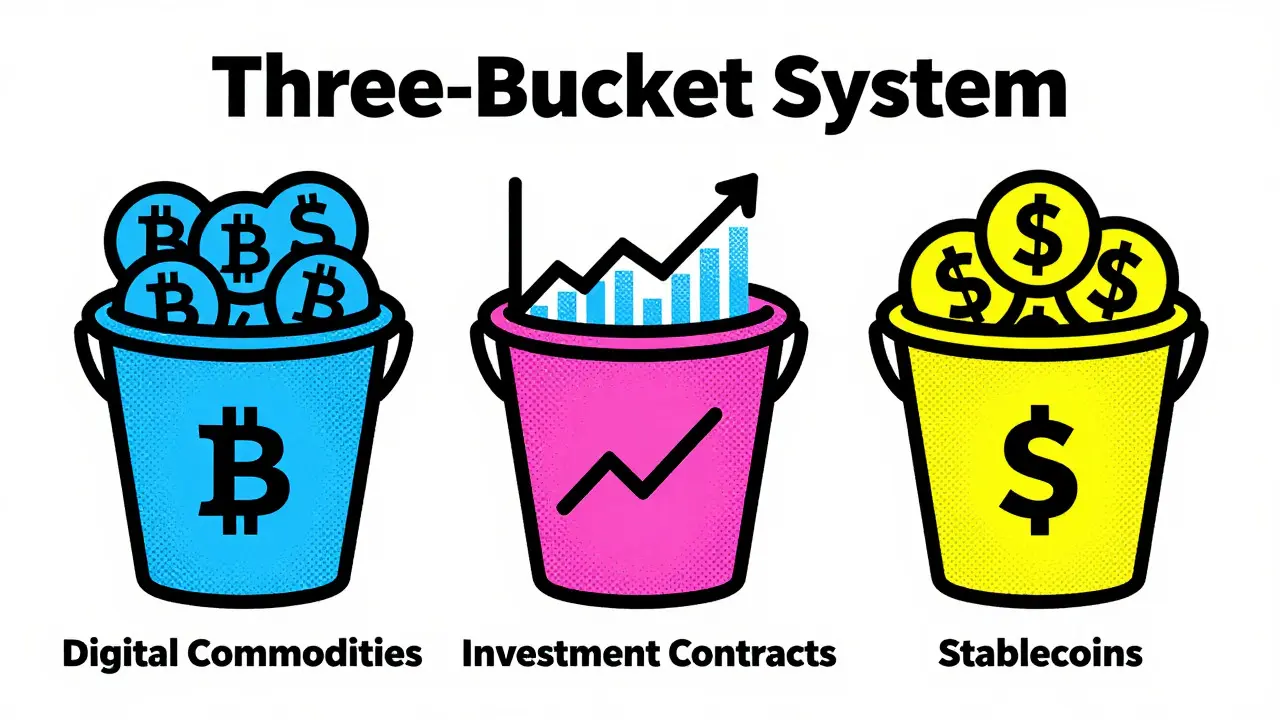
The Three-Bucket System: No More Guessing Games
The biggest headache for traders and firms alike was jurisdictional ambiguity. Did the SEC own your token? Or was it the CFTC's problem? The proposed CLARITY Act resolves this by forcing all crypto assets into three distinct buckets. This tripartite classification system ends the era of the vague Howey test being applied retroactively to everything with a blockchain.
- Digital Commodities: Assets like Bitcoin and Ethereum fall here. They are under the jurisdiction of the Commodity Futures Trading Commission (CFTC). Crucially, they are exempt from state-level "blue sky" laws, which previously made interstate trading a legal nightmare for multi-state businesses.
- Investment Contract Assets: Tokens that clearly represent an investment contract remain under the Securities and Exchange Commission (SEC) oversight. These follow traditional securities laws.
- Permitted Payment Stablecoins: USD-backed stablecoins are regulated under the GENIUS Act framework. This creates a specific lane for payment tokens, separating them from speculative assets.
This structure matters because it allows registered broker-dealers and alternative trading systems (ATSs) to handle digital commodities without fear of losing their exemption eligibility. You can now trade Bitcoin on a national securities exchange alongside stocks, provided the platform meets the new recordkeeping standards.
Stablecoins Get Their Own Rulebook
The GENIUS Act (Guiding and Establishing National Innovation for US Stablecoins Act), signed into law in July 2025, is the first major federal regulation specifically targeting stablecoins. Before this, stablecoins operated in a gray area, often scrutinized as unregistered securities or ignored entirely until a collapse occurred.
The Act focuses strictly on USD-backed payment stablecoins. It establishes comprehensive regulatory oversight, ensuring that issuers maintain adequate reserves and report regularly. For traders, this means higher confidence in the peg. When you hold a permitted stablecoin, you know it backs up to actual dollars held in compliant institutions, rather than opaque corporate bonds.
Compare this to the European Union’s MiCA regulation. While MiCA covers all crypto assets broadly, the GENIUS Act is more targeted. It aims to make the U.S. a hub for dollar-denominated digital payments. With over $1.8 trillion in monthly transaction volume processed by stablecoins in 2025, this clarity unlocks massive institutional usage. Banks can now integrate these tokens into their payment rails without fearing sudden regulatory crackdowns.
What Changes for Retail Traders?
If you are an individual trader, the changes are subtle but significant. The primary benefit is safety and accessibility. Previously, many platforms avoided listing certain tokens due to legal risk. Now, with clear definitions, exchanges can list a wider variety of assets confidently.
- Custody Improvements: The SEC issued a no-action letter in September 2025 allowing registered advisers to use qualified state trust companies for crypto custody. This means your assets are safer. Instead of relying on shady offshore wallets, your funds can be held in institutional-grade custodians that follow strict banking rules.
- Fewer Hidden Fees: As competition increases among compliant platforms, pricing becomes more transparent. The barrier to entry for legitimate exchanges drops, driving down spreads.
- Tax Clarity: While tax law itself hasn’t been rewritten, the classification of assets helps accountants categorize gains. Digital commodities are treated differently than securities, simplifying your tax reporting for capital gains.
However, expect stricter Know Your Customer (KYC) procedures. To comply with the GENIUS and CLARITY frameworks, platforms must verify identities more rigorously. The days of anonymous trading on reputable U.S.-friendly platforms are largely over.
Institutional Adoption Accelerates
The real earthquake is happening behind the scenes with institutional money. Big banks and asset managers were waiting for exactly this kind of legislative certainty. Now that the path is clear, they are moving fast.
State Street Global Advisors and other giants have launched crypto investment products under the new framework. Spot Bitcoin and Ethereum ETFs, which started earlier in the decade, are now joined by actively managed strategies. Chris Rhine from Galaxy Asset Management noted that this legislation ushers in a "new age of financial innovation." He’s right. Traditional finance (TradFi) is merging with DeFi.
Registered Investment Advisers (RIAs) have also seen relief. Under the old rules, employee personal trading of crypto triggered complex surveillance requirements under SEC Rule 204A-1. Now, if an RIA employee trades Bitcoin (a digital commodity), it doesn’t trigger the same level of reporting as trading a stock (a security). This reduces compliance burdens and makes it easier for firms to hire crypto-savvy talent.
| Feature | Pre-2025 Landscape | Post-2025 Landscape |
|---|---|---|
| Jurisdiction | Unclear overlap between SEC and CFTC | Clear split: CFTC for commodities, SEC for securities |
| Stablecoins | Unregulated or enforced ad-hoc | Regulated under GENIUS Act with reserve requirements |
| Custody | Limited options, high risk | Qualified state trust companies allowed |
| State Laws | Subject to varying state blue sky laws | Digital commodities exempt from state blue sky laws |
| Institutional Access | Hesitant due to legal risk | Active integration via ETFs and direct holdings |
Pitfalls to Avoid in the New Era
Clarity brings comfort, but it also brings responsibility. Just because the rules are clear doesn’t mean the market is safe. Here are common traps traders and small firms fall into now.
Misclassifying Assets: Not every token is a commodity. Some newer projects issue tokens that function as investment contracts. If you treat a security token like a commodity, you might face unexpected restrictions on where you can trade it. Always check the issuer’s disclosure documents.
Ignoring Custody Risks: Even with better regulations, private key security remains a user responsibility if you self-custody. Institutional custody is safer, but it costs more. Weigh the fee against the value of your holdings.
Overlooking Compliance Costs: For smaller crypto businesses, the cost of complying with the GENIUS Act’s reporting requirements can be steep. Many small startups are consolidating or partnering with larger entities to share compliance infrastructure. If you run a small fund, consider dual registration strategies early.
Looking Ahead: What Comes Next?
The 2025 acts are foundational, but they aren’t the end of the story. The SEC’s Spring 2025 Regulatory Flex Agenda indicates ongoing rulemaking. Chairman Atkins’ priorities include updating decades-old custody rules to fully accommodate blockchain technology. Expect further refinements in 2026 and 2027.
Additionally, the global context matters. The U.S. approach is more business-friendly than the EU’s restrictive MiCA model but offers stronger protections than offshore havens like the Cayman Islands. This positions the U.S. as the likely global leader in regulated crypto markets. International firms may relocate operations to Boulder, New York, or Miami to take advantage of this clarity.
For the average person, this means a maturing market. Volatility will remain-crypto is inherently volatile-but the risk of regulatory wipeouts decreases. The focus shifts from "will this be banned?" to "how does this perform?" That is a healthy evolution.
Does the Investment and Securities Act 2025 ban any cryptocurrencies?
No, the legislation does not ban any specific cryptocurrencies. Instead, it categorizes them. Digital commodities like Bitcoin are fully legal and exempt from state securities laws. Investment contract assets are legal but subject to SEC oversight. The goal is regulation, not prohibition.
How does the GENIUS Act affect my stablecoin holdings?
The GENIUS Act ensures that USD-backed stablecoins you hold are backed by real reserves and regulated by federal authorities. This reduces the risk of de-pegging events caused by poor management. However, ensure your exchange uses "permitted" stablecoins listed under the Act for maximum protection.
Can I still trade crypto anonymously after 2025?
On regulated U.S. platforms, anonymity is largely gone. Compliance with KYC (Know Your Customer) and AML (Anti-Money Laundering) rules is mandatory for broker-dealers and ATSs handling digital commodities. Decentralized exchanges (DEXs) may offer more privacy, but bridging fiat to DEXs usually requires a regulated on-ramp.
What is the difference between a digital commodity and a security token?
A digital commodity (like Bitcoin) is primarily used as a medium of exchange or store of value and is regulated by the CFTC. A security token represents an investment contract, meaning investors expect profits from the efforts of others, and it is regulated by the SEC. The CLARITY Act provides tools to distinguish between the two.
Will these laws increase trading fees?
Initially, some platforms may pass on compliance costs to users. However, increased competition among compliant exchanges and the entry of large institutional players are expected to drive fees down over time. Transparency in pricing should improve significantly.
Is the CLARITY Act already law?
As of August 2026, the CLARITY Act is widely implemented through regulatory guidance and interim rules, even if full statutory enactment is still pending in some congressional details. The SEC and CFTC are operating under its framework, providing de facto clarity for market participants.
How does this compare to EU regulations?
The U.S. approach is more segmented and business-friendly compared to the EU's MiCA, which applies a broad blanket regulation. The U.S. separates stablecoins (GENIUS Act) from commodities and securities, allowing for more tailored innovation while maintaining strong consumer protections.



Rodmun Tarnowski
August 3, 2026 AT 01:11It is truly exhilarating to witness such a monumental shift in the regulatory landscape! The clarity provided by the CLARITY Act is nothing short of magnificent. We can finally breathe easy knowing that Bitcoin and Ethereum are firmly established as digital commodities under the CFTC's watchful eye. This eliminates the terrifying ambiguity that plagued us for years. No more fear of retroactive enforcement! It is a beacon of hope for all investors who have suffered through the chaos. The GENIUS Act’s focus on stablecoin reserves is equally commendable. It ensures that our hard-earned dollars are protected by tangible assets. This structural integrity will undoubtedly attract institutional capital at an unprecedented rate. We are standing on the precipice of a new financial era. Let us embrace this stability with open arms and optimism!
Carl Michaud
August 4, 2026 AT 02:21Do not be so naive about this "clarity" you speak of. The establishment merely tightened its grip under the guise of innovation. The three-bucket system is a sophisticated mechanism for surveillance, not liberation. By forcing assets into these rigid categories, they ensure every transaction is traceable and taxable. The exemption from state blue sky laws is a Trojan horse allowing federal overreach into local economies. The so-called safety of qualified state trust companies is an illusion designed to centralize custody and eliminate self-sovereignty. Institutional adoption is simply the moment when the whales finish swallowing the minnows. They want your data, your identity, and your compliance. The KYC requirements are not for security; they are for control. You are trading freedom for a comfortable cage.
Prudence Flemming
August 5, 2026 AT 10:10the epistemological shift here is profound yet superficial. we are reifying abstract value into bureaucratic categories. the tripartite classification is a linguistic construct that fails to capture the ontological fluidity of blockchain assets. calling bitcoin a commodity is a reductionist fallacy. it ignores the network effect dynamics that defy traditional economic models. the genius act stabilizes the peg but destabilizes the ideological purity of decentralization. we are seeing the hegemony of tradfi co-opting defi narratives. the jargon of compliance masks the underlying power asymmetry. institutions do not care about innovation they care about risk mitigation and yield optimization. the user becomes a passive participant in a curated ecosystem. true autonomy requires rejecting these imposed frameworks entirely.
Matthew Smith
August 5, 2026 AT 15:49morality has been sacrificed at the altar of efficiency. we allow these corporations to dictate the terms of our financial existence because we crave convenience. the distinction between a digital commodity and a security token is arbitrary and serves only to protect the interests of the elite. why should one asset class be exempt from scrutiny while another is heavily regulated? it creates a two-tiered justice system for finance. the lack of anonymous trading is a moral failing of society. privacy is a fundamental right not a privilege granted by regulators. we have become complicit in our own surveillance. the dust may have settled but the soul of the market is dead.
Matt Kay
August 5, 2026 AT 23:48boring stuff. fees still high. custodians are shady. same old same old just with more paperwork. kyc is annoying af. why do i need to give my id to trade some code. whatever. lets see if it holds up.