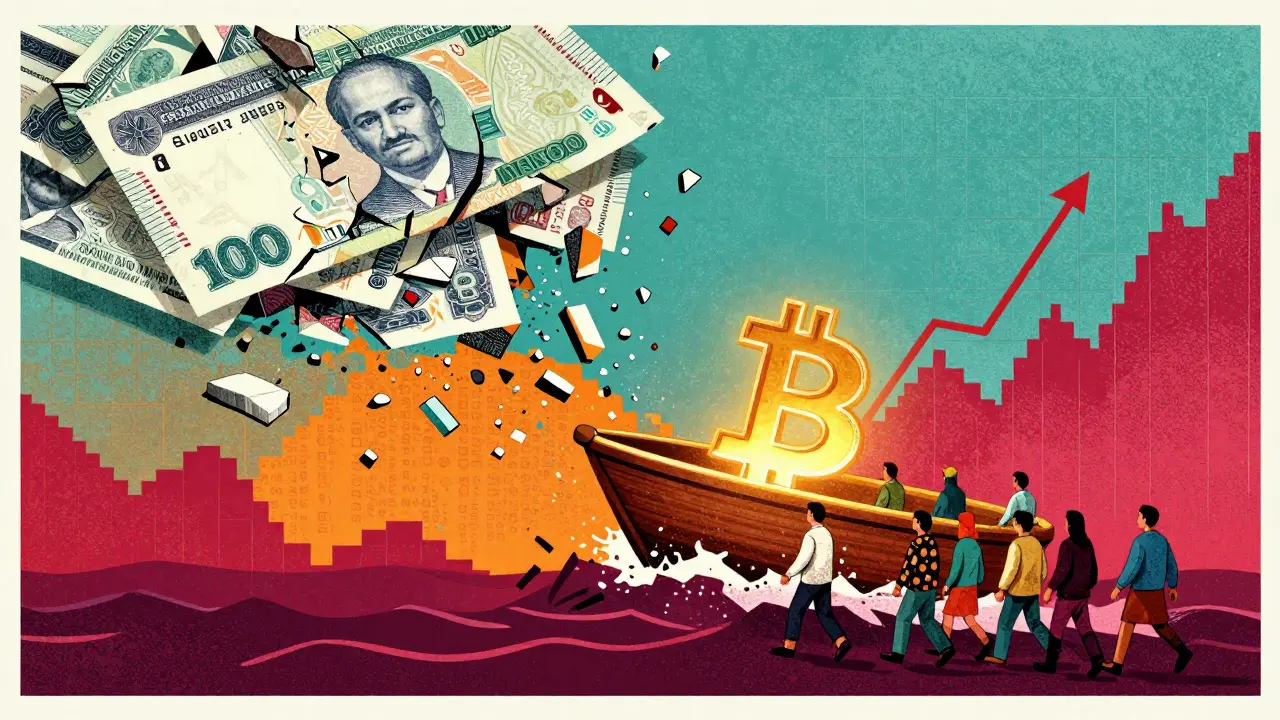
Imagine waking up to find that your life savings have lost 90% of their purchasing power. For millions of people in Iran, this isn't a nightmare-it's their reality. When the local currency collapses and inflation hits 50%, you don't just look for a better bank; you look for a way out of the system entirely. In 2024, that exit ramp was digital. A staggering $4.18 billion crypto outflows from Iran occurred throughout the year, marking a 70% jump from the previous year. But this wasn't a coordinated government plot; it was a mass migration of wealth by regular people trying to survive an economic meltdown.
The Great Digital Escape
When we talk about cryptocurrency in sanctioned countries, the conversation usually centers on hackers or government agents bypassing trade bans. However, the data tells a different story here. According to a report by Chainalysis is a New York-based blockchain analytics firm that tracks cryptocurrency transactions and sanctions compliance , the bulk of these outflows were driven by ordinary citizens. They aren't trying to fund secret projects; they're trying to keep their money from evaporating.
The motive is simple: the Iranian Rial is the official currency of Iran, which has seen catastrophic devaluation due to inflation and international sanctions has been in a freefall since 2018. When you have a choice between a currency that loses value daily and a digital asset that can be moved across borders instantly, the choice is obvious. This has created what researchers call an "alternative financial system" where crypto acts as a lifeboat for the middle class.
Panic Buttons and Geopolitical Spikes
If you look at a chart of these outflows, you'll see they don't move in a straight line. Instead, they spike violently during moments of war and tension. For instance, on April 9th and 14th, 2024, blockchain records showed a massive surge in movement. Why? Because those dates coincided with the bombing of the Iranian Embassy in Damascus and the subsequent retaliatory strikes. When the risk of a full-scale war increases, people panic-buy Bitcoin.
This behavior is backed up by Google Trends is a tool that analyzes the popularity of search queries in different regions and languages data. Search terms like "Iran Israel" peaked exactly when the money started moving. For many Iranians, Bitcoin is the first decentralized cryptocurrency, often used as a hedge against inflation and a store of value has become "digital gold"-the only asset they trust when the headlines get scary.

How it Works on the Ground
Getting your money into crypto isn't as easy as downloading an app when you live under heavy restrictions. Most Iranians rely on VPNs are Virtual Private Networks that encrypt internet traffic and hide a user's location to bypass censorship to access international exchanges. It's a game of cat-and-mouse with the government. While the state tries to block access, users find new proxies and tools to keep the pipeline open.
Before the government cracked down in late 2024, domestic platforms like Nobitex and Wallex handled the heavy lifting. These exchanges allowed people to swap their rials for digital assets quickly. However, as the Financial Action Task Force is an intergovernmental organization that sets global standards to prevent money laundering and terror financing (FATF) continues to keep Iran on its blacklist, the pressure on these exchanges to comply with international laws has grown, making it harder for the average person to operate.
| Country | Primary Driver | Main Entity Involved | Primary Asset |
|---|---|---|---|
| Iran | Retail Wealth Preservation | Private Citizens | Bitcoin |
| North Korea | State Revenue / Theft | Government Hackers | Various (Stolen) |
| Russia | Trade Circumvention | Corporations/State | Stablecoins/Bitcoin |
| Venezuela | Hyperinflation Hedge | Private Citizens | Stablecoins |
The Government's Double Game
The Iranian government's approach to crypto is a paradox. On one hand, they restrict citizens from using international exchanges and demand that domestic platforms hand over all user data. On the other hand, the state has embraced Cryptocurrency Mining is the process of using high-powered hardware to solve complex puzzles and earn new digital coins as a way to generate revenue. By utilizing cheap energy, the government turns electricity into a hard asset that they can use to fund their own operations.
This creates a weird tension. The state wants the profit from mining, but they don't want the people to have a financial exit door. When citizens move billions of dollars into Bitcoin, they aren't just protecting their money-they're removing that money from the government's control. Every dollar moved to a cold wallet is a dollar the central bank can't inflate away.

Real-World Impacts: More Than Just Numbers
To understand the scale, look at the communities forming on Telegram and Reddit. There are Persian-language forums with over 100,000 members sharing tips on how to bypass blocks and which exchanges are still functioning. For a student studying in Europe or the U.S., crypto is often the only way to receive tuition money from home when traditional wire transfers are blocked by OFAC is The Office of Foreign Assets Control, a U.S. Treasury department agency that enforces economic sanctions regulations.
Small business owners are also using it to import goods. Instead of dealing with a dozen intermediary banks and exorbitant fees, they use stablecoins to pay suppliers in third-party countries. It's not about ideology or "believing in the blockchain"; it's about the practical necessity of doing business in a world that has shut your doors.
What Happens Next?
The trend isn't slowing down. As the U.S. Treasury rolls out new enforcement actions via National Security Presidential Memorandums, the tools for hiding transactions are getting better. We're seeing a shift toward decentralized exchanges (DEXs) and more sophisticated routing techniques that make it nearly impossible for analysts to track every single coin.
If the economic situation in Iran doesn't stabilize, these outflows will likely keep growing. We're seeing the birth of a financial system that doesn't rely on trust in a government, but on the math of a distributed ledger. For the people of Iran, cryptocurrency isn't a speculative investment-it's a survival strategy.
Why did crypto outflows from Iran increase so much in 2024?
The primary driver was the catastrophic collapse of the Iranian rial and high inflation (40-50%). Citizens moved their wealth into digital assets like Bitcoin to preserve its value and protect it from government instability.
Was this money being used for illegal activities by the state?
While some state-sponsored activity exists, Chainalysis found that the 2024 surge was largely driven by retail investors-ordinary people seeking financial security rather than government-led sanctions evasion.
Which cryptocurrencies are most popular in Iran?
Bitcoin is the dominant choice, especially during geopolitical crises. Stablecoins are also used for trade and remittances, but Bitcoin remains the preferred hedge against currency devaluation.
How do Iranians access exchanges if they are blocked?
Most users employ VPNs and proxy connections to hide their location and bypass government censorship, allowing them to interact with international cryptocurrency platforms.
What is the government's official stance on cryptocurrency?
It is contradictory. The government restricts citizens' access to foreign exchanges and monitors domestic ones, but it actively promotes and utilizes industrial-scale crypto mining to generate state revenue.



Jimmy vasquez
April 27, 2026 AT 08:28It's really interesting to see how Bitcoin is actually fulfilling its original purpose as a hedge against currency failure in real-time. For anyone wondering, using a hardware wallet is basically the only way to be truly safe in these scenarios since exchange hacks or government freezes are always a risk. 🛡️
Noel Mandotah
April 28, 2026 AT 06:51Oh wow, a digital currency for a failing state. What a totally shocking and unprecedented twist! 🙄
Andrew Todd
April 29, 2026 AT 10:26Who cares about these people. They get what they deserve. America is the only place that actually matters and we should just block all their wallets and be done with it. 🇺🇸
Ryan Nakielny
April 29, 2026 AT 16:48Sure, let's just pretend that the government mining crypto for themselves while blocking the citizens is some kind of brilliant economic strategy. Truly a masterclass in leadership there. 👏
Sri Astuti
April 29, 2026 AT 18:28The sheer inefficiency of the Iranian financial infrastructure is almost comedic if it weren't so tragic, and while the data from Chainalysis is helpful, it barely scratches the surface of the systemic failure inherent in a state that thinks it can play both sides of the blockchain game without facing a complete liquidity crisis in the long run 🙄📉.
Elle Kharitou
April 30, 2026 AT 20:28It's heart-wrenching to think about the sheer desperation that leads a person to navigate a digital labyrinth just to keep their life savings from vanishing into thin air, but there is something deeply poetic about the way technology allows the human spirit to seek freedom and stability when the physical world becomes too restrictive 🕊️✨. We must remember that behind every single transaction is a human story of survival and a hope for a better tomorrow for their children 🌍❤️.
Nitin Gupta
May 1, 2026 AT 10:18I agree that the use of stablecoins for trade is a huge factor here, as it provides a level of predictability that Bitcoin's volatility sometimes lacks for small business owners trying to maintain a supply chain. It's a very practical adaptation to a harsh environment.
Wayne Gillis
May 3, 2026 AT 05:56Wait, do they actually use Telegram for this?? 😱 I wonder if there are any groups I can join to see how they do it! That's so wild lol 🚀
AP Fisher
May 4, 2026 AT 17:20It's crazy to think about. I just hope the regular people get to keep their money safe.