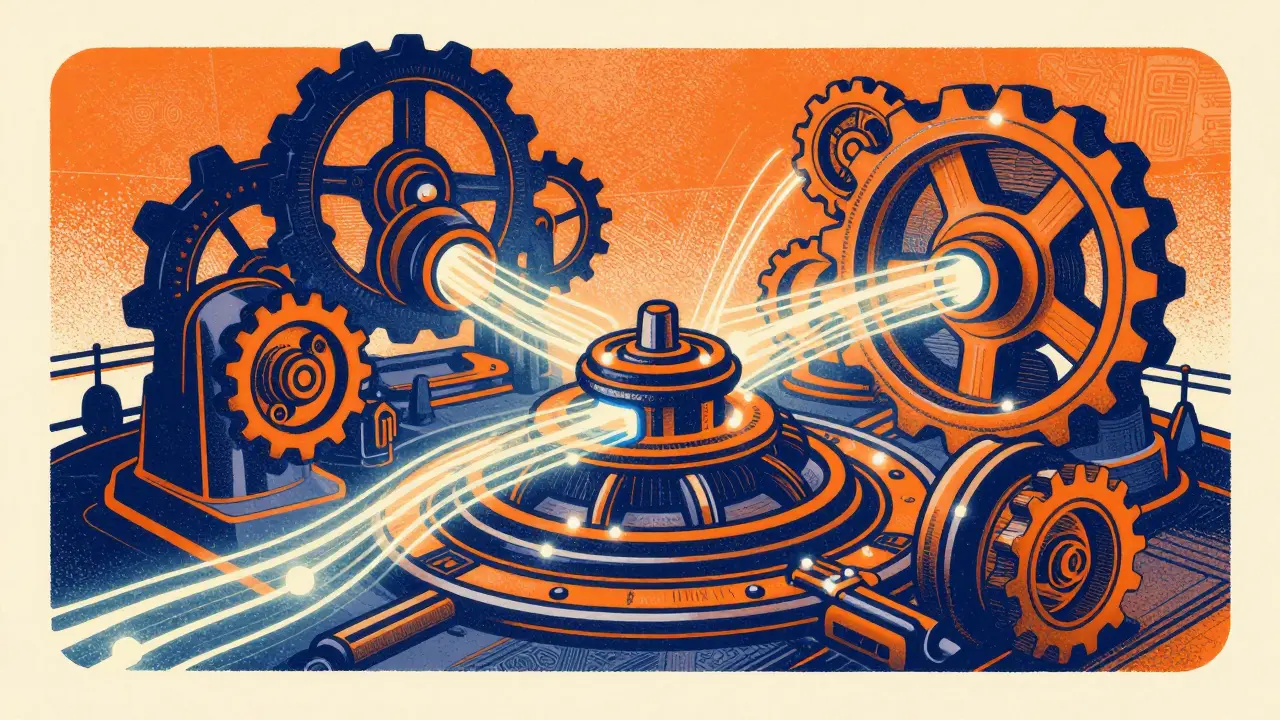
Most people treat decentralized exchanges like simple vending machines: you put in one token, and you get another. But if you're looking at Kodiak V3 is a decentralized exchange (DEX) and vertically integrated liquidity hub built specifically for the Berachain ecosystem. It doesn't just swap tokens; it attempts to solve the massive capital inefficiency that plagues older DEX models. With over $10 million in Total Value Locked (TVL) and a growing volume of trades, it's positioning itself as the primary engine for liquidity on Berachain. If you've ever felt that providing liquidity is a losing game due to impermanent loss, the way Kodiak V3 handles capital might actually interest you.
The Core Engine: How Kodiak V3 Actually Works
Unlike basic platforms, Kodiak V3 doesn't stick to one way of trading. It uses a dual Automated Market Maker (or AMM), a protocol that uses mathematical formulas to price assets automatically without needing a traditional order book. By combining two different styles of liquidity, it caters to both the "set it and forget it" crowd and the professional traders.
First, there's concentrated liquidity. Instead of spreading your assets across every possible price point from zero to infinity, you pick a specific price range. If the asset stays in that range, your capital works much harder, meaning you earn higher fees with less money. Second, they keep full-range AMMs. These are safer for highly volatile assets where you don't want to risk your liquidity falling "out of range" and stopping your earnings.
| Feature | Concentrated Liquidity | Full-Range AMM |
|---|---|---|
| Capital Efficiency | Very High | Moderate |
| Slippage for Traders | Very Low | Higher |
| Management Effort | High (requires range adjustment) | Low (passive) |
| Best For | Stablecoins, Blue-chip assets | New tokens, High volatility |
Trading Experience and Available Assets
Walking through the interface, you'll find it supports 41 different coins across 71 trading pairs. This is a respectable start for an ecosystem that is still scaling. One of the standout parts of the platform is that it's non-custodial. This means your Private Keys stay with you. Kodiak V3 never touches your funds; the smart contracts handle the exchange, so you aren't trusting a CEO with your life savings.
For those who aren't exclusively moving on-chain assets, the integration of a fiat gateway is a huge plus. Being able to use a credit card to enter the Berachain ecosystem removes a significant barrier to entry. Additionally, the platform has expanded beyond simple swaps to include margin and leverage trading. This allows users to trade with more than they actually have in their wallet, though it obviously ramps up the risk of liquidation if the market swings against you.
Analyzing the Numbers: Liquidity and Volume
Numbers don't lie, but they need context. Kodiak V3 has processed more than 13,000 swaps and hit over $5 million in trading volume. While that sounds small compared to a giant like Uniswap, you have to remember it's operating within the specific scope of the Berachain network. Its average bid-ask spread is around 0.65%, which is tight enough that retail traders won't feel cheated on their entries and exits.
Interestingly, the platform ranks in the 82nd to 83rd percentile for combined orderbook depth and volume among its peer group. This tells us that when people trade on Berachain, they're largely choosing Kodiak. This "first-mover" advantage in a specialized ecosystem creates a moat that is hard for new competitors to cross, as liquidity tends to attract more liquidity.
Beyond the Swap: Launchpads and OTC
Kodiak V3 isn't just a place to trade; it's becoming a full-service financial hub. They've implemented a launchpad, which is essentially a springboard for new projects to debut their tokens. This attracts speculators and early adopters, which in turn drives more volume back into the main exchange.
For the "whales" or institutional players, the Over-The-Counter (OTC) trading service is critical. If a big player tried to sell $1 million of a low-liquidity token through the standard swap interface, the price would crash instantly (this is known as massive slippage). OTC trading allows these large blocks to be traded privately and settled without wrecking the public market price.
The Risks: What Could Go Wrong?
Trading on a DEX isn't without its dangers. Because you're interacting with Smart Contracts, the biggest risk is always a code vulnerability. While the platform is built for capital efficiency, a bug in the concentrated liquidity logic could lead to losses. Furthermore, because it is non-custodial, if you lose your seed phrase or send funds to the wrong address, there is no "Forgot Password" button or customer support agent who can recover your money.
There is also the learning curve. If you've only used basic exchanges, managing price ranges in a concentrated liquidity pool can be overwhelming. If the price of an asset moves outside your chosen range, your liquidity becomes "inactive," and you stop earning fees entirely. You'll need to manually rebalance your position, which costs gas fees and requires constant monitoring.
How to Get Started with Kodiak V3
If you're ready to try it out, you can't just use any old wallet. You need a wallet compatible with the Berachain network. Once your wallet is connected and you have some native Berachain tokens for gas, the process is straightforward:
- Connect your wallet to the official Kodiak V3 interface.
- Navigate to the "Swap" tab to exchange one token for another.
- If you want to earn passive income, head to the "Liquidity" section.
- Choose between a full-range pool for ease or a concentrated range for higher potential yields.
- Deposit your pair of tokens and set your price boundaries if using the concentrated model.
Is Kodiak V3 safe for beginners?
It is safe in terms of custody because it's non-custodial, meaning you hold your own keys. However, the concentrated liquidity features have a steep learning curve. Beginners should stick to the full-range AMM or simple swaps until they understand how price ranges and impermanent loss work.
What is the difference between Kodiak V3 and a centralized exchange?
The main difference is control. In a centralized exchange (CEX), the company holds your funds. In Kodiak V3, you interact directly with smart contracts on the Berachain blockchain. There is no sign-up process, no KYC (Know Your Customer) for basic trading, and no central authority that can freeze your account.
What are the fees on Kodiak V3?
Fees generally consist of two parts: the trading fee that goes to liquidity providers and the network gas fee paid to the Berachain blockchain. The exact trading fee varies by pool, but the average bid-ask spread is around 0.65%.
Can I use a credit card to buy crypto on Kodiak V3?
Yes, Kodiak V3 includes a fiat gateway that allows users to purchase cryptocurrency using credit cards, making it easier for people to move from traditional finance into the Berachain ecosystem.
What happens if the price moves outside my liquidity range?
If you are providing concentrated liquidity and the price exits your range, your assets will be converted into the less valuable of the two assets in the pair, and you will stop earning trading fees. You would need to withdraw your liquidity and re-deploy it at a new price range to start earning again.

Artavius Edmond
April 10, 2026 AT 14:51This looks like a solid way to get into Berachain without too much stress. I love that they have both options for liquidity so everyone can find their own vibe regardless of their risk tolerance.
Amanda Faust
April 12, 2026 AT 04:26concentrated liquidity is basically just uniswap v3 clones at this point nothing actually new here
Jason Davis
April 12, 2026 AT 09:30The fiat gateway is a game changer for new users who dont want to deal with central exchanges first. Just be careful with the slippage on some of those smaller pairs cause it can get wild real fast if the liquidity isn't deep enough.
Jessie Tayaban
April 13, 2026 AT 00:12OMG the risk of liquidation on leverage trading literally gives me nightmares!!
I tried a similar setup on another chain and it was an absolute disaster, just total chaos!! Be so careful guys or you'll lose evrything in a heartbeat!!
Swati Sharma
April 14, 2026 AT 20:48For anyone looking to optimize their yield, the delta-neutral strategies combined with concentrated liquidity can really hedge the impermanent loss. It's all about managing the slippage and ensuring the TVL remains stable across the liquidity hubs to maintain high capital efficiency throughout the volatility.
Jonathan Chamma
April 15, 2026 AT 15:32It's like a cozy little neighborhood for your tokens. I think it's wonderful that there's a path for people who just want to dip their toes in the water without feeling like they're jumping into a stormy ocean.
Rebecca Violette
April 16, 2026 AT 14:05i lauterly can't even deal with these complicated ranges. why is crypto always so stressful and why does it feel like i'm just losing money while everyone else is getting rich lol
Rima Dinar
April 18, 2026 AT 07:37If you are feeling a bit overwhelmed by the technical side of things, please remember that it is completely normal to feel this way when you first start navigating the world of decentralized finance, so just take it one small step at a time and perhaps start with a very small amount of capital in a full-range pool where you don't have to worry about the price moving out of your specified boundaries, because the most important thing is that you build your confidence slowly and steadily while you learn the ropes of the Berachain ecosystem, and I truly believe that with a bit of patience and a lot of curiosity, you will eventually find a strategy that aligns perfectly with your financial goals and your personal comfort level without feeling rushed into making mistakes that could have been avoided with a more cautious approach to your initial investments.
Emily H
April 19, 2026 AT 22:52One must exercise extreme caution when interacting with smart contracts, as the risks of code vulnerabilities are ever-present in the current landscape of decentralized finance. It is highly advisable to conduct thorough research regarding the audit history of the protocol before committing significant capital. Furthermore, the utilization of a hardware wallet would provide an additional layer of security that is indispensable for any serious investor.