
Imagine running an online store where every dollar you earn lands directly in your own pocket the second a customer pays. No middleman sitting on your cash. No risk of a payment processor freezing your account because they suspect fraud. No waiting days for a payout. This is the promise of non-custodial crypto payments, a model that ensures merchants retain absolute control over their funds from the moment a transaction is initiated.
The traditional way of accepting payments involves handing over custody of your money to a third party. Banks, credit card processors, and even many crypto gateways hold your funds temporarily. While convenient, this creates a single point of failure. If the provider goes bankrupt, gets hacked, or decides to freeze your assets due to regulatory pressure, you lose access to your revenue. By shifting to a non-custodial architecture, you eliminate this intermediary risk entirely. The funds flow straight from the buyer’s wallet to yours, bypassing any central server.
The Problem with Custodial Payment Processors
To understand why non-custodial solutions matter, we first need to look at how standard custodial models work. When you use a service like PayPal or a traditional crypto gateway such as BitPay, the customer sends money to the platform’s wallet. The platform then records that you are owed funds and transfers them to your bank account or personal wallet later. During this window, the platform controls the assets.
This setup introduces several vulnerabilities:
- Counterparty Risk: If the company fails, your funds might be lost. We’ve seen this happen with major financial institutions and crypto exchanges alike.
- Censorship and Freezes: Platforms can reverse transactions or freeze accounts if they detect suspicious activity or comply with government requests. For high-risk industries, this is a constant threat.
- Lack of Privacy: Custodial services require extensive Know Your Customer (KYC) verification, linking your identity to every transaction.
Non-custodial systems solve these issues by design. They act as a communication layer between the merchant and the blockchain, generating invoices and monitoring payments, but they never touch the private keys required to move the funds. The money stays in the merchant’s control at all times.
Method 1: Direct Wallet Addresses (The DIY Approach)
The simplest way to accept crypto without holding funds is to share your wallet address directly. You generate a QR code or copy-paste your public address into an email or invoice. The customer scans it and sends the payment. The funds arrive directly in your wallet.
This method is truly non-custodial and requires zero trust in any third-party software. However, it lacks the features needed for serious business operations. There is no automated tracking of who paid what. You cannot easily handle refunds, manage recurring subscriptions, or integrate with accounting software. It also poses security risks; if you reuse addresses, your entire transaction history becomes public, compromising privacy. This approach works for occasional freelance gigs but falls short for scalable e-commerce.
Method 2: Self-Hosted Solutions Like BTCPay Server
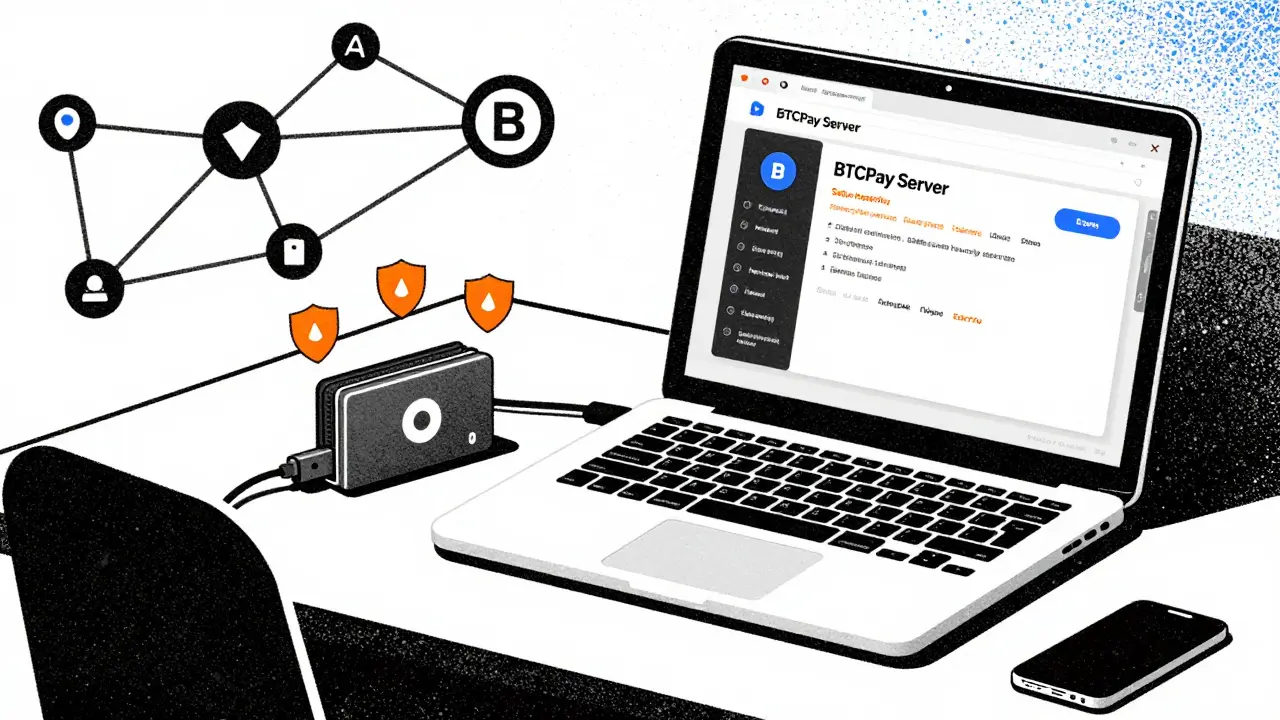
For merchants who want more functionality without sacrificing control, BTCPay Server is an open-source, self-hosted payment processor that allows businesses to accept Bitcoin and other cryptocurrencies without relying on third-party intermediaries. With BTCPay, you install the software on your own server. It connects to your personal wallet and generates unique invoice addresses for each customer.
When a customer pays, BTCPay detects the transaction on the blockchain and updates your dashboard automatically. You get professional invoices, plugins for WooCommerce and WHMCS, and full data privacy since you don’t need to submit KYC documents. Because you host the server, you control the data and the infrastructure.
The trade-off here is technical complexity. You are responsible for server maintenance, security patches, and uptime. Additionally, BTCPay primarily supports Bitcoin, Bitcoin Cash, and USDT. If you want to accept Ethereum, Solana, or other altcoins, you’ll need to look elsewhere. It’s an excellent choice for tech-savvy operators who prioritize sovereignty and have the skills to manage server infrastructure.
Method 3: Managed Non-Custodial Gateways
Most merchants want the benefits of non-custodial payments without the headache of managing servers. This is where managed non-custodial gateways come in. These platforms provide the user interface, invoice generation, and webhook notifications, but they route payments directly to your self-custody wallets. You connect your hardware wallet-like a Ledger or Trezor-to the platform using public keys (xpubs), ensuring your private keys never leave your device.
Several platforms operate in this space, each with different strengths:
| Platform | Supported Chains | KYC Required? | Best For |
|---|---|---|---|
| Blockonomics | Bitcoin only | No | Simplicity and Bitcoin-only merchants |
| PayRam | Multi-chain (ETH, BTC, etc.) | No | Global freelancers and unbanked markets |
| Cryptomus | Multi-chain including low-fee coins | Optional | Merchants prioritizing low transaction fees |
| TxNod | 7 chains (BTC, ETH, TRON, Cardano, Polygon, BSC, TON) | No | Solo founders and developers seeking multi-chain support |
TxNod is a modern non-custodial payment gateway designed for solo founders and indie hackers, supporting seven blockchains and integrating directly with hardware wallets via extended public keys. Unlike older solutions, TxNod emphasizes developer experience and speed. It allows you to connect a Ledger or Trezor device through the browser, deriving unique payment addresses for each invoice without exposing private keys. The platform supports a wide range of assets, including native tokens like Bitcoin and Ethereum, plus stablecoins like USDT and USDC across multiple networks. This breadth is crucial for merchants who want to accept payments from customers using different ecosystems without forcing them onto a single chain.
Another key feature of TxNod is its focus on automation for developers. It offers a TypeScript SDK and an MCP (Model Context Protocol) server, allowing AI coding agents to handle integration tasks. For a solo founder building a new project, this means you can set up a working crypto checkout in minutes rather than days. The platform charges a flat subscription fee with zero take-rate on transactions, meaning you keep 100% of your revenue regardless of volume.

Security Best Practices for Non-Custodial Payments
With great power comes great responsibility. When you hold your own funds, you are your own bank. Security is no longer someone else’s problem-it’s yours. Here are essential practices to protect your assets:
- Use Hardware Wallets: Always store your private keys on a hardware device like Ledger or Trezor. These devices keep keys offline, making them immune to remote hacking attempts. Never use a software wallet (hot wallet) for long-term storage of significant funds.
- Enable Two-Factor Authentication (2FA): Secure your payment gateway account with strong 2FA. Even though the gateway doesn’t hold your funds, it controls the invoice generation and notification system. Compromising it could lead to phishing attacks or missed payments.
- Verify Addresses Locally: Advanced gateways like TxNod allow you to verify that the payment address generated matches your own public key derivation. This prevents man-in-the-middle attacks where a malicious actor swaps the address before the customer sees it.
- Diversify Chains: Accepting payments on multiple blockchains reduces dependency on a single network’s congestion or fee spikes. For example, during periods of high Bitcoin volatility or fees, customers may prefer sending USDT on the TRON or Polygon network.
Why Choose Non-Custodial Billing?
The shift toward non-custodial billing isn’t just about ideology; it’s about business resilience. Traditional payment processors can shut down your ability to sell overnight. Crypto gateways that hold funds introduce counterparty risk. By adopting a non-custodial model, you ensure that your revenue stream is independent of any corporate entity’s stability or compliance decisions.
For solo founders, indie hackers, and small businesses, this independence is invaluable. You can operate globally without worrying about geographic restrictions or banking hurdles. You can accept payments from anyone, anywhere, as long as they have internet access and a crypto wallet. And most importantly, you sleep better knowing that your money is in your control, not in someone else’s ledger.
What is the difference between custodial and non-custodial crypto payments?
In custodial payments, a third-party service holds your funds temporarily before transferring them to you. In non-custodial payments, funds go directly from the customer to your personal wallet, and the service provider never has access to your private keys or funds.
Do I need a hardware wallet to use a non-custodial gateway?
While not strictly mandatory, using a hardware wallet like Ledger or Trezor is highly recommended for security. It keeps your private keys offline. Many non-custodial gateways, including TxNod, are designed to integrate seamlessly with hardware wallets via WebHID or WebUSB.
Can I accept multiple cryptocurrencies with a non-custodial solution?
Yes. While some solutions like Blockonomics focus only on Bitcoin, others like TxNod and PayRam support multiple chains including Ethereum, TRON, Polygon, and BNB Smart Chain, allowing you to accept various native tokens and stablecoins.
Is KYC required for non-custodial payment gateways?
Many true non-custodial gateways do not require KYC because they do not hold your funds. Platforms like TxNod and Blockonomics allow merchants to operate without submitting identity documents, preserving privacy. However, always check the specific terms of service of the platform you choose.
What happens if the payment gateway goes offline?
Since the funds are sent directly to your wallet, the gateway’s status does not affect the settlement of payments. You still receive the money. The only impact is that you might not receive immediate webhook notifications or dashboard updates until the service is restored. Some gateways offer local SDKs to mitigate this.


Caique Muniz
May 9, 2026 AT 17:38lol another article telling us to be our own bank. sure jan.
imma just sit here and let paypal freeze my account because i sold one too many nfts, thanks.
Mike S
May 10, 2026 AT 02:17The sheer audacity of people thinking they can handle their own security is laughable. You lose your seed phrase? Gone. Forever. No customer support hotline to cry to.
I’ve seen countless ‘tech-savvy’ founders get rekt because they stored their keys in a text file on their desktop. It’s not about freedom, it’s about competence, and most of you lack it. Stop pretending that self-custody is for everyone when it’s clearly only for the paranoid elite who actually understand cryptography. The rest of you are just walking ATMs waiting for a phishing link.
robert Whitehead
May 11, 2026 AT 00:47You’re missing the point entirely. This isn’t about convenience; it’s about sovereignty. Every time you use a custodial service, you are voluntarily surrendering your financial rights to a corporation that answers to regulators, not you.
The fact that you’re worried about losing a seed phrase shows you haven’t grasped the fundamental shift in power dynamics here. Yes, there is risk. But the risk of counterparty failure-of FTX collapsing overnight or PayPal banning you for no reason-is infinitely greater than the risk of user error if you follow basic hygiene. Hardware wallets exist for a reason. Use them. Or don’t. But don’t whine about censorship when you chose to give up your keys in the first place.
Bradley Geldenhuys
May 12, 2026 AT 02:00look man, i get what ur saying but its kinda harsh to call everyone dumb for using paypal.
not everybody has the brain space to manage servers and private keys while trying to run a business.
btcpay sounds cool tho, maybe ill try it later when im less tired lol
H F
May 13, 2026 AT 05:38This is brilliant! I’ve been looking for something like TxNod for ages. The idea of connecting my Ledger directly without exposing private keys is exactly what I needed.
I’m setting up a small indie game store and keeping fees low is huge for me. The multi-chain support is a game changer too-my customers are all over the map with which coins they hold. Finally, a solution that doesn’t force me into a single ecosystem. Thanks for sharing this, really helpful read!