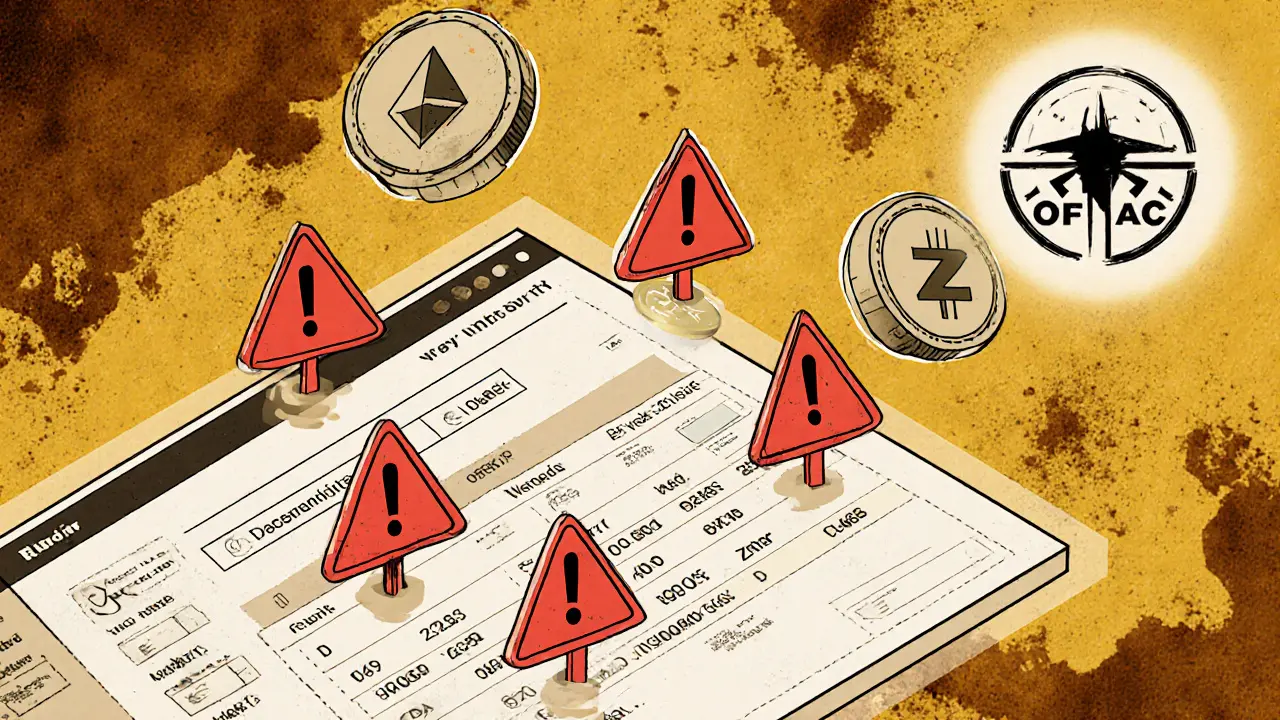
OFAC Sanctions Compliance Calculator
This tool helps you estimate your OFAC compliance requirements based on your business size and transaction volume. Using data from the article, we've calculated realistic compliance needs for crypto businesses.
Business Information
Compliance Requirements
SDN List Addresses (as of October 2025)
1,247
Addresses on OFAC's Specially Designated Nationals List
Estimated Compliance Cost Range
$0 - $0
Annual compliance costs based on business size
Risk Assessment
HIGH RISK
Your business requires immediate compliance action
Recommended Analytics Tool
Chainalysis Reactor
Industry standard with $450,000+ implementation cost
Important: OFAC requires real-time screening of all transactions against SDN list. Failure to implement this could result in fines up to $750,000.
Key Compliance Actions
- 1 Implement real-time transaction screening
- 2 Update risk assessment quarterly
- 3 Train staff on compliance procedures
- 4 Audit your system annually
- 5 Document all compliance activities
OFAC Cryptocurrency Sanctions Are Not Optional - They’re Enforced Daily
If you run a crypto exchange, wallet service, or even a DeFi protocol that touches U.S. users, you’re already under OFAC’s watch. The Office of Foreign Assets Control doesn’t just apply to banks anymore. Since 2018, it has been adding cryptocurrency wallet addresses to its Specially Designated Nationals (SDN) List. By October 2025, 1,247 crypto addresses were on that list - each one a red flag for any transaction system handling digital assets.
OFAC doesn’t care if you didn’t know the wallet was blocked. You don’t need intent to violate sanctions. You just need to process a transaction involving one of those addresses. That’s strict liability. And in 2025, they’re not just warning companies - they’re hitting them with six-figure fines.
ShapeShift Paid $750,000 for Not Blocking Users in Cuba and Iran
In September 2025, ShapeShift AG settled with OFAC for $750,000. Why? Because over two years, users from Cuba, Iran, Sudan, and Syria exchanged over $12.5 million in crypto through their platform. ShapeShift didn’t block those users. They didn’t even check where they were logging in from. No geolocation controls. No IP screening. Just open access.
OFAC didn’t accuse ShapeShift of helping terrorists. They didn’t need to. The violation was simple: allowing sanctioned jurisdictions to use their service. That’s enough. And ShapeShift wasn’t some tiny startup - they were a well-known exchange. If they can get hit, so can anyone else.
Garantex Got Crushed - And So Did Its Entire Network
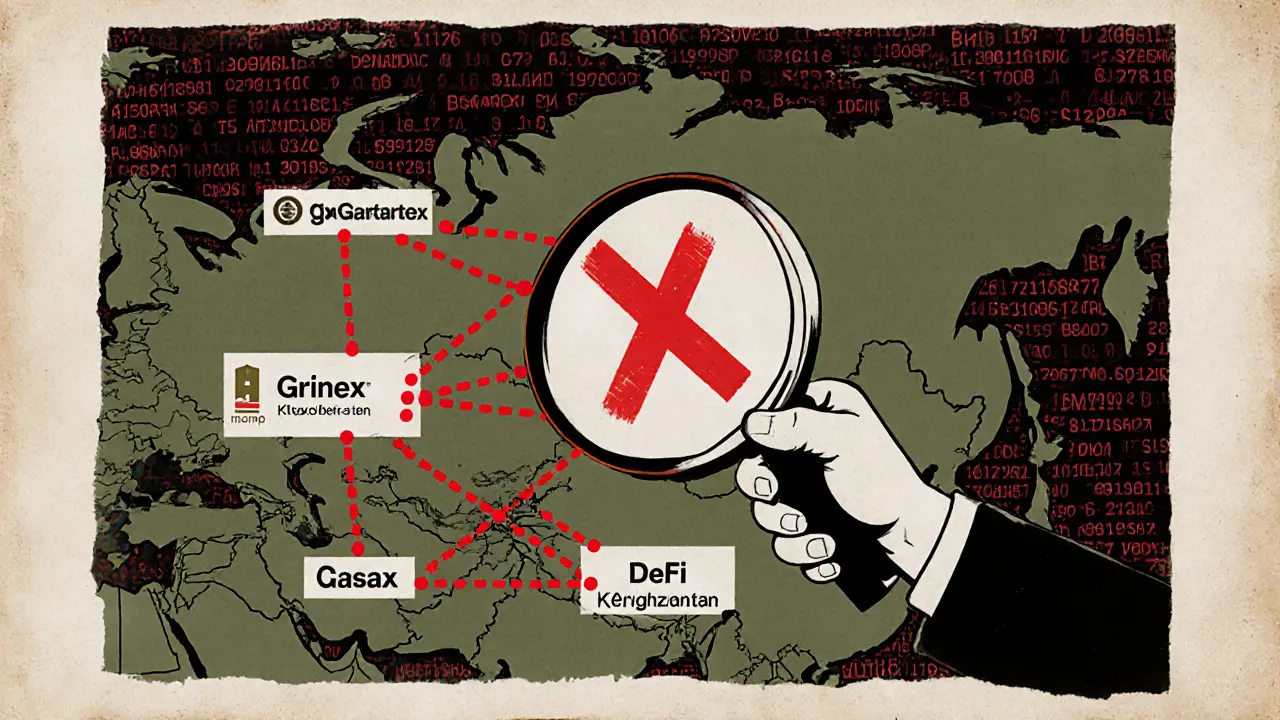
In August 2025, OFAC didn’t just target Garantex Europe OU. They also designated its successor, Grinex, and six other companies linked to it across Russia and the Kyrgyz Republic. Why? Because Garantex processed over $100 million in transactions tied to illicit activity since 2019. But here’s the key: OFAC went after the whole ecosystem. Executives. Supporting companies. Even successor entities.
This isn’t just about one bad actor anymore. It’s about network sanctions. If your business works with a sanctioned entity - even indirectly - you’re at risk. OFAC’s new Digital Asset Sanctions Task Force, launched in September 2025, is built to trace these connections. They’re mapping out who talks to whom on-chain. And they’re not stopping at exchanges.
What OFAC Actually Requires: Five Core Rules
OFAC doesn’t give you vague advice. They laid out a clear framework in their October 2021 Sanctions Compliance Guidance for the Virtual Currency Industry. Here’s what you need to build:
- Management Commitment - Your board must approve and fund your sanctions program. No excuses. If your CEO doesn’t know your compliance budget, you’re not compliant.
- Risk Assessment - Update this quarterly. What chains do you support? Do you handle privacy coins? Are you open to users from sanctioned countries? Document everything.
- Internal Controls - You need automated tools. Manual checks won’t cut it. You must screen every transaction against the SDN List in real time. That means integrating with Chainalysis, Elliptic, or TRM Labs.
- Testing and Auditing - Hire an independent third party to audit your system at least once a year. OFAC will ask for proof.
- Training - All staff who touch transactions must be trained. ACAMS found compliance officers need 147 hours of specialized training just to get started.
These aren’t suggestions. They’re requirements. And OFAC will check them.
Blockchain Analytics Tools Are Not Optional - They’re the Backbone
You can’t screen crypto addresses by hand. There are over 27,500 SDNs, and new crypto addresses are added every week. In Q2 2025 alone, OFAC added 37 new crypto wallet addresses to the list.
Companies like Coinbase reported false positive rates of 12-15% with basic tools. Kraken, after implementing Chainalysis Reactor with custom rules, dropped theirs to 4.3%. That’s the difference between getting flagged constantly and actually catching bad actors.
Here’s what works:
- Crystal Explorer - Real-time wallet screening, great for smaller firms.
- Chainalysis Reactor - Industry standard. Used by Binance, JPMorgan, and Coinbase. Costs $450,000+ to implement.
- TRM Labs - Strong API integration, but weaker documentation. Rated 3.2/5 on G2.
Deloitte’s 2025 survey of 78 crypto firms showed compliance costs range from $150,000 to $2 million per year - depending on transaction volume. If you do over $100 million in daily trades, you need at least 1.7 full-time compliance staff.
Privacy Coins Are a Nightmare - And OFAC Knows It
Monero, Zcash, and other privacy coins are the biggest headache for compliance teams. They hide sender, receiver, and amount. 68% of crypto firms surveyed in October 2025 said they couldn’t reliably screen these coins.
OFAC’s October 2025 update to FAQ 646 says you still need to take “reasonable measures” to block them - even if you can’t see the details. That means:
- Blocking known privacy coin addresses on the SDN List
- Restricting deposits from mixers or tumblers
- Flagging high-volume transfers to privacy wallets
Some firms just ban privacy coins entirely. Others build layered controls. But ignoring them? That’s how you end up in a settlement.
DeFi Is the New Frontier - And It’s Wildly Unregulated
Automated Market Makers (AMMs), liquidity pools, and smart contracts don’t have CEOs. They don’t have KYC forms. They run on code. So who’s responsible when a DeFi protocol processes a transaction to a sanctioned wallet?
73% of firms say they struggle with DeFi. OFAC hasn’t given clear answers yet - but they’re watching. Their new guidance says you must take “reasonable measures” even when you don’t control the counterparty.
That means:
- Blocking access to known DeFi protocols linked to sanctioned addresses
- Monitoring on-chain flows for suspicious patterns
- Partnering with analytics firms that track DeFi interactions
Ethereum’s proposed EIP-7594 - which would add on-chain sanction filters - was met with fierce backlash from developers. But OFAC doesn’t care about community votes. If a DeFi protocol becomes a tool for sanctions evasion, they’ll find a way to shut it down.
The U.S. Is Leading - And Everyone Else Is Playing Catch-Up
Since 2018, OFAC has issued 17 cryptocurrency enforcement actions totaling $48.7 million. The UK’s OFSI? Three actions. Singapore? Five. Even the EU’s 6AMLD directive allows a “reasonable measures” defense. OFAC doesn’t.
That’s why 98% of exchanges processing over $1 billion monthly have full sanction screening. But only 42% of smaller exchanges under $100 million do. That gap is getting dangerous. OFAC is now targeting mid-sized players - the ones who think they’re too small to matter.
And it’s not just exchanges. JPMorgan now screens 2.3 million transactions daily. The big banks are in. The regulators expect everyone else to follow.
What Happens If You Don’t Comply?
You get fined. You get named. You get blacklisted. And your customers leave.
ShapeShift paid $750,000. Garantex got wiped off the map. And in both cases, their reputations took a hit that lasted longer than the fine.
OFAC doesn’t just punish. They publish. Every settlement is public. Every company named is added to a global watchlist. Banks won’t touch you. Payment processors will cut you off. Investors will run.
Compliance isn’t a cost center. It’s a survival tool.
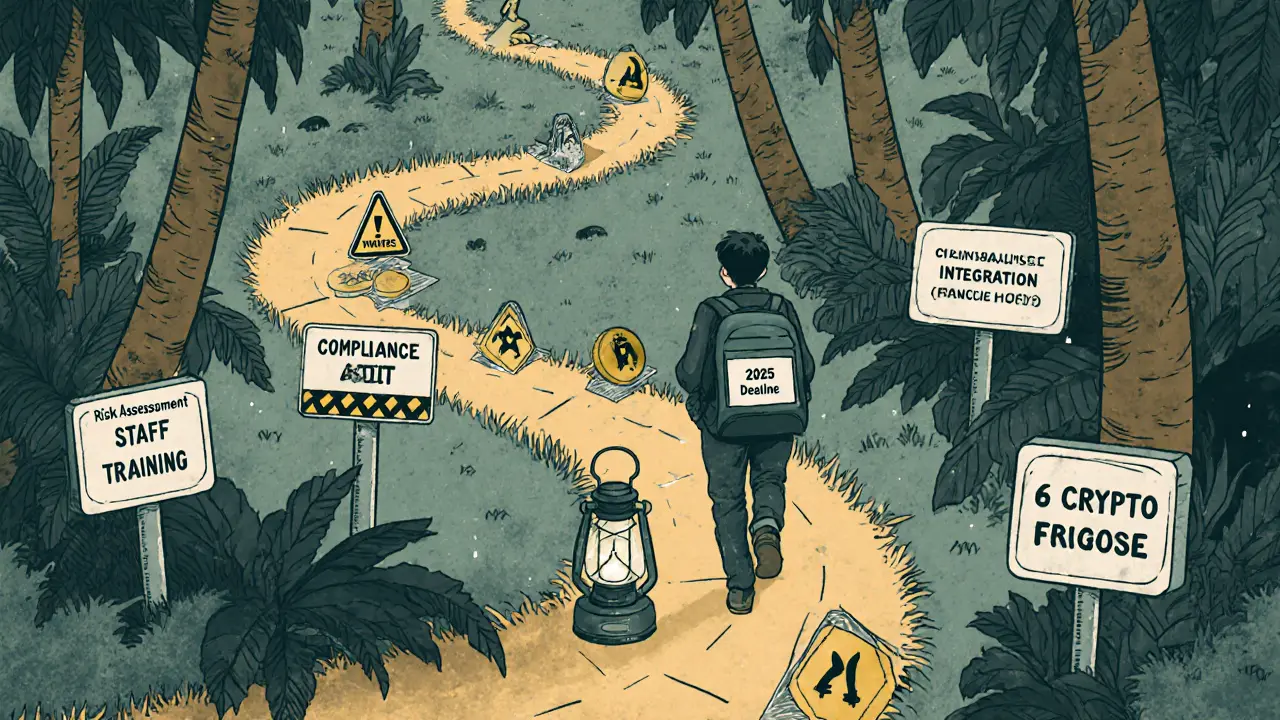
Getting Started: A Realistic 6-Month Plan
- Weeks 1-8 - Do a crypto-specific risk assessment. Map every chain, coin, and user type you support. Document your exposure.
- Weeks 9-20 - Pick a blockchain analytics tool. Start with a pilot. Test it on 10,000 transactions. See how many false positives you get.
- Weeks 21-30 - Integrate with your transaction system. Connect to your wallet, trading engine, and deposit/withdrawal queues.
- Weeks 31-36 - Train your team. Mandatory. Document attendance. Include front-line staff who handle support tickets.
- Month 7 - Bring in an auditor. Get a third-party validation. Keep the report.
That’s 22-36 weeks. No shortcuts. No “we’ll do it later.” If you’re not ready by now, you’re already at risk.
What’s Coming in 2026
The U.S. Treasury’s 2026 budget requests $28 million for crypto sanctions enforcement - a 40% jump from last year. The Digital Asset Sanctions Task Force is growing. New tools are being built to track cross-chain swaps and anonymous protocols.
By 2027, Forrester predicts 65% of all crypto transactions will be screened in real time. Right now, it’s 38%. The gap is closing fast.
And if you think decentralized tech will escape regulation? Think again. The U.S. government doesn’t need to control every node. They just need to make compliance so expensive and risky that bad actors flee - and honest businesses follow the rules.
Final Reality Check
There’s no such thing as a crypto business outside OFAC’s reach if it serves U.S. persons or connects to the U.S. financial system. That includes non-U.S. companies that let Americans use their platform.
OFAC Director Andrew Hallman said it plainly: “There is no such thing as a cryptocurrency business that falls outside OFAC’s jurisdiction.”
So ask yourself: Are you screening every transaction? Do you know where your users are? Are you blocking blocked wallets? Are you updating your tools weekly? If you can’t answer yes to all of those, you’re not compliant - you’re just waiting for the next settlement notice.

Paul McNair
November 30, 2025 AT 11:31Look, I’ve worked with half a dozen crypto startups in the last three years, and the one thing I keep seeing is companies thinking they can wing compliance until they get caught. OFAC doesn’t play. They don’t send reminders. They don’t give you a ‘first time offender’ pass. If your system lets a transaction go through to a flagged wallet, you’re done. I’ve seen founders cry in board meetings when they realize their $2M valuation just got wiped by a $750K fine. It’s not about being paranoid-it’s about being alive in this space.
And don’t even get me started on privacy coins. I had a client who swore Monero was ‘just for privacy,’ not for crime. Then we traced one of their incoming flows back to a mixer linked to a sanctioned Russian entity. They didn’t even know the wallet existed. That’s how fast this stuff spreads. You need tools, not good intentions.
Mohamed Haybe
December 2, 2025 AT 00:29Marsha Enright
December 2, 2025 AT 03:52Just wanted to say thank you for laying this out so clearly. I’m a compliance officer at a small DeFi startup and this post saved me from a potential disaster.
We were using a free blockchain explorer to check addresses-big mistake. After reading this, we signed up for Crystal Explorer (started with the basic plan) and ran a test on our last 5k transactions. Found 12 flagged wallets we’d missed. One of them was from a user in Venezuela who’d used a VPN. We blocked it, flagged it internally, and sent them a polite email explaining why. They actually thanked us.
Training the team was the hardest part. We did a 30-min weekly lunch-and-learn for a month. Now even our support staff knows what to flag. Seriously, if you’re reading this and you’re not screening-start today. You don’t need Chainalysis on day one. Just start somewhere.
Andrew Brady
December 2, 2025 AT 15:10Let’s be honest. This isn’t about sanctions. It’s about control. OFAC is using crypto as a pretext to build a financial surveillance state. Every wallet you screen, every IP you log, every transaction you track-it’s all feeding into a centralized database that will one day decide who can transact and who can’t.
And don’t fall for the ‘reasonable measures’ lie. There’s no such thing as reasonable when the government defines the rules retroactively. Garantex didn’t even know half the addresses on their platform were linked to sanctioned entities. They were using off-the-shelf tools. OFAC still crushed them.
What’s next? Will they require every crypto wallet to be registered with the Treasury? Will they mandate KYC for decentralized wallets? Don’t think they’re not already drafting those rules. This is the thin end of the wedge. And you’re helping them build it by complying.
They want you scared. Don’t give them that power.
Sharmishtha Sohoni
December 3, 2025 AT 13:16