Imagine losing a chunk of your savings because your computer went offline for a few hours. In the world of Proof-of-Stake is a consensus mechanism where validators lock up cryptocurrency to secure the network and earn rewards., that scenario isn't just a nightmare-it's a financial reality known as slashing is an economic penalty imposed on validators who commit protocol violations or fail to maintain network uptime.. If you're running a node or considering staking, understanding how much you could lose is critical. The stakes are high, with billions in assets at risk across major networks, and the difference between a minor deduction and total loss often comes down to the specific rules of the chain you're participating in.
What Exactly Are Slashing Penalties?
At its core, slashing is the enforcement mechanism that keeps validators honest. Unlike Proof-of-Work, where miners spend energy to solve puzzles, PoS validators stake their own capital as collateral. If they cheat-by signing two different blocks at once or disappearing when needed-the network burns part of that stake. This serves two purposes: it punishes the bad actor and deters others from taking shortcuts. However, not all chains treat these mistakes the same way. Some view downtime as a fatal error, while others give you a grace period. Knowing the distinction helps you decide which network fits your risk tolerance and technical setup.
Ethereum’s Multi-Layered Penalty Structure
Ethereum is the leading smart contract platform and the most widely used PoS network for institutional staking. has one of the most detailed slashing frameworks in the industry. It doesn't just slap a single fine on you; it uses a multi-component system. First, if you commit a slashable offense like double-signing, you face an immediate initial penalty. This amount is calculated as exactly 1/32 of your effective balance. For a standard validator with a 32 ETH stake, this initial hit is roughly 1 ETH. That’s a significant chunk gone instantly.
But the pain doesn't stop there. After the initial slash, your validator enters a "slashed_exiting" status. This phase lasts approximately 36 days. During this time, you aren't earning rewards, and you incur additional penalties for every epoch you miss. An epoch is 6.4 minutes long, and missing one costs you 8,000 GWei (or 0.000008 ETH). Over the 36-day exit period, this adds up to about 0.07 ETH. So, a simple mistake can cost you over 1.07 ETH before you even consider the opportunity cost of lost rewards. Furthermore, Ethereum includes a correlation penalty. If many validators get slashed within a short window, the penalty severity increases. This design prevents coordinated attacks where a group might try to disrupt the network simultaneously without facing proportional consequences.
Comparing Penalty Structures Across Major Networks
While Ethereum sets a strong baseline, other networks approach slashing differently. Cosmos is a suite of interoperable blockchains that uses a flexible governance model to adjust slashing parameters. and Polkadot is a multichain framework allowing specialized blockchains to communicate and share security. also utilize slashing mechanisms, but their specific amounts are determined by local governance votes rather than hard-coded constants. This means a Cosmos-based chain might have a stricter downtime penalty than another, depending on what its community decides is fair. Generally, penalties range from small stake deductions for brief downtime to permanent removal for malicious acts. The key variable here is the "slashing fraction," which dictates the percentage of stake removed per offense. On some chains, this is fixed; on others, it’s dynamic, adjusting based on network health and validator behavior history.
| Network | Initial Slash Amount | Downtime Penalty | Correlation Factor | Exit Period Impact |
|---|---|---|---|---|
| Ethereum | ~1 ETH (1/32 of stake) | Included in exit penalties | Yes (increases with cluster size) | ~36 days, ~0.07 ETH extra |
| Cosmos Hub | Variable (Governance set) | Small deduction per missed block | No direct correlation penalty | Jail period (variable) |
| Polkadot | Variable (Governance set) | Small deduction per missed session | No direct correlation penalty | Chilling period (variable) |
Types of Offenses and Their Severity
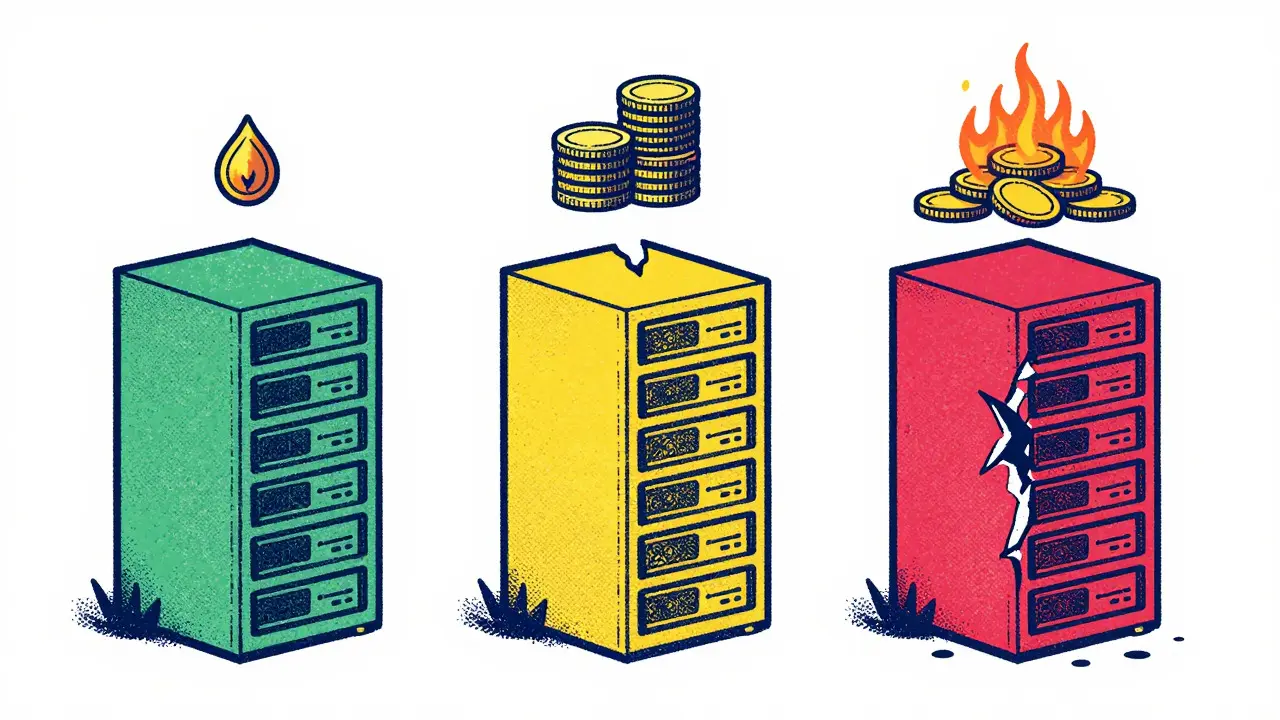
Not all mistakes carry the same weight. Understanding the three primary categories of offenses helps you prioritize your infrastructure upgrades. Double-signing violations occur when a validator signs conflicting blocks or attestations. This is usually the highest-risk offense because it directly threatens consensus integrity. Most networks treat this as a severe breach, often resulting in the largest possible penalty. Downtime penalties apply when you stay offline too long. Here, the penalty is generally proportional to the duration. If your server goes down for five minutes, you might pay a small fee. If it stays down for weeks, the cost climbs. Finally, there are network manipulation attempts, such as trying to reorganize the chain or signing multiple blocks for the same slot. These are considered malicious and often lead to complete stake forfeiture and permanent exclusion from the network. For most retail validators, double-signing is the biggest fear, while downtime is the most common occurrence.
How to Minimize Your Risk of Getting Slashed
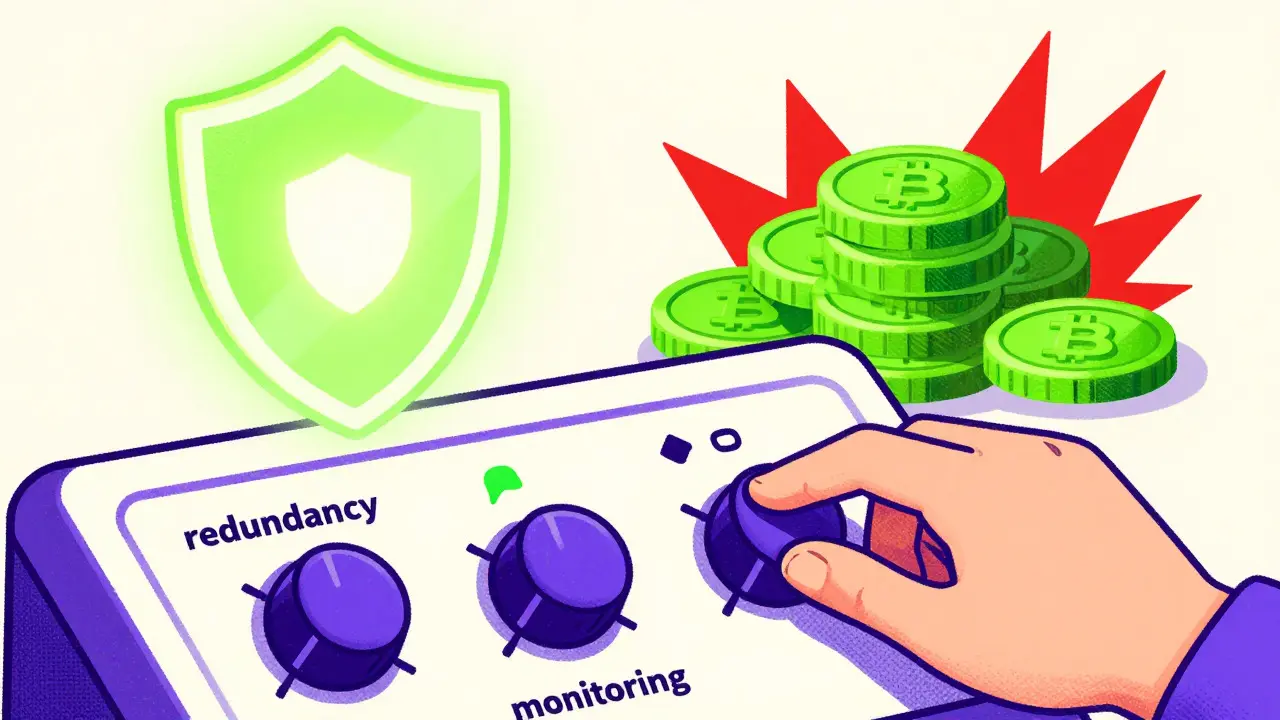
You don’t have to accept slashing as inevitable. With the right setup, you can reduce your risk to near zero. The first line of defense is a slash protection database. This software layer ensures your validator client never signs two conflicting messages, effectively making double-signing impossible due to human error or software bugs. Next, invest in reliable hardware and connectivity. A dedicated server with redundant internet connections (like fiber plus LTE backup) significantly reduces downtime risks. Many professional validators use sentry nodes, which act as intermediaries between your main validator and the public network, protecting your private keys from potential attacks. Additionally, comprehensive monitoring systems are non-negotiable. You need alerts that ping you immediately if your node falls behind or stops attesting. Ignoring warnings is how small issues become expensive slashes. While setting up this level of redundancy costs money-ranging from thousands to tens of thousands of dollars for enterprise-grade setups-it is far cheaper than losing your entire stake.
The Future of Slashing Mechanisms
The landscape is evolving. Current discussions in developer communities focus on creating more nuanced penalty structures. The goal is to better distinguish between honest mistakes and malicious intent. For example, future updates might introduce graduated penalties where repeat offenders face harsher fines, while first-time offenders get a warning. There is also growing interest in reputation-based modifications, where validators with a long history of good performance might receive slightly lower penalties for minor infractions. As liquid staking protocols grow, we are seeing new complexities emerge. When many users pool their funds into a single validator, who pays the penalty? Currently, the loss is socialized among token holders, but new mechanisms are being developed to handle this more fairly. Staying informed about these changes is crucial, as the rules governing your staked assets may shift under your feet.
Frequently Asked Questions
What is the maximum amount I can lose from slashing on Ethereum?
In extreme cases, slashing penalties can eliminate a validator's entire 32 ETH stake. However, historical data shows that most typical slashing events result in a total loss of around 1.07 ETH, combining the initial penalty and exit period costs.
Does downtime always lead to slashing?
No. On Ethereum, short periods of downtime do not trigger an immediate slash. You only face penalties if you remain offline long enough to miss too many attestations during the exit process after a slashable event, or if the network parameters change. Other networks like Cosmos have specific jail periods for downtime before penalties kick in.
Can I recover my staked funds after being slashed?
Yes, but it takes time. On Ethereum, you must wait through the exit period (approximately 36 days) before your remaining balance is returned. During this time, you continue to incur small penalties for missed epochs. Once the process is complete, the un-slashed portion of your stake is released back to your wallet.
Is slashing insurance available for validators?
Yes, a secondary market has emerged around slashing risk management. Several DeFi protocols and insurance providers offer coverage against slashing events. However, premiums vary based on the network, validator history, and coverage limits. Institutional validators increasingly factor these insurance costs into their overall staking strategy.
How does the correlation penalty work on Ethereum?
The correlation penalty increases the severity of the slash if multiple validators commit slashable offenses within a short timeframe (typically a few days). This mechanism is designed to prevent coordinated attacks. If you are slashed alone, you pay the base penalty. If you are part of a large group slashed simultaneously, the penalty multiplier applies, potentially increasing the cost significantly.