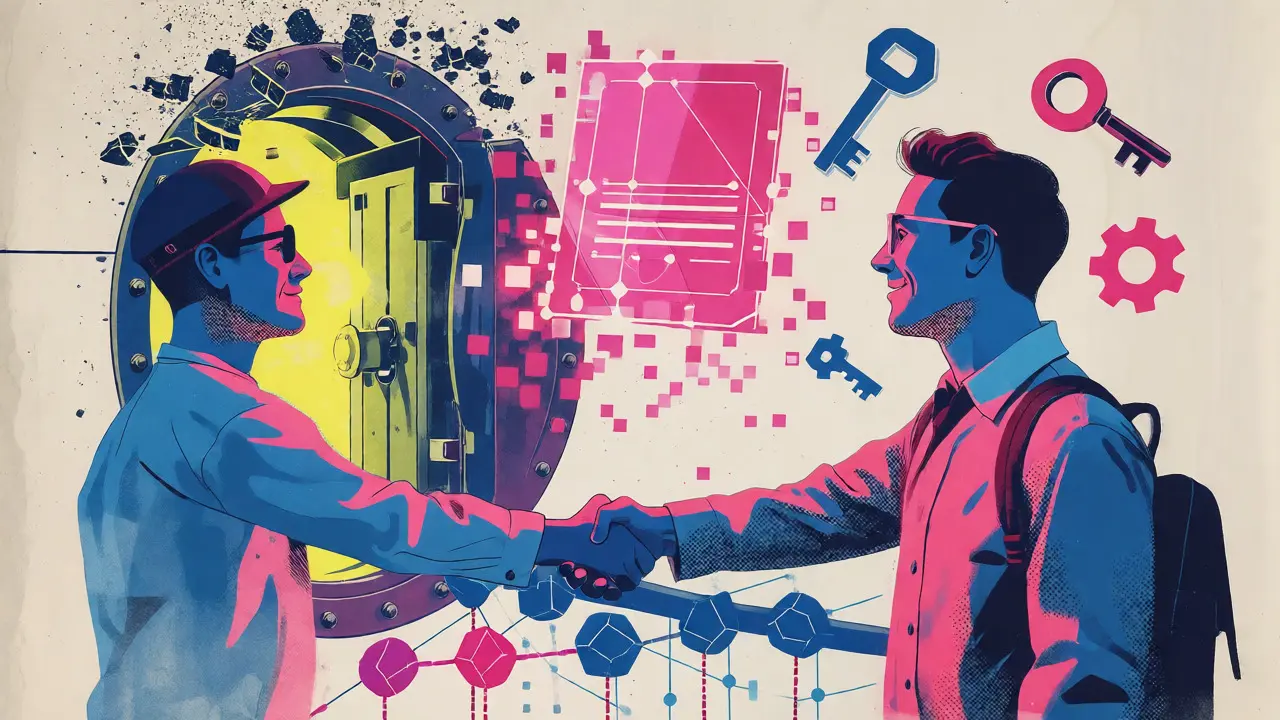
Imagine signing a lease that automatically transfers the security deposit to your landlord the moment you move out, without anyone checking if the apartment is clean. No lawyers, no bank holds, just code doing its job. That is essentially what smart contracts do for financial agreements. They are self-executing digital agreements where the terms of the contract are written directly into lines of code and stored on a blockchain network.
The idea isn't new. Nick Szabo, an American computer scientist, proposed the concept back in 1994. But it wasn't until the rise of platforms like Ethereum that these "digital vending machines" became practical reality. Today, they are reshaping how we handle money, loans, and assets by removing the middlemen who usually take a cut and slow things down.
What Exactly Is a Smart Contract?
At its core, a smart contract is a program stored on a blockchain that runs when predetermined conditions are met. Think of it as a highly sophisticated "if-then" statement. If condition A happens (like a payment being confirmed), then action B executes (like transferring ownership of a digital asset).
Unlike traditional contracts, which rely on trust in human institutions-banks, courts, notaries-smart contracts rely on cryptography and consensus mechanisms. Once deployed, the code cannot be changed. This immutability ensures that no one can alter the rules halfway through the deal. It’s transparent because everyone on the network can see the code, and it’s secure because the data is replicated across thousands of computers rather than sitting on a single server that could crash or be hacked.
| Feature | Traditional Agreement | Smart Contract |
|---|---|---|
| Execution Method | Manual processing by intermediaries | Automated code execution |
| Speed | Days or weeks due to bureaucracy | Seconds or minutes upon condition fulfillment |
| Cost Structure | Fees for banks, lawyers, and agents | Network gas fees only |
| Trust Model | Relies on reputation and legal enforcement | Relies on cryptographic verification |
| Error Risk | Human error and manipulation possible | Bugs in code are the primary risk |
Why Finance Needs This Automation
Financial services are riddled with friction. When you send money internationally, it might pass through three different correspondent banks before reaching the recipient. Each step adds time and cost. Smart contracts streamline this by allowing peer-to-peer transactions that settle instantly once the network verifies the transaction.
The biggest win here is cost reduction. By eliminating intermediaries, you remove their fee structures. There is no need to pay a clearinghouse to verify a trade or a lawyer to draft a standard loan agreement. The code does the work. For businesses, this means operational efficiency. For consumers, it often means cheaper services.
Consider the lending market. In traditional banking, applying for a loan involves paperwork, credit checks, and waiting periods. With Decentralized Finance (DeFi) protocols like MakerDAO, users can borrow stablecoins against crypto collateral instantly. The smart contract monitors the value of the collateral in real-time. If the value drops below a certain threshold, the contract automatically liquidates part of the collateral to repay the loan. No phone calls, no late-night emails from your banker.

Real-World Applications Beyond Crypto Trading
While most people associate smart contracts with buying meme coins, their utility in broader financial agreements is expanding rapidly. Here is how they are being used right now:
- Insurance Claims: Imagine flight insurance that pays out automatically if your flight is delayed by more than two hours. The smart contract connects to an oracle (a trusted data feed) that reports flight status. If the delay condition is met, the payout triggers immediately. No forms, no claims adjusters.
- Supply Chain Payments: Manufacturers can set up contracts that release payment to suppliers only when IoT sensors confirm goods have arrived at a specific location. This reduces disputes over delivery timing and quality.
- Subscription Management: Instead of giving a company permission to charge your credit card every month, you lock funds in a smart contract. The contract releases small amounts monthly as long as the service uptime meets agreed-upon metrics.
- Dividend Distribution: Tokenized stocks can use smart contracts to distribute dividends directly to holders' wallets proportionally, bypassing brokerage delays.

The Security Reality Check
It sounds perfect, but let's be honest: code is not magic. It is written by humans, and humans make mistakes. The reliability of a smart contract depends entirely on its ability to execute exactly as intended. If there is a bug in the logic, the contract will faithfully execute that bug.
This was famously demonstrated by the DAO hack in 2016, where a vulnerability in the code allowed an attacker to drain millions of dollars worth of Ether. Since then, auditing has become a critical industry. Before deploying a financial smart contract handling significant value, companies hire specialized firms to review the code line by line. These audits look for common vulnerabilities like reentrancy attacks or integer overflows.
Another challenge is the "oracle problem." Blockchains are closed systems; they don't know what's happening in the outside world. To trigger a contract based on external events (like stock prices or weather data), blockchains rely on oracles. If the oracle provides bad data, the contract executes incorrectly. Ensuring the integrity of these data feeds is just as important as securing the contract itself.
Getting Started with Financial Smart Contracts
If you are looking to implement smart contracts for financial agreements, whether as a developer or a business owner, here is a practical roadmap:
- Define Clear Conditions: Ambiguity kills smart contracts. Unlike legal language, which can be interpreted, code must be precise. Define exactly what constitutes "payment received" or "delivery complete."
- Choose the Right Blockchain: Ethereum remains the leader for complex financial logic, but networks like Solana offer faster speeds and lower costs for high-frequency trading applications. Consider your throughput needs.
- Audit Your Code: Never skip the audit phase. Use established tools and reputable auditors. The cost of an audit is negligible compared to the loss from a failed deployment.
- Test on Testnets: Deploy your contract on a test network first. Simulate various scenarios, including edge cases where inputs might be unexpected.
- Plan for Upgrades: While contracts are immutable, patterns like proxy contracts allow you to update logic without changing the address. Decide early if you need upgradeability.
The landscape is shifting fast. As regulatory frameworks catch up with technology, we are seeing more hybrid models where smart contracts handle the mechanical aspects of agreements while traditional law handles dispute resolution. This blend offers the best of both worlds: the efficiency of automation and the safety net of legal recourse.
For now, smart contracts are proving that trust doesn't always require a handshake. Sometimes, it just requires good code.
Are smart contracts legally binding?
This depends on jurisdiction. In some regions, smart contracts are recognized as valid legal documents if they meet standard contract requirements (offer, acceptance, consideration). In others, they exist in a gray area. Many experts recommend pairing smart contracts with traditional legal wrappers to ensure enforceability in court.
Can smart contracts be changed after deployment?
Generally, no. Once a smart contract is deployed on a blockchain, its code is immutable. However, developers can design contracts with upgradeable patterns (like proxies) that allow the underlying logic to be swapped out while keeping the same address, effectively allowing for updates without breaking existing connections.
What happens if there is a bug in a smart contract?
If a bug causes incorrect execution, funds may be lost or locked permanently. Unlike traditional software, you cannot simply push a patch to fix a live contract easily. This is why rigorous testing and third-party audits are mandatory before deploying contracts that hold significant financial value.
Do smart contracts eliminate all fees?
No, they eliminate intermediary fees (like bank transfer fees), but they introduce network fees. On Ethereum, these are called "gas fees," paid to validators for processing the transaction. On other networks like Solana or Polygon, these fees are significantly lower, but they still exist.
How do smart contracts access real-world data?
Blockchains are isolated environments. To interact with off-chain data (like stock prices or weather), smart contracts use "oracles." Oracles are decentralized services that fetch external data and deliver it to the blockchain in a verifiable way, ensuring the contract triggers based on accurate real-world information.


musa farid
September 14, 2026 AT 10:07Yo, this is absolute fire 🔥🔥. I'm in Nigeria and we are literally dying waiting for banks to process international transfers while y'all over here talk about "seconds" like it's nothing 😤. The part about the DAO hack scared me though, one typo and boom 💸 gone? That's wild 🤯.
Mark Riquelme
September 15, 2026 AT 02:39It is indeed a paradigm shift, but we must remain grounded in the technical realities. While the efficiency gains are undeniable, particularly in cross-border settlements where correspondent banking fees have historically been exorbitant, the reliance on oracles introduces a new vector of trust that many enthusiasts overlook.
Furthermore, the immutability you highlight is a double-edged sword; while it prevents arbitrary changes by intermediaries, it also means that governance mechanisms for protocol upgrades often become contentious political battles rather than purely technical decisions. We should not forget that smart contracts do not eliminate legal liability entirely, as jurisdictional recognition remains fragmented across global markets. For institutions adopting this technology, the integration with existing compliance frameworks, such as KYC/AML regulations, presents a far more complex hurdle than the code execution itself. It is crucial to approach these systems not as magic bullets, but as sophisticated tools that require rigorous oversight and clear regulatory alignment to truly replace traditional middlemen effectively.
Glenn Watts
September 16, 2026 AT 06:34This whole crypto hype is just another way for elites to dodge American regulations. Why should our hard-earned dollars be subject to some decentralized mess that no government can control? It feels like they're trying to strip away the protections that make our financial system strong. If it breaks, who do we sue? No one. It's chaos disguised as innovation.
Kelsey Hartwig
September 17, 2026 AT 09:09The philosophical implications of removing human discretion from contractual obligations are profound. One might argue that law has always served as a buffer between rigid rules and equitable outcomes. By automating this process, do we risk losing the nuance required for true justice?
Consider the concept of 'force majeure' or unforeseen circumstances which traditionally allow for contract modification. A binary code cannot interpret context or intent in the same manner as a judge. Therefore, while efficiency increases, the capacity for mercy or contextual adjustment diminishes. This creates a sterile environment where adherence to syntax outweighs the spirit of the agreement. It is a trade-off between certainty and flexibility that society has yet to fully evaluate. The removal of the intermediary is not merely an economic optimization but a fundamental restructuring of how humans relate to promises and obligations.
Janine John
September 18, 2026 AT 17:37I appreciate the detailed breakdown, especially regarding the distinction between network fees and intermediary costs. It is important to note that while gas fees exist, their predictability and transparency offer a significant advantage over the opaque fee structures of traditional banking. Additionally, the mention of hybrid models is crucial for enterprise adoption, as it acknowledges the current limitations of purely on-chain enforcement.
Justine Jones
September 20, 2026 AT 16:58Love the insurance example! So much friction removed there. Totally agree on the audit point too-security first always. Great read!