
When a smart contract goes live on a blockchain, there’s no undo button. One line of flawed code can drain millions - and it’s happened over and over again. In 2022 alone, over $2 billion was lost to smart contract exploits. That’s why no serious blockchain project launches without a thorough audit. The firms that do this work aren’t just consultants - they’re the last line of defense between a project and disaster.
Why Smart Contract Audits Matter
Smart contracts are self-executing code on blockchains. They handle everything from DeFi loans to NFT sales and token distributions. Unlike traditional software, once deployed, they can’t be patched. If there’s a漏洞 (vulnerability), hackers will find it. And they’re not just looking for simple bugs - they’re hunting for logic flaws, reentrancy attacks, and integer overflows that only experts can spot. Auditing isn’t a checkbox. It’s a process. Top firms combine manual code reviews, automated scanning tools, and formal verification - a mathematical proof that the code behaves exactly as intended. This isn’t theoretical. In 2025, the top five auditing firms secured over $800 billion in total value locked (TVL) across thousands of projects. That’s not a small market. It’s the backbone of trust in decentralized finance.CertiK: The Scale Leader
CertiK is the biggest player by volume. They’ve audited over 3,000 projects and secured more than $360 billion in TVL. What sets them apart isn’t just size - it’s their Skynet platform. This real-time monitoring system watches live smart contracts 24/7, alerting teams to suspicious activity before it becomes a breach. They also use formal verification, which mathematically proves the contract’s logic is correct. That’s rare. Major protocols like Aave, Polygon, and Terra (before its collapse) trusted CertiK. Their reports are detailed, with clear severity ratings and step-by-step fixes. Some developers say their audits are expensive and rigid, but for high-value protocols, the cost is justified. If you’re handling over $100 million in user funds, CertiK is often the first name on the list.ConsenSys Diligence: The Ethereum Authority
Founded by Joe Lubin, one of Ethereum’s co-founders, ConsenSys Diligence doesn’t just audit - they help build. They’ve completed over 100 audits securing more than $11 billion in value. Their strength? Deep Ethereum expertise. They know the nuances of EVM (Ethereum Virtual Machine), layer-2 solutions like Optimism and Arbitrum, and how upgrades impact security. They offer more than just audits. Their suite includes development tools, testing frameworks, and infrastructure services. This makes them ideal for teams already using ConsenSys products like MetaMask or Infura. Their reports are thorough, and they often stay involved after the audit to help implement fixes. Many Ethereum-native teams say they feel like partners, not just vendors.OpenZeppelin: The Developer’s Choice
OpenZeppelin has been around since 2015 - one of the first firms to focus on smart contract security. They’re not the biggest, but they’re the most respected by developers. Why? They built the most widely used open-source libraries for Solidity. Over 70% of Ethereum-based projects use their audited code templates. Their audits are methodical and transparent. They don’t just hand you a report - they explain why something is risky. Their Defender platform also helps teams monitor contracts after deployment. Many teams start with OpenZeppelin’s open-source tools, then hire them for a formal audit. It’s a natural progression. Developers love their documentation. It’s clear, practical, and constantly updated. If you’re building a new DeFi protocol from scratch, using OpenZeppelin’s libraries and getting their audit is like building with reinforced steel instead of wood.
Cyfrin: The Rising Contender
Cyfrin is smaller but growing fast. They’ve audited over 200 projects securing $15 billion in TVL. What makes them stand out? They combine deep technical expertise with a focus on usability. Their reports are clean, visual, and easy for non-technical stakeholders to understand. They’ve worked with major names like Uniswap, Aave, and Chainlink. Their team includes former blockchain engineers who’ve built protocols themselves. That means they don’t just find bugs - they understand the trade-offs teams make. A founder once told me, “Cyfrin didn’t just tell us what was wrong. They showed us how to fix it without breaking our timeline.” They’re also one of the few firms that audit across multiple chains - not just Ethereum, but Solana, Polygon, and even newer L2s. If you’re building a cross-chain app, Cyfrin is worth serious consideration.Hacken: The Cross-Chain Specialist
Hacken has completed over 1,500 audits across more than 20 blockchains. That’s more than any other firm. They’re not as focused on Ethereum as the others - they’re everywhere. From Bitcoin sidechains to Web3 gaming platforms, they’ve audited it. They’re popular with early-stage projects because they offer tiered pricing. Their basic audit starts at a lower cost than CertiK or ConsenSys, making them accessible to startups. Their reports are detailed, though sometimes less polished. But they’re fast. Most audits are done in under two weeks. Hacken also runs a bounty program where ethical hackers report vulnerabilities. This gives them real-world data on how exploits actually work. It’s one reason they’re often chosen by projects targeting non-Ethereum ecosystems.SlowMist: The Asia Powerhouse
Based in Singapore, SlowMist dominates the Asian market. They’ve audited hundreds of projects across China, Japan, South Korea, and Southeast Asia. Their strength? They don’t just audit code - they audit ecosystems. They offer services like AML (anti-money laundering) compliance, exchange security reviews, and even PR support after a breach. Their MistTrack system tracks suspicious transactions, and their SlowMist Zone platform lets users report vulnerabilities anonymously. Many Asian exchanges and DeFi protocols rely on them for regulatory alignment. Western teams sometimes find their communication style too indirect, but if you’re targeting Asia or need compliance support, they’re unmatched. They’ve helped projects recover from hacks faster than any other firm.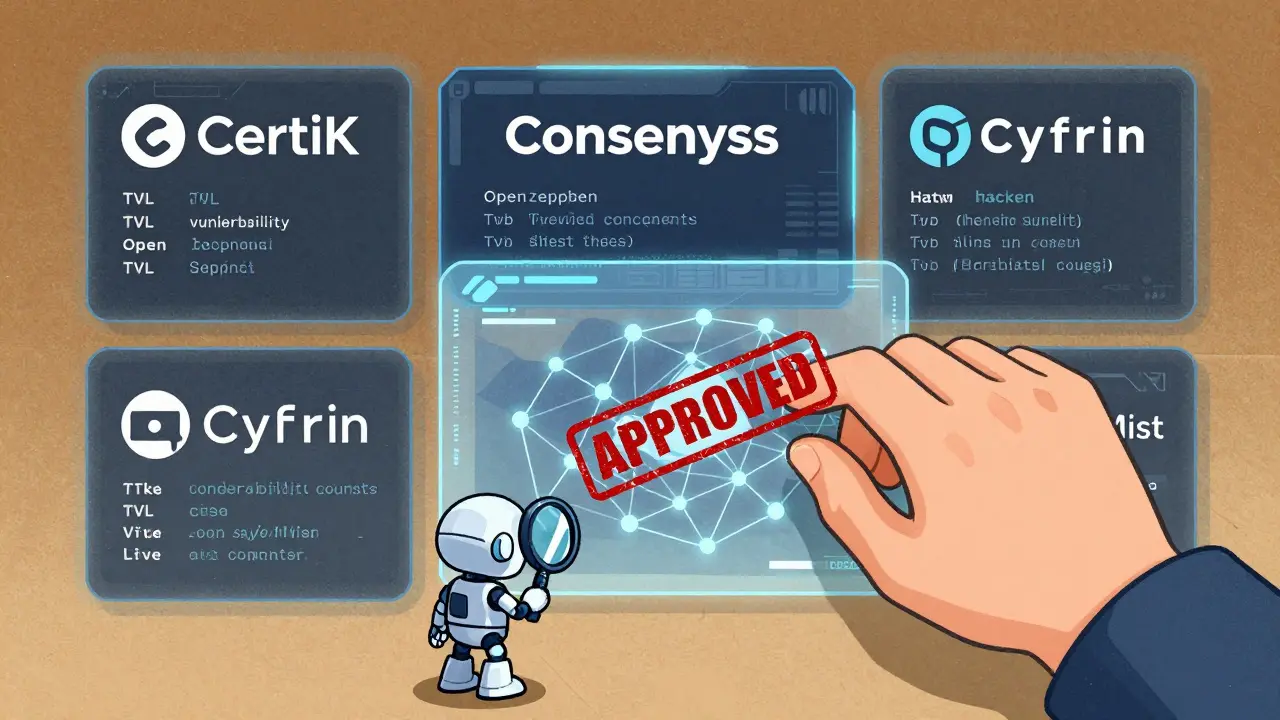
How to Choose the Right Auditor
There’s no single “best” firm. The right choice depends on your project:- Are you a high-value DeFi protocol? CertiK or ConsenSys Diligence are safest.
- Are you building on Ethereum and want developer-friendly tools? OpenZeppelin is ideal.
- Are you on Solana, Polygon, or a new chain? Cyfrin or Hacken offer broader coverage.
- Are you targeting Asia or need compliance help? SlowMist is your go-to.
The Future of Auditing
AI tools are starting to automate parts of auditing. But they can’t replace human judgment. A machine might miss a subtle reentrancy pattern hidden in a complex yield aggregator. Humans understand context - how a token’s economic model affects security. The top firms are adapting. CertiK is integrating AI to flag potential issues faster. OpenZeppelin is training developers with interactive simulations. ConsenSys is building audit tools into their IDEs. The future isn’t human vs. machine - it’s human with machine. Regulation is also changing things. The EU’s MiCA law and U.S. SEC guidance now require audits for certain DeFi products. That means demand will only grow. Firms that can prove compliance, not just security, will win.Final Thoughts
Smart contract auditing isn’t optional anymore. It’s the price of entry. The firms listed here aren’t just service providers - they’re infrastructure. Choosing one isn’t about cost. It’s about trust. If you’re launching a blockchain project, don’t wait for a hack to force your hand. Get an audit before you even go live. The difference between a secure protocol and a drained wallet often comes down to one decision - and one firm.How much does a smart contract audit cost?
Costs vary widely. Basic audits start around $5,000-$10,000 for simple tokens. Complex DeFi protocols with multiple contracts can cost $50,000-$150,000. Firms like CertiK and ConsenSys Diligence charge more due to their depth and reputation. Hacken and Cyfrin offer more budget-friendly tiers, especially for early-stage projects.
How long does a smart contract audit take?
Most audits take 2-4 weeks. Simple contracts (like a standard ERC-20 token) can be done in under a week. Complex DeFi systems - think lending pools, automated market makers, or staking contracts - often take 6-8 weeks. The timeline depends on code complexity, how well-documented the project is, and how quickly the team responds to findings.
Can I skip the audit if I’m using OpenZeppelin’s libraries?
No. Even if you use OpenZeppelin’s audited libraries, your custom logic can still introduce vulnerabilities. Most exploits happen in the glue code - how you connect the pieces. Auditing your full contract ensures your specific implementation is safe, not just the components you borrowed.
Do auditors guarantee my contract is hack-proof?
No one can guarantee 100% security. Even the best audits find 90-95% of vulnerabilities. The goal is to reduce risk to an acceptable level. Top firms don’t promise perfection - they provide confidence. After an audit, you’ll know the biggest risks are addressed, and you’ve taken industry-standard precautions.
What’s the difference between manual and automated auditing?
Automated tools scan for known patterns - like reentrancy or unchecked external calls. They’re fast and cheap. Manual review involves human experts reading every line of code, thinking like an attacker, and testing edge cases. The best audits use both: automated tools to catch the obvious, and humans to find the subtle, logic-based flaws that machines miss.
Should I choose a firm based on their client list?
Yes - but look beyond the big names. If a firm has audited projects similar to yours - same chain, same use case, same funding level - that’s more telling than seeing “Uniswap” on their website. A firm that’s handled a small DeFi yield optimizer is better suited for your startup than one that only works with billion-dollar protocols.



Kayla Thompson
March 25, 2026 AT 01:47Alicia Speas
March 26, 2026 AT 07:37Dheeraj Singh
March 27, 2026 AT 21:38Mike Yobra
March 29, 2026 AT 09:07Jeannie LaCroix
March 29, 2026 AT 17:03Sam Harajly
March 29, 2026 AT 19:30Zion Banks
March 29, 2026 AT 19:33Annette Gilbert
March 30, 2026 AT 10:07John Alde
March 31, 2026 AT 15:14