Cross-Chain Transfers: How Crypto Moves Between Blockchains
When you send Bitcoin to a wallet on Solana, or swap Ethereum for a token on Avalanche, you’re using a cross-chain transfer, a process that moves digital assets between separate blockchain networks without needing a centralized intermediary. Also known as blockchain interoperability, it’s what lets you use your crypto where it’s most useful—whether that’s low fees on Polygon, fast trades on Solana, or stable value on USDC. Without it, you’d be stuck on one chain, paying high gas fees and missing out on better yields, liquidity, or tools.
Most cross-chain transfers rely on bridges—software connectors that lock your crypto on one chain and mint an equivalent on another. But not all bridges are equal. Some, like the one used by stablecoins, digital currencies pegged to real-world assets like the US dollar, designed to reduce volatility and enable smooth transfers across networks, are widely trusted because they’re backed by real reserves and audited regularly. Others, especially those tied to obscure tokens, have been hacked for billions. The best cross-chain tools use atomic swaps, a peer-to-peer method that exchanges crypto directly between chains without a middleman, reducing risk and eliminating counterparty trust. These swaps rely on smart contracts that either complete the trade fully or cancel it entirely—no partial moves, no stolen funds.
Why does this matter now? Because DeFi isn’t stuck on Ethereum anymore. Users are chasing higher APYs on Arbitrum, faster NFT mints on Solana, and cheaper remittances via Celo’s mCEUR. Cross-chain transfers make all of that possible. They’re not just a technical feature—they’re the reason everyday people can access global finance without a bank. The posts below show you exactly how these transfers work in practice: which bridges are safe, how stablecoins move between chains without losing value, why some atomic swaps fail, and how real users are saving money by avoiding centralized exchanges. You’ll also see how cross-chain tools are being used in places like Iran and Vietnam, where traditional banking is blocked but crypto flows freely. This isn’t theory. It’s what’s happening right now.
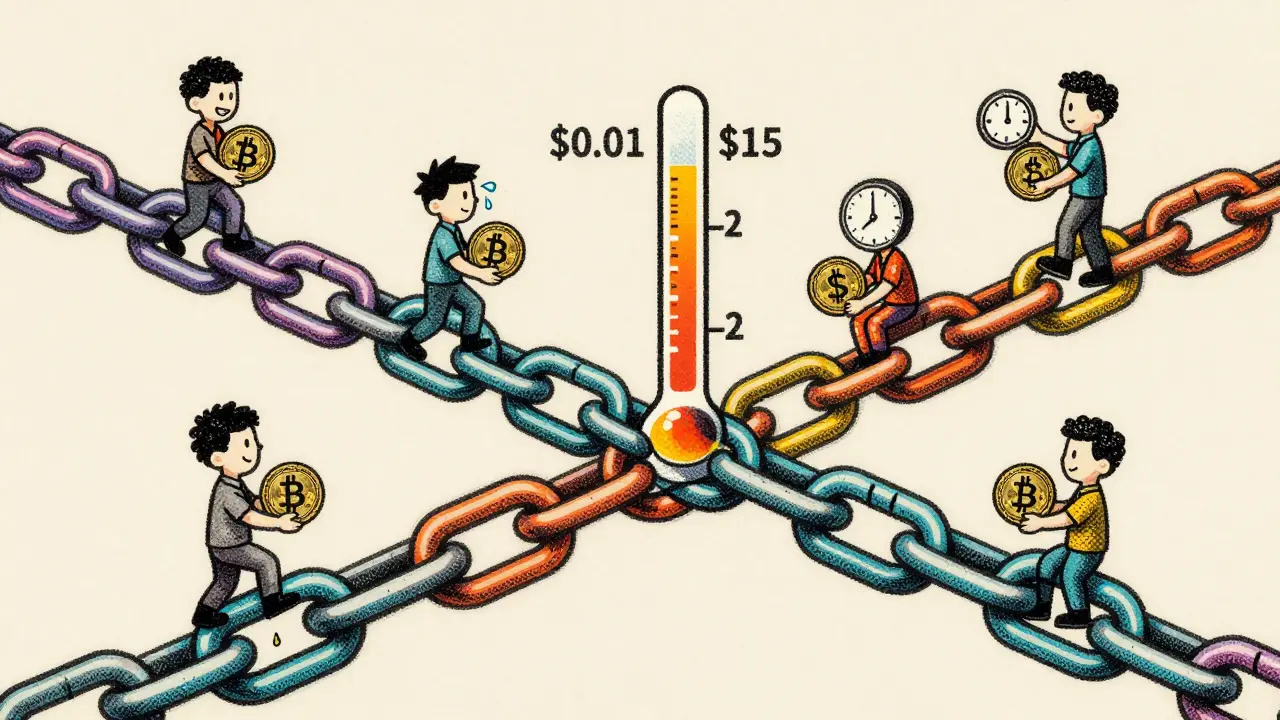
Bridge Fees and Transaction Times: What You Really Pay and Wait for Cross-Chain Transfers
Bridge fees and transaction times vary widely depending on the platform, blockchain, and transfer size. Learn how much you really pay and wait when moving crypto between chains-and how to avoid costly mistakes.
View More