Turkey Crypto Licensing Cost Calculator
This tool calculates the equivalent values of Turkey's mandatory capital requirements for crypto exchanges and custody providers under Law No. 7518 (2024). Determine whether you're meeting regulatory thresholds for operating in Turkey's crypto market.
Current Requirements
Crypto Exchange: 150 million TRY ($4.1 million USD)
Custody Provider: 500 million TRY ($13.7 million USD)
According to Law No. 7518 (June 26, 2024), Turkey requires crypto platforms to meet these minimum capital thresholds to operate legally in the country. The Turkish Capital Markets Board (CMB) enforces these requirements strictly.
Note: These requirements were implemented in July 2024. Unlicensed platforms serving Turkish users are blocked without warning.
Enter values to see equivalent licensing costs in the other currency.
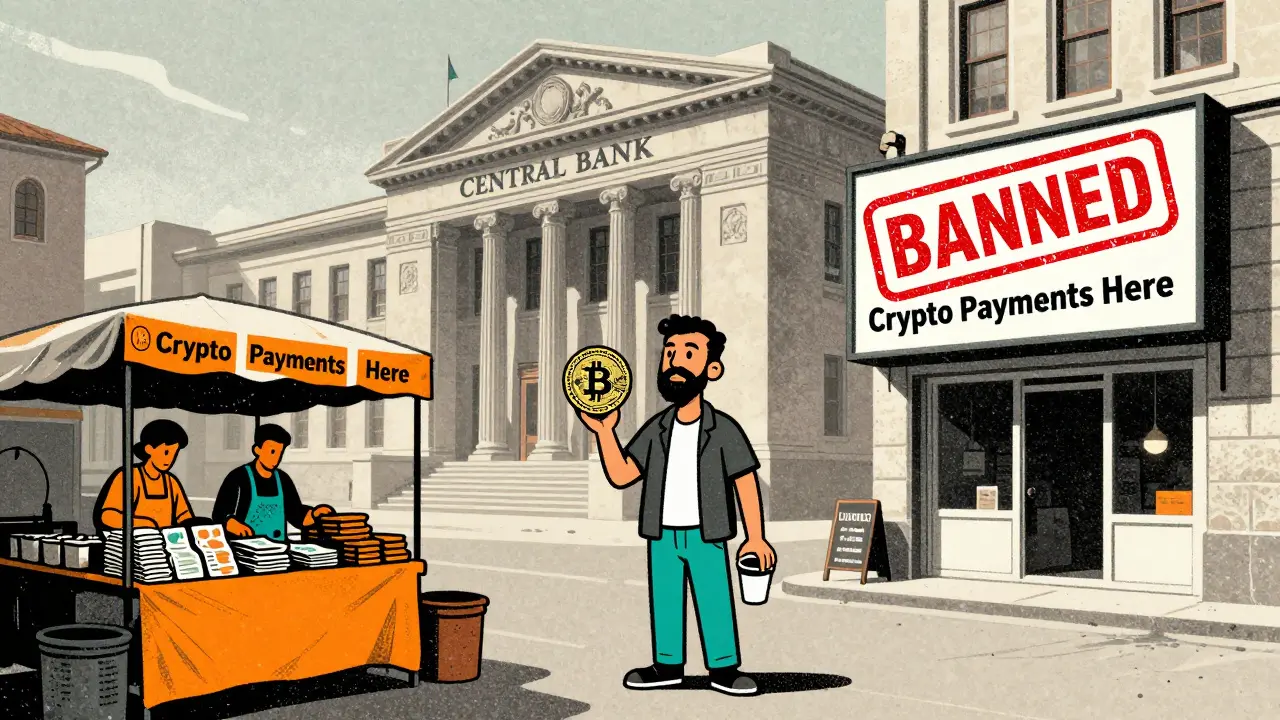
Before 2021, you could buy coffee with Bitcoin in Istanbul. By 2025, that’s illegal. Turkey didn’t just tighten rules-it rebuilt its entire crypto framework from the ground up. This isn’t about slowing down innovation. It’s about control. The government now decides who can trade, how much they can move, and who gets locked out entirely.
The Payment Ban That Changed Everything
In April 2021, Turkey’s Central Bank made a bold move: it banned the use of cryptocurrencies to pay for goods and services. Not trading. Not holding. Just spending. You could still buy Ethereum, hold it in a wallet, or sell it for lira-but you couldn’t use it to buy a phone, pay rent, or order food online. That single rule created a split in the market: crypto as speculation, not currency. Why? The lira. Turkey’s inflation hit 85% in 2022. People flocked to Bitcoin and stablecoins to protect their savings. The government saw that as a threat. If citizens started using crypto instead of lira, the central bank lost control over money supply, interest rates, and economic stability. So they drew a line: trade all you want, but don’t let crypto replace the currency.The Law That Redefined Crypto in Turkey
The real shift came with Law No. 7518, passed on June 26, 2024. For the first time, Turkish law defined what a cryptoasset, wallet, or exchange actually is. No more vague guidelines. No more loopholes. If you run a crypto platform in Turkey, you need a license. And not just any license-this one costs money. Exchanges must have at least 150 million Turkish lira (about $4.1 million) in capital. Custody providers need half a billion lira ($13.7 million). These aren’t suggestions. They’re legal requirements. The Turkish Capital Markets Board (CMB) now controls who gets to operate. And they’re not handing out licenses lightly. By July 2024, every platform serving Turkish users had to register. Unlicensed ones? They were cut off. No warnings. No grace period. Just blocked.Who’s Watching, and How?
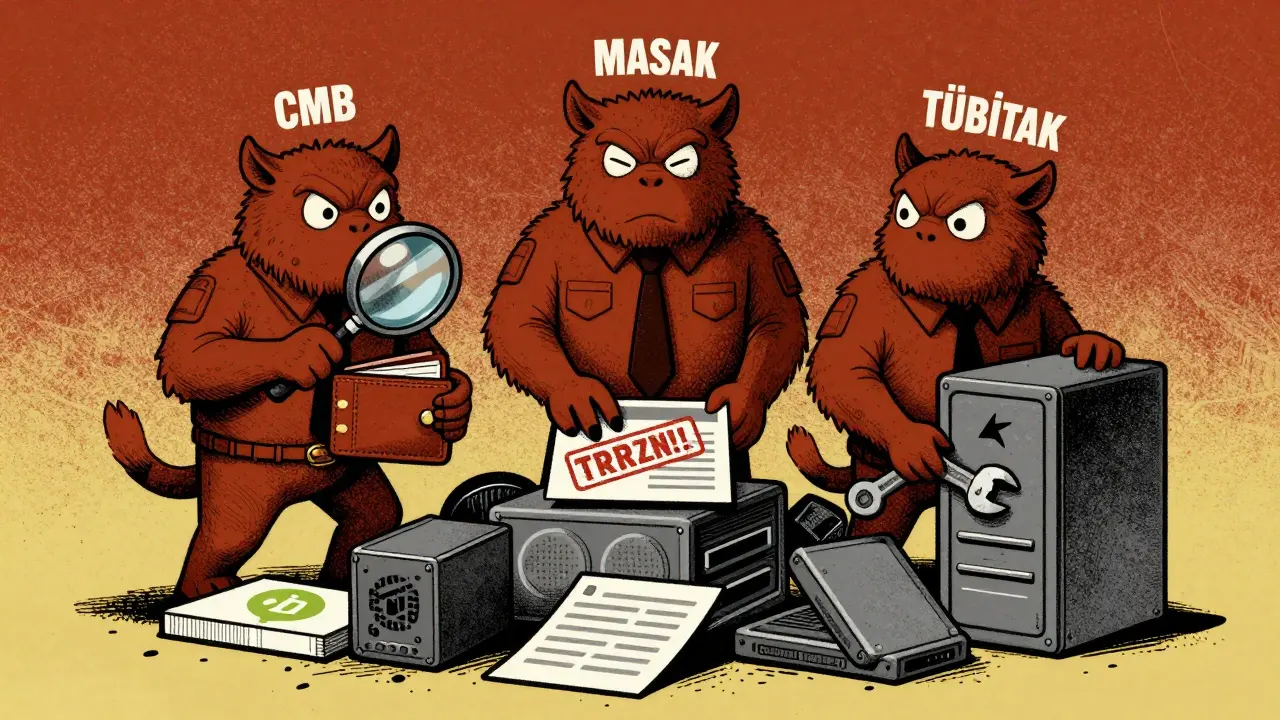
Turkey didn’t just create one regulator. It built a three-layer enforcement machine:- Capital Markets Board (CMB) - The boss. Issues licenses, sets rules, and punishes violators.
- Financial Crimes Investigation Board (MASAK) - The enforcer. Can freeze crypto and bank accounts without a court order if they suspect money laundering. No judge needed. Just suspicion.
- TÜBİTAK - The tech cop. Checks that platforms meet cybersecurity and infrastructure standards. If your server isn’t secure enough, you’re out.
The ICRYPEX Arrest: When Regulation Becomes Politics
On July 28, 2025, the founder of ICRYPEX, one of Turkey’s largest crypto exchanges, was detained. Officially, he was accused of using crypto to fund opposition groups. Unofficially? It sent a message: crypto isn’t just financial. It’s political. This wasn’t just about breaking rules. It was about control. If you’re running a platform that handles billions in transactions, and your users include activists, journalists, or critics of the government-you’re a target. The law gives MASAK the power to freeze accounts based on suspicion alone. That power can be used to silence dissent. Legal experts warn: this sets a dangerous precedent. In most democracies, freezing assets requires judicial review. In Turkey, it’s administrative. One call from MASAK, and your crypto vanishes.How Users Are Coping
Licensed exchanges like Paribu and Binance TR now have strict verification processes. You need a Turkish ID, a selfie, a utility bill, and sometimes a bank statement. It takes days. Some users give up and switch to international platforms. But those are getting blocked too. Reddit threads are full of complaints: “Why does my withdrawal take 72 hours?” “I uploaded my documents three times and still got rejected.” “I can’t buy USDT to send to my cousin abroad because it’s flagged as capital flight.” The truth? The system works for big players. It’s a nightmare for ordinary users. The payment ban means you can’t use crypto to send money home to family in Germany or pay for a Shopify store. The only way to move value internationally is through lira transfers-which come with high fees and exchange rate risks.How It Compares to the Rest of the World
Turkey’s approach is unique. It’s not as extreme as China’s total ban. But it’s stricter than the EU’s MiCA rules, which allow crypto payments. Unlike the U.S., where crypto is regulated by the SEC, CFTC, and state agencies, Turkey has one clear authority: the CMB. South Korea also requires licenses, but their capital requirements are lower. Switzerland welcomes crypto startups with tax breaks. Turkey? You need millions just to apply. The closest comparison? Russia. Both countries allow trading but block crypto as a payment tool. Both use financial regulation to reinforce state control over money flows. But Turkey’s system is more transparent-because it’s written into law.
What’s Coming Next
The government isn’t done. A new bill is being drafted to give MASAK even more power:- Transaction limits for stablecoins to stop people from moving money out of the country.
- Automatic reporting of all crypto-to-lira conversions above 10,000 lira.
- Penalties of up to 10 million lira for non-compliance.
Who Wins? Who Loses?
Big exchanges with deep pockets win. They can afford the $13 million license, the compliance teams, the legal advisors. Small platforms? Gone. Traders still win-sort of. Turkey has one of the highest crypto adoption rates in the world. Over 20% of adults own digital assets. They’re not going away. They’re just playing by new rules. Businesses lose. No one can build a crypto-based e-commerce platform. No one can use stablecoins for payroll. Remittance startups? Dead on arrival. The real winner? The Turkish state. It now controls the flow of money in and out of digital assets. It can track who’s buying what. It can freeze accounts without a court order. And it can use that power to protect its currency-or its political interests.What You Need to Do If You’re in Turkey
If you’re trading crypto in Turkey:- Only use CMB-licensed platforms. Check the official CMB registry.
- Keep every document: ID, bank statements, proof of income. You’ll need them.
- Never use crypto to pay for anything. Even if a merchant says it’s okay.
- Avoid large transfers to foreign wallets. MASAK flags those.
- Don’t assume anonymity. Your IP, wallet, and bank are all linked.
Is it legal to own cryptocurrency in Turkey?
Yes, owning cryptocurrency is legal in Turkey. You can buy, hold, and sell Bitcoin, Ethereum, and other digital assets. But you cannot use them to pay for goods or services. All trading must go through licensed platforms regulated by the Capital Markets Board (CMB).
Can I use Binance or Coinbase in Turkey?
You can use Binance TR and other CMB-licensed platforms. International platforms like Binance.com or Coinbase are blocked by Turkish authorities. Even if you use a VPN, your transactions may be flagged, and your account could be frozen by MASAK if you’re detected using unlicensed services.
Why was PancakeSwap blocked in Turkey?
PancakeSwap was blocked because it’s a decentralized exchange (DEX) that doesn’t have a Turkish license. Under Law No. 7518, all crypto platforms serving Turkish users must be licensed by the CMB. DEXs like PancakeSwap don’t collect user IDs or report transactions, making them non-compliant with Turkish AML rules.
Can MASAK freeze my crypto without a court order?
Yes. MASAK has the legal authority to freeze crypto and bank accounts if they suspect money laundering or terrorist financing-without needing prior court approval. This power was expanded in 2025 and is one of the most controversial aspects of Turkey’s crypto law.
What happens if I don’t comply with Turkey’s crypto rules?
You could face account freezes, fines up to 10 million Turkish lira, or criminal charges if your activity is linked to sanctions evasion or funding opposition groups. Even accidental non-compliance-like using an unlicensed exchange-can trigger MASAK investigations.
Is crypto trading still popular in Turkey despite the rules?
Yes. Over 20% of Turkish adults own cryptocurrency, making it one of the highest adoption rates globally. People still trade to protect savings from inflation. But they do it through licensed platforms, even if the process is slower and more bureaucratic.



Renelle Wilson
December 4, 2025 AT 15:30While the Turkish government's approach to crypto regulation is undeniably stringent, it's worth considering the broader context: hyperinflation has eroded public trust in the lira to such an extent that digital assets became a lifeline, not a luxury. The state’s response-while legally coherent-reflects a deeper anxiety about losing monetary sovereignty. This isn’t merely about controlling capital flows; it’s about preserving the illusion of economic stability in the face of structural collapse. The irony is that by suppressing crypto as a medium of exchange, they’ve only reinforced its role as a store of value, creating a dual economy where the official currency is hollowed out while private digital networks thrive in the shadows.
Moreover, the concentration of regulatory power in the CMB, MASAK, and TÜBİTAK creates a surveillance architecture that’s unprecedented in its integration. Unlike the fragmented U.S. system, Turkey’s model is a top-down monolith, where compliance isn’t just bureaucratic-it’s existential. For ordinary citizens, this means every transaction is a potential audit, every wallet a dossier. The psychological impact is profound: trust in institutions has been replaced by institutionalized suspicion.
And yet, adoption remains high. That tells us something critical: regulation doesn’t kill demand-it just redirects it. People aren’t abandoning crypto; they’re adapting to its constraints, using layered workarounds, offshore wallets, and peer-to-peer networks to preserve autonomy. The state may control the legal channels, but it can’t control human ingenuity. The real test will be whether this model can sustain itself as younger generations, raised on decentralized systems, grow into adulthood with fundamentally different assumptions about money, privacy, and power.
What’s missing from this entire framework is any recognition of crypto’s potential as a tool for financial inclusion. Instead of building bridges to unbanked populations, Turkey has built walls. And in doing so, it’s turned innovation into an act of civil disobedience.
Elizabeth Miranda
December 5, 2025 AT 14:09The way Turkey handles crypto is less about innovation and more about maintaining control over the narrative of economic stability. It’s fascinating how they’ve managed to criminalize use without criminalizing ownership-essentially turning Bitcoin into a speculative asset rather than a currency. This isn’t unique, but the precision of the legal architecture is. They didn’t just ban payments; they redefined the entire ecosystem through statute. The fact that they’ve codified terms like ‘cryptoasset’ and ‘wallet’ into law is a quiet revolution in regulatory clarity.
Still, the human cost is staggering. Imagine needing a utility bill and a selfie just to move your own money. It’s not regulation-it’s financial surveillance dressed in compliance. And the MASAK power to freeze accounts without judicial oversight? That’s not a feature. It’s a bug in any functioning democracy. The state is now the ultimate gatekeeper of digital wealth, and that’s a dangerous precedent-even if inflation justifies some level of intervention.
Chloe Hayslett
December 6, 2025 AT 00:39Wow, so Turkey finally figured out that letting people use crypto to dodge inflation is basically surrendering economic sovereignty. Who knew? Maybe if they hadn’t printed trillions of lira like confetti, they wouldn’t need to ban people from buying USDT to pay for groceries. But nope-better to punish citizens than fix the root problem. Classic.
Jonathan Sundqvist
December 6, 2025 AT 14:46They banned crypto payments because people were using it to escape the lira. So now you can’t buy a coffee with BTC but you can still buy a gun with cash? Real smart. At least the government’s consistent: if you’re trying to be free with your money, you’re the enemy.
Jerry Perisho
December 7, 2025 AT 00:59Key point: Turkey’s system is one of the few where crypto regulation is codified in law rather than enforced through arbitrary decrees. That’s actually a step forward compared to places like Nigeria or Argentina where rules change daily. The licensing thresholds are insane, sure, but at least you know what you’re up against. The real issue isn’t the rules-it’s the lack of appeal mechanisms. If MASAK freezes your account, you’re stuck until they decide you’re not a threat. No judge, no hearing, no recourse. That’s not regulation. That’s authoritarianism with a compliance checklist.
ronald dayrit
December 7, 2025 AT 22:36There’s a philosophical tension here that goes far beyond finance. Crypto, at its core, is a rejection of centralized authority over value. Turkey’s response isn’t just legal-it’s ontological. By outlawing crypto as a medium of exchange while permitting it as a speculative asset, they’ve created a paradox: you can own it, but you cannot use it to assert autonomy. This is a state asserting its right to define the meaning of money itself. And in doing so, it reveals a deeper fear: that if people can assign value outside the state’s control, then the state’s legitimacy is contingent, not inherent.
The CMB’s license regime, MASAK’s warrantless freezes, TÜBİTAK’s infrastructure mandates-they’re not merely regulatory tools. They’re instruments of epistemic control. They tell you what money is, who can handle it, and how you may relate to it. In this framework, crypto isn’t a technology. It’s a threat to the state’s monopoly on meaning.
And yet, people still trade. They still hold. They still send value across borders. Why? Because human beings don’t surrender autonomy easily. Even when the law says you can’t, the human spirit finds a way. The state may control the ledger, but it can’t control the will to be free.
So what happens when the next generation, raised on decentralized networks, inherits this system? Will they accept the lira as sacred, or will they build new ones outside the law? The answer to that question will determine whether Turkey’s model is a triumph of control-or the last gasp of a crumbling order.
Neal Schechter
December 8, 2025 AT 00:19Big picture: Turkey’s crypto rules are like a really strict DMV for money. You need 10 forms, a notarized selfie, and a blood sample just to trade. But hey, at least you know where you stand. The problem is, most people aren’t trying to launder money-they’re just trying to send cash to their sister in Germany or save up for a new phone. This system doesn’t protect the economy. It just makes life harder for normal folks. And the worst part? It’s not even working. People are still using crypto. They’re just doing it through Telegram groups and VPNs. So the government’s spending millions to enforce rules that everyone’s already ignoring. Classic.
Adam Bosworth
December 8, 2025 AT 00:55so like… pancakeswap got blocked? lmao. they think they can just shut down a dex? who do they think they are? the feds? pfft. i bet the guy who wrote this law still uses cash to buy kebabs. absolute joke. masak freezing accounts w/o a warrant? that’s not regulation, that’s a mob hit with a spreadsheet. and the 10 million lira fine? for what? using binance? bro i’m not paying that just to buy dogecoin. this whole thing is a dumpster fire wrapped in a powerpoint.
Annette LeRoux
December 9, 2025 AT 09:35It’s wild how the same government that bans crypto payments lets people buy gold like it’s going out of style. 🤔 So if you’re scared of inflation, you can hoard shiny metal but not a digital token? That’s not policy. That’s hypocrisy with a flag. 💸✨ Also, MASAK freezing accounts without a court order? That’s not law. That’s a villain origin story. 🚨 #CryptoIsFreedom
Vincent Cameron
December 9, 2025 AT 23:09Every time a state tries to control money, it ends up controlling people instead. Turkey’s crypto laws are the perfect example: they didn’t ban Bitcoin-they banned trust. When you can’t use your own money to pay for things without government approval, you’re not a citizen. You’re a customer. And the state? It’s the only vendor that matters. That’s not regulation. That’s the end of economic freedom, dressed up in legal jargon.