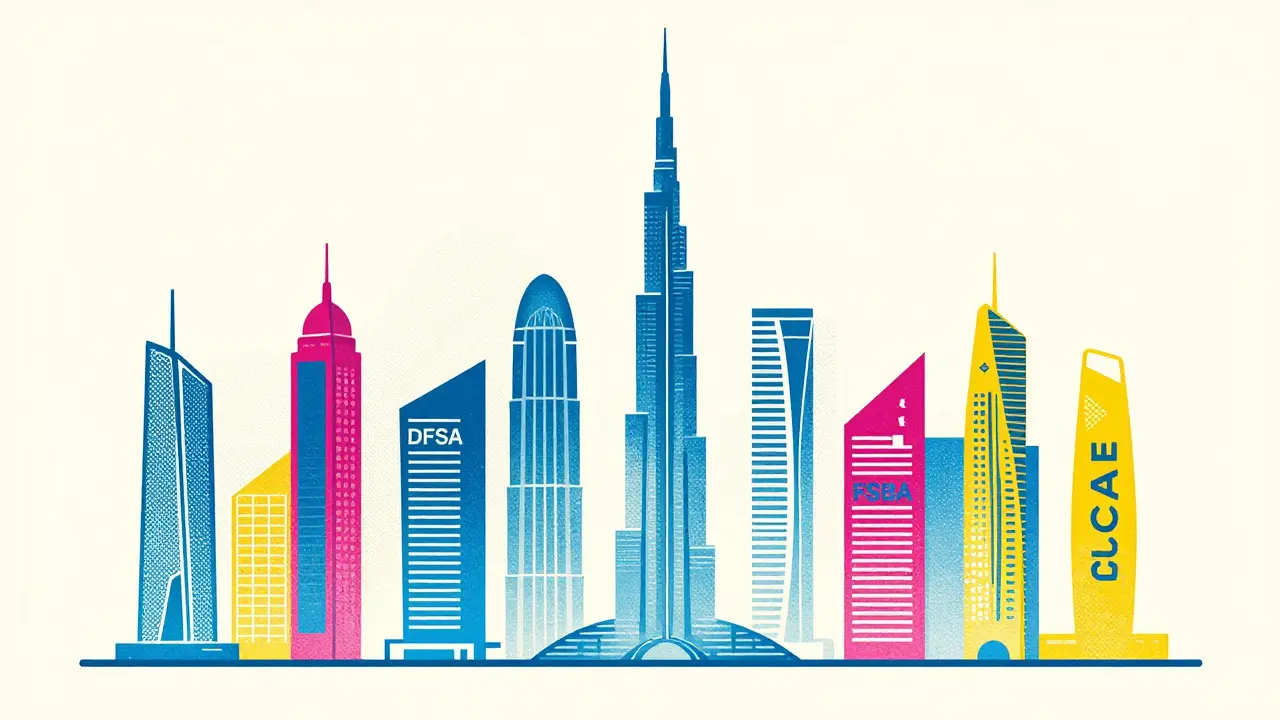
For years, the United Arab Emirates was known as a place where crypto businesses could operate with minimal oversight. That era ended in 2025. Today, the UAE stands as one of the most strictly regulated-and actively supportive-crypto jurisdictions in the world. If you are looking to launch an exchange, custody service, or token project here, you need to understand that "crypto-friendly" no longer means "unregulated." It means "clearly defined."
The regulatory landscape has shifted dramatically since the initial guidelines were drafted in 2020. With the full operationalization of the multi-layered framework in 2025 and the introduction of the Crypto-Asset Reporting Framework (CARF) later that year, the rules are now concrete. For investors and operators, this brings stability but also significant compliance burdens. This guide breaks down who regulates what, how much it costs to get licensed, and what the new tax transparency rules mean for your bottom line.
The Five Pillars of UAE Crypto Regulation
Unlike countries with a single central authority, the UAE uses a fragmented but coordinated approach. There is no single "Crypto Commissioner" for the entire nation. Instead, five distinct authorities share responsibility based on geography and asset type. Understanding which regulator applies to your business model is the first step in compliance.
| Authority | Jurisdiction | Primary Focus |
|---|---|---|
| VARA | Dubai (Mainland & Free Zones excluding DIFC) | Detailed licensing for exchanges, wallets, and token issuance |
| DFSA | Dubai International Financial Centre (DIFC) | Investment-grade activities and institutional custody |
| FSRA | Abu Dhabi Global Market (ADGM) | Brokers, fund managers, and institutional services |
| SCA | Federal Level | Investment-related virtual assets and public offerings |
| CBUAE | Federal Level | Payment tokens and banking sector integration |
VARA, the Virtual Assets Regulatory Authority, is the most prominent name for most crypto startups. Established specifically to regulate virtual assets outside of the DIFC, VARA provides the most granular set of rules. If you are operating a retail exchange or issuing utility tokens in Dubai, VARA is your primary contact. The DFSA and FSRA, by contrast, cater more to traditional financial institutions entering the digital asset space, focusing on investment products and high-net-worth clients.
Licensing Requirements: Costs and Categories
Getting a license in the UAE is not cheap, nor is it quick. The process is designed to filter out serious players from speculative ones. Under VARA’s framework, licenses are divided into specific activity categories. You cannot simply get a "general crypto license." You must apply for the exact services you intend to provide.
The six primary categories include:
- Exchange services (matching buyers and sellers)
- Fiat-to-virtual asset broker services
- Virtual asset-to-virtual asset broker services
- Transfer services (moving assets between wallets)
- Custody services (safeguarding private keys)
- Wallet provision
Token issuance is treated separately. Category 1 tokens require both a license and specific approval from VARA, while Category 2 tokens require a licensed distributor. Closed-loop tokens (those only usable within a specific ecosystem) may be exempt from licensing but remain under supervision.
Financial requirements vary by category. Paid-up capital ranges from AED 100,000 ($27,000) for simpler services up to AED 1.5 million ($408,000) for complex operations like exchanges and custody. Application fees sit between AED 40,000 and AED 100,000, with annual supervision fees ranging from AED 80,000 to AED 200,000. These figures do not include legal counsel, compliance officer salaries, or technology audits, which can easily double your initial outlay.
Tax Changes: VAT Exemptions and CARF Implementation
One of the biggest misconceptions about the UAE is that it is a tax haven. While there is no personal income tax, the regulatory environment has tightened significantly regarding value-added tax (VAT) and international reporting standards.
On November 15, 2024, a major relief measure took effect: most transactions involving virtual assets became exempt from the standard 5% VAT. This includes buying, selling, and exchanging cryptocurrencies like Bitcoin and Ethereum. This exemption makes the UAE highly competitive compared to European jurisdictions where crypto trades often incur VAT liabilities.
However, the real game-changer arrived in September 2025 with the announcement of the Crypto-Asset Reporting Framework (CARF). Modeled after the Common Reporting Standard (CRS) used for bank accounts, CARF mandates that crypto service providers collect and share detailed data with tax authorities. This affects exchanges, brokers, custodians, and wallet providers.
Under CARF, entities must report:
- Account balances at the end of each calendar year
- Gross proceeds from sales or redemptions of crypto assets
- Customer identification details and residency status
- Transaction histories for certain high-value activities
The timeline for full implementation is staggered. Public consultation closed in November 2025, final regulations are expected in 2026, and actual data exchange begins on January 1, 2027. The first automatic exchange of tax data will occur in 2028. For users, this means total transparency. Hiding crypto gains from tax authorities in your home country via a UAE-based exchange is no longer viable.
Compliance and Anti-Money Laundering (AML) Standards
The UAE aligns its AML/CFT (Combating the Financing of Terrorism) controls with recommendations from the Financial Action Task Force (FATF). This is non-negotiable. All licensing applicants undergo enhanced due diligence checks. Key personnel must pass fit-and-proper assessments, demonstrating integrity and technical competency.
In 2025, regulations expanded to explicitly cover decentralized finance (DeFi) protocols and non-fungible tokens (NFTs). Previously, these areas existed in gray zones. Now, DeFi protocols offering centralized interfaces or custodial services fall under VARA’s jurisdiction. NFT marketplaces must comply with KYC (Know Your Customer) requirements if they facilitate fiat on-ramps or off-ramps.
A critical deadline passed in August 2025: all merchants in the UAE, excluding those in Financial Free Zones, are mandated to accept crypto payments only through licensed providers. Unlicensed payment processors were given a 12-month grace period, which has now expired. Businesses found accepting crypto through unverified channels face heavy fines or suspension of operations.

Why Companies Choose the UAE Despite Strict Rules
If the regulations are so strict, why have over 400 companies established operations in the UAE? The answer lies in certainty. In many Western jurisdictions, regulators change their stance overnight. In the UAE, the rules are written down, published, and enforced consistently. Major players like Binance, Crypto.com, Bybit, BitGo, and Laser Digital have chosen the UAE because they know exactly what is required to operate legally.
The multi-jurisdictional structure allows flexibility. A company might choose VARA for its retail-focused exchange license, while setting up a subsidiary in ADGM under FSRA to manage institutional funds. This modularity is unique to the UAE’s federal system. Additionally, the absence of corporate income tax for most free zone companies remains a powerful incentive, provided all regulatory fees and compliance costs are factored into the budget.
Future Outlook: 2026 and Beyond
As we move through 2026, the focus shifts from establishing frameworks to enforcing them. Regulators are conducting more frequent audits and imposing stricter penalties for non-compliance. The integration of real-world asset (RWA) tokenization is another growing area, with specific guidelines emerging for securities tokenization.
For individual investors, the message is clear: keep records. With CARF implementation approaching, your transaction history will be visible to global tax authorities. Use licensed platforms to ensure your assets are protected under UAE law. For businesses, invest heavily in compliance infrastructure early. The cost of retrofitting systems to meet VARA or DFSA standards is far higher than building compliant systems from day one.
Is cryptocurrency legal in the UAE?
Yes, cryptocurrency is legal in the UAE, but it is heavily regulated. Buying, selling, and holding Bitcoin and altcoins is permitted. However, operating a business related to crypto requires a license from one of the five regulatory authorities (VARA, DFSA, FSRA, SCA, or CBUAE). Using unlicensed platforms for commercial activities is illegal.
Do I need a VARA license to trade crypto personally?
No. VARA licenses are for businesses providing services such as exchanges, custody, or brokerage. Individual investors do not need a license to buy or sell crypto. However, you must use licensed service providers to ensure compliance with local laws and anti-money laundering regulations.
How does CARF affect my crypto taxes?
CARF requires crypto service providers in the UAE to report your account balances and transaction data to tax authorities starting in 2027. This data will be shared automatically with other countries. If you are a tax resident of another country, you must declare your crypto gains according to your home country’s laws. The UAE itself does not impose personal income tax on crypto gains, but it facilitates global tax transparency.
What is the cost of getting a crypto license in Dubai?
Costs vary by service type. For VARA licenses, paid-up capital ranges from AED 100,000 to AED 1.5 million. Application fees are between AED 40,000 and AED 100,000. Annual supervision fees range from AED 80,000 to AED 200,000. Additional costs include legal advice, compliance software, and office space in approved free zones.
Can I accept crypto payments as a merchant in the UAE?
Yes, but only through licensed payment providers. Since August 2025, merchants outside Financial Free Zones must use VARA-licensed or other authorized entities to process crypto payments. Direct peer-to-peer payments without a licensed intermediary are restricted for commercial transactions to prevent money laundering.



Eric Braddock
July 7, 2026 AT 23:22The so-called "stability" they tout is merely a sophisticated mechanism for state surveillance and capital control disguised as regulatory clarity. They are not protecting you; they are building the cage while convincing you it's a sanctuary. The CARF implementation is just the latest iteration of the globalist agenda to eradicate financial privacy, ensuring that every satoshi you hold is tracked, taxed, and monitored by the very entities that caused the systemic failures in the first place. It is a trap.
Alicia Hull
July 9, 2026 AT 12:50This article completely ignores the massive barrier to entry for small businesses! You claim it brings stability, but with paid-up capital requirements hitting up to AED 1.5 million for complex operations, you are effectively banning anyone who isn't already wealthy or backed by venture capital firms. How is this fair to local entrepreneurs? The compliance costs alone will bankrupt startups before they even launch. This isn't regulation; it's exclusionary gatekeeping designed to protect big banks from crypto competition.
Anuj Kashyap
July 10, 2026 AT 13:25It is fascinating how the narrative has shifted from "crypto is freedom" to "crypto is compliant banking." 😂 The UAE is simply positioning itself as the Switzerland of digital assets, but without the neutrality. They want the fees, the taxes (via transparency), and the prestige, but none of the decentralization ethos. We are watching the co-opting of technology in real-time. 🤷♂️
Nick Wengel
July 12, 2026 AT 01:56I think there is a lot of value in having clear rules even if they are strict. In many places we do not know what is allowed until after we get fined. Here at least you can read the VARA guidelines and know exactly what to do. It might be expensive but it is better than uncertainty for long term planning.
Johan Otto
July 13, 2026 AT 19:49Boring stuff. Just pay the fees and play the game. Everyone else is crying about freedom while I'm just trying to make money. If they say jump, I ask how high and what the budget is. No drama needed here.
Tracy Marshall
July 14, 2026 AT 22:00the moral decay of our society is evident when people accept total surveillance as a trade off for convenience. these regulations are not about safety they are about control. the government wants to see everything you own. it is a violation of basic human rights to have your private financial data shared internationally without consent. wake up people :(
Guy Davis
July 14, 2026 AT 23:50typical westerners complaining about rules. if u cant afford 1.5m dirhams then maybe dont start an exchange. its simple math. stop whining about fairness. rich countries have always had barriers. now crypto has them too. deal with it.
KEITH WONG
July 15, 2026 AT 09:45Look, the writing on the wall is clear. VARA isn't just regulating; they're curating. Only the elite survive this filter. 📉 If you're thinking of launching a retail exchange, check your wallet balance first. Most of you don't have the liquidity to even file the application, let alone maintain the annual supervision fees. It's a gold rush where only those with pickaxes made of solid gold can dig. 🏦💸
Nick G
July 16, 2026 AT 15:46While I understand the concerns regarding the high initial capital requirements and the intrusive nature of the new reporting frameworks, it is essential to consider the broader context of international financial integration. The UAE is attempting to bridge the gap between traditional fiat systems and emerging digital asset classes, which inherently requires a level of trust and verification that may feel burdensome to purists. However, for the average investor seeking protection against fraud and market manipulation, these stringent measures provide a necessary layer of security that was previously absent in the wild west of early cryptocurrency markets. It is a delicate balance between innovation and consumer protection, and perhaps the current tilt towards regulation is a temporary phase as the industry matures globally.