Have you ever tried to send a simple text message and been charged five dollars for it? That was the reality of using Ethereum is a decentralized blockchain platform that enables smart contracts and dApps just a few years ago. Today, thanks to major protocol upgrades, sending ETH often costs less than buying a cup of coffee. But why do these fees exist at all, and why do they fluctuate so wildly?
If you are holding crypto or planning to interact with decentralized finance (DeFi), understanding gas fees is the computational cost paid to process transactions on the Ethereum network is non-negotiable. These aren't arbitrary taxes; they are the fuel that keeps the engine running. Without them, the network would be clogged with spam, and validators would have no incentive to secure your data. This guide breaks down exactly how gas works, why prices change, and how you can stop overpaying.
What Exactly Is Gas on Ethereum?
Think of Ethereum as a massive, global computer. Every time you want this computer to do something-whether it's transferring money, minting an NFT, or swapping tokens-you need to pay for the electricity and processing power used. That payment is called "gas."
The term "gas" refers to the unit of measurement for the amount of computational effort required to execute specific operations. The more complex the operation, the more gas units it consumes. For example:
- Simple ETH transfer: Requires exactly 21,000 gas units. It’s straightforward because the network only needs to update two balances.
- Token swap on Uniswap: Typically requires around 100,000 gas units. This involves interacting with smart contracts, checking liquidity pools, and executing code.
- NFT Minting: Can range from 50,000 to over 200,000 gas units depending on the contract complexity and metadata storage.
- Smart Contract Deployment: Often exceeds 500,000 gas units because you are writing new code onto the blockchain permanently.
Gas is measured in gwei is a subunit of Ether, where 1 gwei equals 0.000000001 ETH. Using gwei makes the numbers manageable. If we used full ETH values, you’d be dealing with decimals like 0.0000021 ETH, which is confusing. Instead, you see "21 gwei," which is much easier to grasp.
The Two Parts of Your Fee: Base vs. Priority
Before August 2021, setting gas fees felt like gambling. You had to guess what others were paying to get your transaction included in the next block. If you guessed too low, your transaction sat there forever. If you guessed too high, you overpaid. Then came EIP-1559 is a protocol upgrade that changed how Ethereum calculates transaction fees by introducing a base fee and priority fee structure, also known as the London Upgrade. This changed everything.
Today, every transaction fee consists of two distinct parts:
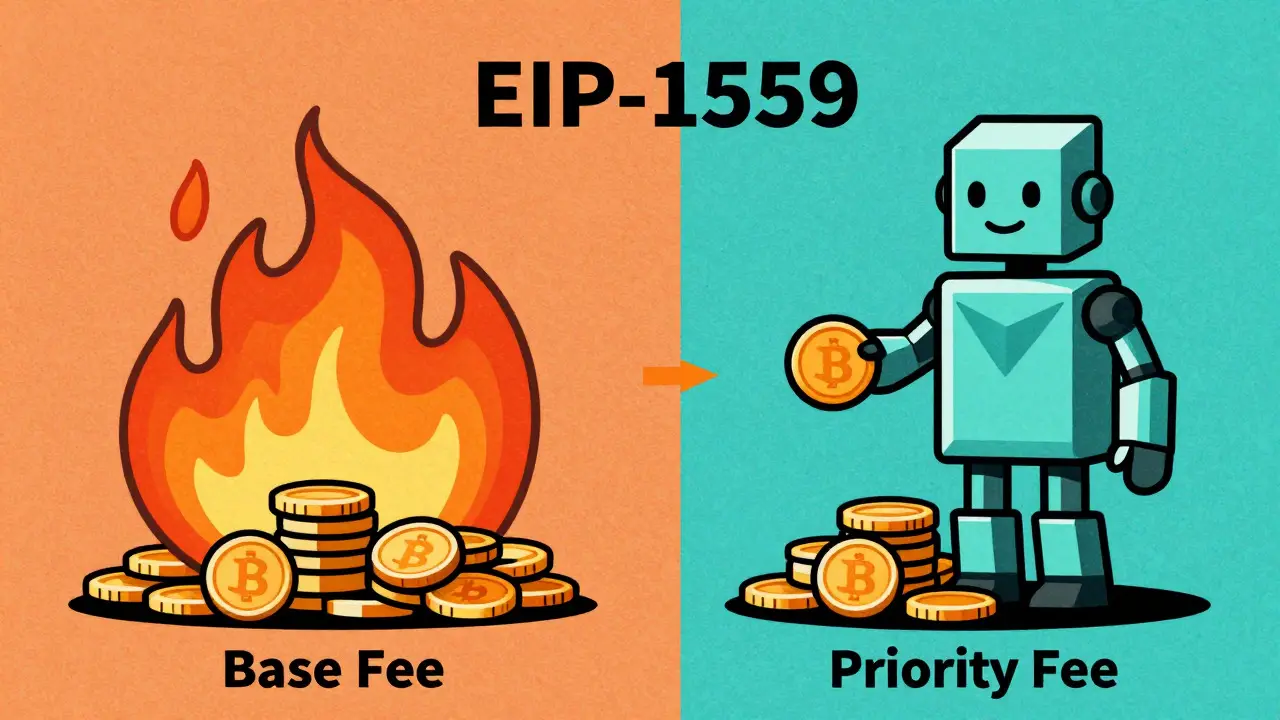
- The Base Fee: This is the minimum price per gas unit required for your transaction to be included in a block. It is determined automatically by the network based on demand. If blocks are full (above 15 million gas usage), the base fee goes up. If blocks are empty, it goes down. Crucially, this fee is burned-removed from circulation entirely. This makes ETH slightly deflationary during busy periods.
- The Priority Fee (Tip): This is a voluntary tip you give directly to the validator who includes your transaction. Validators prioritize transactions with higher tips. During normal times, this might be 1-5 gwei. During a hype event, like a popular NFT drop, it can spike to 150+ gwei.
Your total cost is calculated as: (Base Fee + Priority Fee) × Gas Units Used = Total Transaction Fee.
Why Are Fees So Much Lower Now? The Dencun Effect
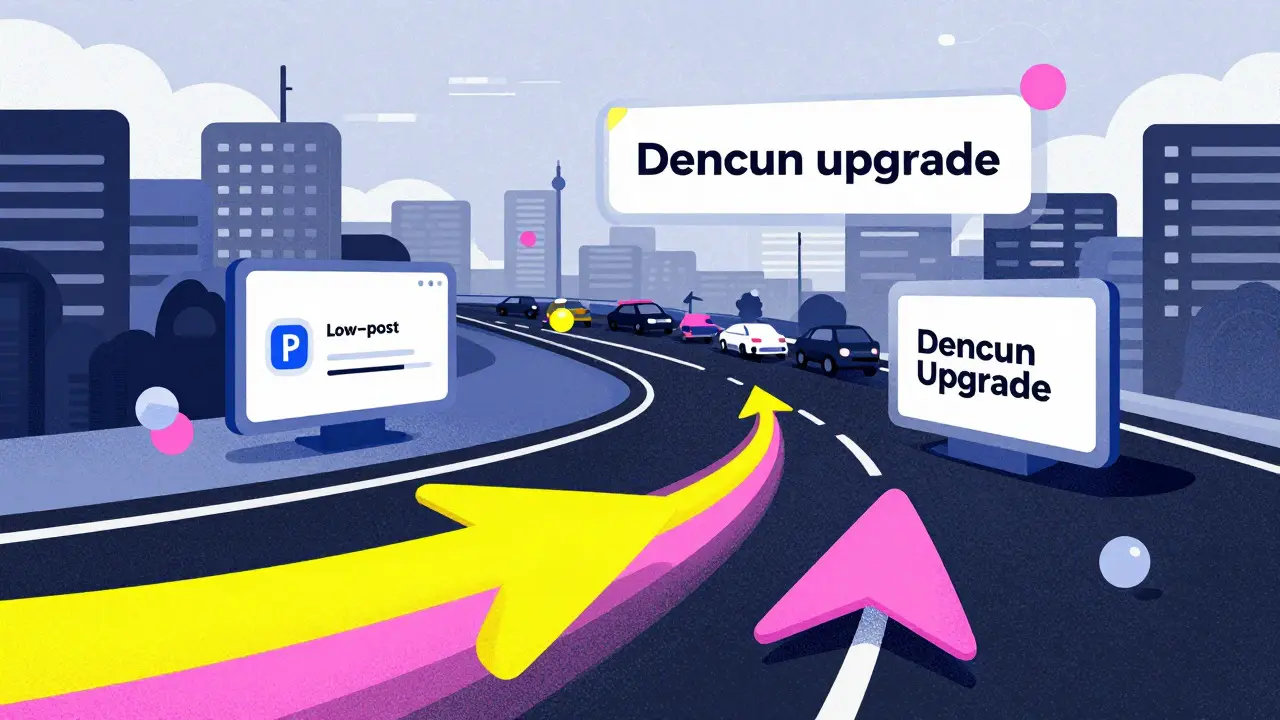
If you remember 2021 or 2024, you likely recall paying $50 or even $100 for a single transaction. In 2026, that is rare. Why? The answer lies in the Dencun upgrade is an Ethereum network upgrade implemented in early 2024 that introduced proto-danksharding to reduce Layer 2 costs.
Dencun introduced a feature called proto-danksharding (EIP-4844). Before this, Layer 2 solutions (like Arbitrum or Optimism) had to post their transaction data directly onto Ethereum's main chain, which was expensive. With Dencun, they can now use "blobs"-cheaper, temporary storage space-to post this data. This reduced data availability costs by approximately 90% for Layer 2 networks.
While Dencun primarily helped Layer 2s, the overall effect has been a significant reduction in congestion on the main Ethereum chain. Many users migrated to cheaper Layer 2s, leaving more room on Mainnet. As a result, simple ETH transfers on Mainnet now often cost between $0.50 and $1.50, compared to the multi-digit dollar averages of previous years. According to recent analyses, standard transaction costs have dropped by roughly 95% compared to peak 2024 levels.
| Network | Avg. Simple Transfer Cost | Primary Use Case | Security Model |
|---|---|---|---|
| Ethereum Mainnet | $0.50 - $1.50 | High-value settlements, DeFi core | Direct Proof-of-Stake |
| Solana | $0.00025 | High-frequency trading, Gaming | Proof-of-History / PoS |
| Polygon PoS | $0.001 | Enterprise apps, Micropayments | Sidechain with checkpoints |
| Arbitrum One (L2) | $0.10 - $0.30 | DeFi, NFTs, General dApps | Optimistic Rollup on ETH |
How to Stop Overpaying: Practical Tips
Even with lower average fees, volatility remains. A sudden surge in activity can still cause spikes. Here is how experienced users manage their costs:
1. Time Your Transactions
Ethereum operates globally, but usage patterns follow human behavior. Network congestion is typically lowest during weekends and late-night hours in major financial hubs (New York, London, Tokyo). Tools like ETH Gas Station is a web tool that provides real-time gas price estimates and historical data for Ethereum transactions update every 15 seconds. Check the map before sending large amounts. If the color is red, wait. If it's green, go.
2. Understand Wallet Presets
Wallets like MetaMask is a popular cryptocurrency wallet and gateway to blockchain apps offer "Slow," "Standard," and "Fast" presets. These are algorithms predicting how quickly you want confirmation.
- Slow: Good for non-urgent transfers. You save money but might wait 10-20 minutes.
- Standard: The sweet spot for most users. Confirms within 1-2 blocks.
- Fast: Only use this if you are front-running a trade or minting a limited-edition NFT. Otherwise, you are throwing money away.
3. Set Custom Gas Limits Carefully
A common mistake beginners make is letting the wallet auto-set the gas limit. While usually accurate, sometimes wallets overestimate to ensure success. For a simple ETH transfer, the limit is always 21,000. You can manually set this. For complex interactions, set the limit 10-15% higher than the estimated minimum to prevent failure, but not so high that you waste funds. Remember: if your transaction fails due to out-of-gas errors, you still lose the gas paid.
4. Consider Layer 2 Solutions
If you are doing frequent small trades or playing blockchain games, stay off Mainnet. Use Layer 2 networks like Arbitrum, Optimism, or Base. They settle on Ethereum for security but charge a fraction of the gas. The user experience is nearly identical, but the cost difference is drastic.
The Future of Gas: Verkle Trees and Beyond
Ethereum developers are not resting. The next major milestone is the implementation of Verkle Trees is a cryptographic data structure designed to replace Merkle Patricia trees to reduce state size and gas costs. Scheduled for later in 2025 or early 2026, this upgrade aims to reduce the amount of data nodes need to store. For users, this means further reductions in gas costs for state-heavy operations, potentially lowering fees by another 30-40%.
Long-term forecasts suggest that while absolute fees may continue to drop, the *value* of Ethereum will remain high due to its security and ecosystem depth. Analysts predict that by 2027, Ethereum will maintain over 50% of the smart contract market share. The goal isn't just cheap transactions; it's scalable, secure ones.
For businesses, the tax implications have also clarified. IRS Notice 2025-12 now classifies gas fees as deductible business expenses for crypto transactions, simplifying accounting for companies using blockchain technology. This regulatory clarity encourages more enterprise adoption, as seen with institutions like JPMorgan processing hundreds of thousands of daily transactions on-chain.
Common Mistakes to Avoid
Even with better tools, pitfalls remain. Here are three scenarios where users lose money:
- The "Stuck" Transaction: You send a transaction with a low priority fee, and it gets stuck. You try to cancel it by sending another transaction with a higher fee. If you don't increase the nonce correctly, you might end up paying double. Always use the "Speed Up" or "Cancel" features in your wallet, which handle the nonce logic for you.
- Ignoring Slippage Tolerance: In DeFi swaps, if gas spikes mid-transaction, the price might change enough to exceed your slippage tolerance, causing the transaction to revert. You lose the gas, and the trade doesn't happen. Set reasonable slippage limits (usually 0.5% - 1%) and monitor gas trends before swapping.
- Using Mainnet for Micro-transactions: Sending $5 worth of ETH on Mainnet when the gas is $2 is inefficient. Use Layer 2s or stablecoin bridges for small value transfers.
Understanding gas fees is about understanding economics. You are paying for security, speed, and certainty. By learning how the base fee and priority fee work, and by leveraging tools like ETH Gas Station and Layer 2 networks, you can navigate the Ethereum ecosystem efficiently without wasting capital.
What is the cheapest time to transact on Ethereum?
Historically, gas fees are lowest during weekends (Saturday and Sunday) and during late-night hours in major financial centers like New York and London. Specifically, between 10 PM EST and 6 AM EST on weekends, network congestion is often at its minimum, resulting in lower base fees.
Does the base fee get burned forever?
Yes. Since the EIP-1559 upgrade, the base fee portion of every transaction is removed from circulation (burned). This mechanism helps control inflation and can make ETH deflationary during periods of high network usage. Only the priority fee (tip) goes to validators.
Why did my transaction fail but I still lost money?
When a transaction fails due to insufficient gas limit or a smart contract error, the computational work already performed by the network is not refunded. You pay for the gas used up to the point of failure. To avoid this, ensure your gas limit is sufficient for the operation type (e.g., 21,000 for ETH transfers, ~100,000 for swaps).
Is it better to use Ethereum Mainnet or Layer 2?
For most daily activities like trading, gaming, or small transfers, Layer 2 networks (such as Arbitrum, Optimism, or Base) are significantly cheaper and faster. Use Ethereum Mainnet for high-value settlements, storing large amounts of assets, or interacting with protocols that only exist on Mainnet.
How does the Dencun upgrade affect gas fees?
The Dencun upgrade introduced proto-danksharding (EIP-4844), which drastically reduced the cost of posting data to Ethereum. This primarily lowered fees for Layer 2 networks by up to 90%, indirectly reducing congestion on Mainnet and leading to lower average gas fees across the entire ecosystem.