Imagine trying to send an email without a mail server. You’d have to know exactly where the recipient’s computer is, hope it’s on, and hope they’re listening. That’s basically how early file-sharing worked before modern Peer-to-Peer (P2P) Networks became standard. In the world of Blockchain, this isn’t just a convenience-it’s the entire foundation. Without P2P networks, Bitcoin wouldn’t exist, Ethereum couldn’t run smart contracts, and the whole idea of decentralization would fall apart.
Most people hear "blockchain" and think about coins or NFTs. But if you peel back those layers, what you find underneath is a massive, global network of computers talking to each other directly. No boss. No central database. Just peers sharing data. If you’ve ever wondered why your crypto transaction doesn’t need a bank’s permission, or why the internet didn’t crash when one big server went down during a major outage, the answer lies in how these networks are built. Let’s break down exactly what peer-to-peer networks are in the context of blockchain, why they matter, and how they actually keep your digital assets safe.
The Core Concept: No Bosses Allowed
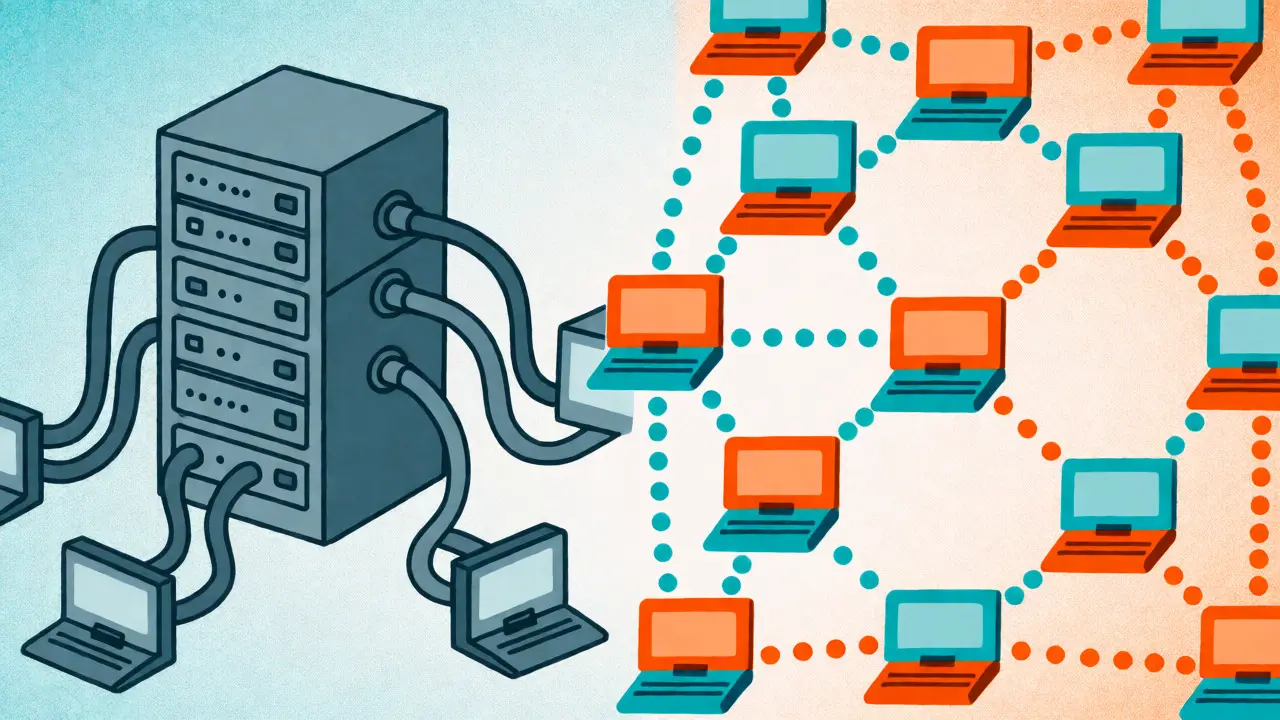
In traditional tech, we use a client-server model. Think of Netflix. Your phone (the client) asks Netflix’s servers (the server) for a movie. If Netflix’s servers go down, nobody watches anything. It’s simple, but it creates a single point of failure.
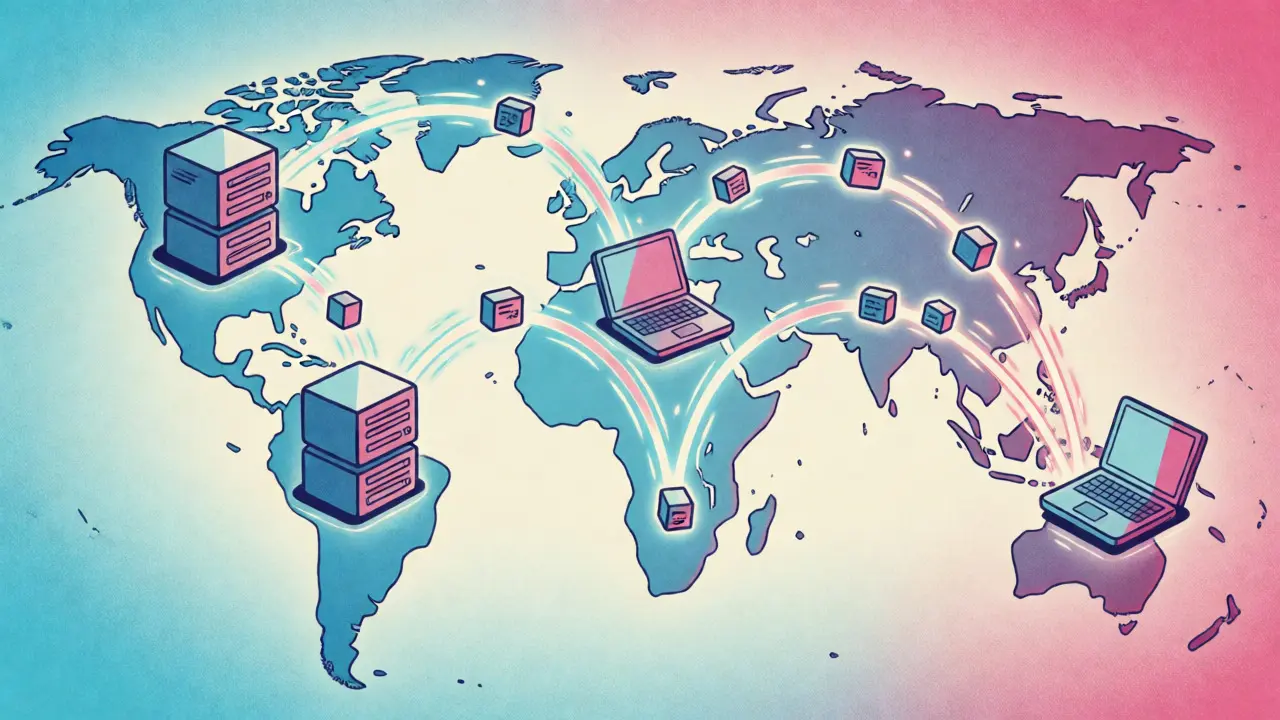
A Peer-to-Peer network flips this script entirely. In a P2P system, every participant-called a node or peer-is equal. Each computer acts as both a client and a server simultaneously. They don’t ask a central authority for data; they share data with each other. If one node goes offline, the others pick up the slack. This structure is what allows Bitcoin to operate without a CEO, headquarters, or even a single company controlling it.
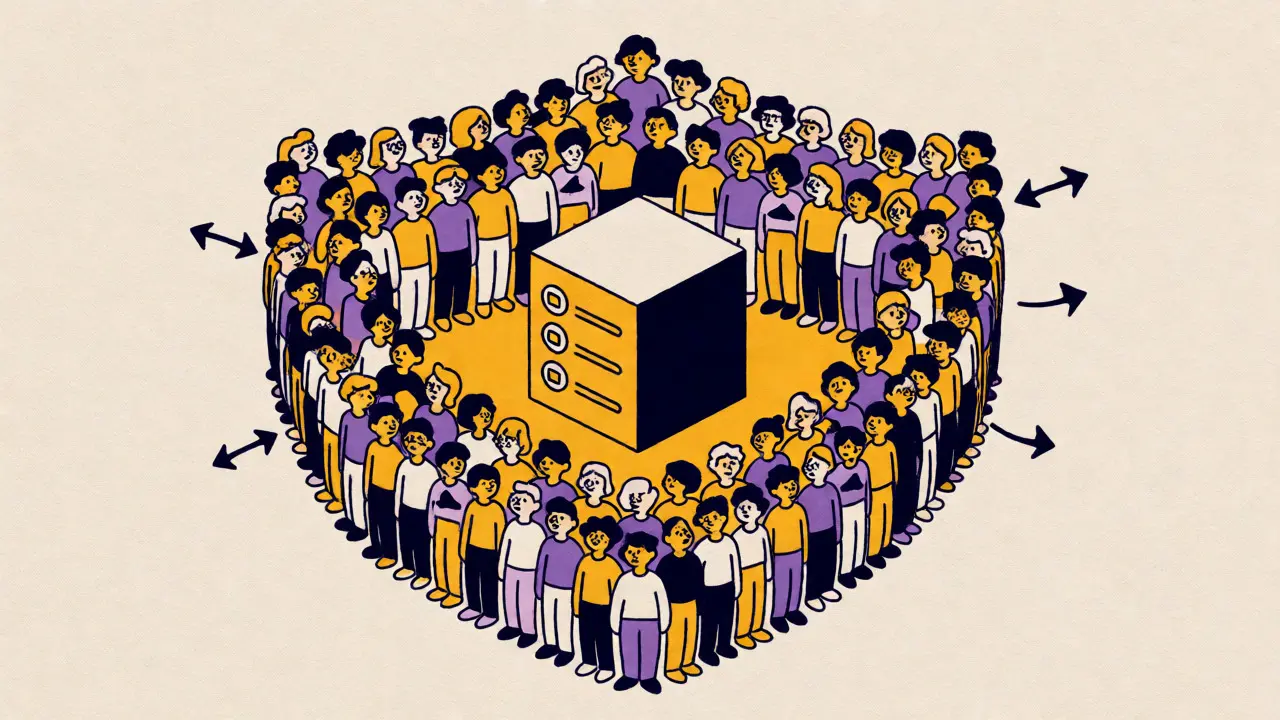
Why does this matter for blockchain? Because trust requires redundancy. If you store your money in one bank vault, you trust the bank. If you store your money in a P2P blockchain, you trust the math and the thousands of independent computers verifying that math. The network itself becomes the authority, not a person or a corporation.
How Nodes Actually Talk to Each Other
You might wonder, "If there’s no central server, how do these computers find each other?" It’s surprisingly robust. When you download a blockchain client like Bitcoin Core or Geth, your software connects to a handful of existing nodes. These initial connections act like entry points into the wider web. Once connected, your node starts gossiping-literally sharing information about new transactions and blocks with its neighbors.
This communication happens over standard internet protocols, mostly TCP/IP. There’s no special proprietary cable running from New York to Tokyo. It’s just regular internet traffic, encrypted and structured so that only valid data gets accepted. Here’s a quick look at how this differs from traditional setups:
| Feature | Client-Server Model | P2P Blockchain Network |
|---|---|---|
| Control Point | Centralized Server(s) | Distributed Nodes (No center) |
| Data Storage | Held on specific servers | Copied across all participating nodes |
| Failure Risk | High (Single Point of Failure) | Low (Redundant by design) |
| Trust Requirement | Trust in the operator | Trust in consensus algorithms |
| Scalability | Scale up (better hardware) | Scale out (more nodes) |
The key takeaway here is resilience. In a centralized system, if the main data center burns down, you lose access. In a P2P network, if a node loses power, the rest of the network barely notices. In fact, most users connect to several peers at once. If one drops out, your client instantly routes requests through another neighbor. This fault tolerance is critical for financial systems where downtime equals lost money.
Consensus Needs Connection
A P2P network provides the plumbing, but it doesn’t decide who is right. That’s the job of the consensus mechanism, like Proof of Work (PoW) or Proof of Stake (PoS). However, these mechanisms can’t function without the P2P layer.
Consider Proof of Work. Miners compete to solve complex mathematical puzzles. When one miner solves it, they broadcast the new block to their immediate peers. Those peers verify the work. If it checks out, they pass it along to their peers. This propagation continues until the majority of the network has seen and validated the block.
If the P2P network were slow or unreliable, miners might waste energy working on outdated blocks. This leads to "orphaned" blocks, which reduces efficiency. So, while the algorithm decides validity, the network topology determines speed and reliability. Developers spend significant time optimizing how nodes discover each other and how quickly data propagates across the globe. For example, Bitcoin uses a technique called "compact blocks" to reduce bandwidth usage, ensuring that even nodes with slower internet connections can stay in sync.
Security Through Distribution
People often worry about hackers breaking into the blockchain. In a centralized database, a hacker needs to breach one firewall. In a P2P blockchain, a hacker needs to compromise more than 50% of the network’s computing power (in PoW) or stake (in PoS) simultaneously to rewrite history. This is known as a 51% attack.
Because nodes are geographically dispersed-running on laptops in Berlin, servers in Singapore, and home rigs in Texas-an attacker can’t just cut a cable or bribe one administrator. They have to coordinate attacks across thousands of independent entities. This geographic and organizational diversity makes tampering incredibly expensive and difficult.
Furthermore, P2P networks enhance privacy. Since transactions are broadcast to peers rather than sent to a central processor, metadata analysis is harder. While public blockchains aren’t fully anonymous, the lack of a central observer means no single entity sees the complete picture of who is talking to whom. Some newer projects, like Monero, take this further by using P2P mixing techniques to obscure transaction paths even more.
Challenges and Trade-offs
It’s not all sunshine and decentralization. P2P networks come with costs. The biggest one is resource duplication. Every full node stores a copy of the entire blockchain history. As of 2026, the Bitcoin blockchain is over 500 GB. Running a node requires storage, bandwidth, and processing power. This barrier to entry means not everyone runs a full node; many rely on lightweight clients that trust nearby nodes for headers, which slightly compromises the "trustless" ideal.
Another issue is connectivity. If too many nodes drop off suddenly-say, due to a regional internet outage-the network can fragment. While it usually heals itself, temporary splits can cause confusion about which chain is canonical. Developers mitigate this with checkpoints and aggressive reconnection logic, but it remains a physical reality of relying on the open internet.
Also, latency varies wildly. A node in New York talks to a node in London faster than one in Sydney. This uneven speed can create slight advantages for some participants, though consensus algorithms are designed to tolerate these delays. Still, for high-frequency trading applications, raw P2P latency is often too slow, leading to hybrid solutions that use centralized sequencers temporarily before settling on-chain.
Real-World Examples Beyond Bitcoin
While Bitcoin popularized P2P blockchains, other platforms adapt the concept differently. Ethereum uses a similar P2P gossip protocol but adds complexity because nodes must also execute smart contracts. This means the network load isn’t just about storing data; it’s about computation.
Newer chains like Solana optimize for throughput by reducing the number of messages passed between nodes, using leader rotation to streamline communication. They still rely on P2P principles for distribution, but they tweak the networking stack to handle higher speeds. Then there are Layer 2 solutions like Lightning Network, which build payment channels on top of the Bitcoin P2P base. These channels allow instant, low-cost transfers between two peers without broadcasting every tiny transaction to the whole network immediately. This shows how P2P architecture is flexible enough to support everything from slow, secure value storage to fast, frequent micro-payments.
Final Thoughts on Decentralized Infrastructure
Understanding P2P networks helps you see blockchain not as magic, but as engineering. It’s a deliberate choice to trade efficiency for resilience and autonomy. By removing the middleman, you accept higher resource costs and slower propagation times in exchange for censorship resistance and uptime.
As we move deeper into 2026, the trend is toward better P2P tooling. Tools like libp2p are making it easier for developers to build custom networking stacks for different dApps. Whether you’re mining, staking, or just holding coins, your participation strengthens the network. Every node you run, or even every wallet that verifies signatures locally, adds to the collective security. The next time you check your crypto balance, remember: it’s not stored in the cloud. It’s verified by thousands of strangers around the world, talking to each other directly, keeping the ledger true.
Do I need to run a full node to use blockchain?
No, you don't. Most users interact with blockchain via light wallets or exchanges. However, running a full node gives you maximum security because you verify every transaction yourself instead of trusting a third party. Light nodes rely on peers for block headers, which is faster but requires a degree of trust in the source.
What happens if half the nodes go offline?
The network remains functional as long as a majority of hashing power or stake is online. If 50% of nodes drop, the remaining nodes continue to validate and propagate transactions. The network may become slightly slower or less redundant, but it won't stop. Consensus rules ensure that the chain with the most accumulated work or stake is considered valid.
Is a P2P network the same as the Internet?
Not exactly. The Internet is the underlying infrastructure (TCP/IP) that allows devices to connect. A P2P network is an application layer built on top of the Internet. Blockchain nodes use the Internet's routing capabilities to establish direct connections with each other, bypassing centralized servers for data exchange.
Can governments shut down a P2P blockchain network?
It is extremely difficult. To shut down a global P2P network, regulators would need to ban the software installation and block the ports used by the protocol on every device worldwide. Since nodes can be hosted anywhere-from residential homes to cloud servers-and the code is open-source, total shutdown is practically impossible without dismantling the Internet itself.
Why is data redundancy important in blockchain P2P networks?
Redundancy ensures that no single point of failure exists. If data is stored on only one server, corruption or deletion destroys the record. In a P2P network, the ledger is copied across thousands of nodes. Even if hundreds of nodes fail or are corrupted, the correct data persists on the remaining healthy nodes, allowing the network to self-heal and maintain integrity.