
Ever clicked on a crypto chart only to find zero trading volume? That’s the reality for many tokens in the Layer-2 ecosystem today. Velocore (VC) is one of them. It’s not just another meme coin hoping for viral fame; it’s a decentralized exchange protocol built to fix liquidity problems on networks like zkSync Era and Linea. But if you’re looking at VC right now, you’re probably wondering: is this dead money, or is it waiting for its moment?
The short answer is that Velocore is a functional piece of infrastructure with a complicated past. It launched with big promises as a "veDEX" (vote-escrowed decentralized exchange), suffered a massive $7 million hack in mid-2024, and has since struggled to regain mainstream attention. Today, it remains active in development but trades with extremely low volume. If you hold VC or are thinking about buying, you need to understand exactly how the token works, why the price is so volatile, and what happened during that security breach.
How Velocore Actually Works
To get VC, you first have to understand what it does. Most people think of tokens like Bitcoin or Ethereum as digital cash. VC isn’t really designed for that. Instead, it’s a utility and governance token for a specific type of automated market maker (AMM).
Velocore uses a mechanism called ve(3,3), which stands for "vote-escrow." This model was popularized by protocols like Curve Finance and later adapted by Velodrome Finance. The idea is simple but powerful: instead of paying liquidity providers with newly printed inflationary tokens, the protocol rewards them with existing value. Here’s how it breaks down:
- Liquidity Providers (LPs): You deposit assets into a pool (like ETH/USDC). In return, you earn VC tokens as an incentive to keep your money there.
- veVC Holders: Some users take their VC tokens and lock them up to become veVC. These holders don’t trade; they govern. They vote on which pools get more incentives and collect transaction fees from the exchange.
This creates a cycle. LPs provide liquidity to earn VC. veVC holders use their voting power to direct those VC emissions to specific pools, ensuring those pools stay deep and liquid. Theoretically, this aligns everyone’s interests. In practice, it requires constant activity to keep the engine running.
Tokenomics: Supply, Circulation, and Value
Numbers tell a story, and Velocore’s numbers are a bit messy due to conflicting data across exchanges. Let’s look at the facts as reported by major aggregators like CoinMarketCap and CryptoRank through late 2025.
| Metric | Value / Detail |
|---|---|
| Total Max Supply | 60,000,000 VC (Confirmed by official docs and major trackers) |
| Circulating Supply | ~36.77 Million VC (Self-reported snapshots from 2025) |
| Token Type | ERC-20 (Governance & Utility) |
| Derivative Token | veVC (Fungible ERC-20 for voting and fee sharing) |
| Primary Chains | zkSync Era, Linea (Ethereum Layer-2s) |
A critical detail here is the relationship between VC and veVC. Unlike older systems where you locked tokens for years and couldn’t touch them, Velocore allows you to convert VC to veVC instantly. However, this conversion is irreversible within the protocol. If you want your liquidity back, you can’t just redeem veVC for VC directly from the smart contract. You have to sell your veVC on the secondary market to another user. This design encourages long-term commitment but adds friction for those who want to exit quickly.
As for price, VC has hovered around fractions of a cent-often between $0.002 and $0.003-in recent months. Trading volumes are frequently near zero on centralized exchanges like Binance or Coinbase. This means if you try to sell a large amount, you could face significant slippage because there aren’t enough buyers on the order books. The real action happens on-chain, within the Velocore DEX itself.
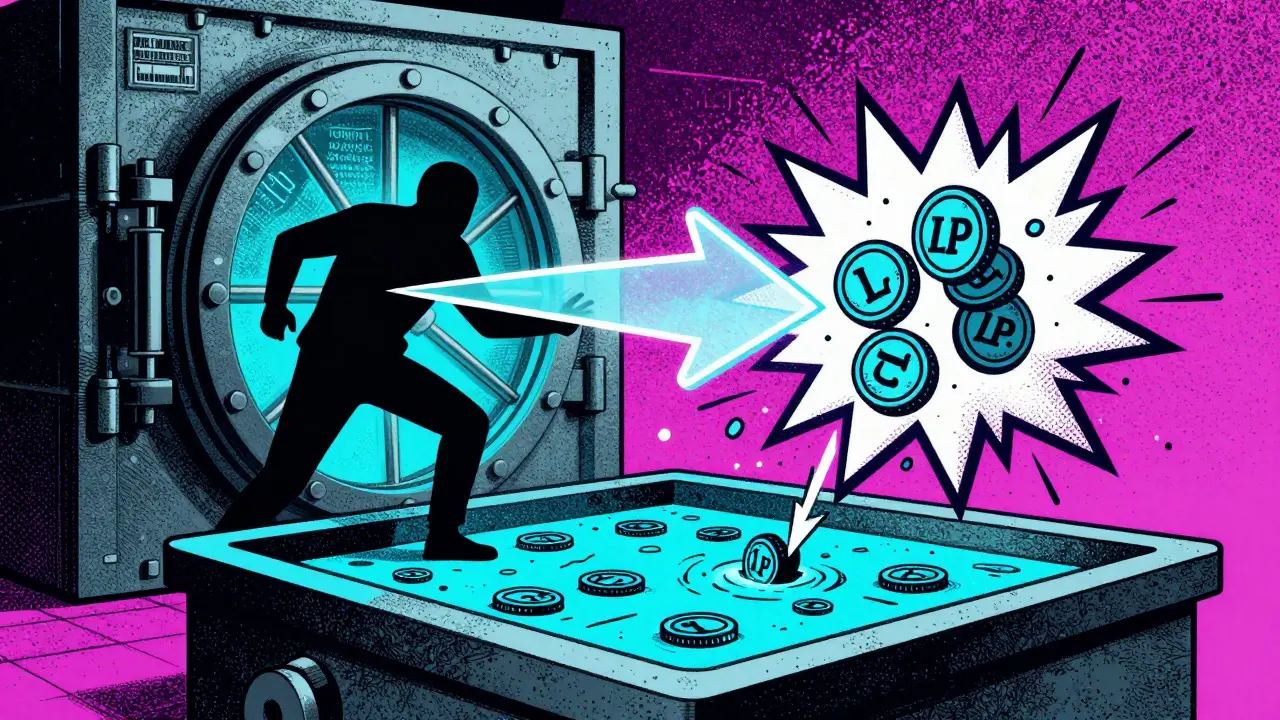
The June 2024 Hack: What Went Wrong?
You can’t talk about Velocore without addressing the elephant in the room: the exploit that occurred on June 1-2, 2024. This event shook confidence in the project and highlighted the dangers of early-stage DeFi code.
An attacker targeted Velocore’s Balancer-style Constant Product Market Maker (CPMM) pools on both zkSync Era and Linea. The vulnerability wasn’t in the vault itself, but in the logic calculating fees and liquidity provider accounting. Specifically, an underflow error in the `velocore__execute()` function allowed the `feeMultiplier` to exceed 100%.
Here’s how the attack unfolded in plain English:
- The attacker used a flash loan to borrow a large amount of LP tokens.
- They withdrew most assets from the pool, shrinking its size drastically.
- Then, they performed a tiny withdrawal. Due to the coding bug, the system misinterpreted this small move as a massive deposit.
- This minted an absurd number of new LP tokens, effectively draining the remaining liquidity (mostly ETH) from the pool.
- The attacker repaid the flash loan and kept the profit, laundering roughly $6.8 to $7.6 million through Tornado Cash.
The response was swift. Linea temporarily halted block production to stop further bleeding. Velocore froze affected pools and offered a white-hat bounty to encourage the return of funds. While some mechanisms were put in place for victims to claim losses based on snapshots, the reputational damage was severe. Security audits by firms like Hacken had previously rated Velocore’s documentation quality as moderate (5/10), noting gaps in technical clarity. This incident proved that even complex mathematical models fail if basic access controls and overflow checks are missing.

Current Status and Development in 2026
So, is Velocore dead? Not entirely. As of January 2026, the team continues to update its V2 architecture. The smart contracts are public, and the documentation reflects ongoing maintenance. The focus has shifted toward stabilizing the platform and improving security after the hack.
Velocore positions itself as a key primitive for the MetaCene ecosystem, integrating with broader metaverse and gaming initiatives. This suggests a strategy beyond just swapping tokens-they aim to support digital publishing and cross-industry adaptability. However, adoption remains niche. The user base consists largely of dedicated zkSync Era developers and DeFi enthusiasts rather than retail investors.
Trading activity remains thin. Data from Holder.io and other aggregators often lists VC as "not active" or awaiting proper listing on major venues. This lack of liquidity is a double-edged sword. On one hand, it keeps the price stable against wild swings. On the other, it makes entering or exiting positions difficult without impacting the market price significantly.
Should You Use or Invest in Velocore?
If you are a developer building on zkSync Era or Linea, Velocore offers interesting tools. Its Vault-centric execution model allows for complex operations involving NFTs (ERC-721) and multi-asset stable pools (ERC-1155) in single transactions. For advanced users comfortable with reading smart contract docs and managing gas costs on Layer-2s, it provides low-slippage trading opportunities.
If you are a casual investor, proceed with extreme caution. The low trading volume means high risk. There is no guarantee of price appreciation, and the history of the 2024 hack serves as a reminder that smart contract risks are real. Never invest more than you can afford to lose, and always verify current audit statuses before interacting with any DeFi protocol.
Velocore represents the ambitious, experimental side of crypto. It tries to solve real problems-liquidity fragmentation and inefficient incentives-but operates in a space where mistakes can cost millions. Understanding the mechanics behind the token is the best defense against getting caught off guard.
Is Velocore (VC) still active after the 2024 hack?
Yes, Velocore remains active. The team continued updating its V2 architecture and documentation through early 2026. While the June 2024 exploit caused significant financial loss and reputational damage, the protocol patched the vulnerabilities, allowed affected users to claim funds via snapshots, and resumed operations with enhanced security measures.
What is the difference between VC and veVC?
VC is the standard ERC-20 token used for liquidity mining rewards. veVC is the vote-escrowed version used for governance and fee collection. You convert VC to veVC to gain voting power and earn protocol fees. This conversion is irreversible within the protocol, meaning you must sell veVC on the secondary market to regain liquidity.
Which blockchain networks does Velocore operate on?
Velocore primarily operates on zkSync Era and Linea, both of which are Ethereum Layer-2 scaling solutions. This allows users to benefit from lower transaction fees and faster confirmation times compared to the Ethereum mainnet.
Why is the trading volume for VC so low?
VC is a specialized utility token for a niche DeFi protocol. It lacks widespread adoption among retail investors and is not heavily listed on major centralized exchanges. Most trading occurs on-chain within the Velocore DEX itself, leading to thin order books and low reported volume on external aggregators.
Can I recover my funds if Velocore gets hacked again?
Recovery depends on the specific nature of the exploit and the protocol's emergency response. In the 2024 incident, Velocore worked with chain operators to halt blocks and offered snapshot-based claims for affected liquidity providers. However, there is no guarantee of full recovery in future incidents. Always use hardware wallets and limit exposure to untested protocols.