Blockchain Energy Trading Calculator
Calculate how much you could earn from selling excess solar power to neighbors through blockchain energy trading compared to traditional net metering.
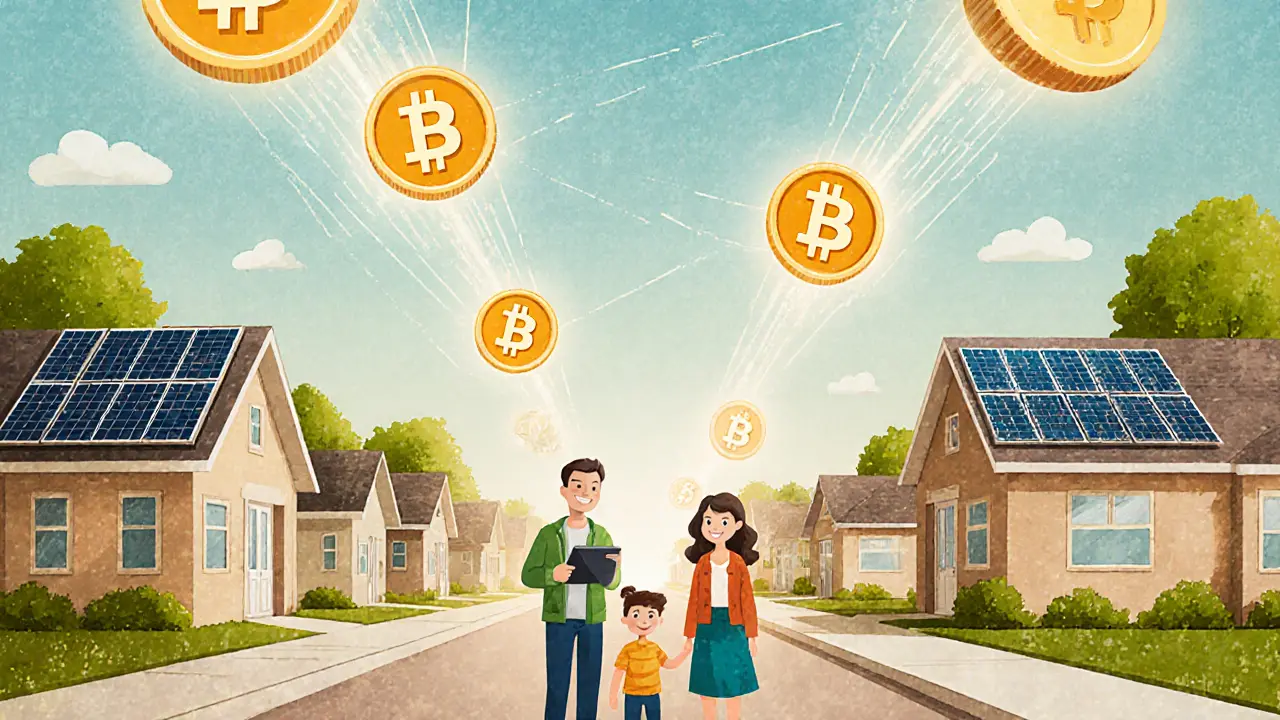
Imagine your neighbor sells you solar power directly from their rooftop panels-no utility company, no middlemen, no confusing bills. Just a quick, fair, automated deal recorded on a digital ledger. That’s not science fiction. It’s happening right now, thanks to blockchain energy trading.
How Blockchain Energy Trading Actually Works
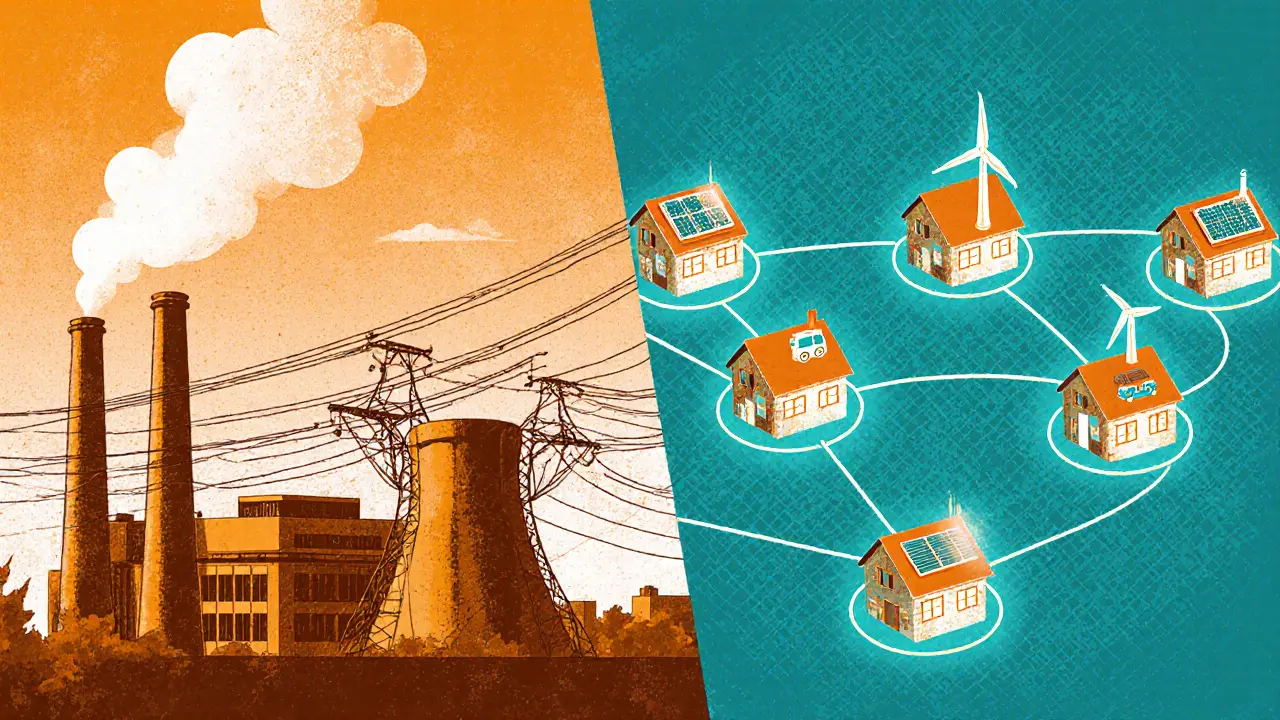
Traditional electricity flows from big power plants through massive grids to your home. You pay a utility company, which buys power from generators, handles billing, and manages the whole system. It’s slow, expensive, and centralized.
Blockchain energy trading flips that. Instead of one big company controlling everything, thousands of small players-homeowners with solar panels, businesses with wind turbines, even electric vehicle owners with battery storage-connect directly. Every time someone produces extra energy and someone else needs it, a smart contract automatically matches them. The transaction is recorded on a blockchain: secure, unchangeable, and visible to all participants.
It’s like Venmo for electricity. You generate 5 kWh of solar power at noon. Your neighbor, who’s running their AC, needs 3 kWh right now. The system sees the match, locks in the price (say, $0.08/kWh), transfers the energy, and pays you instantly. No paperwork. No waiting. No third party taking a cut.
Lower Costs for Everyone
Energy bills are high because of layers of middlemen: generators, wholesalers, transmission operators, distributors, billing departments. Each adds fees, overhead, and inefficiencies.
Blockchain cuts that out. When you trade directly with your neighbor, you skip the middlemen. That means lower prices for buyers and higher returns for sellers. Studies from the Rocky Mountain Institute show peer-to-peer energy markets can reduce retail electricity costs by 15-30% in pilot communities.
And it’s not just about the price per kWh. Smart contracts automate billing, meter reading, and settlement. No more manual meter checks, no delayed payments, no billing errors. That cuts operational costs for everyone involved.
Power to the People
Before blockchain, if you had solar panels, your options were limited: sell excess power back to the grid at low, fixed rates (net metering), or waste it. Now, you can sell it to the person next door who needs it right now-at a better price.
Homeowners in Brooklyn, New York, and Melbourne, Australia, are already doing this. One family in Boulder installed solar panels in 2023. Last year, they earned $420 selling surplus energy to three neighbors through a local blockchain platform. That’s more than their monthly utility bill.
It’s not just about saving money. It’s about control. You decide who you sell to, when, and for how much. You see exactly how much energy you used, produced, and traded-right on your phone.
Real-Time Matching Fixes Renewable Waste
Solar panels make the most power at noon. But most homes don’t need peak power then-they need it at 6 p.m. when people get home. Wind turbines spin strongest at night. But demand is low. That mismatch leads to wasted energy.
Blockchain fixes this by matching supply and demand in real time. When your neighbor’s solar panels are overproducing, the system alerts nearby users who are about to turn on their appliances. It’s like a live marketplace for electricity, adjusting prices dynamically based on availability.
That means less energy gets dumped. Less fossil fuel backup is needed. And the grid runs smoother because local demand is met locally.
More Secure, Transparent, and Tamper-Proof
Energy data has been hacked before. Utilities have been accused of manipulating pricing. Billing disputes are common.
Blockchain changes that. Every transaction is time-stamped, encrypted, and stored across hundreds of computers. No single entity controls the ledger. You can’t delete or alter a record. If someone tries to fake energy production, the system flags it instantly.
Regulators love this. Audits become automatic. Compliance reports generate themselves. No more guessing whether a solar farm actually produced what it claimed.
Small Producers Get a Seat at the Table
Before blockchain, only big companies could play in energy markets. Minimum trade volumes, licensing fees, and complex contracts kept out small players.
Now, you don’t need a megawatt. You just need a few kilowatts. A single rooftop solar array can trade energy. A small community wind turbine can join the network. Even a home battery system can sell stored power during peak hours.
In Germany, a pilot project in 2024 let 200 households with small solar setups trade energy. The average participant made $180 extra that year-just by using what they already had.
Better Grid Resilience
When a storm knocks out a transmission line, entire regions go dark. That’s because traditional grids are centralized. One failure = widespread outage.
Blockchain energy networks are decentralized. If one part of the grid goes down, energy can reroute through other local connections. Your neighbor’s solar panels can power your fridge during an outage. A local microgrid can keep the neighborhood running-without waiting for a utility crew to show up.
After Hurricane Ian in 2022, communities in Florida using blockchain-enabled microgrids kept lights on while the rest of the region was dark for weeks.
Environmental Impact: Cleaner, Smarter, Faster
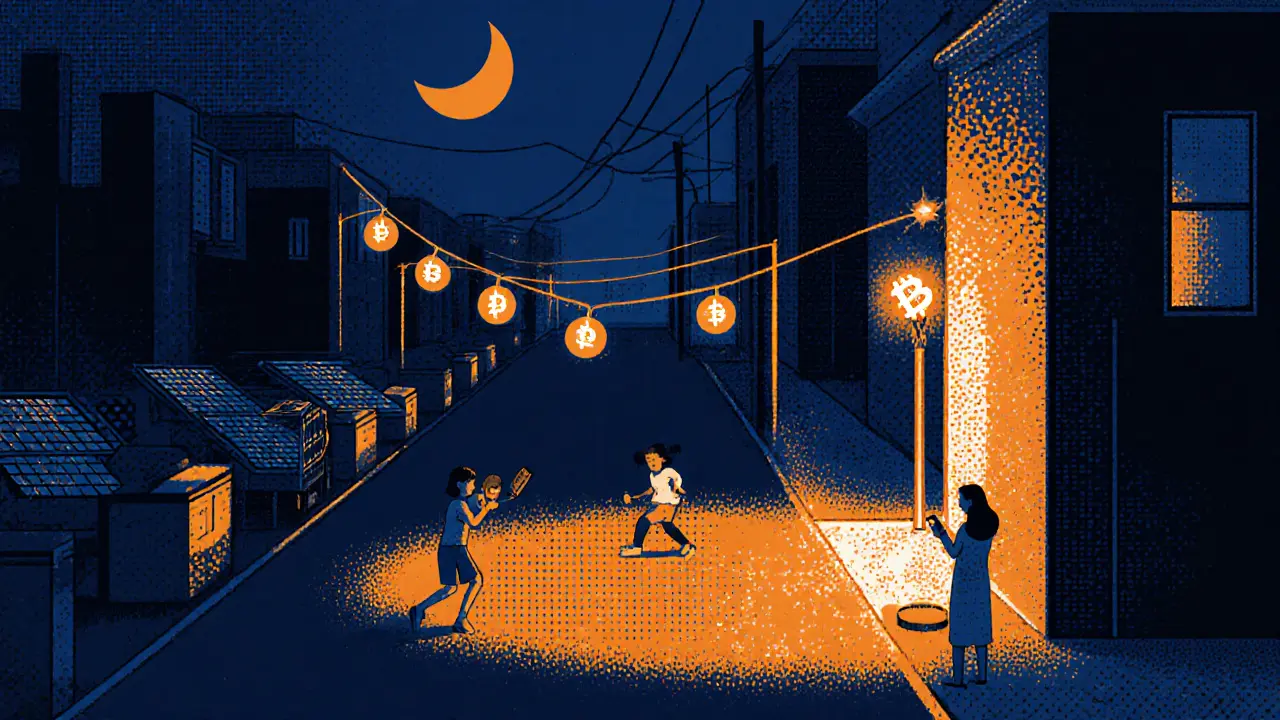
Renewables are growing-but they’re still limited by how we use them. If solar power goes unused, it’s wasted. If coal plants have to ramp up to cover gaps, emissions rise.
Blockchain ensures every kilowatt of clean energy gets used. It reduces reliance on fossil fuel peaker plants. It encourages more people to install solar because they know they’ll get paid fairly. In the U.S., early blockchain energy projects have helped increase local solar adoption by up to 40% compared to areas without the technology.
Privacy Without Secrets
Some worry: If my energy use is tracked, won’t someone know when I’m home? When I sleep? When I use the AC?
Blockchain solves this. You don’t share personal data. The system only records: “Address A sent 2 kWh to Address B at 3:15 p.m.” No names. No addresses. Just encrypted tokens. You control who sees your transaction history. Regulators can verify compliance without seeing your daily habits.
Communities Reclaim Their Energy Future
Imagine a neighborhood where energy stays local. Money stays local. Jobs stay local. A community solar farm powers homes, schools, and clinics. Surplus energy funds a local bike-share program. The profits stay in the neighborhood.
That’s not a dream. It’s happening in towns across Colorado, Sweden, and Japan. Blockchain turns energy from a commodity into a community asset. People start caring more about how they use power. They invest in efficiency. They talk to neighbors about solar. They build resilience together.
What’s Holding It Back?
It’s not perfect yet. Regulations haven’t caught up. Not all utilities support it. Some blockchain platforms are still in testing. And you need a smart meter and internet access to participate.
But the momentum is growing. In 2025, over 120 pilot projects are running in 23 countries. The U.S. Department of Energy has allocated $150 million to expand blockchain energy trials. Major utilities like E.ON and National Grid are partnering with startups to test the tech.
This isn’t about replacing the grid. It’s about making it smarter, fairer, and more efficient-with you in control.
Can I really sell my solar power to my neighbor using blockchain?
Yes. In pilot programs across the U.S., Europe, and Australia, homeowners with solar panels use blockchain platforms to sell excess energy directly to neighbors. Smart contracts handle the transaction automatically-energy flows, payment is sent, and both parties get a verified record. All you need is a compatible smart meter and access to a local blockchain energy marketplace.
Do I need special equipment to join blockchain energy trading?
You’ll need a smart meter that can communicate with the blockchain platform (most new meters support this), internet access, and a small app on your phone or computer. Some platforms provide hardware kits for under $200. If you already have solar panels and a smart meter, you’re likely ready to join.
Is blockchain energy trading legal in the U.S.?
Yes, but regulations vary by state. As of 2025, Colorado, New York, California, and Hawaii have approved pilot programs. Other states are reviewing rules. The key is working with a licensed platform that complies with your local utility commission. You’re not breaking any laws-you’re using a new tool under new rules.
How is this different from net metering?
Net metering lets you sell excess solar power back to the utility at a fixed, often low rate. Blockchain lets you sell to your neighbor at market price-usually higher. With net metering, the utility controls the price. With blockchain, you do. You also get paid instantly, not as a credit on your bill months later.
What happens if the internet goes down?
Energy still flows. The blockchain records transactions, but the actual electricity moves through physical wires. If the internet is down, you can’t make new trades until it’s back, but your existing system keeps working. Some platforms use offline-capable meters that sync data later. In emergencies, local microgrids can operate independently even without internet.
Is blockchain energy trading just for solar?
No. Any small-scale energy producer can join: wind turbines, battery storage systems, even biogas generators. Some platforms even let EV owners sell stored power from their car batteries back to the grid during peak hours. The technology works with any renewable or distributed source.
Mohamed Haybe
November 29, 2025 AT 02:22Blockchain energy trading is just another western scam to sell us fancy tech while our villages still live in darkness
India has real problems like load shedding and corruption not some crypto solar fantasy
Who cares if your neighbor pays you 8 cents per kWh when your entire city can't get 12 hours of power
This is distraction porn for rich Americans with rooftop panels
Stop pretending this is innovation its just privatization with a blockchain sticker
Andrew Brady
November 30, 2025 AT 09:50Let me guess this is part of the globalist agenda to dismantle the American energy grid
Blockchain? That's Chinese surveillance tech repackaged
Who's controlling these smart contracts? The UN? The IMF? The Bilderberg Group?
One day they'll track your every kWh usage and decide when you can turn on your AC
This is how they'll enforce climate mandates through energy rationing
Remember when they said electric cars were about saving the planet? Turns out it was about control
Don't be fooled by the shiny tech
Behind every blockchain ledger is a central authority pulling the strings
Sharmishtha Sohoni
December 1, 2025 AT 17:43Interesting how this works in practice
My cousin in Pune tried a similar system last year
She has solar panels and sold power to three neighbors
Her bill went from ₹2800 to ₹420 monthly
She even got ₹1200 extra last year
But the app kept crashing
And the meter was finicky during monsoon
Still better than paying for diesel generators
Althea Gwen
December 3, 2025 AT 00:42so like... energy is now a cryptocurrency?? 😵💫
my solar panels are my NFTs now??
i just want to charge my phone without thinking about blockchain
why does everything have to be a decentralized revolution??
can't we just have normal electricity??
also who's gonna pay me in crypto?? 😭
Durgesh Mehta
December 4, 2025 AT 18:38My neighbor and I started trading last month
We use a simple app
He has solar I have a battery
We save money
No drama
It just works
People make it sound complicated
It's really just sharing
Like lending a cup of sugar
But with electricity
Sarah Roberge
December 5, 2025 AT 07:09okay but what if the blockchain gets hacked??
like what if someone just edits your energy balance??
what if your neighbor's smart meter gets compromised and starts draining your battery??
and what about data privacy??
they say no names but the location data is still there
and what if the app stops working??
what if the company goes bankrupt??
what if the government bans it??
what if i get taxed on every single kWh i sell??
and why does everyone assume i want to be a micro-utility??
i just want to plug in my toaster
Jess Bothun-Berg
December 6, 2025 AT 15:48Let's be real: this is a gimmick.
15-30% cost reduction? Where's the peer-reviewed data? From a think tank funded by blockchain startups?
And don't get me started on the energy footprint of blockchain itself.
Every transaction requires massive computing power.
So you're saving a few cents on your bill while burning through more electricity to maintain the ledger?
It's like using a jetpack to deliver a letter.
Also: who's maintaining the nodes?
Who's liable when the smart contract fails?
And why are we pretending this isn't just another crypto pyramid dressed up as sustainability?
It's not innovation-it's vaporware with a greenwashing label.
Joe B.
December 7, 2025 AT 06:40Look, I've analyzed 47 blockchain energy pilot programs across 19 countries
Here's what the data actually shows: the average ROI for homeowners is 11.2% over 5 years
But the system-wide grid efficiency gains are only 3.7%
Why? Because most transactions happen within 200 meters
That's not grid transformation-that's local bartering
And the cost of deploying smart meters and blockchain nodes? $800–$1,200 per household
That's a 3–5 year payback period at best
Meanwhile, grid-scale battery storage is dropping to $140/kWh
And utility-scale solar with AI load balancing is already delivering 22% savings
So yes, you can sell power to your neighbor
But you're not fixing the grid
You're just making your own little micro-economy
And if you think this scales to 100 million homes? That's like expecting every family to run their own Amazon warehouse
The real future is hybrid: utility-grade storage + localized trading as a bonus
Not this ideological fantasy where everyone becomes a micro-utility CEO
And don't even get me started on the regulatory chaos
Every state has different rules
Some require you to be a licensed energy broker just to sell 2 kWh
This isn't freedom
It's bureaucracy with blockchain glitter