
When trading crypto derivatives, you’re not just betting on price moves-you’re choosing a contract type that shapes your costs, risks, and long-term success. Two main options dominate the market: perpetual futures and quarterly futures. They look similar on the surface-both let you go long or short on Bitcoin, Ethereum, or other assets without owning them-but underneath, they’re built for completely different kinds of traders.
Perpetual Futures: No Expiration, But a Hidden Cost
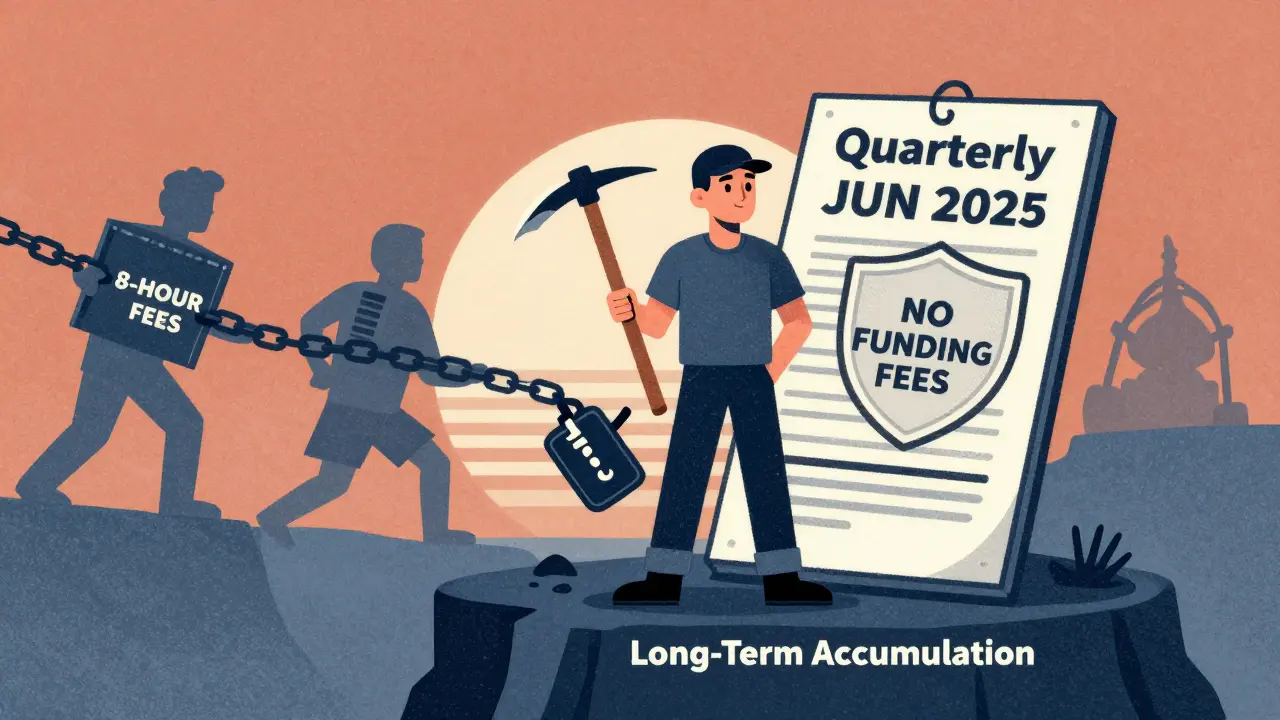
Perpetual futures never expire. That’s their biggest selling point. You can hold a position for days, weeks, or even years without worrying about a contract rolling over or expiring. This makes them perfect for day traders, scalpers, and anyone who wants to react instantly to market moves-whether it’s a 3 a.m. Bitcoin dump or a weekend rally. But there’s a catch: funding fees. Every eight hours, traders pay or receive a small payment based on the difference between the perpetual contract price and the underlying spot price. If you’re long and the contract trades above spot, you pay funding to shorts. If you’re short and the contract trades below spot, you get paid by longs. It’s designed to keep the futures price anchored to the real market price. That sounds fair, right? But over time, those fees add up. Let’s say you hold a Bitcoin perpetual position for 30 days. With an average funding rate of 0.01% every 8 hours, you’ll pay about 0.09% in fees over that period. Sounds small? Multiply that by a $10,000 position with 10x leverage, and you’re paying $9 in fees. Do that for three months? You’re paying $81-just for holding. And that’s if rates stay low. In volatile markets, funding rates can spike to 0.1% or more, turning a profitable trade into a losing one. Perpetual futures also tend to offer higher leverage-up to 100x on some exchanges. That means you can control a $100,000 position with just $1,000. But high leverage cuts both ways. A 2% move against you can wipe out your entire margin. Exchanges automatically liquidate your position if your equity falls below the maintenance margin. No warning. No second chance.Quarterly Futures: Set It and Forget It (Until It Expires)
Quarterly futures have a hard expiration date: the last Friday of March, June, September, and December. So a BTC 0925 contract expires on September 25, 2025. No extensions. No rollovers unless you manually close and reopen. The biggest advantage? No funding fees. Ever. That’s why institutional traders, hedge funds, and long-term holders prefer them. If you believe Bitcoin will hit $150,000 by December, you can buy a BTC 1225 quarterly contract and hold it without paying anything extra. No surprise fees. No erosion of profits over time. These contracts also settle in Bitcoin, not USDT or USD. That means when the contract expires, you don’t get cash-you get actual BTC. For traders who want to accumulate the underlying asset without buying it on spot exchanges, this is a huge benefit. You can short BTC on a quarterly future and receive BTC when you close, avoiding exchange fees and KYC. Leverage is usually lower than perpetuals-typically 10x to 20x on major exchanges. That might seem limiting, but it’s actually safer. Lower leverage means less chance of being liquidated by a sudden price swing. It also encourages more thoughtful position sizing. The downside? You’re locked in. If the market turns against you two weeks before expiration, you can’t just “wait it out” like you can with perpetuals. You have to decide: close early and take the loss, roll into the next quarter (which means paying spread and possibly higher premiums), or hold through expiration and get settled in BTC. That forced decision-making is a discipline tool-for some, it’s a headache.Cost Comparison: What You Pay to Hold
Here’s a real-world breakdown of holding a $10,000 long position in BTC for 90 days:- Perpetual futures: Average funding rate = 0.01% every 8 hours → 90 days = 337 funding payments → Total fees ≈ $33.70
- Quarterly futures: Funding fees = $0
Who Uses What-and Why
If you’re trading 5-minute charts, chasing pumps, or using bots that open and close hundreds of trades a day, perpetual futures are your only real option. They’re liquid, always available, and built for speed. Binance, Bybit, and OKX report that over 80% of their daily volume comes from perpetual contracts. But if you’re building a position over months-say, accumulating BTC as a store of value or hedging a mining operation-you’re better off with quarterly futures. Fidelity, Coinbase Institutional, and BitMEX’s professional traders overwhelmingly use quarterly contracts. Why? Because they don’t want their profits eaten away by tiny, recurring fees. Hedgers also prefer quarterly. A Bitcoin miner who expects to sell 10 BTC in June can lock in a price today with a June futures contract. No funding fees. No daily margin calls. Just a clean hedge that expires when they need it.Liquidity and Market Depth
Perpetuals win on volume. They’re the most traded crypto derivative by far. That means tighter spreads and faster execution. If you’re scalping, that’s everything. Quarterly contracts, while less liquid overall, often see spikes in volume right before expiration. That’s when traders close positions, roll over, or settle. These events create natural liquidity events-and sometimes big price swings. For example, in December 2024, BTC quarterly futures saw 40% higher volume on the last trading day than the average daily volume. That’s because hundreds of institutional positions were being settled or rolled. Traders who timed their entries around these events made significant gains.
Which Should You Choose?
Ask yourself these three questions:- How long do I plan to hold? Days? Perpetuals. Months? Quarterly.
- Am I sensitive to small, recurring costs? If yes, avoid perpetuals unless you’re trading aggressively.
- Do I want to receive actual Bitcoin at expiration? If yes, quarterly is your only path.
Final Tip: Use Both
You don’t have to pick one. Many professional traders use both. They take short-term positions in perpetuals to scalp volatility, then shift their core exposure to quarterly futures for long-term holds. It’s a hybrid strategy that combines flexibility with cost efficiency. The market doesn’t force you to choose. But your strategy should.Do perpetual futures have expiration dates?
No, perpetual futures do not expire. They’re designed to trade indefinitely, which is why they’re ideal for active traders who need constant access. However, they require regular funding fee payments every 8 hours to keep the contract price aligned with the spot market.
Why do quarterly futures have funding fees?
They don’t. Quarterly futures eliminate funding fees entirely. That’s one of their biggest advantages over perpetuals. Instead of daily or hourly payments, their price naturally converges with the spot price as expiration approaches through arbitrage and settlement mechanics.
Can I hold a quarterly future past its expiration date?
No. Quarterly futures expire on a fixed date-usually the last Friday of March, June, September, and December. Before expiration, you must either close your position, roll it into the next quarter’s contract, or let it settle automatically. If you don’t act, the exchange will settle your position in the underlying asset (like Bitcoin) at the settlement price.
Which contract type is better for long-term Bitcoin accumulation?
Quarterly futures are better for long-term accumulation. Since they have no funding fees and settle in actual Bitcoin, you can build a position over months without paying recurring costs. Perpetuals, while flexible, slowly drain your capital through funding payments, making them inefficient for holding over 30+ days.
Are quarterly futures less liquid than perpetuals?
Yes, generally. Perpetual futures dominate trading volume on most exchanges, offering tighter spreads and faster fills. But quarterly contracts see major liquidity spikes near expiration dates, especially for Bitcoin and Ethereum. For institutional traders, this is often preferred-it creates predictable settlement windows and reduces slippage during key market events.
Do I need to worry about liquidation with quarterly futures?
Yes, you still can be liquidated if your margin falls too low. Quarterly futures use leverage too-just usually lower than perpetuals. If the market moves sharply against your position and your equity drops below the maintenance margin, your position will be closed automatically. The difference is that with quarterly futures, you’re less likely to be caught in sudden liquidations because the contracts are less volatile and less leveraged on average.


Prateek Chitransh
January 4, 2026 AT 01:24Perpetuals are the crypto equivalent of a subscription box you didn’t sign up for - tiny charges every 8 hours until your wallet cries. I’ve seen guys blow up accounts thinking they’re ‘hodling’ when really they’re just paying the exchange to play roulette. 🤦♂️
Michelle Slayden
January 5, 2026 AT 20:00One must consider the epistemological underpinnings of financial instruments: perpetual futures, by virtue of their indefinite temporal extension, introduce a metaphysical uncertainty into the trader’s relationship with capital. Quarterly contracts, by contrast, impose a teleological structure - a terminus - which aligns more closely with the Aristotelian notion of purposeful action in economic endeavor.
christopher charles
January 5, 2026 AT 21:30Brooo, I used to trade perps like a maniac - 50x leverage, no chill - until I realized I was paying $200/month just to breathe. Switched to quarterly and my account stopped screaming. Seriously, if you’re holding longer than a week? Just go quarterly. No funding fees = no mental breakdowns. 😅
Amy Garrett
January 6, 2026 AT 21:56quarterlys are the real MVP!!! no fees no stress just chillin like a villain while my perp account is crying in the corner 😭💸
Haritha Kusal
January 7, 2026 AT 05:59OMG yes!! I started with perps and thought I was so smart… until I checked my profit and it was just… gone. Like, poof. Then I tried quarterly and it felt like I finally got a break. So happy I didn’t give up on crypto! 💪✨
Mike Reynolds
January 8, 2026 AT 12:20Really appreciate this breakdown. I’ve been on the fence for months. The part about miners hedging with quarterly contracts? That actually clicked for me. Makes total sense - no surprise fees messing with your cash flow. I’m switching my next position over.
dayna prest
January 9, 2026 AT 00:41Perpetuals? More like perpetual money-pumps for Binance. And quarterly futures? Oh, you mean the ‘I’m too rich to care about fees’ luxury yacht of crypto derivatives? Please. The only people who use them are the same ones who buy gold bars and store them in vaults named ‘Daddy’s Retirement.’
Brooklyn Servin
January 10, 2026 AT 17:21Y’all are missing the bigger picture. Perpetuals are the playground for retail traders who want to play with fire - and guess what? FIRE IS FUN UNTIL YOU BURN DOWN YOUR HOUSE. 🏚️🔥 But quarterly? That’s the real chess game. You’re not just trading price - you’re trading time, sentiment, and settlement dynamics. I’ve made 20% in a week just by front-running the December roll. It’s not ‘boring’ - it’s strategic. And yes, I’m still holding BTC from a settled contract. No KYC. No fees. Just pure, unfiltered blockchain magic. 🤖💎
Phil McGinnis
January 11, 2026 AT 12:39It is a well-documented fact that American financial markets have been corrupted by speculative derivatives. Perpetual futures are a symptom of this decay - a tool for the undisciplined, the impatient, the weak-minded. Quarterly contracts, by contrast, reflect the dignity of long-term planning. In my country, we do not gamble with time. We honor it. This post is, in essence, a manifesto for financial maturity.