Bitcoin Mining Pool Earnings Calculator
Calculate your net earnings after all mining pool fees and costs. This tool shows you exactly how much you keep after fees, electricity, and hidden costs.
Important note: Your actual earnings may vary due to:
- Hidden costs like withdrawal thresholds and payout delays
- Network difficulty changes
- Transaction fee fluctuations
- Pool-specific rules
When you mine Bitcoin, you don’t actually mine alone. Even if you’ve got a powerful ASIC rig, the odds of finding a block on your own are slimmer than winning the lottery twice. That’s why nearly every miner joins a mining pool. These groups combine computing power to find blocks faster, then split the rewards. But here’s the catch: every pool takes a cut. And that cut isn’t always obvious.
Some pools charge 0%. Others charge 4%. Some hide fees in fine print. Some adjust fees daily based on network traffic. And if you don’t understand how these fees work, you could be losing hundreds - or thousands - of dollars a year without even realizing it.
What Mining Pool Fees Actually Cover
Pool fees aren’t just profit grabs. They pay for real infrastructure. Think servers in data centers running 24/7, software updates to stay compatible with Bitcoin’s protocol, DDoS protection to keep your rig online, and staff to handle payouts and support. A pool with no fee might seem great - until it goes offline during a spike in network activity, or pays out late because they can’t afford to run reliable servers.
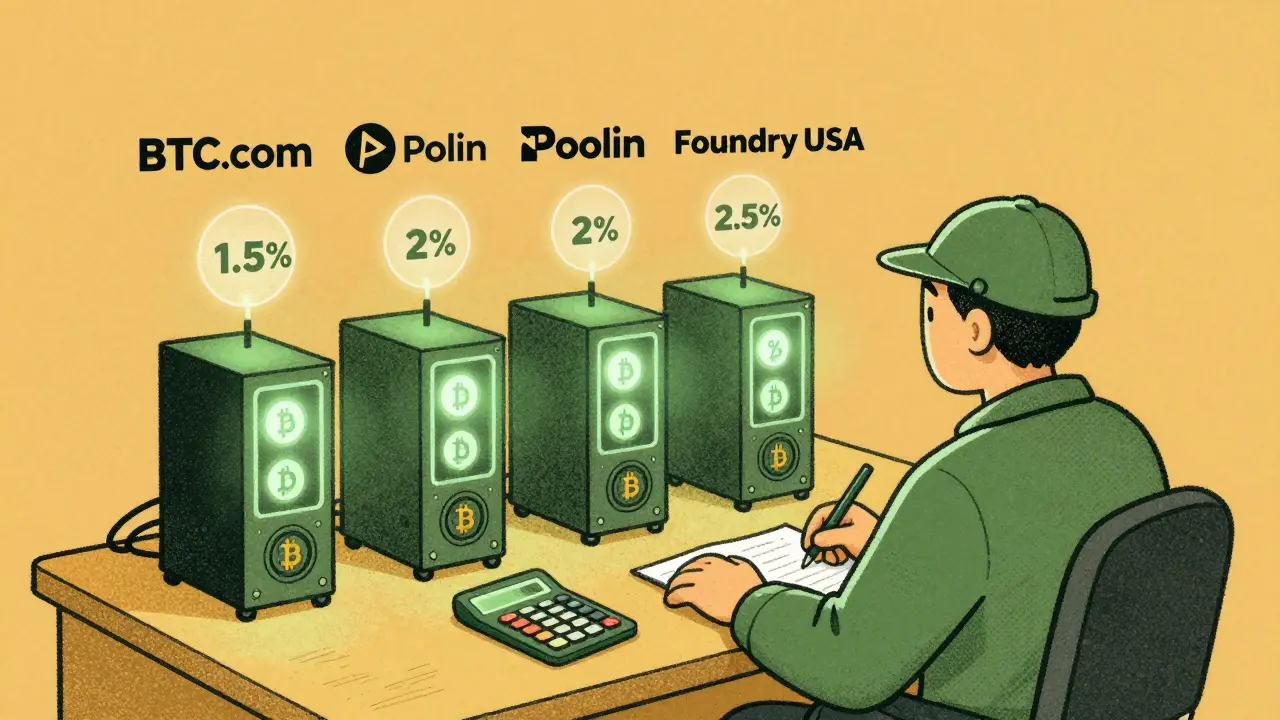
The average fee across top pools in 2025 is between 1% and 2.5%. But that number alone doesn’t tell the whole story. What matters more is how the fee is structured, what it includes, and how often you get paid.
The Three Main Fee Models - and Which One Suits You
Not all mining pools charge the same way. The model they use changes how your earnings are calculated - and how much risk you carry.
- PPLNS (Pay Per Last N Shares): You get paid based on the shares you submitted in the last N shares before a block was found. No guaranteed payout. If the pool doesn’t find a block for days, you earn nothing. But when they do, you get a big slice. Fees are often 0% to 1.5%.
- PPS (Pay Per Share): You get paid immediately for every valid share you submit, no matter if the pool finds a block. It’s like getting a salary. But the pool absorbs all the risk - so they charge more, usually 3% to 4%.
- FPPS (Full Pay Per Share): This is the sweet spot for most miners. You get paid per share, and the pool also includes transaction fees in your payout. Fees are typically 1.5% to 2.5%. Most top pools use this model in 2025.
Here’s the reality: if you’re mining with less than 100 TH/s, stick with FPPS. It gives you steady income. If you’re running a large farm and can handle volatility, PPLNS might save you money. PPS? Only consider it if you’re desperate for cash flow and don’t mind paying a premium.
Top Mining Pools in 2025 - Fees, Thresholds, and Real Numbers
As of mid-2025, the top five pools control over 85% of Bitcoin’s hashrate. Here’s what they actually charge - not what their websites claim on the homepage.
| Pool | Fee Structure | Base Fee | Min. Withdrawal | Payout Frequency | Special Features |
|---|---|---|---|---|---|
| Foundry USA | FPPS | 2.5% | 0.001 BTC | Daily | Transparent fee breakdown, enterprise support, tiered discounts for >1 EH/s |
| Antpool | PPLNS: 0%, PPS+: 4% | 0% to 4% | 0.001 BTC | Daily | Lowest PPLNS fee, but PPS+ is expensive. High variance in earnings |
| F2Pool | FPPS | 2.5% | 0.005 BTC | Daily | Supports 40+ coins, good uptime, but higher withdrawal threshold |
| Poolin | FPPS | 2% (1.5% during high-fee periods) | 0.001 BTC | Daily | Dynamic fees, advanced dashboard, popular with ASIC miners |
| BTC.com | FPPS | 1.5% | 0.001 BTC | Daily | Best fee transparency, SEC-compliant real-time calculator |
| Slush Pool | PPLNS | 2% | 0.0001 BTC | Multiple times/day | Oldest pool, highest transparency, lowest withdrawal threshold |
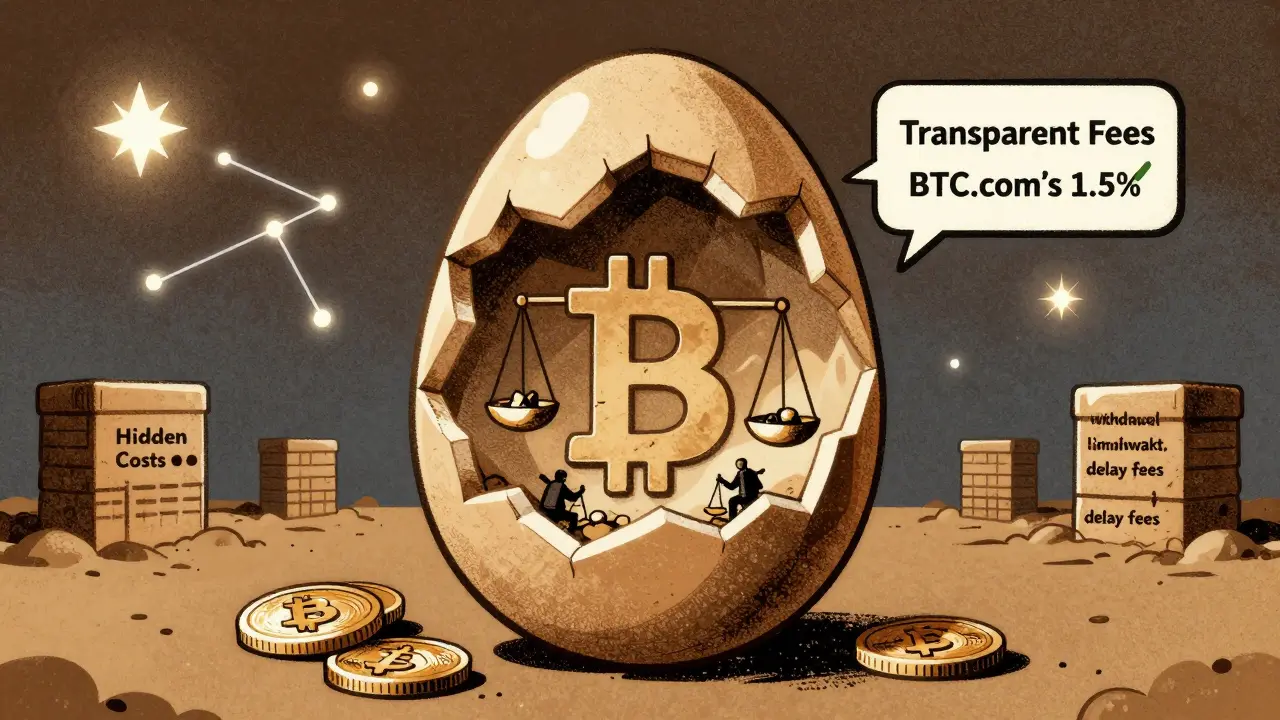
Foundry USA leads in hashrate and trust. Their 2.5% fee sounds high, but they break down exactly how much goes to infrastructure vs. transaction fees. BTC.com’s 1.5% fee is the lowest among major pools - and their real-time fee calculator makes it easy to see what you’re paying. Slush Pool, despite being the original, still offers the lowest minimum payout. That’s huge if you’re just starting out.
Hidden Costs That Don’t Show Up in the Fee Percentage
Just because a pool says “0% fee” doesn’t mean you’re getting free money. Here’s what else can eat into your profits:
- Withdrawal thresholds: F2Pool requires 0.005 BTC before you can cash out. At $60,000/BTC, that’s $300. If you mine slowly, you could wait weeks. BTC.com and Foundry USA let you withdraw at 0.001 BTC - that’s just $60.
- Payout delays: Some pools only pay out every 2-3 days. That’s cash tied up. Daily payouts mean you can reinvest or cover electricity bills faster.
- Transaction fees on withdrawals: Some pools charge extra to send your BTC to your wallet. Always check the fine print. Foundry USA and BTC.com don’t charge extra. Others do.
- Variable fees: Antpool’s PPS+ model can hit 4% when transaction fees spike. That’s not a fixed rate - it’s a trap for the unaware.
One miner on Reddit, @HashMaster87, switched from ViaBTC (4% fee) to Poolin (2% fee) and saw his net earnings jump by 1.8% - not because his rig got better, but because he stopped paying hidden costs.
How to Pick the Right Pool for Your Setup
There’s no “best” pool. Only the best for you.
If you’re a small miner (under 50 TH/s): Go for BTC.com or Slush Pool. Low fees, low withdrawal limits, daily payouts. You need consistency, not fancy features.
If you’re a medium-sized farm (100-500 TH/s): Foundry USA or Poolin. Their FPPS models give steady income, and their dashboards help you track performance. Poolin’s dynamic fee drop during high-fee periods can save you money when the network gets busy.
If you’re an enterprise miner (over 1 EH/s): Foundry USA’s tiered discount kicks in. You get 0.5% off your fee. That’s thousands in savings per month. Also, their enterprise support team responds in minutes - not hours.
Don’t fall for the “lowest fee” trap. A pool charging 0% with a 0.01 BTC withdrawal limit and weekly payouts might cost you more in lost opportunity than a 2% pool that pays daily.
How to Track Your Real Earnings
Don’t guess. Calculate.
Use this simple formula to see your true net profit:
Net Revenue = (Block Reward + Transaction Fees) × Your Pool’s Hashrate Share × (1 - Pool Fee) - Electricity Cost
For example: You contribute 0.5% of the pool’s hashrate. The pool finds a block with 6.25 BTC + 1.8 BTC in fees. Pool fee is 2%.
Your share: (6.25 + 1.8) × 0.5% = 0.04025 BTC
After fee: 0.04025 × (1 - 0.02) = 0.039445 BTC
Now subtract your electricity cost per day. If you’re paying $0.10/kWh and your rig uses 3,000W, that’s $7.20/day. At $60,000/BTC, that’s 0.00012 BTC. So your net gain: 0.039445 - 0.00012 = 0.039325 BTC per day.
Tools like MinerStat and WhatToMine auto-calculate this for you. Run a weekly report. If your net earnings drop by more than 5% in a week, check your pool’s fee changes.
What’s Changing in 2025 - And What to Watch For
The mining pool landscape is shifting fast.
- Foundry USA now offers lower fees for miners using renewable energy - a 0.2% discount. If you’re running solar or hydro, ask your pool if they offer green miner discounts.
- Poolin’s dynamic fee system adjusts automatically when Bitcoin transaction fees spike. That’s smart. Most pools still charge fixed rates.
- Regulators are pushing for fee transparency. BTC.com and Foundry USA now show real-time fee breakdowns to comply with SEC guidelines. Other pools may follow.
- Decentralized pools like Ocean Pool are experimenting with community-voted fees. They’re small now, but if they gain traction, they could disrupt the entire model.
By late 2025, experts predict 80% of profitable miners will be on pools with clear, predictable fees. The days of hidden charges and confusing models are ending. The winners will be the ones who make it easy to understand what you’re paying - and why.
Final Tip: Don’t Set and Forget
Miners who check their pool every month earn 12% more on average than those who pick one and never look back. Fees change. Payout rules change. Your rig’s efficiency changes. Re-evaluate every 30 to 60 days. Use a spreadsheet. Track your payouts. Compare with what other miners are reporting on Bitcointalk or Reddit.
There’s no magic pool. But there is a smart choice - and it’s the one that matches your mining style, your risk tolerance, and your need for cash flow. Don’t just pick the biggest name. Pick the one that gives you the most BTC in your wallet - after fees, after delays, after hidden costs.
What’s the lowest Bitcoin mining pool fee in 2025?
The lowest base fee is 0% - offered by Antpool under their PPLNS model. But that’s only if you’re okay with unpredictable payouts. For steady income, BTC.com offers the lowest reliable fee at 1.5% FPPS. Poolin also drops to 1.5% during high-fee periods.
Are 0% mining pools safe?
They can be, but they’re risky. A 0% fee pool might be underfunded. If the pool can’t afford good servers, it might go offline during network spikes. Or it might delay payouts to save cash. Slush Pool charges 2% but has been running since 2010. A 0% pool with no track record? Proceed with caution.
Do mining pool fees change over time?
Yes. Poolin lowered its fee to 1.5% during high-fee periods in April 2025. Foundry USA introduced tiered discounts for large miners in May 2025. Fees can also change if a pool adds new services or faces regulatory pressure. Always check your pool’s blog or announcements monthly.
Can I mine without a pool?
Technically yes, but it’s not practical. The odds of finding a block solo are less than 1 in 10 billion per day for most miners. Even with a $10,000 ASIC, you might wait years to earn one Bitcoin. Pools make mining profitable for everyone except the largest operations.
Which pool has the best customer support?
Foundry USA and Binance Pool offer 24/7 enterprise support with response times under 15 minutes. Smaller pools like Slush Pool or WhitePool rely on community forums and may take 24-48 hours to respond. If you’re running serious hardware, support speed matters.
Should I switch pools if my earnings drop?
Not immediately. Earnings can dip due to network difficulty spikes, electricity cost changes, or temporary pool downtime. Wait at least 7-10 days. Use MinerStat to compare your hashrate and payout history against the pool’s average. If your net income is consistently below 90% of what other miners with similar rigs are earning, then it’s time to switch.

Murray Dejarnette
December 3, 2025 AT 02:42Bro, just use BTC.com. 1.5% is the sweet spot. Everything else is either a scam or a trap for newbies who think '0% fee' means free money. I lost $800 last year because I trusted Antpool's '0% PPLNS' - turned out they paid out two weeks late and charged me $12 in withdrawal fees. Don't be that guy.
Ann Ellsworth
December 3, 2025 AT 10:04Frankly, your entire analysis is fundamentally flawed if you're not accounting for the marginal cost of capital allocation inefficiency inherent in PPS models. The opportunity cost of liquidity lockup under FPPS, especially in a high-volatility macro environment, renders the 0.5% fee differential statistically insignificant when weighed against the entropy of payout variance. You're conflating surface-level fee structures with systemic risk exposure - a rookie error.
Reggie Herbert
December 5, 2025 AT 09:08Yeah right. BTC.com’s '1.5%'? They're just hiding it in the withdrawal fees. I checked their TOS - they charge 0.0002 BTC per withdrawal. At $70k/BTC, that’s $14 per payout. Do the math. You’re paying 2.2% minimum if you withdraw daily. Slush Pool’s 2% is actually cheaper if you’re not a whale.
Nancy Sunshine
December 6, 2025 AT 21:29As someone who’s been mining since 2021, I can’t stress this enough: your pool isn’t just a transaction partner - it’s a long-term relationship. I switched from Foundry to Poolin last year because of their dynamic fee drop during mempool spikes. It saved me over $2,300 in Q1 2025 alone. And yes, the dashboard is ugly, but the numbers don’t lie. Track your hashrate consistency, not just the fee percentage. A pool that pays daily with 2% is better than one that pays weekly with 0.5% - because cash flow is oxygen in mining.
Also, if you’re using solar or wind, ask about green miner discounts. Foundry gives 0.2% off - that’s $40/month on a 10 EH rig. Don’t leave free money on the table.
And please, for the love of Satoshi, stop chasing '0% fees.' That’s like buying a car with no monthly payment but no engine. It looks good on paper until you’re stranded on the highway.
Philip Mirchin
December 8, 2025 AT 01:43Just want to add - if you're new, start with Slush Pool. Low minimum payout (0.0001 BTC!) means you can see your first Bitcoin in days, not months. It’s not the fanciest, but it’s reliable. I got my first 0.001 BTC payout after 11 days with a 20 TH/s rig. That got me hooked. Once you scale up, switch to FPPS. But for beginners? Slush is the gateway drug to mining.
Sarah Locke
December 9, 2025 AT 23:25To everyone who says 'just pick the lowest fee' - I see you. And I’m proud of you for even trying to understand this. But mining isn’t about saving pennies. It’s about building a sustainable operation. I’ve watched so many new miners quit because they picked a pool with 0% fees, got zero payouts for 17 days, and assumed Bitcoin mining was a scam. It’s not. It’s just complicated. Find a pool that treats you like a partner, not a number. BTC.com and Slush do that. They answer emails. They update blogs. They don’t ghost you when the market dips. That’s worth more than 0.5%.
You’re not just mining Bitcoin. You’re mining trust. Choose wisely.
Alan Brandon Rivera León
December 10, 2025 AT 10:54My buddy in Colombia uses F2Pool because he mines on solar and needs to wait until his battery charges up. He doesn’t care about daily payouts - he just needs it to work when the sun’s out. Point is: there’s no one-size-fits-all. What works in Texas won’t work in Jakarta. Look at your power source, your rig size, and your patience level. Not just the fee.
Also, if you’re using a pool that doesn’t show real-time fee breakdowns? Run. They’re hiding something.