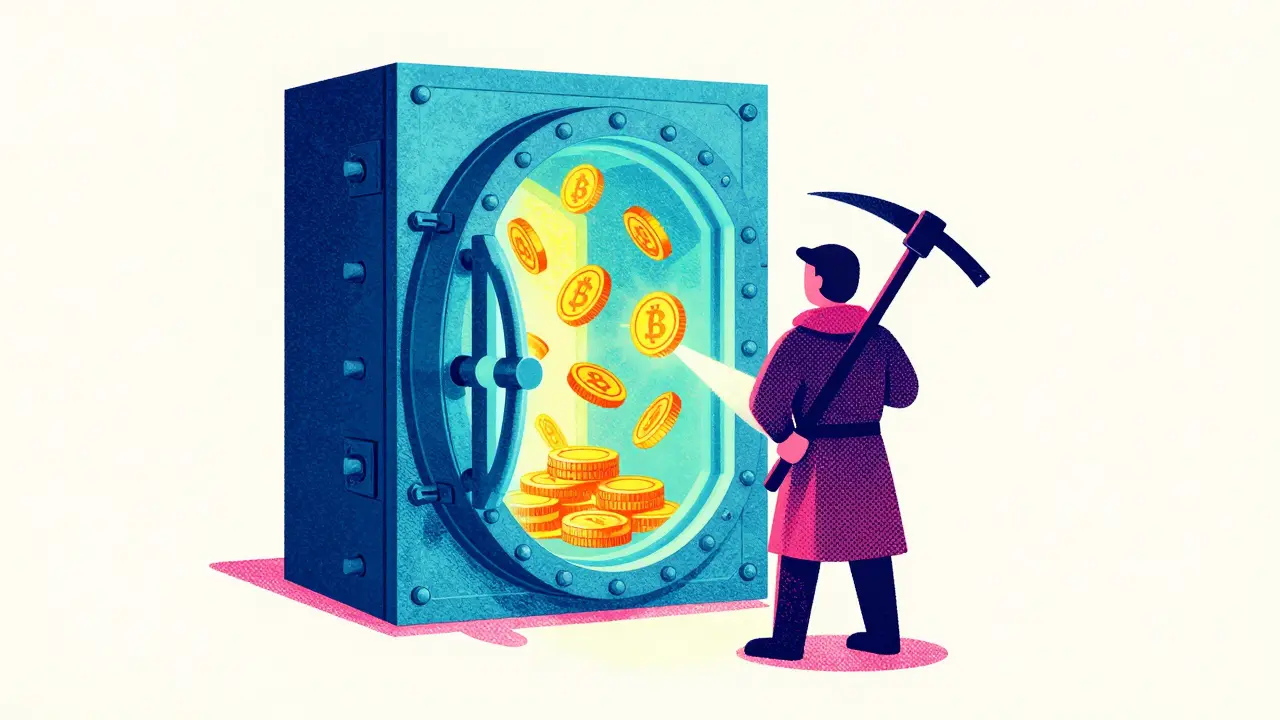
Imagine a world where the people protecting your bank vault get paid not by the bank, but by the sheer act of securing it. That is the core idea behind block rewards, which are the financial incentives given to miners or validators for adding new blocks to a blockchain ledger. Without this mechanism, blockchains would have no defense against hackers, no way to issue new currency fairly, and no reason for anyone to spend electricity or stake capital on the network. It is the economic engine that keeps decentralized systems running.
But how does this actually work? Why do miners care about solving complex math puzzles? And what happens when the reward gets cut in half? Understanding these mechanics is crucial for anyone holding crypto, because the value of your coins is directly tied to the security provided by these rewards.
The Anatomy of a Block Reward
A block reward isn't just one thing. It is a package deal consisting of two distinct parts. First, there is the block subsidy, which refers to newly minted coins created out of thin air by the protocol. This is how new Bitcoin enters circulation. Second, there are transaction fees, which are the tips users pay to have their transactions processed quickly. These fees come from existing coin holders, not from new issuance.
In the early days of Bitcoin, the block subsidy made up nearly 100% of the reward. Today, that balance is shifting. As Satoshi Nakamoto designed it in the 2008 whitepaper, the subsidy was meant to be the primary incentive initially, ensuring widespread distribution of coins. Over time, however, the goal was always for transaction fees to take over as the main source of income for validators. This transition is the central tension in modern crypto economics.
Bitcoin’s Deflationary Clock: The Halving Cycle
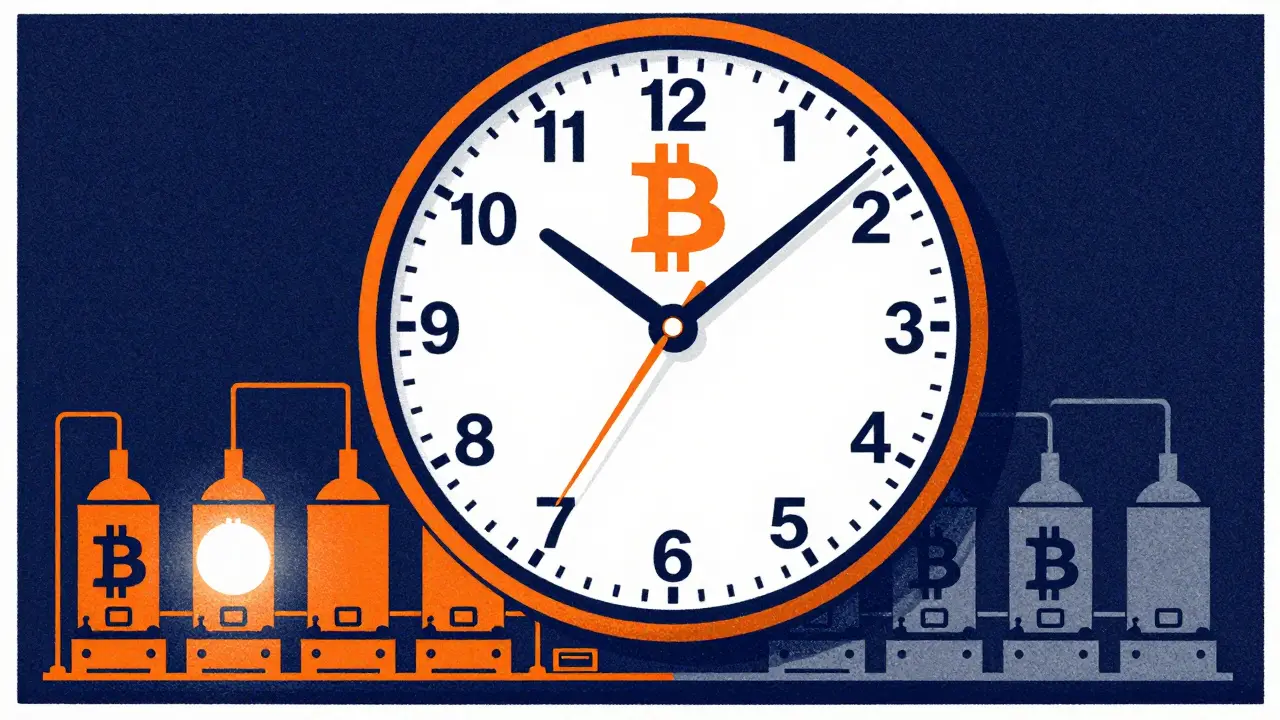
Bitcoin operates on a strict monetary policy known as the halving, a periodic event that cuts the block subsidy in half every 210,000 blocks (approximately four years). When Bitcoin launched in 2009, miners received 50 BTC per block. By November 2012, that dropped to 25 BTC. Then 12.5 BTC in 2016, and 6.25 BTC in May 2020. The next major milestone occurred in April 2024, reducing the reward to 3.125 BTC.
This predictable scarcity is why many investors view Bitcoin as "digital gold." There will never be more than 21 million bitcoins. The last fraction of a bitcoin is expected to be mined around the year 2140. At that point, the block subsidy will hit zero, and miners will rely entirely on transaction fees. This creates a disinflationary environment where the supply growth slows down over time, theoretically increasing the value of each remaining unit if demand stays steady or grows.
However, halvings create immediate pressure on mining operations. When the reward drops by 50%, miners with high electricity costs or older hardware often become unprofitable overnight. This leads to consolidation, where only the most efficient, large-scale industrial farms can survive. Critics argue this centralizes power, while proponents say it simply optimizes the network for long-term survival.
Ethereum’s Shift: From Proof-of-Work to Proof-of-Stake
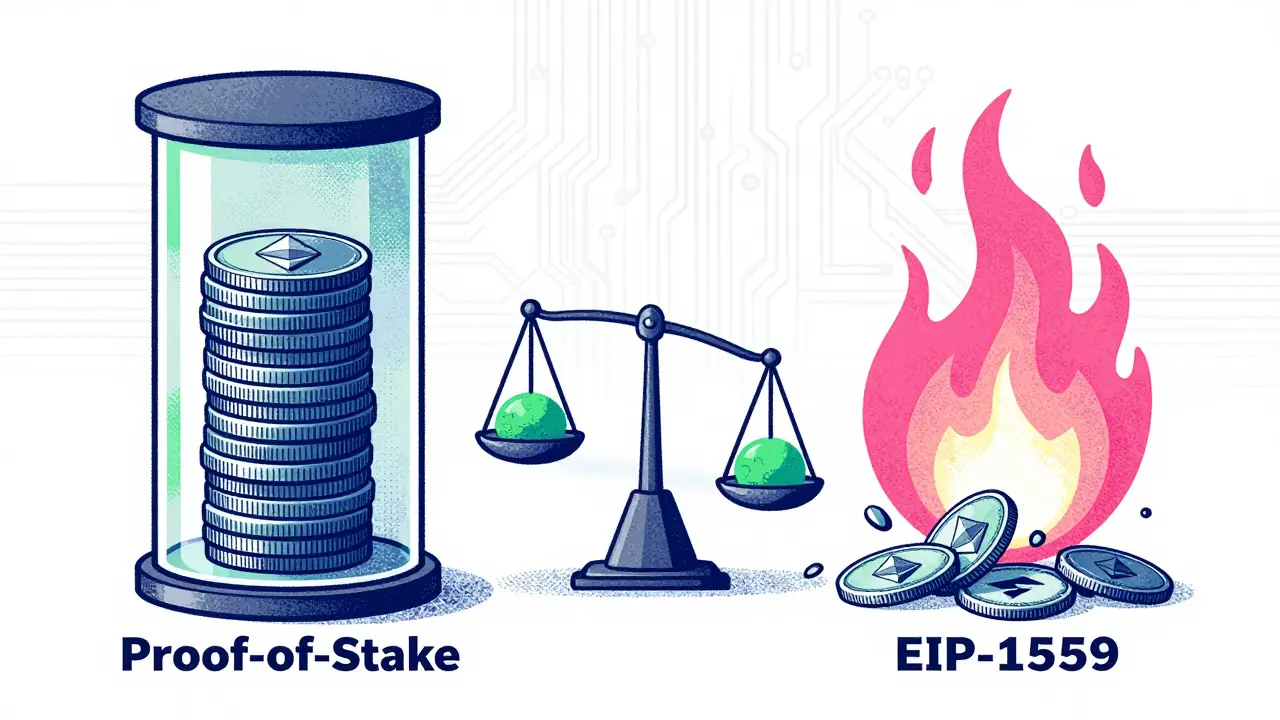
While Bitcoin doubled down on its energy-intensive model, Ethereum took a radically different path. On September 15, 2022, Ethereum completed "The Merge," transitioning from Proof-of-Work (PoW) to Proof-of-Stake (PoS), a consensus mechanism where validators secure the network by locking up ETH rather than using computational power. This change fundamentally altered block reward economics.
In PoW, you need expensive ASIC machines and cheap electricity. In PoS, you need 32 ETH to become a validator. The barrier to entry is lower in terms of capital expenditure (no $5,000+ miners), but higher in terms of opportunity cost (your ETH is locked up). More importantly, Ethereum introduced EIP-1559, a fee market improvement implemented in August 2021. Under this system, a base fee is burned (destroyed) with every transaction, while tips go to validators.
This means Ethereum can become deflationary. During periods of high network activity, like the NFT boom in late 2021, more ETH was burned than was issued as rewards. Currently, Ethereum’s annual issuance rate hovers between 0.2% and 0.5%, significantly lower than Bitcoin’s pre-halving rates. This dynamic model allows Ethereum to adjust its security budget based on actual usage, rather than following a rigid calendar.
| Feature | Bitcoin (PoW) | Ethereum (PoS) |
|---|---|---|
| Consensus Mechanism | Proof-of-Work | Proof-of-Stake |
| Reward Source | Newly minted BTC + Fees | Staking rewards + Tips (Base fee burned) |
| Supply Cap | Fixed at 21 Million | No hard cap; variable issuance |
| Halving/Adjustment | Every 4 years (fixed schedule) | Dynamic based on staked amount |
| Annual Issuance Rate | ~0.85% (post-2024 halving) | 0.2% - 0.5% |
| Primary Cost | Electricity & Hardware | Capital Opportunity Cost |
The Fee Market: Can Transactions Pay for Security?
The biggest question facing all blockchains is sustainability after subsidies disappear. For Bitcoin, analysts estimate that transaction fees would need to average $50 per transaction to maintain current security levels once the subsidy hits zero. Is that realistic? Probably not for everyday purchases like buying coffee. However, Bitcoin’s role may shift toward settling large institutional transfers, where higher fees are acceptable.
Layer-2 solutions like the Lightning Network aim to solve this by handling small payments off-chain, while the main chain handles high-value settlements. If this model works, the main chain remains secure through high-value fees, and users enjoy low-cost daily transactions. For Ethereum, the upcoming Dencun upgrade (EIP-4844) reduces data costs for Layer-2s by roughly 90%, potentially flooding those networks with traffic while keeping mainnet validator rewards stable through staking yields.
User behavior plays a huge role here. A 2023 survey found that 68.3% of crypto users consider transaction fees the most important factor when choosing a blockchain. If fees get too high, users leave. If they stay too low, validators quit. Finding that sweet spot is the holy grail of block reward economics.
Centralization Pressures and Miner Profitability
Block rewards don’t exist in a vacuum. They drive real-world business decisions. After the 2020 Bitcoin halving, only miners with access to sub-4 cents per kWh electricity could remain profitable with standard S19 Antminers. This forced smaller operators out of the game or into underground mining setups. Large companies like Marathon Digital and Riot Platforms raised hundreds of millions in public markets to build massive mining farms, arguing that scale is necessary for efficiency.
This trend worries some decentralization purists. When mining becomes an industrial operation requiring $5 million+ in capital investment, it looks less like a democratic network and more like a utility company. Yet, the hashrate-the total computational power securing Bitcoin-has continued to rise despite halvings, suggesting the economic model is robust enough to attract professional capital.
Future Trajectories and Regulatory Risks
As we move further into 2026, the landscape continues to evolve. Regulatory bodies are watching closely. The U.S. SEC has hinted that certain aspects of mining and staking could fall under securities regulations, depending on how rewards are structured and promised. This adds a layer of legal risk to the economic equation.
Meanwhile, alternative models are emerging. Monero uses a "tail emission" model, where a constant 0.6 XMR per block is issued forever to ensure miners always have an incentive, avoiding the fee-only cliff edge entirely. Litecoin follows Bitcoin’s halving path but with faster blocks. Each approach offers trade-offs between predictability, flexibility, and decentralization.
Ultimately, block reward economics is a balancing act. It must incentivize enough participants to secure the network without inflating the supply so much that the asset loses value. Bitcoin bets on fixed scarcity. Ethereum bets on dynamic utility. Both models have proven resilient so far, but the true test lies ahead as subsidies shrink and fees must carry the weight of global security.
What happens to Bitcoin miners after the block reward reaches zero?
After the block subsidy disappears around the year 2140, Bitcoin miners will rely exclusively on transaction fees for revenue. To remain viable, the network must generate enough fee volume from high-value transactions or Layer-2 settlement layers to compensate miners for their electricity and hardware costs. If fees are insufficient, hash rate could drop, potentially affecting network security until a new equilibrium is reached.
How does the Ethereum halving differ from Bitcoin's?
Ethereum does not have a fixed "halving" schedule like Bitcoin. Instead, its issuance rate is dynamic and depends on the total amount of ETH staked by validators. As more people stake ETH, the percentage yield for each validator decreases, effectively lowering the inflation rate. Additionally, EIP-1559 burns a portion of transaction fees, which can make the net supply deflationary during high-activity periods.
Why do block rewards decrease over time?
Block rewards decrease to control inflation and create scarcity. In Bitcoin’s case, the halving mechanism ensures a maximum supply of 21 million coins, mimicking the extraction difficulty of physical commodities like gold. This controlled issuance prevents hyperinflation and aims to preserve the purchasing power of the currency over decades.
Can transaction fees alone secure a blockchain?
Yes, but it requires significant network usage. For a blockchain to be secured solely by fees, there must be enough transaction volume and willingness to pay high fees to cover the operational costs of validators or miners. Bitcoin’s future security depends on this transition, supported by Layer-2 solutions that increase throughput while funneling settlement fees to the main chain.
What is the impact of block rewards on crypto prices?
Block rewards influence supply dynamics. When rewards are cut (halvings), the rate of new supply entering the market drops. If demand remains constant or increases, basic supply-and-demand economics suggest prices should rise. However, prices are also driven by broader market sentiment, regulation, and adoption, so halvings are not guaranteed price triggers.

Jon Milton
June 28, 2026 AT 19:41Look, I get the hype around digital gold but let's be real about the centralization happening here. The article glosses over how the halving basically evicts anyone who doesn't have industrial-grade power contracts. It's not a democratic network anymore it's a utility monopoly run by publicly traded mining firms. When you need sub-4 cent electricity to survive you aren't securing freedom you're securing margins for shareholders in Texas and Canada. This isn't decentralization it's just financial engineering with extra steps.
Maurice Flynn
June 28, 2026 AT 23:10I see your point about the consolidation but I think you're missing the bigger picture of why this efficiency matters long term. The network hashrate keeps hitting all time highs despite these halvings which shows the economic model is actually working as intended to attract professional capital. It's less chaotic now sure but also much more robust against attacks because the barriers to entry are high enough to deter casual bad actors.
Jon Milton
June 29, 2026 AT 08:10Robust against attacks maybe but robust against censorship? That's the trade off we're making. You call it efficiency I call it vulnerability to regulatory pressure on those big mining farms. If the SEC decides to squeeze Marathon or Riot do you really think the average person with a laptop can step in and secure the chain? No. They will just watch their coins become worthless while the big players negotiate deals behind closed doors. It's a slow death for the original ethos.
Fiona Ellis
June 30, 2026 AT 14:48The comparison table is quite illuminating regarding the fundamental differences between Proof-of-Work and Proof-of-Stake mechanisms. However, one must consider that Ethereum’s dynamic issuance rate introduces a layer of complexity that Bitcoin’s fixed schedule avoids entirely. While Ethereum aims for deflation through burning fees, this reliance on user activity means its security budget is volatile rather than guaranteed. It feels like betting on market sentiment rather than mathematical certainty.
nancy jarecki
July 1, 2026 AT 07:05Let us be intellectually honest here: the entire premise of 'security via transaction fees' is a theoretical fantasy that ignores basic human behavior regarding cost sensitivity. The notion that users will willingly pay $50 per transaction for settlement layers is absurd when Visa charges fractions of a cent. The fee market equilibrium required to sustain PoW security post-subsidy is economically unfeasible without hyper-inflationary fee structures that would kill adoption dead in the water. It is a Ponzi scheme waiting for the liquidity to dry up.
Trent Erman1
July 2, 2026 AT 23:04You guys are way too negative! Look at the potential here. Layer 2 solutions are literally solving the fee problem right before our eyes. Lightning Network and rollups mean we don't need every single coffee purchase to hit the main chain. The main chain stays secure with high-value institutional fees while everyday people use cheap L2s. It's a beautiful symbiosis. We are witnessing the evolution of money in real-time and it's incredibly exciting to see how these protocols adapt and improve. Keep an open mind!
Nicole Woessner
July 4, 2026 AT 22:34i think the real issue is that nobody knows what happens after 2140 honestly it's so far away it feels irrelevant but then again crypto moves fast. the tail emission idea monero uses seems way more practical than waiting for fees to magically cover everything. why force a cliff edge when you can just have a tiny steady stream of new coins to keep miners happy forever? it makes so much more sense than this whole scarcity panic.
Mélanie Boulay
July 5, 2026 AT 05:39While I appreciate the detailed breakdown of the economic incentives, it is important to recognize that the transition from subsidy-reliant models to fee-reliant models represents a fundamental shift in the social contract between validators and users, requiring not only technological adaptation but also a significant change in user expectations regarding transaction costs and confirmation times, which may ultimately determine the longevity and viability of these decentralized networks in a competitive financial landscape where traditional banking systems continue to offer instant and virtually free transfers for the majority of global transactions.