Remittance Cost Calculator
Compare the real cost and time of sending money across borders using mCEUR versus traditional services. mCEUR transactions cost just $0.008 and complete in under 10 seconds on the Celo network, while traditional remittances like Western Union cost up to $12 and take 2 days.
Enter an amount above to see cost comparison.
mCEUR is not just another crypto coin-it’s a digital version of the Euro built specifically for mobile payments and decentralized finance on the Celo blockchain. Unlike Bitcoin or Ethereum, mCEUR doesn’t aim to be a speculative asset. Its only job is to hold the same value as one Euro, no more, no less. That makes it useful for sending money across borders, paying for goods in DeFi apps, or saving without worrying about wild price swings. If you’re in Europe, Africa, or Latin America and want to use Euros digitally without banks, mCEUR might be the tool you didn’t know you needed.
How mCEUR Works: A Synthetic Euro on a Mobile-First Blockchain
mCEUR is a stablecoin, meaning its value is tied to the Euro. But here’s the twist: it’s not backed by real Euro bank deposits like EURS or eURT. Instead, it’s a synthetic asset created inside the Moola protocol on the Celo network. When someone deposits collateral-like CELO tokens or cUSD-into Moola’s lending system, they can borrow mCEUR. The system automatically adjusts interest rates and collateral ratios to keep mCEUR’s value locked at $1.10-$1.20 (roughly €1), even if the price of CELO drops.
This design lets mCEUR work without needing a bank to hold Euros. That’s important because it means the coin can run on a blockchain optimized for phones, not desktops. Celo uses phone numbers as wallet addresses. So if your friend in Kenya has a Celo wallet linked to their phone number, you can send them mCEUR just by typing their number. No long crypto addresses. No QR codes. Just like texting money.
Why Celo? The Mobile Payment Network Behind mCEUR
Celo is an Ethereum-compatible blockchain built for people who don’t have bank accounts. It’s carbon-negative, processes transactions in under 5 seconds, and charges less than a penny per transfer. That’s why mCEUR lives here-not on Ethereum or Solana. Celo’s whole reason for existing is to make crypto accessible on low-end Android phones in places like Nigeria, Colombia, or the Philippines.
That focus shapes mCEUR’s use cases. You won’t find it on Binance or Coinbase for direct fiat swaps. But you’ll find it in apps like Valora, Celo’s official wallet, or on UbeSwap, a decentralized exchange built for Celo. People use it to pay for solar energy subscriptions in Kenya, send remittances to family in Portugal, or borrow against their crypto holdings without leaving the app.
mCEUR vs. Other Euro Stablecoins: What Sets It Apart
There are other Euro stablecoins out there-EURS from Stasis, eURT from Tether, and even EURC from Circle. But here’s the difference: those coins run on Ethereum or Polygon. They’re designed for traders and institutional investors. mCEUR is designed for everyday people in emerging markets.
Compare the numbers:
| Feature | mCEUR | EURS / eURT |
|---|---|---|
| Blockchain | Celo | Ethereum, Polygon |
| Transaction fee | ~$0.0001 | $1-$5 |
| Wallet access | Phone number-based | Wallet address only |
| Circulating supply (Oct 2023) | 8.28 million | Over 300 million |
| Primary use case | Mobile payments, remittances | Trading, DeFi lending |
mCEUR doesn’t compete with EURS on volume. It competes on accessibility. If you’re in a village with poor internet and a $100 Android phone, mCEUR works. EURS? You’d need a desktop, a hardware wallet, and a few minutes to figure out gas fees.
Where You Can Use mCEUR Right Now
Don’t expect to buy coffee with mCEUR at Starbucks. But you can use it in real, working systems:
- Valora Wallet: Send mCEUR to anyone using just their phone number. Used by over 500,000 people in Africa and Latin America.
- UbeSwap: Swap mCEUR for cUSD, CELO, or other Celo tokens without leaving the app.
- Moola Finance: Deposit mCEUR to earn interest, or use it as collateral to borrow other assets.
- Worldline Partnerships: Starting in early 2024, mCEUR will be accepted at over 10,000 merchant terminals across 12 European countries.
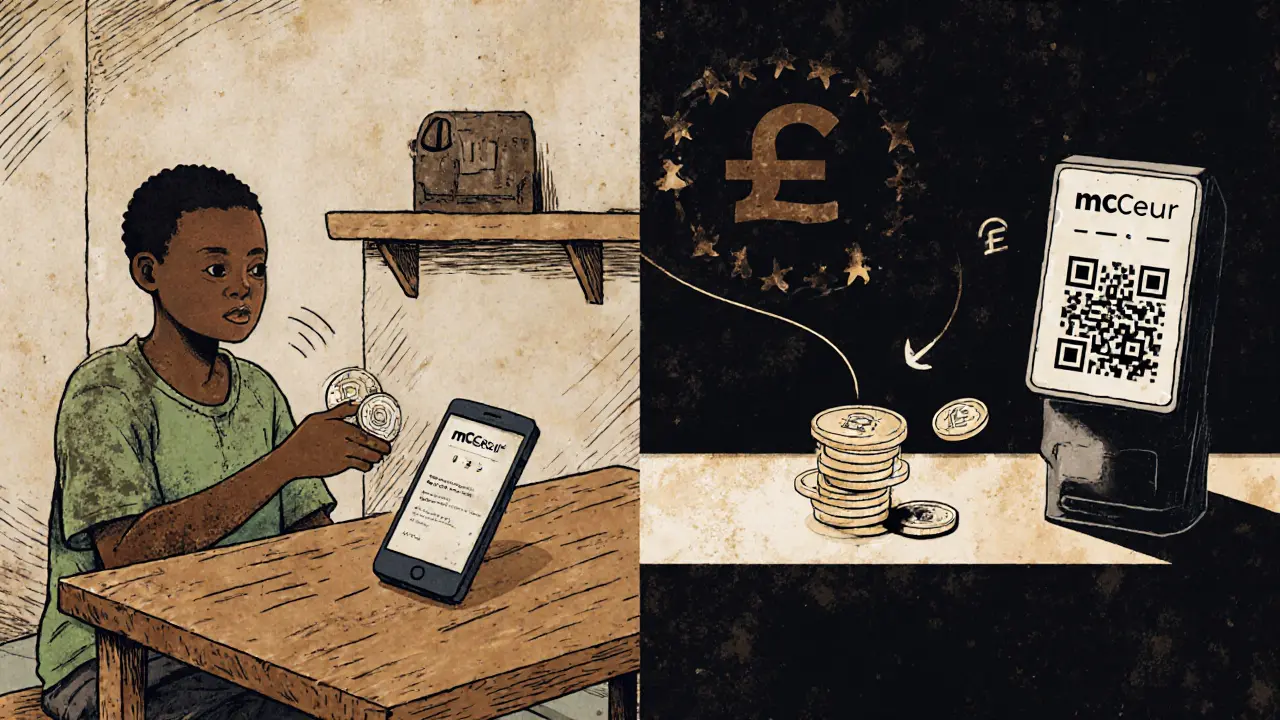
One Reddit user in Germany told how he used mCEUR to pay his sister in Ghana for her mobile airtime. The transaction took 7 seconds. Fees? $0.008. Traditional services like Western Union would’ve taken 2 days and cost $12.
How to Get mCEUR: A Step-by-Step Guide
Getting mCEUR isn’t as simple as buying Bitcoin on Coinbase. Here’s how real users do it:
- Buy CELO or cUSD on a centralized exchange like Binance or KuCoin.
- Transfer it to a Celo-compatible wallet (Valora, Rabby, or MetaMask with Celo network added).
- Open UbeSwap (ube.app) in your mobile browser.
- Connect your wallet and swap CELO or cUSD for mCEUR.
- Use it immediately for payments, lending, or saving.
For beginners, this takes 30-45 minutes. Mistakes happen-like sending ETH to a Celo wallet. That’s irreversible. Always double-check the network. Celo’s Discord has 24/7 support, and 92% of questions get answered in under a day.
Is mCEUR Safe? Risks and Limitations
It’s not risk-free. Here’s what you need to know:
- Smart contract risk: mCEUR relies on Moola’s code. If there’s a bug, funds could be lost. Audits exist, but no system is perfect.
- Liquidity risk: With only 8.28 million in circulation, swapping large amounts can cause price slippage.
- Regulatory uncertainty: The EU’s MiCA rules, effective in 2024, require stablecoins to hold 1:1 reserves. mCEUR doesn’t. That could trigger legal action or forced changes.
- Adoption risk: If Celo doesn’t grow, mCEUR won’t either. It’s tied to one ecosystem.
Experts are split. Galaxy Digital’s Alex Thorn says regional stablecoins like mCEUR “face an uphill battle.” But Celo’s partnerships with Worldline and mobile money providers in Kenya suggest real-world traction.
What’s Next for mCEUR?
The Celo Foundation is pushing hard. The upcoming Baklava upgrade will make mCEUR easier to swap across chains. The Worldline integration could bring it to cash registers in Paris, Berlin, and Madrid by mid-2024. If it works, mCEUR could become the go-to Euro stablecoin for everyday users in Europe and beyond.
But don’t expect it to replace USDC. It’s not trying to. It’s trying to replace bank transfers for people who don’t have banks.
Frequently Asked Questions
Is mCEUR the same as EURS or eURT?
No. EURS and eURT are Euro stablecoins on Ethereum or Polygon, backed by real Euros in bank accounts. mCEUR is a synthetic Euro created on the Celo blockchain using crypto collateral. It’s designed for mobile payments, not trading.
Can I cash out mCEUR for Euros directly?
Not easily. You can’t sell mCEUR for Euros on Binance or Coinbase. You’ll need to swap it for cUSD or CELO first, then convert that to fiat through a supported exchange. Some Celo partners offer direct Euro withdrawals in Europe, but it’s still limited.
How stable is mCEUR’s price?
It’s designed to stay at €1. In October 2023, it traded between $1.15 and $1.17. Its value is maintained algorithmically by the Moola protocol through collateral ratios and interest rate adjustments-not by holding Euros. Minor deviations happen, but it’s generally stable within 2%.
Do I need a bank account to use mCEUR?
No. That’s the whole point. You only need a smartphone and a Celo-compatible wallet. Many users in Africa and Latin America use mCEUR because they don’t have bank accounts.
Is mCEUR legal in the EU?
It’s in a gray area. The EU’s MiCA regulation, effective in 2024, requires stablecoins to be fully backed by reserves. mCEUR is synthetic, not backed by Euros. The Celo Foundation is working with regulators to clarify its status, but legal risk remains.
Can I earn interest on mCEUR?
Yes. On the Moola protocol, you can deposit mCEUR and earn interest from borrowers. Rates vary, but they’ve ranged from 3% to 8% APY. It’s not FDIC-insured, but it’s one of the few ways to earn yield on Euros without a bank.
Final Thoughts: Who Should Use mCEUR?
If you’re a trader looking for the next 10x coin, walk away. mCEUR isn’t for you.
If you’re someone who sends money to family abroad, runs a small business in Europe, or lives where banks are unreliable-then mCEUR is worth your time. It’s slow to grow, but it’s solving real problems. Low fees. Fast transfers. No middlemen. And it works on a $50 phone.
Its future isn’t about becoming the biggest stablecoin. It’s about becoming the most useful one-for the people who need it most.

Ann Ellsworth
November 29, 2025 AT 17:13mCEUR is essentially a synthetic asset masquerading as a stablecoin-devoid of the foundational reserve backing that confers legitimacy in the eyes of any rational financial actor. The Moola protocol’s algorithmic peg is a house of cards built on volatile CELO collateral, and the notion that this is ‘money’ for emerging markets is a dangerous illusion. When the collateral ratio collapses under market stress-and it will-there’s no FDIC, no central bank, no recourse. This isn’t innovation; it’s financial theater dressed in blockchain aesthetics.
Ankit Varshney
November 29, 2025 AT 23:10I use mCEUR to send money to my sister in Punjab. She doesn’t have a bank account, but she has a phone. Last week, I sent 5000 INR worth of mCEUR-converted from cUSD-and she got it in 12 seconds. No middlemen, no fees, no waiting. This isn’t about speculation. It’s about dignity. People don’t need Wall Street to move money. They need a simple tool. mCEUR is that tool.
Ziv Kruger
November 29, 2025 AT 23:15What is money, really? Is it the number on a screen? The paper in your wallet? The promise of a bank? mCEUR strips away the institutions and leaves only the transaction-pure, direct, and unmediated. It doesn’t ask for your ID, your credit score, or your birth certificate. It asks for a phone number and a willingness to trust code over bureaucracy. In a world where every interaction is surveilled and monetized, this is radical. Not because it’s perfect-but because it’s possible. And maybe, just maybe, that’s enough.
Heather Hartman
November 30, 2025 AT 09:32This is so exciting!! I’ve been watching Celo for months and mCEUR is finally starting to feel real. I love that it’s designed for people who’ve been left out of the financial system for too long. The fact that you can send money just by typing a phone number? That’s magic. And the low fees? Game changer. Keep pushing, Celo team-you’re building something beautiful for real humans, not just investors. I’m telling all my friends in Lagos and Mexico City about this!!
Catherine Williams
December 2, 2025 AT 00:17Just wanted to add: if you’re new to Celo and trying to get mCEUR, don’t panic if your first swap fails. I sent ETH to my Celo wallet once-total disaster. But the Discord community walked me through recovery in 20 minutes. They’re not just helpful-they’re kind. That’s rare in crypto. And yes, MiCA is a threat, but Celo’s working with regulators. This isn’t a gamble-it’s a movement. And if you’ve ever sent money to family across borders and felt the sting of fees or delays? You already know why this matters.