
When a stablecoin drops from $1.00 to $0.90 and stays there, it’s not a glitch. It’s a crisis. Stablecoins were built to be the quiet backbone of crypto - digital dollars that don’t swing like Bitcoin. But history shows they’re far from bulletproof. The moment a stablecoin depegs, it doesn’t just hurt traders. It rattles the entire crypto market, shakes trust in blockchain finance, and can even spill over into traditional banking systems.
What Is a Stablecoin Depeg?
A stablecoin depeg happens when a digital token designed to hold a fixed value - usually $1 - starts trading at a different price. If you own $1 worth of USDT and it suddenly sells for $0.97, that’s a depeg. It’s not a minor fluctuation. It’s a breakdown in the system meant to keep the value steady. Most stablecoins claim to be backed one-to-one by real assets: cash, Treasury bills, or other liquid reserves. But backing doesn’t mean safety. It means trust. And trust can vanish in minutes.The UST Collapse: The Worst Depeg in History
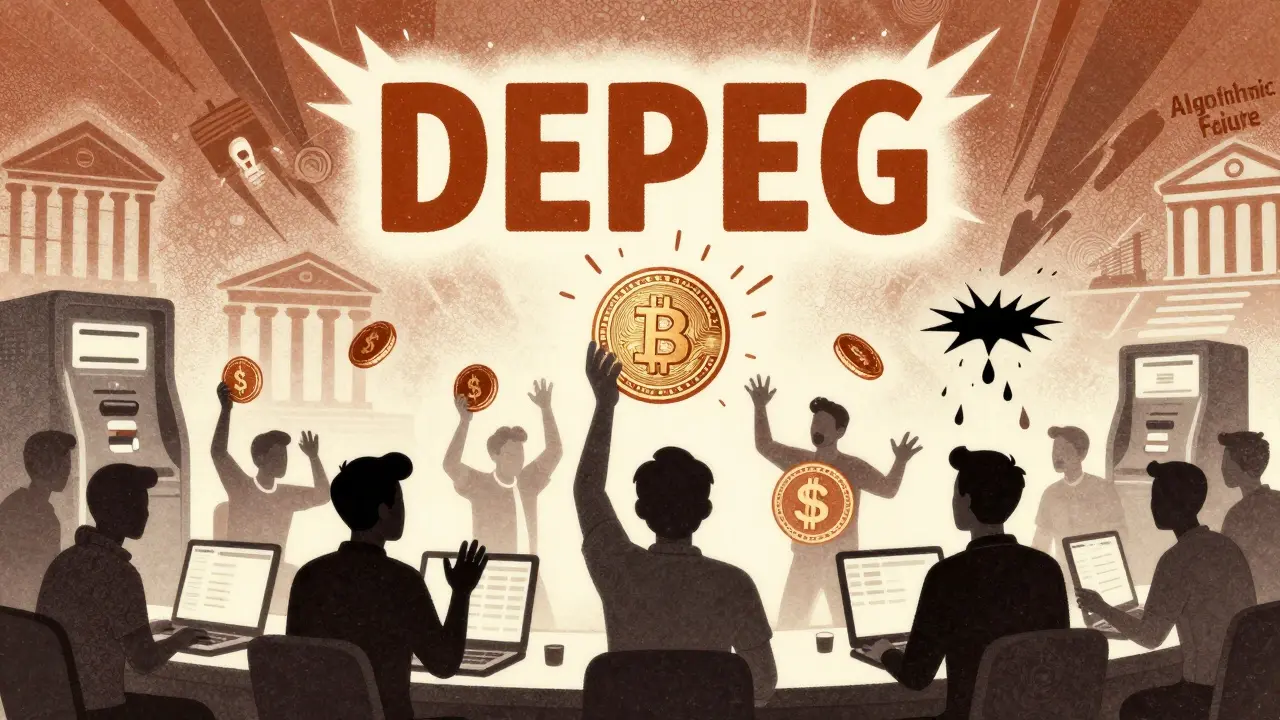
The most dramatic example came in May 2022 with TerraUSD (UST). Unlike USDT or USDC, UST wasn’t backed by cash. It was algorithmic - meaning its value was supposed to be maintained by a complex system of automated trades with another token called LUNA. When market pressure hit, the mechanism broke. Traders started selling UST, trying to cash out. The system tried to burn LUNA to print more UST and bring the price back up. But the market flooded with UST faster than the system could respond. LUNA’s price collapsed. UST dropped to 70 cents, then 50 cents. Within days, it was worthless. Over $40 billion in market value evaporated. This wasn’t a bug. It was a design flaw. Algorithmic stablecoins rely on constant market participation to work. When panic hits, they have no real assets to fall back on. UST didn’t just depeg - it died.Tether’s Long Shadow: When Backing Isn’t What It Seems
Tether (USDT) is the most widely used stablecoin. It claims to be fully backed by reserves. But in 2021, the U.S. Commodity Futures Trading Commission fined Tether $41 million for misleading claims about its reserves. The company admitted it wasn’t holding $1 for every USDT. Instead, it held commercial paper, corporate bonds, and even loans to its own affiliates. These aren’t cash. They’re risky, illiquid assets. If everyone tried to redeem USDT at once, Tether couldn’t pay. And that’s exactly what happened during the 2022 crypto crash. USDT briefly dipped to $0.95. It recovered - but only because big players stepped in to buy it up. The market didn’t trust it. It just had nowhere else to go.Why Some Stablecoins Hold Up - And Others Don’t
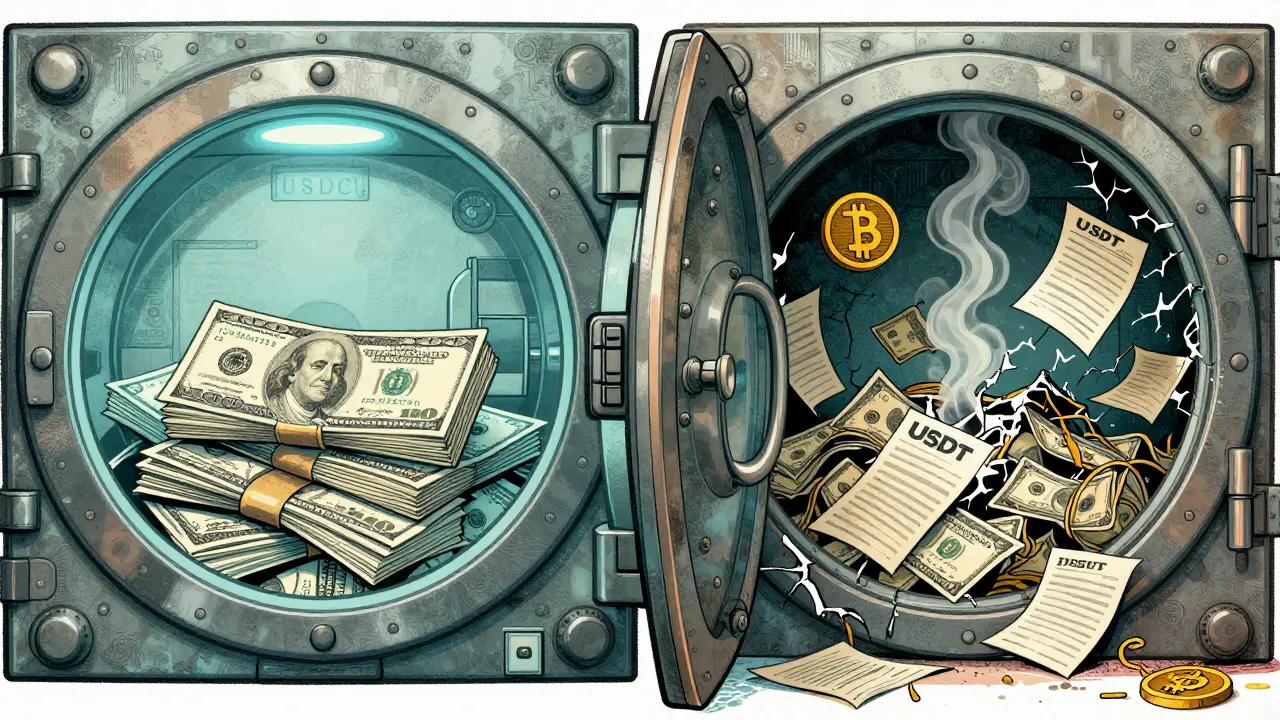
Not all stablecoins are built the same. Here’s how they stack up:| Stablecoin | Backing Type | Key Risk | Stability Record |
|---|---|---|---|
| USDC | USD cash + short-term Treasuries | Issuer risk (Circle) | Minimal depegs; recovered quickly in 2023 bank run |
| USDT | Commercial paper, bonds, loans | Liquidity crunch | Multiple minor depegs; always bounced back |
| DAI | Crypto collateral (ETH, USDC) | Overcollateralization failure | Minor dips during extreme volatility |
| UST | Algorithmic (no real assets) | Design fragility | Permanent collapse in 2022 |
USDC stayed near $1 even when Silicon Valley Bank collapsed in March 2023. Why? Because its reserves were held in U.S. government securities - the safest assets on Earth. When people panicked, they could still redeem USDC for real dollars.
DAI, the decentralized stablecoin, held up during the 2022 crash because it’s overcollateralized. For every $1 of DAI, users lock up $1.50 or more in crypto. That buffer absorbs shocks. But if ETH crashes 50%, even DAI can struggle.
What Triggers a Depeg?
Depegging doesn’t happen randomly. It’s usually a chain reaction:- Market panic - A major crypto sell-off starts. Traders rush to exit.
- Redemption pressure - People try to cash out their stablecoins for real USD.
- Liquidity crunch - The issuer can’t sell assets fast enough to meet demand.
- Loss of confidence - Rumors spread. More people sell. The price drops further.
- Self-fulfilling collapse - The depeg becomes permanent because no one believes the peg can be restored.
This is exactly what happened with UST. It wasn’t hacked. It wasn’t stolen. It just ran out of trust.
Who Gets Hurt When a Stablecoin Depegs?
The damage isn’t limited to people holding the coin.- Traders - Lose money instantly. A 10% depeg on $10,000 in USDT means $1,000 gone.
- DeFi protocols - Many lending platforms use stablecoins as collateral. If USDT drops, borrowers get liquidated. Lenders lose.
- Exchanges - Withdrawal requests spike. Some platforms freeze withdrawals to avoid insolvency.
- Traditional finance - Banks that hold stablecoins as digital cash face unexpected losses. Money market funds that invest in crypto-backed assets get dragged down.
When UST collapsed, it triggered a $60 billion crypto market sell-off. Bitcoin fell 20% in 48 hours. It wasn’t because Bitcoin was weak. It was because the system holding everything together cracked.
How to Spot a Risky Stablecoin
Not all stablecoins are equal. Here’s how to tell if one’s safe:- Check the reserve report - Does it publish monthly audits by a big firm like Grant Thornton or BDO? USDC does. USDT’s reports are vague.
- Look at the assets - Cash and U.S. Treasuries = safe. Corporate bonds, crypto, and loans = risky.
- Watch the trading volume - If a stablecoin trades less than $100 million a day, it’s easy to manipulate.
- See if it’s regulated - USDC is regulated in the U.S. and EU. Many others aren’t.
DAI is the only major stablecoin with no central issuer. That’s good for decentralization, but bad for simplicity. If ETH crashes hard, DAI can still depeg - just not as badly.
What’s Changed Since 2022?
The UST collapse forced the industry to change. Regulators are stepping in. The EU passed the MiCA law, requiring stablecoin issuers to hold 100% reserves in safe assets. The U.S. is moving toward similar rules. Issuers are now more transparent. USDC’s reserves are fully public. Tether still holds risky assets, but it’s reduced them by 30% since 2022. But the core problem remains: stablecoins are still unregulated financial instruments masquerading as digital cash. They’re used like money, but they’re not protected like bank deposits. If your bank fails, the FDIC covers you. If USDT fails, you’re on your own.Can Stablecoins Ever Be Truly Safe?
Yes - but only if they’re treated like money, not crypto. Real safety means:- 100% backing in cash or U.S. Treasuries
- Regular, independent audits
- Legal clarity: holders have first claim on reserves
- Regulation that treats them like banks
USDC is the closest to this ideal. DAI is close, if you accept crypto volatility. USDT? It’s still a gamble.
Algorithmic stablecoins? They’re dead. No serious project is launching one today. The market learned: if it doesn’t have real assets behind it, it’s not stable. It’s a house of cards.
What Should You Do?
If you use stablecoins:- Stick to USDC or DAI. Avoid USDT unless you’re comfortable with its risks.
- Don’t leave large amounts in stablecoins long-term. Move them to a bank account if you’re not trading.
- Never assume a stablecoin is risk-free. Even USDC could fail if Circle goes bankrupt.
- Watch for sudden price drops. A 2% depeg is a warning. A 5% depeg is a red flag.
Stablecoins were supposed to make crypto safe. Instead, they exposed how fragile the whole system is. The next depeg might not be as big as UST - but it could be just as damaging if you’re unprepared.
What causes a stablecoin to depeg?
A stablecoin depegs when market pressure overwhelms its ability to maintain its peg. This happens due to panic selling, insufficient liquidity, loss of confidence in reserves, or flaws in its stabilization mechanism. Algorithmic stablecoins like UST are especially vulnerable because they rely on complex code instead of real assets.
Is USDT still safe to use?
USDT is widely used, but it’s not the safest. Tether’s reserves include risky assets like commercial paper and loans, not just cash. While it’s never fully depegged permanently, it has dipped below $1 multiple times. If you’re holding large amounts, consider switching to USDC, which has fully transparent, government-backed reserves.
Why did UST collapse while USDC didn’t?
UST had no real assets backing it - it relied on an algorithm that burned LUNA tokens to maintain its $1 peg. When selling pressure hit, the system couldn’t keep up. USDC, on the other hand, is backed by actual U.S. dollars and Treasury bills. When panic hit in 2023, USDC could still be redeemed for real money.
Can a stablecoin recover from a depeg?
Yes - if it has real backing. USDT recovered from its 2022 dip because large buyers stepped in and the issuer had enough liquidity. But UST never recovered because it had no assets to sell. Recovery depends entirely on whether the issuer can access enough cash or liquid assets to meet redemption demands.
Are there any stablecoins that are 100% safe?
No stablecoin is 100% safe - but USDC comes closest. It’s fully backed by cash and U.S. Treasuries, audited monthly, and issued by a regulated company. Even so, its safety depends on Circle’s solvency. If Circle goes bankrupt, USDC holders could still lose out. True safety would require government-backed insurance, like FDIC for banks - which doesn’t exist yet.
How can I protect myself from stablecoin depegging?
Use only USDC or DAI. Avoid algorithmic stablecoins. Don’t hold large amounts long-term. Check reserve reports monthly. Withdraw to a bank account if you’re not actively trading. Treat stablecoins like a payment tool, not a savings account.


Gareth Fitzjohn
January 31, 2026 AT 16:40It’s wild how something meant to be the quiet anchor of crypto ended up being its most fragile part. I’ve held USDC for years, never thought twice - until the 2023 bank run. Even then, it held. That says more than any whitepaper ever could.
Algorithmic stablecoins? They’re not finance. They’re performance art with code. And when the audience leaves, the show collapses.
Real money doesn’t need a smart contract to stay worth $1. It just needs trust. And trust? That’s not built in Python.
Moray Wallace
February 1, 2026 AT 15:27USDT’s still around because people have nowhere else to go. It’s like using a broken phone because it’s the only one you’ve got. Doesn’t make it safe - just convenient.
I’ve seen traders panic-sell ETH to buy USDT during dips, then curse it when it dips to $0.96. Irony’s thick in this space.
Dylan Morrison
February 1, 2026 AT 15:51Stablecoins are the emotional support animals of crypto 🥺💸
We pretend they’re money, but they’re really just hope wrapped in a whitepaper. UST died because it was built on vibes. USDC survives because it’s backed by actual government IOUs - the original decentralized ledger.
It’s not about tech. It’s about who you trust. And honestly? I’d rather trust the U.S. Treasury than some guy in a Cayman Islands office with a PDF audit.
William Hanson
February 3, 2026 AT 08:15Everyone’s acting like USDC is some holy grail. Newsflash: Circle is a private company. They could vanish tomorrow. You think the FDIC covers your USDC? LOL. You’re not protected. You’re just delusional.
And DAI? Overcollateralized? That’s not stability - that’s waste. You’re locking up $1.50 to make $1. That’s not finance. That’s financial self-harm.
Kevin Thomas
February 4, 2026 AT 09:30Look, if you’re holding stablecoins long-term, you’re already playing the wrong game. They’re not savings accounts. They’re transit lanes - move in, move out, don’t park.
USDC? Solid. DAI? Fine if you’re okay with ETH swings. USDT? Only if you’re okay with sleeping with one eye open.
But here’s the real tip: if you’re not checking the reserve reports every month, you’re not investing - you’re gambling. And if you don’t know what commercial paper is? Don’t touch USDT. Period.
Also, stop treating crypto like a bank. It’s not. It’s a wild west with better UI.
Withdraw to your bank account weekly. Seriously. Your future self will thank you.
Jack Petty
February 4, 2026 AT 14:14They’re all controlled by the Fed. USDC? Circle’s a puppet. USDT? Tether’s a shell. DAI? ETH’s just another asset the banks want to own.
They want you to think you’re free, but you’re just moving your cash between different colored boxes in the same prison.
And don’t even get me started on ‘audits.’ They’re PR stunts. The same firms audit the same liars every time. It’s a cult with spreadsheets.
Real money is gold. Or cash under your mattress. Everything else? A digital illusion. Wake up.
Brianne Hurley
February 5, 2026 AT 05:40Ugh. I can’t believe people still think DAI is ‘decentralized.’ It’s just ETH + USDC with extra steps. And USDC? Please. Circle’s got a CEO who tweets about ‘financial freedom’ while sipping avocado toast in SF. It’s all theater.
And why is everyone acting like UST’s collapse was some surprise? The whitepaper literally said ‘algorithmic.’ Like, duh. It was a Ponzi with a GitHub repo.
Meanwhile, I’m over here holding actual USD in a bank account. Like, you know, the thing we used before crypto invented ‘stablecoins’ to make us feel better about our FOMO?
Also, why do you all keep using ‘depeg’ like it’s a real word? It’s not. It’s just ‘losing value.’