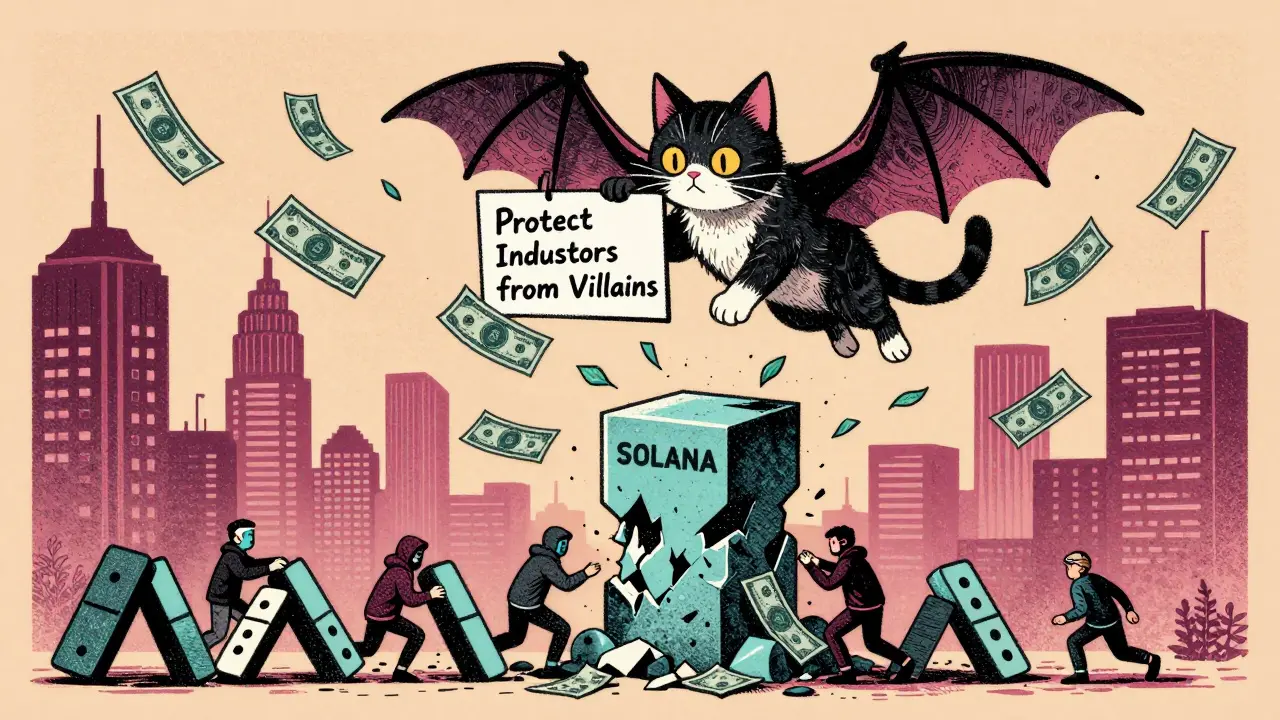
There’s a new coin floating around crypto Twitter called Batcat (BTC). It’s not Bitcoin. It’s not Ethereum. It’s not even a serious project. It’s a memecoin - and if you’re thinking about buying it, you need to know what you’re really getting into.
Batcat launched in early 2024 on the Solana blockchain. It doesn’t have a whitepaper. It doesn’t have a roadmap. It doesn’t have a team you can look up. What it does have is a story: it’s here to “protect investors from villains.” Sounds like a comic book plot. And honestly? That’s the whole point. Batcat isn’t trying to change finance. It’s trying to go viral.
Right now, Batcat trades for about $0.00001354. That’s less than a penny - and it’s down over 98% from its all-time high of $0.002992 in April 2024. Think about that. If you bought in at the peak, you’d have lost almost everything. The price swings are wild. One day it’s up 20%, the next it’s down 15%. That’s not volatility - that’s gambling.
How many people own it? Around 3,500. That’s not a community. That’s a small Discord server. Compare that to Bitcoin, which has millions of holders. Batcat’s market cap? Between $12,000 and $60,000 depending on which site you check. That’s less than the cost of a used car. Most major coins have market caps in the billions. Batcat doesn’t even make the top 1,000. CoinGecko lists it at #7818. CoinPaprika says #9048. You’re not investing in a coin. You’re betting on a meme.
It runs on Solana. That means it’s not its own blockchain. It’s just a token - like Chainlink or Polygon - but way less useful. Solana handles the speed and fees. Batcat just sits on top, riding the wave. No unique tech. No smart contracts that do anything special. No utility. No staking. No yield. No DeFi integration. Just a ticker symbol and a logo of a cat with bat wings.
Here’s the kicker: Batcat’s total supply is 1 billion tokens. Almost all of them are already out there. That’s why its market cap and fully diluted value are nearly the same. No more coins are being made. But that doesn’t mean it’s scarce. It means the entire supply was dumped into circulation early. Most of those coins are probably sitting in wallets of early buyers who sold off long ago. The ones still holding? They’re either believers… or people who bought at the bottom and are hoping for a miracle.
Trading volume? Barely there. Some sites say $10.28 in 24 hours. Others say $0. That’s not liquidity. That’s a ghost market. If you wanted to sell your Batcat right now, you’d struggle to find a buyer. Exchanges? Only one major listing, according to CoinPaprika. That means you can’t trade it on Binance, Coinbase, or Kraken. You’re stuck on obscure platforms with low trust and high risk.
Why does this even exist? Because memecoins thrive on emotion, not logic. Dogecoin made people rich - and then crushed them. Shiba Inu did the same. Batcat is just the next in line. It’s not built on innovation. It’s built on hype. The “protect investors from villains” angle? That’s marketing. It’s not a feature. It’s a slogan. And slogans don’t pay bills.
There’s no development team posting updates. No GitHub commits. No blog posts. No technical breakdowns. You can’t even find a clear token contract address without digging through forums. That’s not transparency. That’s silence. And in crypto, silence usually means the project is dead - or worse, a rug pull waiting to happen.
People who still chase Batcat say things like, “It’s going to 1 cent!” or “It’ll hit $0.10 next moon!” But look at the numbers. It’s been two years since its peak. It’s been dropping steadily. The community hasn’t grown. The volume hasn’t improved. The narrative hasn’t evolved. If this were a real project, it would have launched features, partnerships, or tools by now. Batcat? Still just a logo and a promise.
Is it a scam? Not officially. There’s no proof of fraud. But it’s also not an investment. It’s a lottery ticket. You’re not buying a coin. You’re buying a dream. And dreams like this? They almost always fade.
If you’re still curious, here’s the reality check: Batcat has no long-term future. It has no utility. No adoption. No innovation. No team. No roadmap. No exchange support. No liquidity. And a price that’s been falling for over two years. The only thing it has left is a small group of people hoping for a bounce - and a whole lot of people who already lost money.
There are thousands of memecoins out there. Most die within months. Batcat is one of the ones still breathing - barely. If you want to play, fine. But don’t call it investing. Call it gambling. And if you do, only risk what you’re okay losing. Because when the last person stops talking about Batcat, the price drops to zero. And no one will care.
Is Batcat (BTC) the same as Bitcoin?
No. Batcat (BTC) is a memecoin on the Solana blockchain. Bitcoin (BTC) is the original cryptocurrency, built on its own blockchain, with a market cap over $1 trillion. They share the same ticker symbol, but that’s where the similarity ends. Batcat is a joke. Bitcoin is a global asset.
Can I buy Batcat on Coinbase or Binance?
No. Batcat is not listed on any major exchange like Coinbase, Binance, Kraken, or KuCoin. It’s only available on one or two small, obscure platforms. That makes buying and selling risky. You’ll need to use a decentralized exchange on Solana, which requires wallet setup and higher risk of scams.
Why is Batcat’s price so low?
Batcat peaked at $0.002992 in April 2024. Since then, it’s lost over 98% of its value. That’s because the hype faded. No real use case, no team updates, no adoption. The initial buyers sold off, and new buyers didn’t come in. Without demand, the price keeps falling. It’s a classic memecoin collapse.
Is Batcat a good investment?
No. Batcat has zero fundamentals. No technology, no utility, no development, no community growth. Its only value comes from speculation. Most memecoins like this go to zero. If you buy Batcat, you’re not investing - you’re gambling. Only use money you’re prepared to lose completely.
How many Batcat tokens are in circulation?
The total supply is 1 billion tokens. Most sources say nearly all of them are already in circulation - between 999 million and 1 billion. That means no more coins will be created. But with so many already out there and no demand, the price has nowhere to go but down.
What makes Batcat different from other memecoins?
It doesn’t. Batcat’s “protect investors from villains” theme is just another meme. It’s not more innovative than Dogecoin, Shiba Inu, or Pepe. It has less adoption, lower volume, and weaker community engagement. There’s no real difference - just a different logo and a slightly different story.
Can Batcat’s price go back up?
Technically, yes - but it’s extremely unlikely. For Batcat to rise again, it would need a massive surge of new buyers, a viral moment on social media, or a fake news story. But without any real development or utility, any price bump would be short-lived. Most coins like this never recover from a 98% drop.
Should I hold Batcat long-term?
No. Holding Batcat long-term is like holding a lottery ticket that’s been sitting in your drawer for two years. The odds of winning are near zero. The longer you hold, the more likely you are to lose everything. There’s no evidence this project will ever become valuable. Let it go.

Christina Young
March 6, 2026 AT 05:07Steven Lefebvre
March 6, 2026 AT 12:41nalini jeyapalan
March 8, 2026 AT 02:02Drago Fila
March 8, 2026 AT 04:27Ken Kemp
March 9, 2026 AT 21:43James Burke
March 11, 2026 AT 18:04Nick Greening
March 13, 2026 AT 04:17Jesse VanDerPol
March 13, 2026 AT 05:01