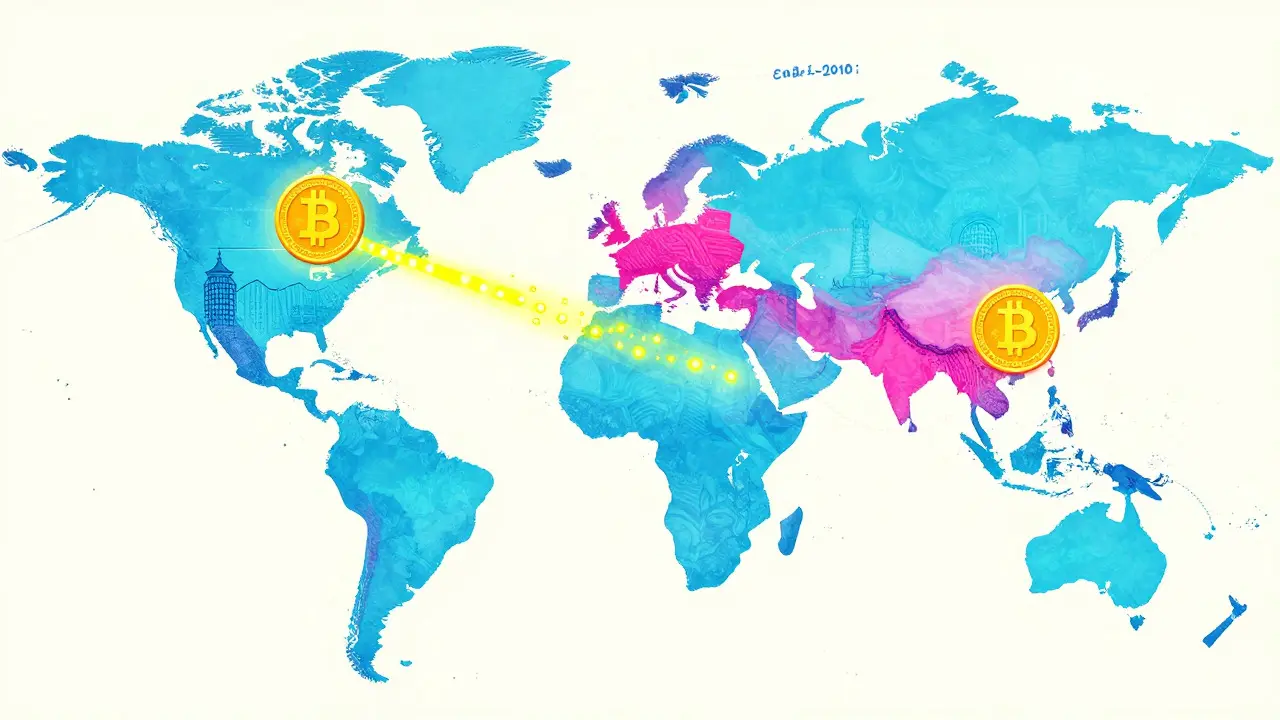
Imagine sending $50,000 in Bitcoin from a wallet in Dubai to an exchange in Singapore. In the past, this was a ghost trail-hard to track, easy to hide. But by 2026, that transaction leaves a digital footprint that regulators can read like a book. Cross-border crypto monitoring has shifted from a theoretical concern to a practical reality, driven by a global push to stop money laundering and sanctions evasion. For businesses and investors, this means the days of total anonymity are ending, replaced by a web of data sharing between governments, banks, and crypto platforms.
The core problem is simple: money doesn't respect borders, but laws do. When digital assets move across jurisdictions, they often slip through cracks in national regulations. International authorities are now closing those cracks using a combination of technology, new laws, and bilateral cooperation. Understanding how this works isn't just for compliance officers; it's essential for anyone moving significant value on-chain or holding assets in multiple regions.
The Core Mechanism: The Travel Rule and Data Sharing
At the heart of cross-border monitoring is the Travel Rule, which is a regulatory requirement mandating that financial institutions share originator and beneficiary information for transactions above a certain threshold. Originally designed for wire transfers, this rule has been adapted for cryptocurrencies. In the United States, the Financial Crimes Enforcement Network (FinCEN) enforces this under the Bank Secrecy Act. If you send more than $3,000 in convertible virtual currency, your Virtual Asset Service Provider (VASP)-whether it's an exchange, custodian, or wallet provider-must collect and transmit specific data.
This data includes the name, address, and account number of both the sender and receiver. It also covers the amount, date, and unique identifiers like wallet addresses. The goal is to ensure that if a transaction looks suspicious, investigators can trace it back to a human being, not just a string of code. While the threshold varies slightly by country, the principle remains consistent: transparency for larger movements. Smaller transactions might still fly under the radar, but high-value transfers are now subject to the same scrutiny as traditional bank wires.
| Jurisdiction | Primary Regulation | Key Authority | Monitoring Focus |
|---|---|---|---|
| United States | Bank Secrecy Act / FinCEN Rules | FinCEN | AML/CFT, Travel Rule ($3,000+), KYC for VASPs |
| European Union | MiCA (Markets in Crypto-Assets) | National Competent Authorities | Risk-based AML, Enhanced Due Diligence, Stablecoin Oversight |
| Global Standard | FATF Recommendations | Financial Action Task Force | International Benchmark for AML/CFT, Travel Rule Adoption |
How Regulators Actually Track Your Wallets
It’s not just about collecting names and addresses. The technical side of monitoring relies heavily on blockchain analytics. Companies like Chainalysis and Elliptic provide software to regulators and exchanges that maps out complex transaction networks. These tools can identify patterns, such as when funds from a sanctioned entity are moved through a series of "mixers" or "tumblers" to obscure their origin.
However, tech-savvy users have found ways around basic tracking. One common method is using private wallets that don’t require Know Your Customer (KYC) checks. Another is leveraging decentralized finance (DeFi) protocols where ownership is held via smart contracts rather than centralized accounts. To counter this, authorities are expanding their definition of who must comply. Recent proposals suggest that even unhosted wallets (self-custody) could be subject to reporting requirements if they interact with regulated entities. This blurs the line between private ownership and public accountability.
Sanctions enforcement adds another layer. The UK’s Office of Financial Sanctions Investigations (OFSI) and the US Department of the Treasury actively monitor for attempts to bypass sanctions using crypto. They look for red flags like:
- Transactions routed through VPNs to hide geographic location.
- Use of intermediary wallets to separate deposits from withdrawals.
- Interactions with known sanctioned exchanges or individuals.
If you’ve ever tried to buy crypto using a prepaid card or a third-party payment processor, you’re already part of this monitoring ecosystem. Every step creates a data point that regulators can connect.

The Role of International Cooperation
No single country can police the entire crypto world alone. That’s why international bodies like the Financial Action Task Force (FATF) set the global standards. FATF recommendations are adopted by over 190 jurisdictions, creating a baseline for what “compliant” looks like worldwide. Without this alignment, a company could easily operate in a lax jurisdiction and ignore rules elsewhere.
Bilateral agreements are becoming increasingly important too. The UK-US Transatlantic Task Force is a prime example. Launched to coordinate on licensing, custody, and stablecoin standards, this group helps prevent regulatory arbitrage. By agreeing on common definitions and reporting formats, the US and UK make it harder for companies to shop for the most lenient regulator. This cooperation extends to data sharing, allowing investigators in London to request records from New York without lengthy legal battles.
For businesses, this means compliance isn’t optional-it’s a prerequisite for doing business globally. If you want to offer services to customers in Europe, you need to meet MiCA standards. If you serve US clients, you must adhere to FinCEN rules. Trying to navigate these separately is inefficient and risky. Most large firms now build their compliance systems to handle multiple frameworks simultaneously.
Challenges and Gaps in Current Systems
Despite progress, significant gaps remain. The decentralized nature of crypto makes perfect tracking impossible. Layer-2 solutions, cross-chain bridges, and privacy coins all add complexity. Regulators are particularly concerned about stablecoins, which mimic fiat currency but often operate outside traditional banking oversight. A stablecoin issued in one country can be used in another without clearing a local central bank, creating a parallel monetary system that’s hard to monitor.
Another challenge is the speed of innovation. New tokens and protocols emerge daily, often faster than regulators can classify them. Is a new token a security? A commodity? A utility? Until there’s a clear answer, compliance becomes a guessing game. This uncertainty leads to inconsistent enforcement, where one regulator might fine a company while another ignores the same behavior.
Small and medium-sized exchanges also struggle with the cost of compliance. Implementing robust AML systems requires expensive software and specialized staff. For smaller players, this can be a barrier to entry, potentially consolidating the market into fewer, larger, better-regulated firms. While this improves safety, it reduces competition and choice for consumers.
What This Means for You
If you’re an individual investor, the immediate impact is less dramatic than for businesses, but it’s still real. Expect stricter KYC processes when signing up for new exchanges. You may need to provide proof of address or source of funds more frequently. Large transfers might trigger additional questions from your platform’s compliance team. Don’t panic-this is standard practice-but keep your documents organized.
For businesses, the message is clear: integrate compliance early. Waiting until a regulator knocks on your door is expensive. Work with licensed partners who already have AML infrastructure in place. Use reputable blockchain analytics tools to monitor your own risk exposure. And stay updated on changes in FATF recommendations, as these ripple out to national laws within months.
The trend is toward greater transparency, not less. As central banks roll out their own digital currencies (CBDCs), the distinction between “crypto” and “traditional money” will blur further. Monitoring will become seamless, built into the fabric of the financial system itself. The question isn’t whether cross-border crypto monitoring will expand, but how quickly it will reach every corner of the digital asset economy.
Does the Travel Rule apply to all crypto transactions?
No, it typically applies to transactions above a specific threshold, such as $3,000 in the US. Smaller peer-to-peer transfers between self-custody wallets may not be captured unless they involve a regulated service provider.
Can I use a private wallet to avoid monitoring?
You can hold assets in a private wallet, but you’ll likely need to use a regulated exchange or bridge to move funds in or out. Those points of contact are where monitoring happens. Purely offline or isolated on-chain activity is harder to track but less useful for spending or trading.
Which countries have the strictest crypto monitoring?
The US, UK, and EU members generally lead in enforcement due to detailed legislation like MiCA and FinCEN rules. Countries with strong capital markets and active financial crime units tend to have more robust monitoring capabilities.
How do regulators track stablecoins?
Stablecoins are tracked similarly to other cryptos, but regulators also monitor the issuer’s reserve backing. Since stablecoins aim to maintain a 1:1 peg with fiat, any discrepancy can signal fraud or insolvency, triggering enhanced scrutiny.
Will CBDCs replace crypto monitoring needs?
Not entirely. CBDCs will have built-in programmability and transparency, making them easier to monitor. However, private crypto assets will still exist, so a dual-layer monitoring system will likely persist, combining CBDC oversight with existing AML frameworks for non-CBDC assets.


Walker Perry
August 25, 2026 AT 06:14It is not about privacy it is about control and they are coming for your keys right now. The Travel Rule is just the first step in a total surveillance state where every satoshi you move is logged by the deep state. You think your private wallet is safe? It is only safe until you touch an exchange or a bridge which is exactly when they grab you. This is the end of financial freedom as we know it unless you go fully offline and burn the hardware wallets. The US government has always wanted this but now with global cooperation they have no excuse to fail. Stop trusting the banks and stop trusting the regulators because they are all in on it together to keep you poor. The real conspiracy is that they want to replace cash with CBDCs so they can tax your thoughts. Wake up before the net closes completely and you are left with nothing but digital IOUs. We need to fight back with true decentralization not these half-measures that still rely on VASPs. Every time you buy coffee with crypto you are handing over another piece of your soul to the algorithm. Do not let them win do not let them track your life through your transactions. The future belongs to those who refuse to be monitored by the leviathan.
Evelyn Kula
August 27, 2026 AT 04:14One must appreciate the sheer audacity of these regulatory bodies trying to impose their will on such a sophisticated asset class. It is truly beneath us to worry about such mundane compliance issues when we could be focusing on the macroeconomic implications of stablecoin adoption. However, for the common man, yes, the KYC requirements are becoming quite tedious and frankly embarrassing. I recently had to provide proof of address for a transfer under $5k which was utterly ridiculous given my net worth. The EU’s MiCA framework is actually quite elegant in its approach if one looks past the bureaucratic noise. It shows a level of sophistication that the US lacks in its patchwork of laws. We should be proud of our national standards though they are often more effective than the chaotic mess abroad. The idea that a simple wire transfer rule applies to blockchain is laughable to anyone with basic knowledge. Yet here we are dealing with the reality of FATF recommendations forcing our hand. One cannot ignore the geopolitical advantages of having strict AML controls in place. It keeps the riffraff out of the high-level trading floors. Let the small investors suffer the friction while we navigate the compliant channels with ease. The era of anonymity is dead long live the age of verified elite access. Do not complain about the paperwork it is the price of admission to the serious market.
manish jha
August 29, 2026 AT 03:54The path to clarity lies in understanding the moral imperative of transparency. Those who hide their assets are hiding from justice or from taxes. There is no middle ground in the eyes of the law. The regulations are there to protect the honest citizen from the criminal element. To resist them is to resist order itself. One must accept that privacy is a privilege not a right in a connected world. The guru knows that structure brings safety and chaos brings ruin. Follow the rules and sleep well at night. Deviate and face the consequences without complaint. The system works for those who respect it. Do not seek loopholes seek understanding. The light of regulation illuminates the dark corners of finance. Embrace it or be consumed by the shadows. There is no debate only truth. Accept the monitoring as a form of protection. Your wealth is safer when it is watched by the state. Resist not but adapt. The wise man complies silently. The foolish man argues loudly. Choose wisely. The end result is inevitable. Order prevails over disorder always. Submit to the process and find peace. The journey is the destination of compliance. Walk it with dignity. Do not look back at the old ways of secrecy. They are gone forever. Move forward into the light of full disclosure. That is the only way to survive in this new era. Trust the process and trust the authorities. They have your best interests at heart. Believe in the system and it will reward you. Doubt it and it will punish you. The choice is yours to make. Make it correctly. Make it morally. Make it legally. Make it right. The end.
Ashley Snyder
August 29, 2026 AT 22:34I actually think this is pretty cool honestly. It makes me feel safer knowing that if someone steals from me they can be tracked down. I used to be scared of losing everything to a scammer but now with all these tools it feels more secure. I don't mind doing the extra paperwork if it means less risk for everyone. My friend tried to use a mixer last year and got his account frozen for months so this is definitely better. I guess it is annoying to fill out forms but at least it is consistent now. I like that the US and UK are working together on this too. It shows that countries can actually cooperate on something important. I am not super tech savvy so I just follow what my exchange tells me to do. If they say I need ID then I send it and move on with my day. It saves me from making mistakes that could cost me big. I think the future is going to be really interesting with all these digital currencies coming out. Maybe one day we will not even need paper money anymore. But for now I am happy just keeping my savings safe in a regulated place. Thanks for the info it helped clear up some confusion I had. Keep writing posts like this please!
Susan Kiley
August 30, 2026 AT 17:21Oh my goodness did you see how they are tracking even the small transfers?? :O It is absolutely terrifying how much power they have over our digital lives now. I mean who would have thought that buying lunch with a card would lead to a federal investigation?! :D The elites are laughing at us while we scramble to keep up with the rules. It is like being a rat in a maze designed by gods. But hey at least we have Chainalysis to tell us where we stand! :P I bet they are reading our minds through our wallet addresses right now. Isn't it just wonderful how technology serves the master? :/ I try to stay positive but sometimes the weight of surveillance is just too heavy. We are all just data points in their grand experiment. Who cares about privacy when you can be fined for holding too many coins? :S The drama is endless and the stakes are incredibly high. I just hope we all learn to dance in the spotlight soon. Until then keep your heads down and your wallets open. Life is a performance and we are all actors in this play. Don't forget to smile for the camera! :)
Darren Moon
September 1, 2026 AT 00:31One observes a rather tedious proliferation of regulatory frameworks that serve little purpose beyond creating administrative overhead for the diligent participant. The concept of the 'Travel Rule' applied to immutable ledgers is, at best, a clumsy adaptation of archaic banking protocols to a fundamentally different technological paradigm. It creates a false sense of security while simultaneously stifling innovation through excessive compliance costs. The reliance on third-party analytics firms introduces a single point of failure and potential bias into the monitoring ecosystem. Furthermore, the international coordination efforts, while laudable in theory, often result in conflicting interpretations that confuse rather than clarify the legal landscape. The average user is left to navigate this labyrinthine web of jurisdictions with minimal guidance and significant risk of error. It is a situation where the cost of non-compliance far outweighs the benefits of participation for smaller entities. The market consolidation predicted by such measures is inevitable but undesirable for consumer choice. Ultimately, the system remains reactive rather than proactive, constantly chasing the next innovation rather than anticipating it. One must question whether the current approach is sustainable or merely a temporary reprieve before the next wave of disruption. The emotional toll on investors trying to remain compliant is also frequently overlooked in these dry technical discussions. It is a exhausting endeavor to stay ahead of the curve when the curve is constantly shifting. Perhaps a more holistic approach to digital asset governance is required. Until then, we remain stuck in this purgatory of uncertainty and bureaucratic fatigue. The jargon-heavy nature of these reports does not help the general public understand their rights. It is a system designed by insiders for insiders. The rest of us are merely spectators to this complex game. And we are expected to pay the entry fee. How quaint. How utterly inefficient. How very Britishly understated in its dysfunction. One sighs deeply at the state of affairs. But one must press on regardless. The work continues. The forms must be filed. The audits must be passed. The cycle repeats. Ad infinitum. Or at least until the next major shift occurs. Which it always does. Inevitably. Predictably. Boringly. Yes. Very boring indeed.
Quang Thai Tran
September 2, 2026 AT 13:52It is evident that the global architecture of financial oversight is being meticulously constructed to eliminate any possibility of sovereign escape from monetary policy. The implementation of cross-border data sharing agreements signals a coordinated effort to neutralize the disruptive potential of decentralized finance. One must recognize that the current push for transparency is not merely regulatory but strategic in nature. The integration of blockchain analytics into state apparatuses represents a significant escalation in surveillance capability. This trend suggests that the boundary between public and private financial activity is dissolving rapidly. The role of intermediaries is expanding to include not just custody but also behavioral monitoring. Consequently, the concept of self-sovereignty in digital assets is becoming increasingly theoretical. The practical reality is that interaction with regulated entities triggers immediate data capture. This mechanism ensures that even isolated on-chain activities are eventually linked to identity. The speed of enforcement is accelerating due to automated detection systems. Human review is being supplemented by algorithmic flagging of anomalous patterns. This dual-layer approach reduces the margin for error in both evasion and detection. The long-term implication is a unified global ledger of financial behavior. Such a system would allow for real-time assessment of economic health and stability. However, it also concentrates immense power in the hands of a few regulatory bodies. The balance of power between states and individuals is shifting decisively toward the former. Citizens must adapt to this new paradigm of continuous accountability. Resistance is futile against the tide of institutional convergence. Compliance becomes the primary mode of existence for the financially active. The alternative is isolation from the mainstream economy. Few are willing to make that sacrifice. Thus, the system gains universal acceptance through necessity. The future is bright for those who align with the flow. Dark for those who attempt to swim against it. The waters are rising. Adapt or drown. That is the simple truth. The complex details are merely distractions. Focus on the core message. Transparency is the new normal. Privacy is the old luxury. Enjoy the view from the top. Or struggle in the mud below. Your choice defines your fate. Act accordingly. Do not hesitate. Do not doubt. Do not delay. Time is of the essence. The clock is ticking. The net is closing. The game is changing. Play smart. Play safe. Play compliant. That is the only winning strategy. Remember this. Always.
Kate Staab
September 3, 2026 AT 10:08It is simply wrong that they are watching our every move. Where is the line between safety and tyranny? They claim it is for our own good but who decides what is good? I feel like we are living in a prison with invisible walls. The morality of this situation is questionable at best. They treat us like criminals before we have even done anything wrong. Presumption of guilt is built into the system. It is a heavy burden to carry. The weight of constant observation is crushing. We have lost our right to err in private. Every mistake is recorded and judged. By whom? By bureaucrats who do not understand our lives. The drama of modern existence is defined by this lack of trust. It is a tragedy playing out in real time. We are the characters in a story written by others. And we are expected to applaud. How absurd. How infuriating. How utterly unfair. The moral compass of society is spinning wildly. We need to find our center again. We need to reclaim our dignity. Not through rebellion but through quiet resistance. Through the simple act of demanding respect. For our privacy. For our autonomy. For our humanity. These are the values that matter. Not the efficiency of a database. Not the precision of a tracker. But the soul of the individual. Do not let them erase it. Hold on tight. The storm is coming. And it will test us all. May we stand firm. May we remain kind. Even in the face of such injustice. Especially then. Kindness is our shield. Truth is our sword. Use them wisely. The battle is long. But the victory is ours. If we believe. If we fight. If we never give up. That is the promise. That is the hope. That is the dream. Live it. Breathe it. Be it. The end is near. But the beginning is now. Start today. Start now. Start within. The change begins with you. Remember that. Always.
Tasha Davis
September 4, 2026 AT 17:34You guys are overthinking this so much! It is actually super easy to handle if you just stay organized. I made a folder for all my docs and now I am stress free. Just keep your ID ready and you are good to go. No need to panic about the big bad regulators. They just want to make sure you are not doing anything shady. And who among us is really doing anything shady? Probably not most of us! So relax and enjoy the ride. The crypto world is growing and that is a good thing. More people means more opportunities for everyone. So let's welcome the changes with open arms. It is exciting times to be alive! Keep smiling and keep stacking sats. You got this! 💪🚀
Abigail Sparks
September 6, 2026 AT 02:53Listen up, you are missing the bigger picture here. The key is not just to comply but to leverage the compliance infrastructure for competitive advantage. If you are running a business, integrate your AML checks directly into your onboarding flow. Do not treat it as a separate task. Make it seamless. Use API connections to your analytics provider so data flows automatically. This reduces human error and speeds up processing. For individuals, the best strategy is to maintain a clean history. Avoid mixing funds unnecessarily. Keep your transaction patterns consistent. Regulators look for anomalies, not just volume. If you suddenly move large sums after years of small ones, you will get flagged. Plan your movements accordingly. Also, consider using reputable exchanges with strong compliance teams. They will handle the heavy lifting for you. Do not try to DIY your way through complex cross-border transfers unless you are an expert. The risk of getting stuck in limbo is too high. Stay informed about the latest FATF updates. They release guidance notes regularly. Read them. Understand the nuances. It will save you headaches later. The goal is to operate smoothly within the system. Not to fight it. Fighting it wastes energy and resources. Channel that energy into growth instead. Build relationships with compliance officers at major platforms. They are helpful if you are respectful and prepared. Ask questions. Show that you care about doing things right. It pays off in the long run. You will get faster approvals and fewer audits. That is the secret. Proactive engagement beats passive reaction every time. Apply this mindset and you will thrive in the new regulatory environment. Do not wait for problems to arise. Prevent them. That is the professional approach. Adopt it today. See the difference tomorrow. Your future self will thank you. Now go execute. Do not procrastinate. Action is the only answer. Move forward. Confidently. Decisively. Effectively. That is how winners operate. Join their ranks. Start now.