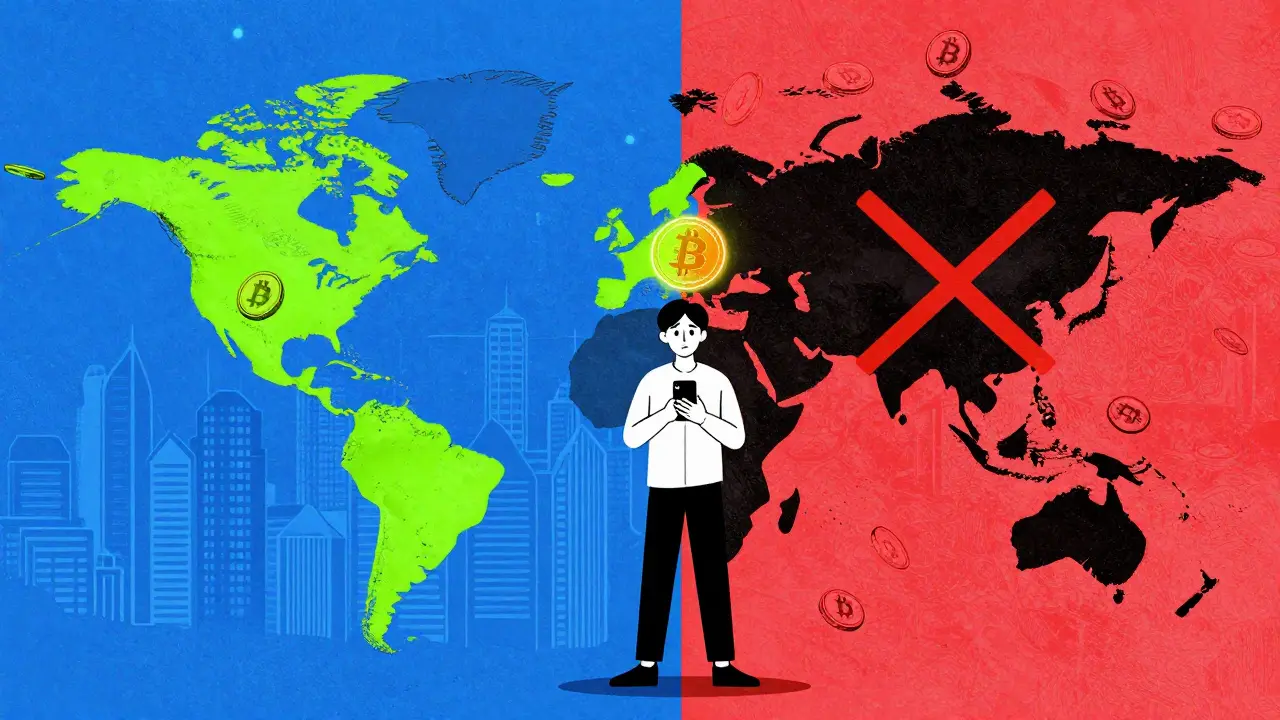
Imagine checking your wallet balance only to realize that holding those digital coins is a felony in your country. For millions of people living in nations with strict cryptocurrency bans, this isn't just a hypothetical nightmare-it's a daily reality. The global landscape for digital assets has fractured sharply. While some economies embrace blockchain innovation, others have drawn a hard line, imposing severe criminal penalties for crypto ban violations ranging from massive fines to prison sentences.
The confusion around these laws is staggering. You might hear that "crypto is illegal" but still see friends using it without issue. Why? Because enforcement varies wildly depending on whether you are an individual user, a business owner, or a money launderer. Understanding the difference between a total prohibition and a targeted sanction is crucial for your financial safety. Let’s break down where the red lines are drawn, what the actual punishments look like, and how governments are changing their tactics in 2026.
Who Actually Bans Crypto? The Global Split
To understand the risks, you first need to know where you stand geographically. The Atlantic Council’s 2025 Cryptocurrency Regulation Tracker analyzed 75 countries and found a clear divide. About 45 nations fully legalize crypto, treating it as property or a payment method. Another 20 countries impose partial bans, often restricting banks from dealing in crypto while leaving individuals in a gray area. Then there are the 10 countries with general or outright bans.
The countries with the strictest prohibitions include Algeria, Egypt, Morocco, and China. In these jurisdictions, the law doesn’t just discourage usage; it explicitly criminalizes it. For example, Algeria’s Article 117 prohibits the purchase, sale, use, and holding of virtual currency. Egypt similarly bans individuals, banks, and financial institutions from dealing in cryptocurrencies. However, the definition of "ban" changes depending on who you ask. A ban on banks means you can’t use your credit card to buy Bitcoin, but it doesn’t necessarily mean the police will raid your home if you hold BTC in a private wallet.
| Country/Region | Ban Type | Target of Enforcement | Known Penalties |
|---|---|---|---|
| Algeria | Full Prohibition | All transactions | Fines, potential imprisonment under existing exchange laws |
| Egypt | Full Prohibition | Individuals & Banks | Unspecified criminal charges, asset seizure |
| Morocco | Exchange Control Ban | Currency conversion | Fines under Office des Changes regulations |
| China | Business/Mining Ban | Exchanges, Mining, Businesses | Heavy fines, shutdowns; individual holding less penalized |
| USA (Specific Cases) | Sanctions-Based | Terrorist financing, Sanctions evasion | Asset freezes, federal prison time |
What Are the Actual Criminal Penalties?
When we talk about "criminal penalties," we aren't just talking about a slap on the wrist. In countries with full bans, violating the law can trigger provisions related to fraud, illegal banking, or capital flight. The specific charges vary, but the outcomes are often severe.
In Morocco, the Office des Changes declared that transactions via virtual currencies infringe on exchange regulations. This isn't a new crime specifically for crypto; instead, authorities apply existing laws regarding foreign exchange violations. Penalties here include significant fines and potentially short-term imprisonment, though most cases result in financial penalties rather than jail time for average users.
Egypt presents a riskier environment. While the Central Bank of Egypt issued warnings against crypto usage, the legal framework allows for prosecution under broader anti-money laundering statutes. If authorities suspect you are moving capital out of the country illegally using crypto, the charges escalate from simple regulatory violation to economic crimes, which carry heavier prison sentences.
Perhaps the most misunderstood case is China. Since 2021, China has banned crypto exchanges, trading platforms, and mining operations. The government views these activities as threats to financial stability. However, the Chinese government has historically been reluctant to prosecute individual citizens simply for *holding* Bitcoin. Instead, they target the infrastructure-shutting down servers, freezing bank accounts linked to exchanges, and fining companies. For an individual, the primary penalty is usually the inability to cash out through official banking channels, leading to forced peer-to-peer (P2P) trades which carry their own legal risks.
The Shift from Bans to Sanctions
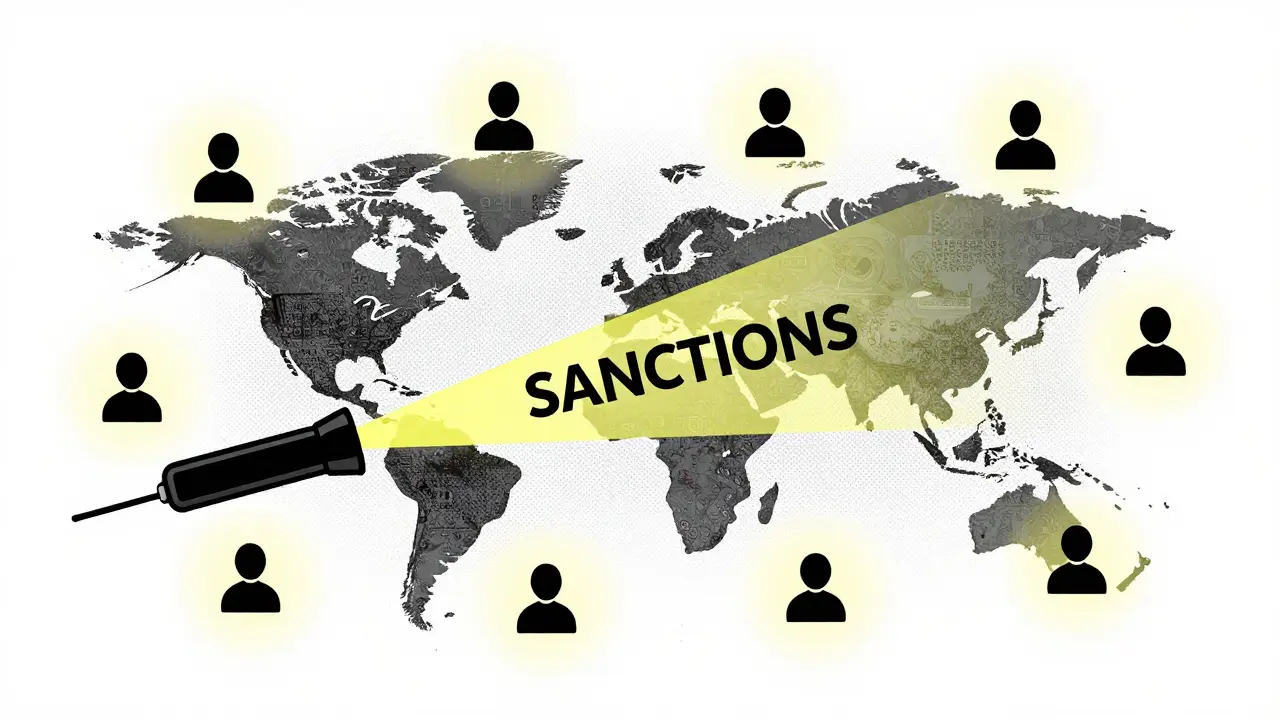
A major trend in 2025 and 2026 is the move away from blanket criminalization toward targeted sanctions. Governments are realizing that banning crypto entirely is ineffective because adoption rates remain high even in prohibited regions. Instead, agencies like the U.S. Department of the Treasury’s Office of Foreign Assets Control (OFAC) are using sanctions as a surgical tool.
This approach was highlighted in the TRM Labs 2025 Crypto Crime Report. Rather than arresting every person who buys Bitcoin, OFAC designates specific wallets, exchanges, and individuals involved in illicit activities. For instance, entities supporting Russia’s illicit economy, Hamas, or Hezbollah have had their crypto addresses sanctioned. If you transact with a sanctioned address, you violate international law. The penalty? Your assets get frozen, and you face federal criminal charges for aiding sanctioned regimes.
This distinction is vital. Being a crypto user in a banned country might land you in local trouble. But interacting with sanctioned entities lands you in international hot water. The U.S. Department of Justice released a memorandum in April 2025 titled "Ending Regulation by Prosecution." This guidance clarified that prosecutors should prioritize misappropriation of funds, sanctions evasion, and fraud. They deprioritized prosecuting people merely for using crypto in ways that were legally ambiguous. This signals a maturation of global enforcement: punish the criminals, not the confused investors.
Enforcement Realities: Do People Actually Get Caught?
Here is the uncomfortable truth: enforcement is patchy. A CoinDesk survey from May 2025 revealed that only 12% of users in banned jurisdictions reported facing personal legal consequences for using cryptocurrency. Most people fly under the radar by using decentralized finance (DeFi) protocols or P2P platforms like LocalBitcoins.
However, "not getting caught" is not the same as "being safe." When enforcement does happen, it tends to be aggressive and public. Authorities often seize assets to make an example. In cases involving terrorist financing, such as the designation of Mustafa Ayash for raising funds for Hamas, the response is immediate and severe. These high-profile cases serve as deterrents, reminding users that anonymity is not absolute.
Blockchain analysis firms like Chainalysis help governments track these flows. Even if you use a mixer or a privacy coin, the entry and exit points-where you convert fiat to crypto or vice versa-are visible. If you withdraw $50,000 into a bank account in a country where crypto is banned, the bank’s compliance software will flag it. That’s when the penalties kick in. The risk isn’t the blockchain itself; it’s the moment you touch the traditional financial system.
Navigating the Gray Areas: Partial Bans and Regulations
Not all restrictions are outright bans. Many countries fall into the "partial ban" category. South Korea, for example, passed the Virtual Asset Users Protection Act in 2023. This didn’t ban crypto; it regulated it. They require exchanges to keep detailed records and ensure transparency. If you fail to report gains or use unlicensed exchanges, you face tax penalties and administrative fines, not criminal prison time.
Similarly, the European Union implemented the Markets in Crypto-Assets (MiCA) framework in 2024. MiCA establishes strict licensing requirements for service providers but does not criminalize user activity. The focus is on consumer protection and preventing market manipulation. In these regulated environments, the "penalty" for non-compliance is usually losing access to licensed services or paying back-taxes, rather than facing a criminal indictment.
Understanding this spectrum helps you assess your risk. If you live in a country with MiCA-style rules, your main concern is tax compliance. If you live in Algeria or Egypt, your concern is avoiding detection entirely. The strategies for staying safe are completely different.
Future Outlook: Will Bans Disappear?
By 2027, experts predict a continued decline in outright criminal bans. The Atlantic Council notes that over 90% of countries now have active Central Bank Digital Currency (CBDC) projects. Governments are competing with private crypto by creating their own state-backed digital currencies. It makes little sense to ban a technology you are trying to replicate.
Instead of banning, regulators are focusing on integration. The GENIUS Act, signed into U.S. law in July 2025, regulates stablecoins as payment instruments. This sets a precedent for functional regulation rather than prohibition. As more countries adopt similar frameworks, the line between "legal" and "illegal" will blur into "regulated" and "unregulated." The criminal penalties will shift from punishing ownership to punishing misuse-specifically, money laundering, terrorism financing, and sanctions evasion.
Is it illegal to own cryptocurrency in countries with a ban?
It depends on the specific country. In places like Algeria and Egypt, owning and transacting with crypto is explicitly prohibited by law. However, in countries like China, the ban primarily targets businesses, exchanges, and mining operations, while individual possession remains in a legal gray area, though converting crypto to fiat through banks is strictly monitored and often blocked.
What happens if I trade crypto in a banned country?
Penalties vary widely. In Morocco, you may face fines for violating exchange control laws. In Egypt, you could face criminal charges related to money laundering or capital flight. In many cases, the immediate consequence is the freezing of your bank accounts if the transaction is flagged by financial institutions.
Can I go to jail for using cryptocurrency?
Yes, but typically only if the usage involves other crimes. Simple possession rarely leads to prison unless the country has very strict capital controls and views crypto use as an attempt to evade them. Prison sentences are more common for those involved in large-scale money laundering, terrorist financing, or operating unlicensed exchanges.
How do governments enforce crypto bans?
Governments primarily enforce bans through the banking sector. They instruct banks to block transactions to known crypto exchanges. They also use blockchain analytics tools to trace large movements of funds. If you try to cash out a significant amount of crypto into a traditional bank account, the bank is required to report suspicious activity, triggering an investigation.
Are sanctions the same as a crypto ban?
No. A ban prohibits all or most crypto activity within a jurisdiction. Sanctions target specific individuals, entities, or addresses involved in illicit activities like terrorism or evading international trade restrictions. Violating sanctions is a serious international crime, whereas violating a domestic ban is a local legal issue.

Pramendra Singh
May 3, 2026 AT 19:13I really appreciate how this article breaks down the nuance between a total ban and targeted sanctions. It is easy to get scared by headlines, but understanding that China targets infrastructure rather than individual holders provides a lot of clarity for those of us in similar regulatory environments. The shift towards integration rather than prohibition seems like the only logical path forward for global finance.
debra hoskins
May 4, 2026 AT 08:06Let's not pretend these bans are about 'financial stability' or protecting consumers from fraud. They are simply tools for capital control and surveillance. Governments want to ensure every cent stays within their borders so they can tax it or spend it as they see fit. The moment you hold an asset they cannot track or seize, you become a threat to their power structure. This isn't regulation; it is authoritarianism disguised as law.
Chloe Fletcher
May 6, 2026 AT 03:24I completely agree with the point about enforcement being patchy! 😊 It is actually quite reassuring to know that most people fly under the radar using DeFi or P2P platforms. However, we must remain vigilant because when authorities do strike, they often go after the on-ramps and off-ramps where fiat touches crypto. Staying educated on local laws is key to keeping our assets safe 🛡️
Ralph Espinosa
May 7, 2026 AT 20:39The distinction regarding Morocco is particularly important to note.;; Many users assume that because there is no specific 'crypto crime,' they are immune.;; In reality, the Office des Changes applies existing foreign exchange violation statutes.;; This means penalties can include significant fines and potentially short-term imprisonment.;; It is crucial to understand that the lack of a dedicated law does not equate to legality.;; One must always consult with local legal counsel before engaging in transactions.;; Ignorance of the law is rarely a valid defense in court.;; Proceed with extreme caution in such jurisdictions.;;
Jehan ZA
May 9, 2026 AT 20:14It is fascinating to observe the divergence in global policy. While some nations embrace blockchain innovation, others cling to outdated prohibitions that hinder economic growth. The data presented here suggests that outright bans are becoming increasingly ineffective as adoption rates continue to rise despite restrictions. Perhaps the focus should shift towards education and consumer protection rather than criminalization.
Amanda Macy
May 10, 2026 AT 05:38There is a profound philosophical implication in the move from bans to sanctions. By targeting specific illicit actors rather than banning the technology itself, governments acknowledge the inevitability of decentralized systems. This reflects a maturation of regulatory thought, recognizing that one cannot stop the tide of technological progress by simply declaring it illegal. The future lies in integration and oversight, not suppression.
Mitali Rajvanshi
May 10, 2026 AT 16:13This is a very helpful overview of the current landscape. I think many people overlook the risk associated with interacting with sanctioned entities, thinking that if they are just holding Bitcoin, they are fine. But as mentioned, transacting with addresses linked to terrorist financing or sanctions evasion can lead to severe international consequences. It is important to stay informed and use reliable blockchain analysis tools to ensure your wallet remains clean.