
The Heavy Hand of the Indian Crypto Tax Regime
Buying Bitcoin or Ethereum in India isn't just a financial decision anymore; it's a compliance minefield. If you are trading virtual assets from Mumbai to Bangalore, you need to know that the government treats your gains like lottery winnings. Since April 2022, the rules have been strict, expensive, and increasingly complex. With new Goods and Services Tax (GST) layers added in mid-2025, the cost of holding and moving crypto has skyrocketed.
You might think penalties are just a theoretical threat, but the enforcement machinery is tightening. The Central Board of Direct Taxes (CBDT) is actively reviewing how these laws work because the current system is causing traders to flee offshore. This article breaks down exactly what you owe, how they catch you, and what happens if you slip up.
How Virtual Digital Assets Are Taxed
To understand the penalties, you first need to understand the tax structure itself. India classifies cryptocurrencies under Virtual Digital Assets (VDAs). This legal definition covers everything from Bitcoin to NFTs. The taxation framework operates under Section 115BBH of the Income Tax Act.
Here is the core rule: You pay a flat 30% tax on all capital gains from VDAs. That is non-negotiable. Unlike stocks or mutual funds, you cannot offset losses against gains. If you lose ₹1 lakh on Solana and make ₹1 lakh on Bitcoin, you still pay 30% tax on the Bitcoin profit. You also cannot deduct expenses like electricity for mining or transaction fees from your taxable income. It is a blunt instrument designed to discourage speculation rather than encourage investment.
In addition to the capital gains tax, there is a 1% Tax Deducted at Source (TDS) under Section 194S. Every time you sell or transfer crypto above a certain threshold, the buyer or the exchange must deduct 1% and send it to the government. This creates a permanent paper trail for every significant transaction you make.
New Rules: The 18% GST Shock of 2025
If the 30% tax wasn't enough, July 2025 brought another layer of complexity. Starting July 7, 2025, an 18% Goods and Services Tax (GST) applies to almost all services provided by crypto platforms to Indian users. This was implemented via Notification No. 11/2017-Central Tax.
This means exchanges now charge 18% GST on:
- Spot trading fees
- Margin trading and derivatives
- Staking rewards and fees
- Withdrawal and deposit charges
- Custody and wallet management services
Platforms are classified as Online Information and Database Access or Retrieval (OIDAR) services. This forces even small platforms to register for GST, regardless of their turnover. For you, the trader, this means your effective cost of trading has increased significantly. When calculating your 'Cost Price' for the 30% capital gains tax, you can usually claim back input tax credit only if you are a registered business entity, which most retail investors are not.
How Enforcement Actually Works
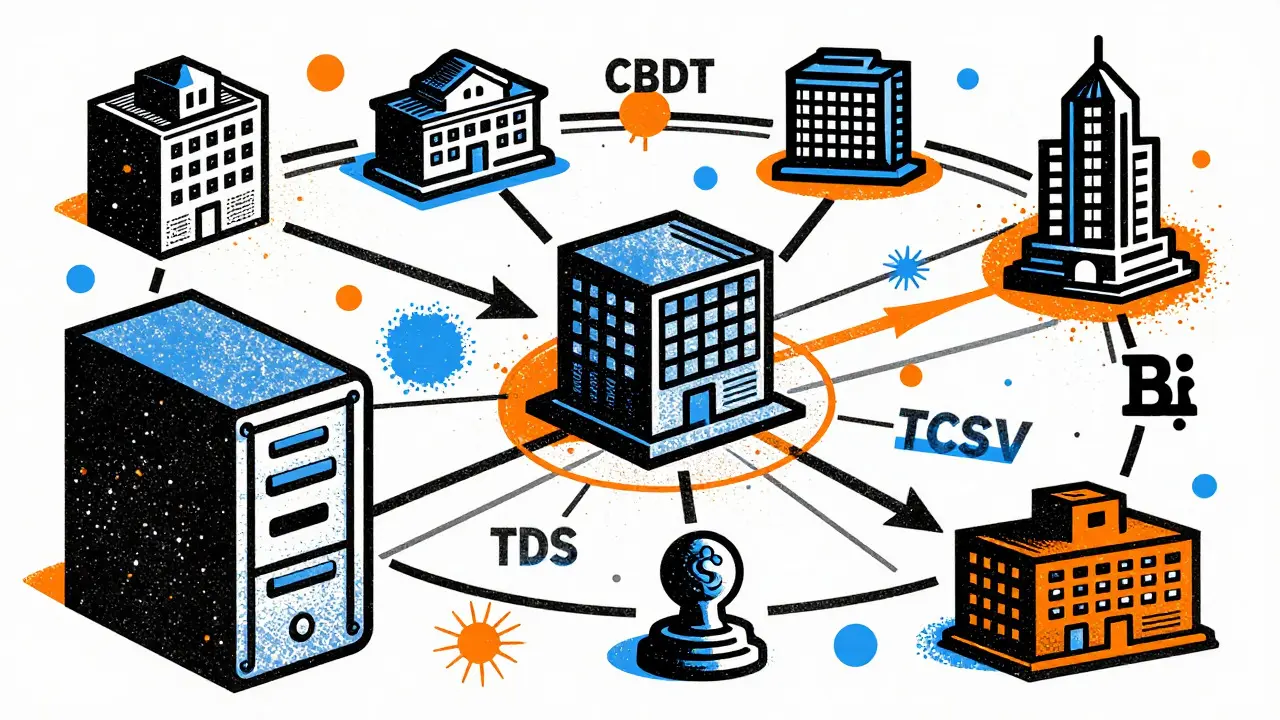
You might wonder, "How do they know I traded?" The answer lies in data sharing. Indian exchanges are required to report user transactions to the CBDT. More importantly, the 1% TDS mechanism ensures that the government knows about high-value transfers. If you receive a large amount of crypto, the sender’s exchange likely deducted TDS and reported it. If you don’t declare this income in your returns, the mismatch triggers an alert.
The Central Board of Direct Taxes (CBDT) uses sophisticated analytics to cross-reference bank deposits with declared crypto income. If you sell crypto on an exchange, withdraw the INR to your bank account, and then file a return showing zero income from VDAs, the system flags you. The Reserve Bank of India (RBI) also monitors unusual banking flows related to crypto businesses, adding another layer of scrutiny.
However, enforcement has gaps. Peer-to-peer (P2P) trades and decentralized finance (DeFi) protocols are harder to track. But relying on these loopholes is risky. In August 2025, the CBDT began consulting with industry stakeholders, signaling that they are aware of capital flight to offshore exchanges and are planning tighter controls on cross-border data sharing.
Penalties for Non-Compliance
What happens if you forget to report your VDA gains? The penalties are severe because the government views undeclared crypto income as tax evasion. Under the Income Tax Act, failure to disclose foreign assets or digital assets can lead to:
- Penalty under Section 270A: You may be fined between 50% and 200% of the tax evaded. So, if you owed ₹30,000 in tax and didn't pay it, you could face a fine of ₹60,000 to ₹60,000+ depending on intent.
- Interest under Section 234A/B/C: You will pay simple interest on the delayed payment, typically ranging from 1% to 1.5% per month.
- Criminal Prosecution: In cases of willful concealment exceeding ₹25 lakhs, criminal proceedings can be initiated, potentially leading to imprisonment.
Additionally, if you fail to report VDA holdings in your annual return using the mandatory Schedule VDA section (available in ITR-2 and ITR-3 forms), your return is considered defective. You must file a revised return to avoid further penalties. Ignoring notice letters from the tax department regarding unexplained crypto income can escalate the situation quickly.

Filing Your Returns: A Step-by-Step Guide
Getting your paperwork right is the best defense against penalties. Here is how you should handle your crypto taxes for the Financial Year 2024-25:
- Choose the Right Form: Use ITR-2 if you have capital gains from crypto. Use ITR-3 if you treat your trading as a business.
- Locate Schedule VDA: Both forms have a specific schedule for Virtual Digital Assets. Enter the details of every sale, gift, or transfer.
- Calculate Gains Correctly: Subtract the purchase price from the sale price. Remember, no deductions allowed.
- Pay the 30% Tax: Pay this tax before filing your return to avoid interest charges.
- Report TDS: Ensure the 1% TDS deducted by exchanges is reflected in your Form 26AS so you get credit for it against your total tax liability.
| Feature | Cryptocurrency (VDA) | Equity Shares |
|---|---|---|
| Tax Rate on Gains | Flat 30% | 10% (LTCG > ₹1L) / 15% (STCG) |
| Loss Offset Allowed? | No | Yes |
| TDS Applicable? | Yes (1%) | Yes (varies) |
| GST on Trading Fees | Yes (18% since July 2025) | No |
| Expense Deduction | No | Limited |
The Future of Enforcement: What to Expect in 2026
The landscape is shifting. The CBDT’s consultations in late 2025 revealed frustration with the current model. Many local exchanges lost volume to offshore platforms that don't enforce TDS. The government is considering comprehensive crypto legislation that might replace the current patchwork of tax rules with a dedicated regulatory framework.
Expect stricter KYC norms and potentially direct reporting requirements for wallets holding significant value. The Securities and Exchange Board of India (SEBI) is also exploring its role in regulating crypto derivatives. For now, assume the worst-case scenario: full transparency. Treat every satoshi as if the taxman is watching. The cost of being wrong is far higher than the hassle of compliance.
Is crypto trading illegal in India?
No, trading cryptocurrency is not illegal in India. However, it is heavily taxed. The Supreme Court lifted the banking ban in 2020, allowing banks to service crypto customers, though many remain cautious due to RBI warnings.
Can I offset crypto losses against other income?
Currently, no. Under Section 115BBH, losses from Virtual Digital Assets cannot be set off against gains from other VDAs, nor can they be deducted from salary or business income. This makes crypto one of the most expensive asset classes to trade in India.
What is the penalty for not declaring crypto income?
You face a penalty of 50% to 200% of the tax evaded under Section 270A, plus monthly interest. In severe cases of willful concealment, criminal prosecution is possible. Always use Schedule VDA in your ITR to stay compliant.
Does the 18% GST apply to my personal wallet?
The 18% GST applies to services rendered by platforms (exchanges, custodians). If you use a centralized exchange, they will add 18% GST to their fees. If you trade purely peer-to-peer or on decentralized protocols without a service provider charging fees, GST may not apply directly, but capital gains tax still does.
Will the 30% tax rate change soon?
There is ongoing discussion. The CBDT consulted with industry players in 2025 about the negative impact of the 30% rate on liquidity. While no official change has been announced for 2026, a shift toward a more standard capital gains framework is possible in future budget sessions.



Matt Kay
July 29, 2026 AT 10:09its a scam basically
Carl Michaud
July 29, 2026 AT 23:00The narrative of 'compliance' is merely a sophisticated veneer for state-sanctioned asset forfeiture. When you analyze the structural intent behind Section 115BBH, it becomes abundantly clear that this is not about revenue generation but rather the systematic dismantling of decentralized financial autonomy. The 30% flat tax is a punitive measure designed to create an economic desert where only state-approved instruments can survive. They are leveraging the TDS mechanism as a digital panopticon, ensuring that every satoshi moves under the gaze of the bureaucratic apparatus. This is classic technocratic overreach disguised as fiscal responsibility. The introduction of GST on OIDAR services is the final nail in the coffin for retail liquidity, effectively taxing the very act of accessing information and exchange protocols. It is a coordinated effort to drive capital offshore, thereby weakening the domestic currency's purchasing power while enriching the elite who control the fiat printing presses. The mention of 'criminal prosecution' for amounts exceeding ₹25 lakhs is a thinly veiled threat to instill fear among the middle class. They want you compliant because compliance equals control. The data sharing between CBDT and RBI is not about catching evaders; it is about mapping the entire financial graph of the populace. We are seeing the early stages of a total surveillance economy where privacy is treated as a criminal act. The so-called 'consultations' with industry stakeholders are theater, nothing more than a way to delay inevitable crackdowns while they perfect their algorithms. Trust no one in this system. The game is rigged from the start.
Prudence Flemming
July 29, 2026 AT 23:51the ontology of value shifts when the state imposes such arbitrary friction. we see here a collision between emergent digital consensus mechanisms and legacy fiscal structures. the 30% rate is not just a number but a philosophical statement on the nature of risk and reward in a post-trust society. by disallowing loss offsets they reject the statistical reality of variance in speculative markets. it forces a binary outcome where survival is the only metric. the GST layer adds another dimension of complexity essentially taxing the metadata of transactions rather than the transaction itself. this creates a paradox where the cost of verification exceeds the value of the asset for smaller players. the enforcement gap in DeFi is temporary because the state always seeks to colonize new frontiers. eventually even the decentralized protocols will be forced to interface with centralized identity providers. the real question is whether the market will adapt or flee. currently the flight to offshore exchanges suggests a rejection of local regulatory hegemony. this is a form of silent protest through capital mobility. the penalties are severe because the state fears irrelevance more than it desires revenue. if crypto becomes untradeable locally it ceases to be a threat to the monetary policy. thus the harshness is proportional to the perceived existential danger posed by VDA adoption. we must consider if these rules will evolve into a dedicated framework or remain a patchwork of hostile measures. the latter seems more likely given the current political climate. the future looks like increased KYC and wallet monitoring. transparency is being weaponized against the individual.
Dave Kjendal
July 31, 2026 AT 15:11most people dont get it. its simple really. you pay up or you go to jail. thats the lesson. stop complaining about the rates. if you cant afford the tax then you shouldnt be trading. its that easy. the government needs money for roads and stuff. why are you so upset? maybe you are just bad at investing. look at the table. stocks are cheaper. so buy stocks. why make it hard for yourself. the rules are clear. read them. schedule vda is there for a reason. use it. dont be lazy. if you hide your assets you are a thief. plain and simple. the penalty is fair. 200% is harsh but you asked for it. interest is also normal. time is money. criminal charges are for the worst offenders. most of you are just annoying. follow the rules and you will be fine. its not rocket science. just file your returns. pay the 30%. pay the gst. done. move on. life goes on. dont overthink it. the system works if you work within it. stop trying to break it. you will lose.
Kat Bennett
August 2, 2026 AT 01:50I find it quite fascinating how the landscape is evolving, don't you think? It is interesting to observe the shift towards stricter regulations, and while it might seem daunting at first glance, there is a certain logic to the progression of these policies that one cannot entirely dismiss. The introduction of the 18% GST on various services provided by crypto platforms certainly adds a layer of complexity to the everyday trader's experience, yet it also highlights the growing recognition of these digital assets as legitimate economic entities within the broader financial ecosystem. One might wonder if this increased scrutiny could eventually lead to greater stability and trust in the market, allowing for more mainstream adoption in the long run. The fact that the CBDT is actively consulting with industry stakeholders suggests a willingness to engage and perhaps refine these frameworks to better suit the unique characteristics of virtual digital assets. It is encouraging to see that despite the heavy hand of enforcement, there is still room for dialogue and potential adaptation in the coming years. Perhaps the current stringent measures are merely a transitional phase before a more balanced and comprehensive regulatory structure emerges. I believe that understanding these nuances can help us navigate the challenges more effectively and perhaps even find opportunities within the constraints. The journey of crypto taxation in India is certainly a complex one, filled with twists and turns, but it is also a testament to the dynamic nature of this emerging field. Let us hope that the future brings clarity and fairness for all participants in this exciting space.
Candice Cornett
August 2, 2026 AT 04:16you are all missing the point. its not about the money. its about morality. the fact that you are hiding assets shows a lack of character. the state knows best. if you cant handle the heat get out of the kitchen. the 30% tax is a gift really. it keeps the riffraff out. only the serious investors remain. those who complain are weak. they want easy profits without the responsibility. the gst is just another fee you have to pay. deal with it. the penalties are necessary to maintain order. chaos is bad. order is good. the government provides order. so pay your dues. stop whining about offshore accounts. bring the money home. support the local economy. if you dont like it leave. but dont expect sympathy. you chose this path. now walk it. the rules are clear. follow them. or face the consequences. its that simple. dont make it complicated. the truth is you are greedy. and greed is a sin. the tax is penance. accept it. and move on. the rest is noise.