
Bitcoin Mining Location Comparison Tool
Compare Top Mining Countries
View detailed hash rate distribution, energy sources, and sustainability metrics for leading Bitcoin mining nations. Select countries to compare their mining characteristics.
No countries selected
Select countries from the dropdown to compare their mining characteristics.
The Bitcoin network is only as secure as the computational power behind it. That power - called the hash rate - isn’t spread evenly across the globe. In 2025, nearly half of all Bitcoin mining happens in just one country. This isn’t just a technical detail; it’s a geopolitical story about energy, regulation, and who really controls the world’s most decentralized currency.
What Is Bitcoin Hash Rate, and Why Does It Matter?
Bitcoin mining is how new coins are created and transactions are verified. Miners use powerful machines called ASICs to solve complex math problems. The faster they solve them, the more likely they are to earn Bitcoin rewards. The total computing power of every miner on the network is the hash rate. As of October 2025, that number hit 1,020.71 exahashes per second (EH/s). That’s over a quintillion calculations per second.This isn’t just a number. A higher hash rate means the network is harder to attack. If someone wanted to take over Bitcoin - say, by reversing transactions or double-spending coins - they’d need to control more than half the total hash rate. That’s called a 51% attack. The bigger and more spread out the hash rate, the less likely that is to happen.
But here’s the catch: the hash rate isn’t as decentralized as Bitcoin’s original vision promised. It’s concentrated. And that concentration is changing fast.
The U.S. Dominates - But It’s Not Just Texas
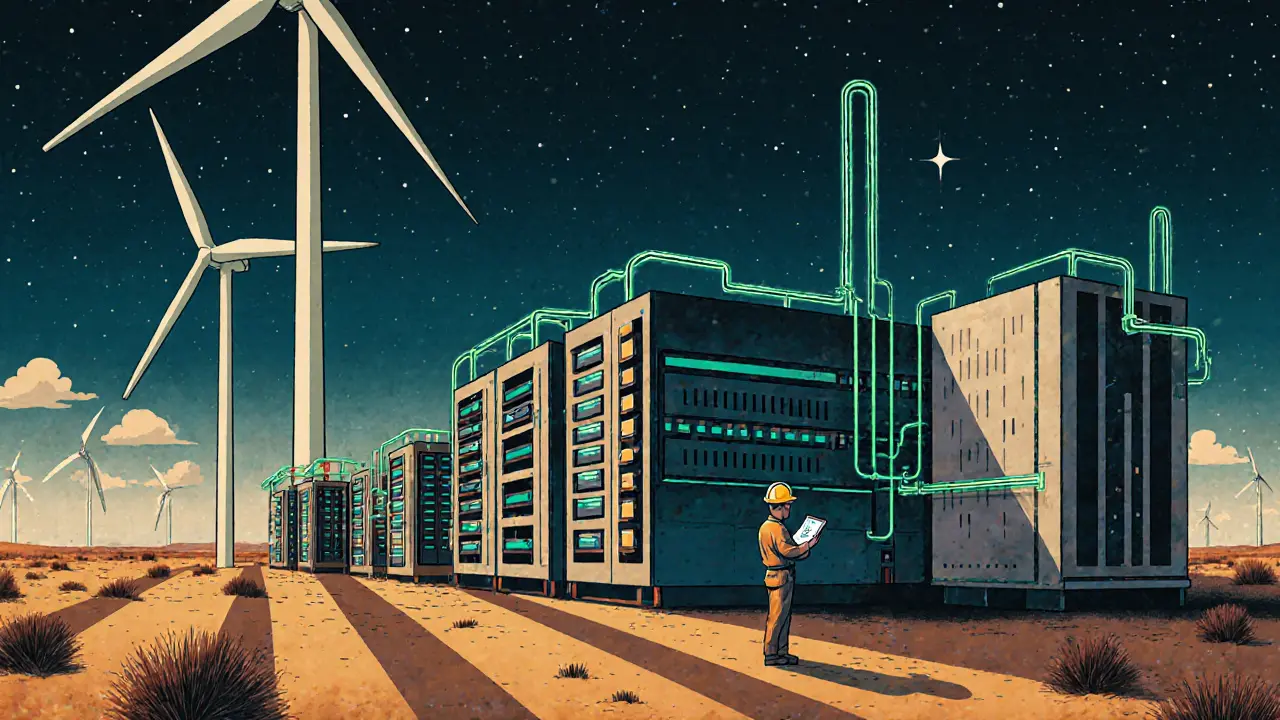
As of late 2025, the United States controls 44% of the global Bitcoin hash rate. That’s more than the next four countries combined. And it’s not just one state doing the heavy lifting.Texas leads the pack. Its deregulated energy market lets miners buy power directly from generators, often at night when demand is low. Renewable energy from wind farms in West Texas powers entire mining campuses. Some operators even use flare gas from oil fields - waste that would’ve been burned off - to generate electricity. That’s not just cheap; it’s sustainable.
Pennsylvania, Georgia, and Washington state are also growing fast. Why? Stable regulations, access to grid power, and local governments actively courting mining companies. Unlike in 2021, when China banned mining overnight, U.S. states are now competing to attract miners with tax breaks and infrastructure support.
Kazakhstan, Russia, and Canada: The Energy Arbitrage Players
Kazakhstan holds 12% of the hash rate. It’s not glamorous, but it’s practical. The country has cheap coal and natural gas, and its regulators kept mining legal after China’s crackdown. But recent policy shifts - like sudden electricity price hikes - are making miners nervous. Some are already packing up and moving to the U.S. or Canada.Russia contributes 10.5%. Its mining boom isn’t about high-tech data centers. It’s about waste. In remote areas like Siberia and the Far East, oil companies flare off excess gas - burning it into the air. Russian miners tap into that same gas to power their rigs. They turn pollution into profit. Cold winters help too - natural cooling cuts electricity costs for air conditioning.
Canada holds steady at 9%. Alberta and Quebec are the powerhouses. Quebec uses hydroelectric power from rivers and dams - clean, reliable, and cheap. Alberta combines natural gas with wind. Canadian miners are also more likely to report their operations openly, making their data easier to track and more trusted by investors.
The Nordic Edge: Where Green Mining Thrives
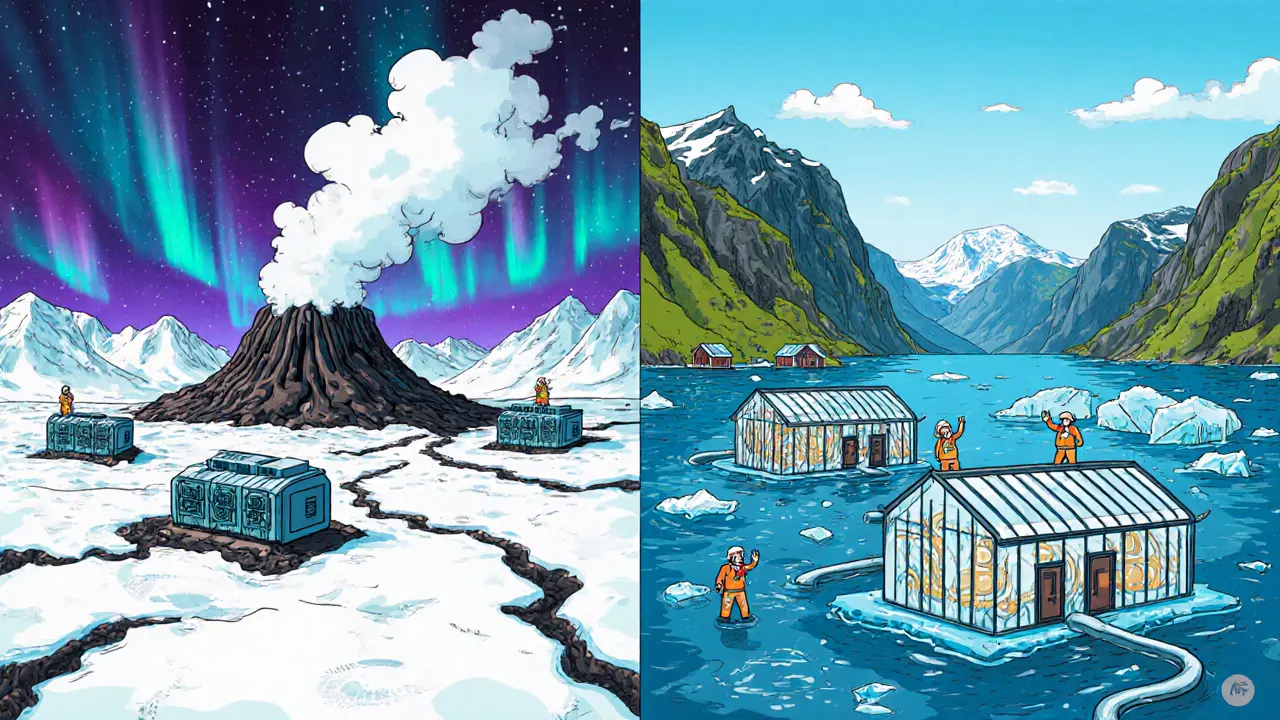
Iceland and Norway aren’t big in raw numbers, but they’re the quiet leaders in sustainable mining.Iceland runs over 92% of its mining on geothermal and hydropower. The island sits on volcanic activity - heat from the earth powers the rigs. The cold air outside does the rest. No need for expensive cooling systems. Miners there aren’t just saving money; they’re proving Bitcoin can be green.
Norway is even more extreme: 96% of its electricity comes from hydropower. Miners in northern Norway use fjord-cooled server rooms. Some even pipe excess heat into nearby homes and greenhouses. These aren’t hobbyists. They’re institutional players - hedge funds and energy companies - betting that ESG (Environmental, Social, Governance) compliance will be the next big requirement for crypto investors.
Iran: The Underdog With Potential
Iran contributes 4.2% of the global hash rate. That’s not huge, but it’s surprising. The country faces U.S. sanctions, power rationing, and international isolation. Yet, it’s still mining. Why? Because electricity is heavily subsidized. For a miner, it’s like getting paid to run a machine.But it’s risky. The government can cut power at any time - especially during winter when heating demands spike. Some miners operate underground or in remote areas, using diesel generators as backup. It’s not ideal, but it’s profitable enough to keep going. Iran’s mining scene is a reminder: if the price of Bitcoin stays high enough, people will find a way to mine - no matter the obstacles.
What Happened to China?
In 2021, China controlled over 60% of Bitcoin’s hash rate. Sichuan province, with its rainy season and cheap hydropower, was the epicenter. Xinjiang, with its coal-fired plants, powered the rest. Then, the government banned mining. Overnight, 40% of the network’s power vanished.It wasn’t just a shock - it was a reset. Miners scattered. Many ended up in the U.S., Kazakhstan, and Canada. The event proved Bitcoin could survive even the biggest regulatory blow. But it also showed how fragile the network’s geographic balance could be.
How Do We Even Know Where Miners Are?
You might wonder: how do researchers know which country has how much hash rate? It’s not like they can walk into a warehouse and count machines.They use data from mining pools - groups of miners who combine their power and split rewards. Pools like BTC.com, Poolin, and Foundry report where their miners connect from. That’s usually based on IP addresses. But here’s the problem: miners use VPNs to hide their location. A miner in China might connect through a server in Germany, making it look like Germany has more mining than it does.
That’s why the Cambridge Centre for Alternative Finance is considered the gold standard. They work directly with major pools and use multiple data sources to cross-check locations. Even then, their data is often 1-3 months old. Real-time tracking is impossible. So when you see a map saying “U.S. has 44%,” it’s the best estimate we have - not a live feed.
Energy Use and the Sustainability Debate
Critics say Bitcoin uses too much electricity. In early 2022, its annual consumption surpassed that of Finland. Today, it’s closer to Australia or the Netherlands. That’s still a lot - but it’s not growing like it used to.Why? Because miners are smarter. New ASICs are 35% more efficient than models from 2023. That means more hashes per watt. Miners now focus on watts per terahash (W/TH). Lower is better. Operators in high-cost regions can still compete because their machines are so efficient.
And more miners are using renewable energy. In 2025, over 58% of Bitcoin mining runs on sustainable sources - up from 39% in 2021. That’s not because of guilt. It’s because clean power is cheaper and more reliable. Miners don’t care about carbon credits - they care about their profit margins. And right now, renewables win.
What’s Next for Hash Rate Distribution?
The future of Bitcoin mining won’t be decided by ideology. It’ll be decided by electricity prices, regulations, and technology.Look at emerging markets. Argentina, Saudi Arabia, and the UAE are starting to build mining infrastructure. They have cheap gas, solar potential, and political will. If they offer stable rules and grid access, they could take market share.
But small-scale miners are fading. Running a rig in your garage is no longer profitable. The industry is moving toward institutional operators - companies with capital, legal teams, and data centers. That means more consolidation. More power in fewer hands.
Still, Bitcoin’s network is more secure now than ever. The hash rate is higher than at any point in history. The challenge isn’t security - it’s decentralization. If 80% of mining ends up in just three countries, is Bitcoin still decentralized?
Maybe not in geography. But the protocol itself? It still runs on open-source code, verified by nodes worldwide. No single government can shut it down. That’s the real strength of Bitcoin - and why, even with all this concentration, the network keeps going.
Key Takeaways
- The U.S. leads global Bitcoin mining with 44% of the hash rate, driven by Texas, Pennsylvania, and renewable energy access.
- Kazakhstan (12%) and Russia (10.5%) rely on cheap fossil fuels and stranded energy, but face growing regulatory uncertainty.
- Canada (9%) and Nordic countries (Iceland, Norway) dominate in sustainable mining, using hydropower and geothermal energy.
- Iran (4.2%) mines despite sanctions, thanks to subsidized electricity - but risks blackouts and policy shifts.
- China’s 2021 mining ban reshaped the global map, accelerating the U.S. and Canada’s rise.
- Efficiency gains from new ASICs allow miners in expensive regions to compete, reducing reliance on cheap power alone.
- Over 58% of Bitcoin mining now uses renewable energy - a major shift driven by economics, not ethics.
How is Bitcoin’s hash rate measured?
Bitcoin’s hash rate is estimated by tracking how often new blocks are added to the blockchain. The network adjusts its mining difficulty every 2,016 blocks (about every two weeks) to keep block times at roughly 10 minutes. By analyzing the time between blocks and the current difficulty level, experts calculate the total computational power being used. Mining pools also report their hashrate, which helps validate these estimates.
Why does hash rate concentration matter for Bitcoin’s security?
A higher and more widely distributed hash rate makes Bitcoin more secure. If one entity controls over 50% of the network’s power, it could theoretically manipulate transactions - a 51% attack. Concentration increases this risk. Right now, no single country or pool controls a majority, so the network remains secure. But if one country reaches 60% or more, that could trigger concern among investors and developers.
Can Bitcoin mining be done anywhere with electricity?
Technically, yes - but not profitably. You need more than just power. You need a stable grid, cooling systems, fast internet, and physical security for expensive hardware. In places with unreliable electricity or high costs, mining is a losing game. That’s why mining clusters form in places like Texas, Kazakhstan, and Iceland - where infrastructure and energy costs align.
Do mining pools control Bitcoin’s hash rate?
Miners join pools to share rewards and reduce income volatility. While pools aggregate hash rate, they don’t control it. No single pool holds more than 15% of the total hash rate as of 2025. The largest - like Foundry USA and Poolin - are spread across regions and regulated entities. This prevents any one group from dominating the network.
Is Bitcoin mining bad for the environment?
It depends on where and how. In places using coal, mining adds carbon emissions. But over half of Bitcoin mining now runs on renewable energy - more than many traditional industries. In Iceland and Norway, mining uses existing hydro and geothermal power. In Texas, it helps absorb excess wind energy that would otherwise be wasted. The industry is shifting toward sustainability because it’s cheaper, not just because it’s ethical.

Ivanna Faith
November 30, 2025 AT 21:25Akash Kumar Yadav
December 1, 2025 AT 04:58Bhoomika Agarwal
December 1, 2025 AT 23:24Katherine Alva
December 2, 2025 AT 08:33Nelia Mcquiston
December 3, 2025 AT 01:37Mark Stoehr
December 4, 2025 AT 20:28justin allen
December 6, 2025 AT 16:47ashi chopra
December 8, 2025 AT 12:25Darlene Johnson
December 8, 2025 AT 21:55