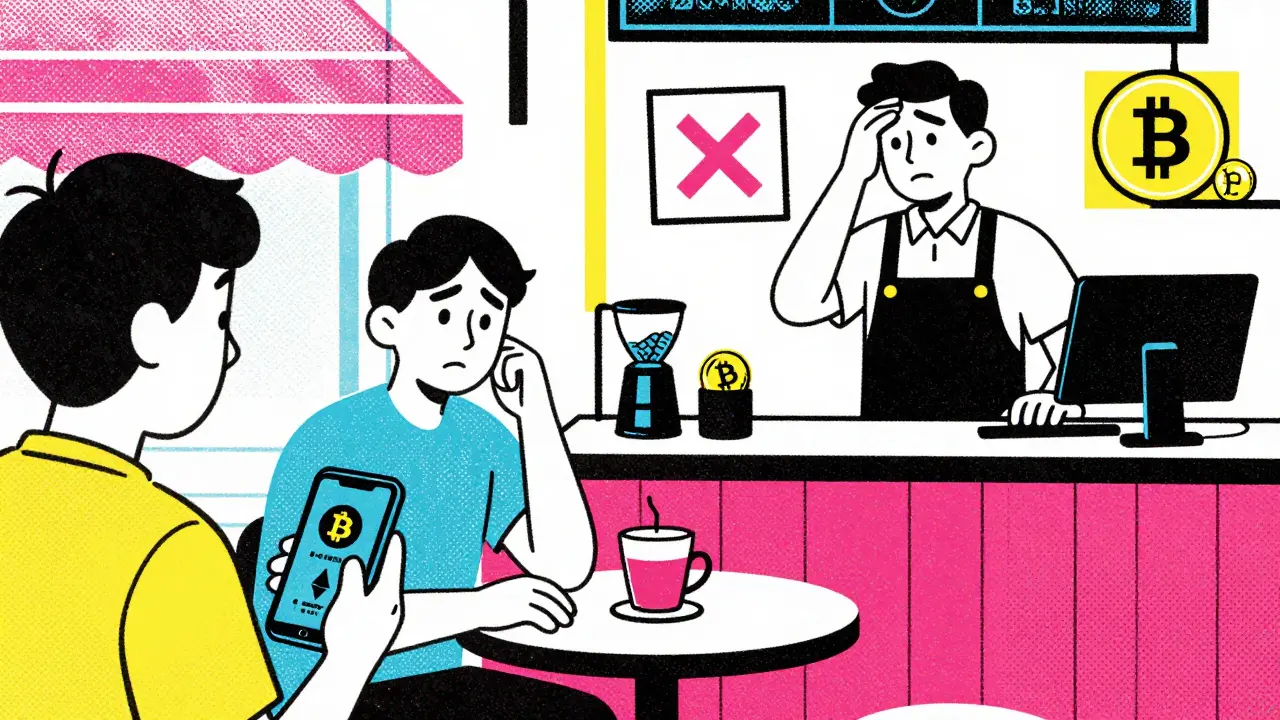
You can buy Bitcoin in Jakarta. You can trade Ethereum on your phone. But if you try to pay for coffee with USDT at a local cafe, the transaction will fail. This is the confusing reality of Indonesia crypto payment ban. It’s not that cryptocurrency is illegal there; it’s just that you can’t spend it like cash.
This distinction trips up many investors and businesses. The rules have shifted significantly in recent years, moving from commodity oversight to strict financial regulation. If you are doing business in Southeast Asia or holding Indonesian assets, understanding this split between 'trading' and 'paying' is critical. Let’s break down exactly what is allowed, what is forbidden, and why the government keeps these two worlds separate.
The Core Rule: Trading Is Legal, Paying Is Not
To understand the current landscape, you first need to know who is in charge. For a long time, the Commodity Futures Trading Regulatory Agency (Bappebti) handled crypto. They treated Bitcoin and other coins like commodities-similar to gold or rice. In January 2025, that changed. Oversight moved to the Financial Services Authority (OJK). Under OJK Regulation No. 27 of 2024, cryptocurrencies are now classified as 'digital financial assets.'
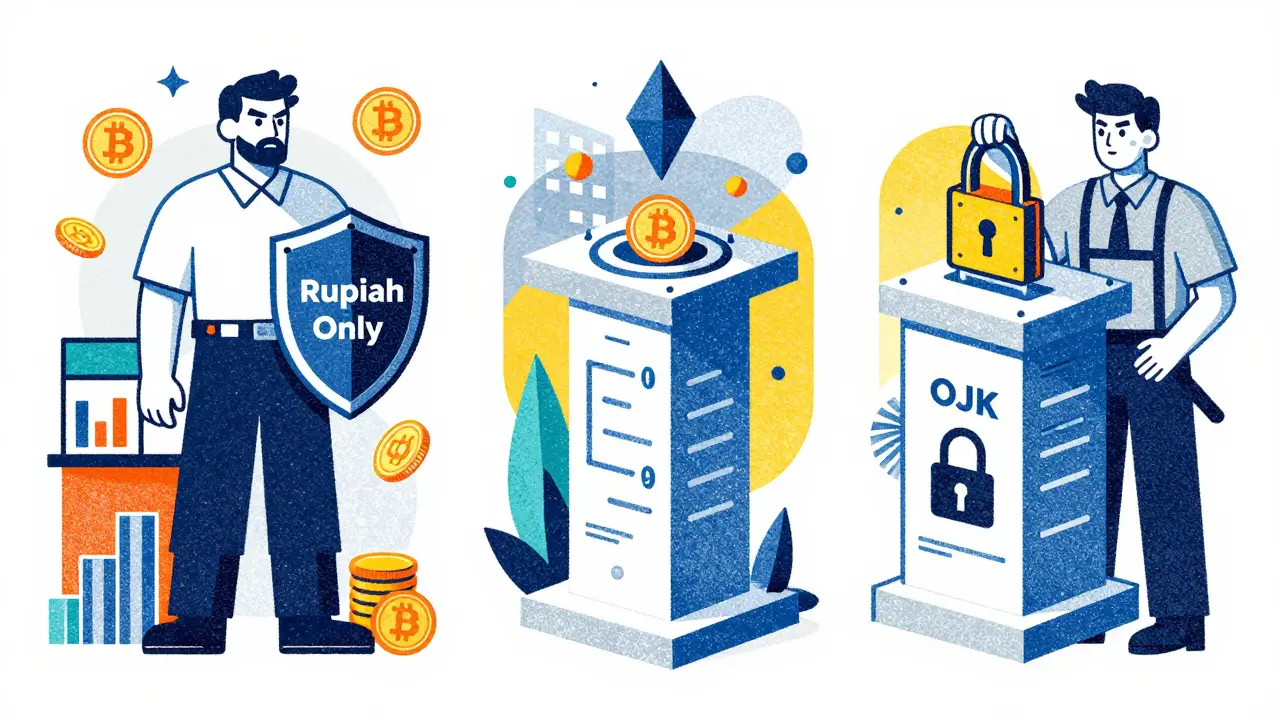
This sounds like progress, right? Maybe. But here is the catch: while OJK regulates how you *buy* and *sell* these assets, Bank Indonesia (BI) strictly controls how money moves in the economy. Bank Indonesia has maintained a hard line since 2016. Their regulations (specifically PBI 18/40/PBI/2016 and PBI 19/12/PBI/2017) explicitly ban any payment system operator from processing transactions using virtual currency.
In November 2025, BI Executive Director Agusman made this crystal clear in a public warning: "Virtual currency including bitcoin is not recognized as a valid payment instrument." The reason? The Rupiah is the sole legal tender under Indonesia’s Currency Law. Allowing crypto payments could undermine monetary policy and create instability in the national banking system.
| Entity | Role | Key Restriction/Power |
|---|---|---|
| Bank Indonesia (BI) | Central Bank / Monetary Policy | Bans crypto as a payment method; protects Rupiah status. |
| Financial Services Authority (OJK) | Financial Market Supervisor | Licenses exchanges; sets capital requirements; oversees trading integrity. |
| Ministry of Finance (MoF) | Taxation | Determines tax rates on trades and mining (e.g., PMK 50). |
Why Did They Ban Crypto Payments?
You might wonder why Indonesia bans payments when countries like Singapore allow them under certain conditions. The answer lies in financial stability. Bank Indonesia worries about two main things: inflation control and consumer protection.
If merchants accept Bitcoin directly, they bypass the traditional banking system. This makes it harder for the central bank to track money supply and manage interest rates. Additionally, crypto prices are volatile. Imagine a baker accepting Bitcoin for bread, only to see the value drop 10% before they can convert it to Rupiah. That risk falls on small businesses and consumers who may not understand market fluctuations.
There is also the issue of illicit finance. While regulated exchanges follow strict Anti-Money Laundering (AML) rules, peer-to-peer crypto payments are harder to trace. By banning crypto as a payment method, BI aims to keep all commercial transactions within the supervised banking channel, where they can be monitored for fraud and terrorism financing.
This approach aligns Indonesia more closely with Vietnam than with its neighbors Thailand or Singapore. Thailand allows crypto payments for specific merchants, and Singapore permits them through licensed providers. Indonesia chooses a stricter path to protect its developing financial infrastructure.
New Rules for Exchanges: Higher Standards, Lower Fees
While you can’t spend crypto, the government wants to make sure the platforms you use to trade it are rock-solid. The shift to OJK oversight brought tougher requirements for exchanges like Indodax, Tokocrypto, and Pintu.
Under OJK Regulation No. 27 of 2024, digital asset exchanges must hold minimum capital of IDR 50 billion (about USD 3.2 million). Custodians need IDR 25 billion, and token issuers need IDR 10 billion. These entities must also implement robust AML protocols that meet Financial Action Task Force (FATF) standards. Technically, platforms must maintain 99.5% uptime and use multi-factor authentication meeting ISO/IEC 27001:2022 security standards.
However, there is a sweetener. To encourage compliance and growth, OJK waived all regulatory fees for licensed crypto service providers for the entire year of 2025. Previously, exchanges paid annual fees ranging from IDR 50 million to IDR 500 million. Hasan Fawzi, Executive Head of Financial Technology Innovation at OJK, called this fee suspension a way to build an "innovation-driven digital finance ecosystem."
This creates a paradoxical situation. The government is making it cheaper and safer to *trade* crypto, but it remains impossible to *use* it for commerce. William Sutanto, CTO of Indodax, described this as "operational schizophrenia" for businesses that want to integrate crypto into their broader financial strategy.
Tax Changes: From VAT to Final Income Tax
If you are trading crypto in Indonesia, your tax bill changed dramatically in August 2025. Before this date, crypto transactions were subject to a 1% Value Added Tax (VAT). This was often seen as a barrier to entry because it taxed every single trade, regardless of profit.
Effective August 1, 2025, Minister of Finance Regulation No. 50 of 2025 (PMK 50) eliminated that 1% VAT. Instead, it introduced a 0.21% final income tax rate on transaction values. This reclassifies crypto from "taxable goods" to "digital financial assets," treating them more like stocks or bonds.
This change simplifies things for traders. You no longer pay tax on the act of buying; you pay a small percentage on the transaction value as a final income tax. The Ministry of Finance also established a dedicated Crypto Asset Taxation Unit with 147 specialized auditors to monitor these transactions via integration with OJK’s monitoring system (SIM IAKD).
For miners, separate regulations (PMK 53 and PMK 54) outline specific reporting requirements and taxation methods. The goal is clarity. By aligning crypto taxes with securities rather than goods, the government hopes to attract institutional investors who prefer predictable fiscal policies.

The Real-World Impact on Businesses and Users
Rules on paper look different from daily life. For Indonesian businesses, the payment ban creates significant friction, especially for cross-border trade. An analysis by Alvarez & Marsal in July 2025 found that Indonesian businesses face 37% higher transaction costs and 3.2 extra days in processing times for international settlements compared to countries that allow crypto payments.
Consider a merchant in Jakarta selling electronics to a buyer in Dubai. The buyer wants to pay in USDT (a stablecoin pegged to the US dollar). Because Indonesian banks cannot process this payment, the merchant must either refuse the sale or find a workaround. Many users report losing sales due to this restriction. On Reddit’s r/IndonesiaCrypto community, a user named u/JakartaToko shared losing a $12,000 order because the customer couldn't pay via USDT.
This leads to "regulatory arbitrage." A study by Professor Budi Suharjo at Universitas Gadjah Mada found that 68% of surveyed merchants still accept crypto payments through informal channels. How do they do it? They convert crypto payments into gift cards or prepaid credits, effectively laundering the transaction outside the formal banking system. This increases risk for consumers, as there is no legal recourse if something goes wrong.
Despite these challenges, the market is growing. Indonesia had 14.3 million active crypto users in late 2024, with trading volume reaching IDR 127.5 trillion (USD 8.1 billion) in 2024. Institutional adoption is rising too, with 87% of Indonesia’s top 100 publicly listed companies reporting crypto holdings in their 2025 Q2 financial statements.
What Comes Next? CBDCs and Potential Loopholes
Is the ban permanent? Probably not forever, but don’t expect immediate changes. The Indonesian House of Representatives is reviewing Draft Law No. 12/2025 on Digital Rupiah Integration. This law explores the possibility of a Central Bank Digital Currency (CBDC).
A CBDC is a digital version of the Rupiah issued by Bank Indonesia. Unlike Bitcoin, it is centralized and controlled by the state. Some experts believe a CBDC could eventually bridge the gap, allowing for faster digital payments while maintaining BI’s control over monetary policy. However, Governor Perry Warjiyo stated in October 2025 that relaxing the crypto payment ban would require a "comprehensive assessment of monetary policy transmission mechanisms."
Until then, the status quo remains: trade freely under OJK supervision, pay your 0.21% tax, but keep your crypto in your wallet and your spending in your bank account. For now, Indonesia is building a regulated trading hub, not a crypto-spending society.
Can I use Bitcoin to pay for goods in Indonesia?
No. Bank Indonesia explicitly prohibits using cryptocurrency as a means of payment. Merchants cannot legally accept Bitcoin or other cryptos for goods and services. Doing so violates central bank regulations regarding the Rupiah as the sole legal tender.
Who regulates cryptocurrency in Indonesia now?
Since January 2025, the Financial Services Authority (OJK) regulates crypto assets as "digital financial assets." Previously, the Commodity Futures Trading Regulatory Agency (Bappebti) oversaw them as commodities. Bank Indonesia still bans crypto payments.
What is the tax rate for crypto trading in Indonesia?
As of August 1, 2025, the previous 1% VAT on crypto transactions was replaced by a 0.21% final income tax rate on transaction values. This applies to trades conducted on licensed exchanges.
Are there penalties for using crypto as payment?
Yes. Payment system operators face severe penalties for processing crypto transactions. For individuals and merchants, using informal channels to circumvent the ban carries risks of fraud and lack of consumer protection, though direct criminal penalties for individual users are less commonly enforced than for institutions.
Which crypto exchanges are legal in Indonesia?
Only exchanges licensed by the OJK (and previously Bappebti) are legal. Major licensed platforms include Indodax, Tokocrypto, and Pintu. International exchanges like Binance have very limited presence due to strict licensing requirements.