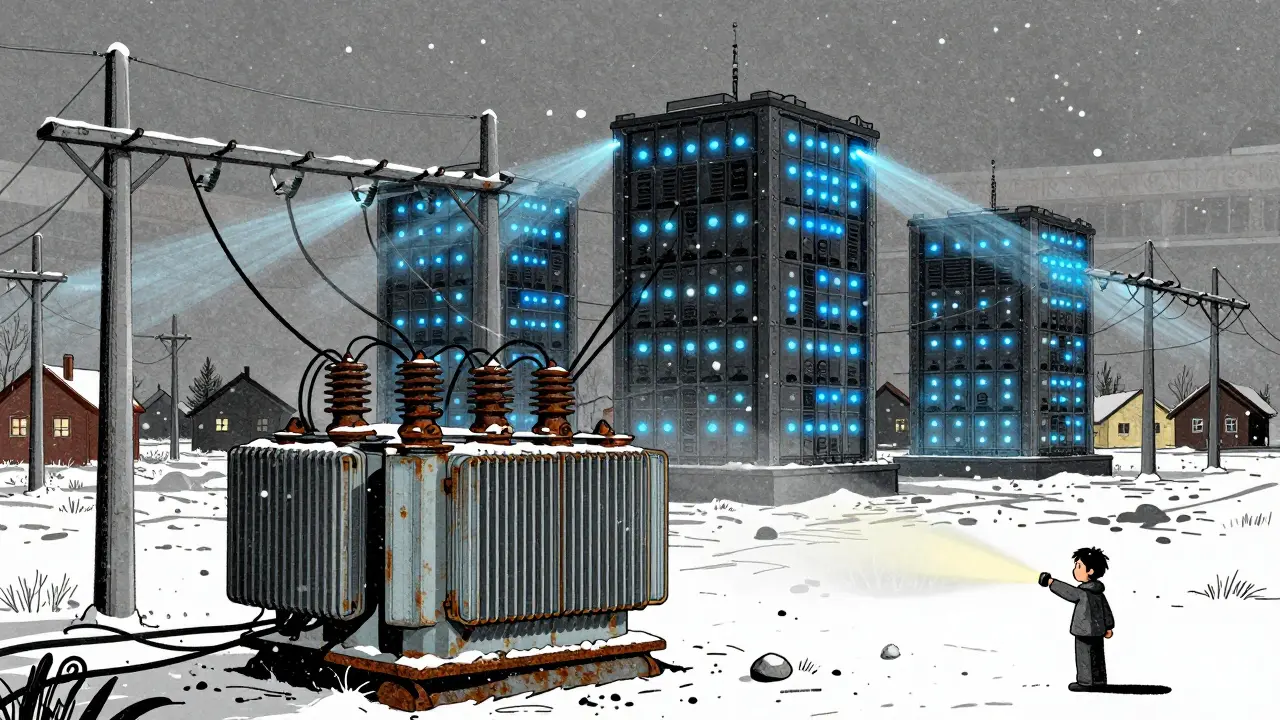
By early 2025, Kazakhstan’s power grid was on the brink. In the city of Oral, lights flickered every other night. In Almaty, factories shut down for hours because the grid couldn’t handle the load. And in rural areas, people waited weeks for repairs after transformers blew out. The problem wasn’t just bad weather or old wires-it was a system pushed beyond its limits, and one of the biggest drivers was something many didn’t expect: crypto mining.
How Bad Is Kazakhstan’s Power Grid Really?
Kazakhstan’s power grid is one of the oldest in Central Asia. As of January 2024, over one-third of its 220 power plants were operating with 70% to 90% wear and tear. Some regional grids? Up to 97% degraded. That’s not just aging-it’s failing. The national grid operator, KEGOC, manages a system with a total installed capacity of 24,641.9 MW, but only 20,428.4 MW is actually available. That’s a 17% gap right there.And it’s getting worse. In 2022, there were 18,609 reported technical violations on the grid. By 2023, that jumped to over 28,000. Even in the first eight months of 2024, violations were still at 18,263. These aren’t minor glitches. These are failures that cause blackouts, damage equipment, and sometimes start fires.
Then there’s the loss. Electricity doesn’t just disappear-it gets wasted. In developed countries, transmission losses stay under 10%. In Kazakhstan, they’re between 13% and 18%. In some places, like Oral in 2023, every fifth kilowatt of electricity sent through the lines vanished before reaching homes. That’s not just inefficient-it’s expensive. And it’s not because of theft. It’s because the wires are rusted, the transformers are outdated, and the software to monitor them doesn’t exist.
Renewables Are Coming-But Too Slow
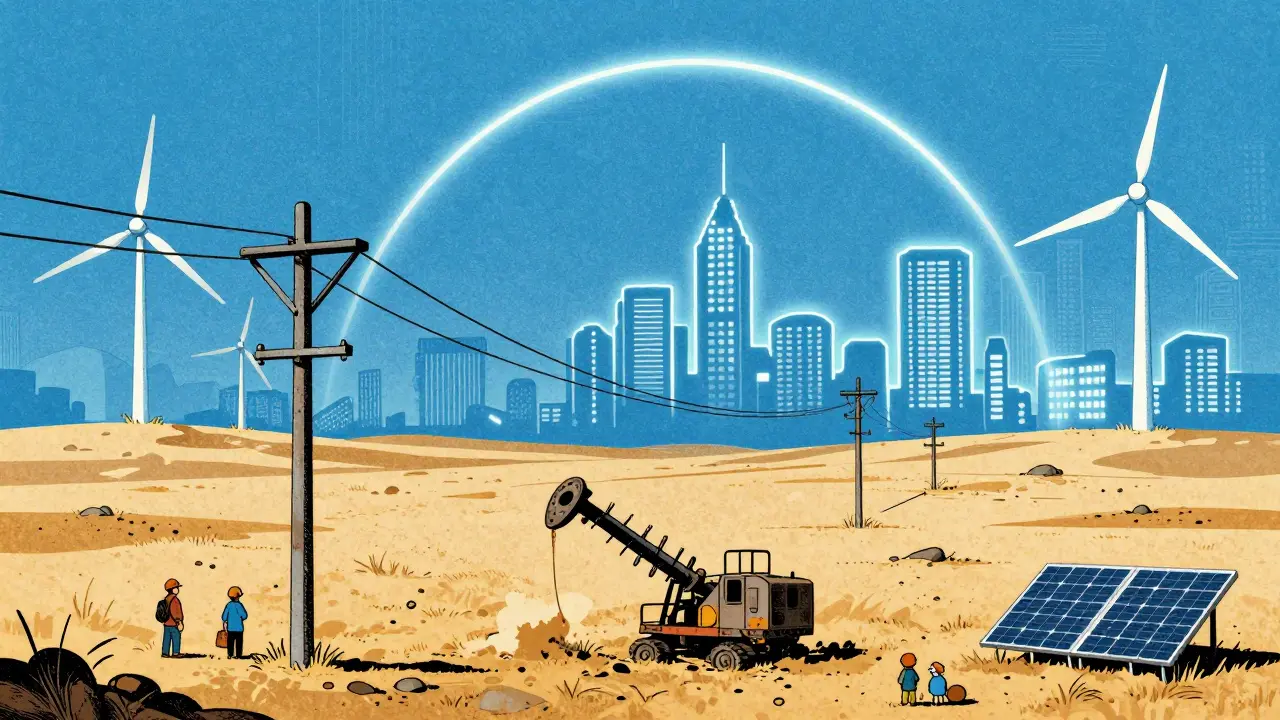
Kazakhstan has set big goals. Three new 1-gigawatt wind farms. Solar plants popping up across the south. The government says renewables will overtake coal by 2025. Sounds promising, right?But here’s the catch: only 6% of the country’s electricity comes from renewables today. And while $2.6 billion has been promised to the sector, that’s less than half of what Uzbekistan is investing. Worse, the grid can’t handle the new power. Wind and solar don’t run on schedule. They turn on and off with the weather. The current grid? It’s built for coal plants that run 24/7. It doesn’t know how to balance sudden spikes or drops in supply.
There’s a plan to fix it. KEGOC’s 2023-2032 roadmap includes building a North-South HVDC line between 2024 and 2029. That’s a high-voltage direct current line that will add 2,000 MW of transmission capacity. It’s a step forward. But it won’t be done until 2029. Meanwhile, demand keeps rising.
Crypto Mining Was the Last Straw
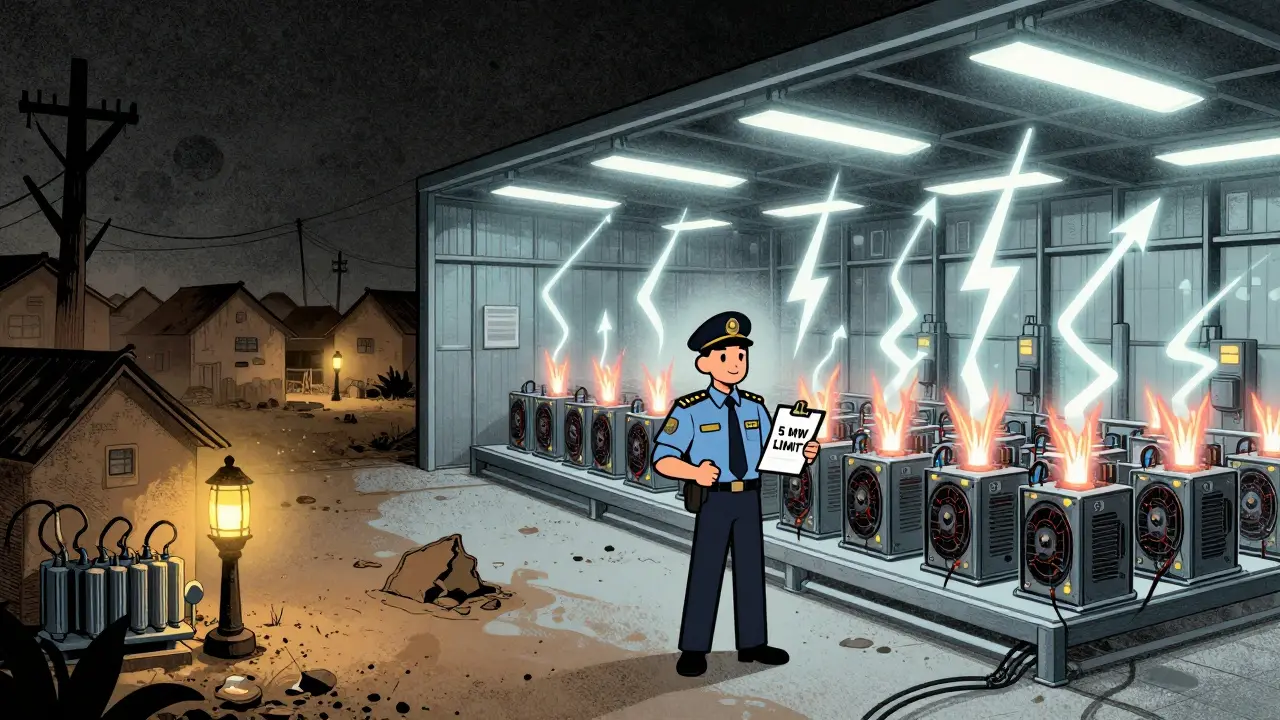
In 2021, Kazakhstan became the world’s second-largest crypto mining hub after the Chinese crackdown. Miners flocked here for cheap electricity and cold winters that helped cool their rigs. At its peak, crypto mining used up to 10% of Kazakhstan’s total electricity. That’s not small. That’s the equivalent of powering every home in Astana and Almaty combined.And it wasn’t just residential miners. Big industrial farms moved in-warehouses filled with racks of ASICs, sucking power 24/7. The grid didn’t have the capacity to handle this extra load. Power plants that were already at 90% capacity were pushed to 110%. Transformers overheated. Lines overloaded. Blackouts became common in mining-heavy regions like Karaganda and East Kazakhstan.
By late 2023, the Ministry of Energy started seeing clear patterns: when mining activity spiked, so did grid failures. In January 2024, after a major blackout in the eastern region, officials quietly began tracking mining operations. They found that some farms were using illegally connected lines, bypassing meters entirely. Others were siphoning power from rural villages that already had unreliable service.
By April 2025, the government moved. Not with a full ban-but with a targeted shutdown. Mining operations that used more than 5 MW of power were required to install smart meters and pay a new grid-use fee. Farms that couldn’t prove they were paying for their electricity or that their operations didn’t threaten grid stability were disconnected. Over 400 large-scale mining sites were shut down in the first half of 2025. Smaller miners? They were told to either connect legally or stop.
It wasn’t a ban on crypto. It was a ban on uncontrolled, unmonitored, grid-crippling energy use.
Why This Matters Beyond Kazakhstan
Most people think of crypto mining as a digital problem. But in places like Kazakhstan, it’s a physical one. It’s about wires, transformers, and whether a hospital can keep its life-support machines running.Kazakhstan’s experience shows something important: when energy infrastructure is weak, crypto mining doesn’t just compete with homes and factories-it breaks them. And when governments react, they don’t always ban mining outright. They ban unmanaged mining. They ban the kind that ignores the grid’s limits.
This isn’t unique to Kazakhstan. In Texas, crypto miners have been asked to curtail usage during heatwaves. In Iran, the government has cut power to mining farms during winter energy shortages. The pattern is clear: when the grid is fragile, crypto mining becomes a liability-not an innovation.
What’s Next for Kazakhstan?
The government is now focusing on three things:- Modernizing the grid with smart meters and AI-based load balancing
- Building the North-South HVDC line to move power from renewable zones to population centers
- Creating a real-time monitoring system for all major energy users, including mining farms
They’re also pushing small-scale solar for homes and businesses. But here’s the problem: most people can’t afford the upfront cost. A 5-kW solar system costs $6,000. The average monthly income in rural Kazakhstan? $300. Without subsidies or financing, the transition stalls.
Meanwhile, electricity prices jumped 50% in April 2025. Families are choosing between heating and charging phones. Factories are cutting shifts. And the grid? Still hanging by a thread.
What Can Other Countries Learn?
Kazakhstan didn’t fail because it allowed crypto mining. It failed because it didn’t upgrade its grid first.Many countries are rushing to attract mining operations with tax breaks and cheap power. But if your grid can’t handle even 10% more load, you’re not attracting investment-you’re inviting disaster.
The lesson? Don’t wait for the crisis to hit before you fix the wires. Build the infrastructure first. Then invite the miners. Or don’t invite them at all. But don’t let them break your lights.
Did Kazakhstan completely ban crypto mining?
No, Kazakhstan did not ban crypto mining outright. Instead, it imposed strict rules on large-scale operations. Mining farms using more than 5 MW of power must now install smart meters, pay grid-use fees, and prove they’re not overloading local infrastructure. Farms that bypassed meters or caused grid instability were shut down. Small-scale miners who connect legally and pay for their power are still allowed to operate.
Why did crypto mining cause so many blackouts in Kazakhstan?
Crypto mining rigs run 24/7 and use massive amounts of electricity. At its peak, mining consumed up to 10% of Kazakhstan’s total power supply. Many mining operations were connected to aging regional grids that couldn’t handle the load. Transformers overheated, lines failed, and emergency backups couldn’t keep up. In some areas, mining farms were illegally tapping into rural power lines, leaving villages without electricity for days.
Is renewable energy solving Kazakhstan’s power problems?
Not yet. While Kazakhstan plans to build three 1-gigawatt wind farms and expand solar, renewables still make up only 6% of total electricity generation. The bigger issue is that the existing grid can’t integrate intermittent sources like wind and solar without major upgrades. Without smart grid technology and better transmission lines, adding more renewables won’t fix blackouts-it could make them worse.
How much electricity does Kazakhstan lose in transmission?
Transmission losses vary by region but average around 17.42% in the worst cases, with some areas hitting 18%. In developed countries, losses are typically under 10%. Kazakhstan’s losses are among the highest in the world, caused by outdated infrastructure, corroded wires, and lack of monitoring systems. The Ministry of Energy says smart grid tech could cut losses by half.
What’s being done to fix the grid?
Kazakhstan is building the North-South HVDC transmission line (2024-2029) to move 2,000 MW of power between regions. They’re also installing smart meters, upgrading substations, and requiring all major energy users-including mining farms-to be monitored in real time. Long-term plans include integrating distributed solar and wind, but progress is slow due to funding gaps and bureaucratic delays.
For now, Kazakhstan’s grid remains a fragile lifeline. The country didn’t lose power because of crypto. It lost power because it ignored its infrastructure for too long. And when you ignore the wires, no amount of digital innovation can save you.


Michael Teague
March 3, 2026 AT 05:58so like... they just let crypto eat their grid? lol. i mean, if you can't even keep the lights on, why are you hosting bitcoin farms? this is why i hate when countries think they're cool by letting crypto in without planning. dumb. just dumb.
also, transformers don't just 'blow out'-they die because someone didn't replace them in 20 years. no one wants to fix old stuff. easier to let miners take the power and blame them later.
just say no to lazy infrastructure. fix the wires before you invite the rigs.
kati simpson
March 3, 2026 AT 08:49i think the real issue here is that nobody wanted to admit the grid was broken until it was too late. it’s not that crypto mining was evil it’s that no one had the courage to say hey we need to upgrade this thing before we let anything else connect to it. we keep doing this over and over. wait for the crisis then act like we didn’t see it coming. but we did. we just chose not to fix it. and now families are choosing between heat and charging their phones. that’s not a tech problem. that’s a moral one.
Cory Derby
March 4, 2026 AT 21:08It is imperative to recognize that Kazakhstan's response was not reactionary, but rather strategically calibrated. The imposition of smart metering and grid-use fees for operations exceeding five megawatts demonstrates a commitment to accountability and systemic integrity. Rather than banning cryptocurrency mining outright, authorities prioritized infrastructure resilience. This approach reflects a mature understanding of energy governance: innovation must be accommodated, but not at the expense of public safety or grid stability. The integration of real-time monitoring and the North-South HVDC corridor represents a foundational step toward sustainable energy transition. The lesson is not to avoid innovation, but to institutionalize its responsible integration.
Mary Scott
March 6, 2026 AT 10:34Shannon Holliday
March 7, 2026 AT 14:02ok but like… imagine if we all just switched to solar panels on our roofs 🌞🏠 and stopped letting mega farms suck up the grid 💡🤯
also why is everyone so scared of renewable energy? it’s not magic, it’s just… wires and sun. and wind. and not being greedy. 💚
Jeremy buttoncollector
March 8, 2026 AT 04:34the systemic failure here is ontological: the grid as a cyber-physical assemblage was never designed for non-deterministic load profiles. crypto mining introduced a non-stationary entropy sink into a feedforward analog infrastructure-this is not a bandwidth issue, it’s a topological mismatch. the 17% loss metric is merely symptomatic of a deeper epistemic rupture between centralized generation paradigms and distributed demand curves. we need a neo-kybernetic feedback loop, not more HVDC lines. the real solution is a decentralized microgrid mesh with AI-driven predictive load balancing-preferably on-chain. 🤖⚡