
You put your money in a DeFi pool expecting easy passive income, but when you check your portfolio, it looks like you lost money. Did you actually lose it? Or did the market just move faster than your position could keep up? This is the classic dilemma of liquidity provision: balancing trading fees against IL. If you are asking whether providing liquidity is worth the pain of impermanent loss, the answer isn't a simple yes or no. It depends entirely on how volatile the assets are and how much fee revenue you generate.
The Quick Verdict: When Is It Worth It?
Before we get into the math, here is the bottom line for anyone short on time. Liquidity provision is generally worth it if you are pairing correlated assets (like ETH and WBTC) or stablecoins, where price divergence is minimal. It becomes risky-and often not worth it-if you are pairing highly volatile, uncorrelated assets during a bull run or crash. In those scenarios, the opportunity cost of holding the assets usually outweighs the trading fees you earn.
- Worth it: Stablecoin pairs (USDC/USDT), correlated major pairs (ETH/WBTC), or low-volatility periods with high trading volume.
- Risky: Meme coin pairs, new token launches with wild swings, or single-sided exposure to a crashing asset.
- The Rule of Thumb: If your earned fees do not exceed the calculated impermanent loss by at least 20%, you might have been better off holding.
What Actually Happens During Impermanent Loss?
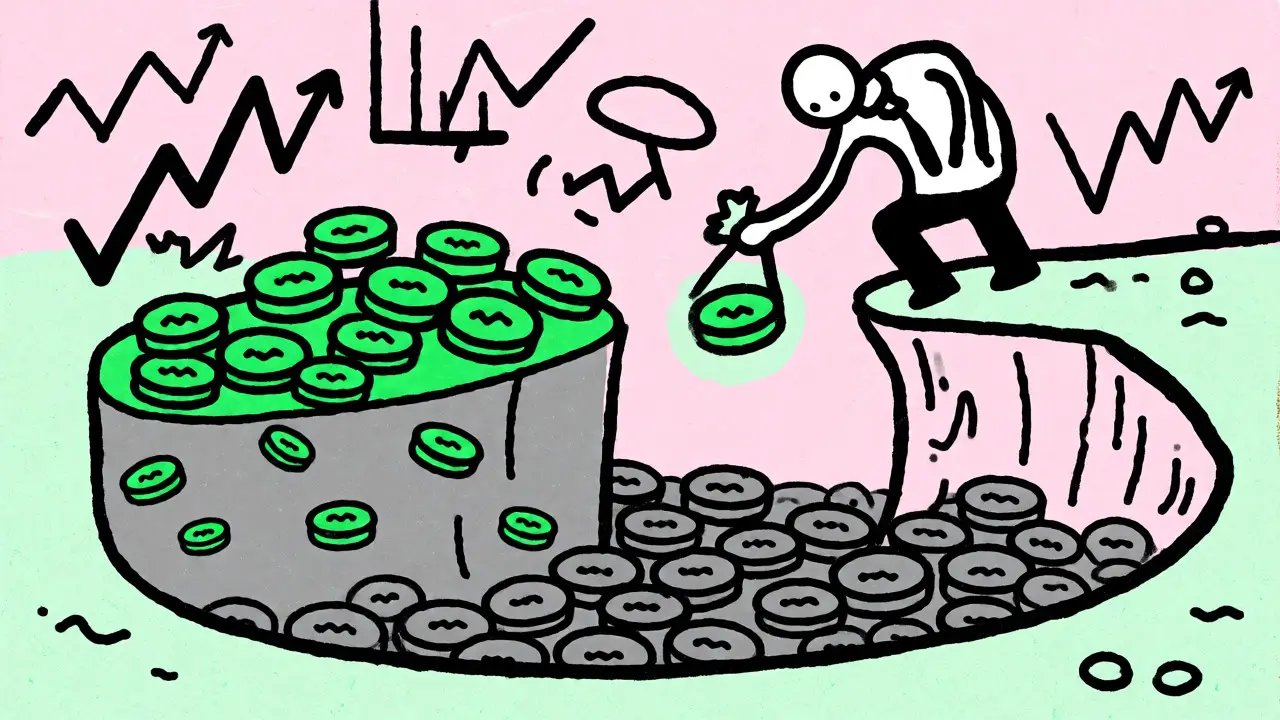
Let's strip away the jargon. Impermanent Loss is an opportunity cost that occurs when the price of your deposited assets changes compared to when you deposited them. You aren't losing principal in the traditional sense; you are just ending up with less value than if you had simply held the tokens in your wallet.
Here is why this happens. Automated Market Makers (AMMs like Uniswap) use a mathematical formula to keep the ratio of two assets in a pool balanced. When one asset goes up in price, arbitrage traders buy the cheaper asset from the pool and sell the more expensive one back into it. This rebalancing means you end up selling some of your winner too early and buying more of the loser too late.
| Price Change | Pool Value (LP) | HODL Value | Impermanent Loss % |
|---|---|---|---|
| 1.25x (25% increase) | $4,038 | $4,250 | -0.6% |
| 1.5x (50% increase) | $4,082 | $4,500 | -2.3% |
| 2.0x (100% increase) | $4,142 | $5,000 | -5.7% |
| 4.0x (300% increase) | $4,291 | $6,500 | -13.4% |
As you can see, the loss accelerates as volatility increases. A small price blip barely hurts you. But if a token does a 4x, you are giving up over 13% of your potential gains. That is a steep tax for "passive" income.
Fees vs. Loss: The Breakeven Calculation
The only thing that saves you from impermanent loss is Trading Fees. Every swap that happens in the pool pays a small percentage to liquidity providers. To make liquidity provision worthwhile, these fees must cover the impermanent loss plus any gas costs you paid to enter and exit the position.
Let's look at a real-world scenario. Imagine you provide liquidity for ETH/USDC. You deposit $10,000 total ($5,000 in ETH, $5,000 in USDC). ETH doubles in price. Your impermanent loss is roughly 5.7%. That means you would have made about $570 more by holding. To break even, you need to have earned at least $570 in trading fees during that period.
If the pool has high volume-say, generating 0.3% fees per day-you might recoup that loss in under two weeks. But if the pool is quiet, earning only 0.05% per day, it could take months. And if the price keeps moving, the loss grows while you wait. This is why checking the Fee-to-Value Ratio before entering a pool is critical. If a pool doesn't show healthy historical volume, you are likely signing up for a net loss.

Why "Impermanent" Can Become Permanent
The term "impermanent" is misleading. The loss is only temporary if the prices return to their original ratio. If you withdraw your funds while the price divergence exists, that loss becomes permanent. Many beginners get burned because they panic-sell during a dip or take profits during a spike, locking in the divergence.
Consider the market conditions in 2022. During the crypto downturn, many liquidity providers saw their paired assets drop significantly. Because both assets were falling, the relative divergence wasn't always huge, but the absolute value dropped. However, in euphoric bull markets, the divergence explodes. One asset skyrockets while the other stays flat or drops. If you don't have enough fee accumulation to offset that gap, withdrawing locks in a poor performance compared to simply HODLing.
Advanced Strategies to Mitigate Risk
You don't have to accept impermanent loss as a fact of life. There are ways to tilt the odds in your favor.
1. Choose Correlated Pairs
Pairing assets that move together reduces divergence. An ETH/BNB pair will experience less impermanent loss than an ETH/MemeCoin pair because they tend to rise and fall in tandem. If both go up 10%, the ratio between them stays roughly the same, meaning zero impermanent loss.
2. Use Concentrated Liquidity Carefully
Uniswap V3 allows you to concentrate your liquidity within specific price ranges. This boosts your capital efficiency, meaning you earn more fees per dollar deposited. However, it also amplifies impermanent loss. If the price moves out of your range, you end up holding 100% of the underperforming asset. This requires active management. If you are lazy, stick to full-range positions. If you are active, concentrated liquidity can double your returns-but it can also double your headaches.
3. Look for IL Protection
Some newer protocols offer Impermanent Loss Protection. These platforms reimburse you for IL if you hold your position for a certain period (usually 3-6 months). While this sounds great, be wary of the lock-up periods and lower base APYs. You are essentially paying for insurance via lower yields.
Real User Experiences: What Works and What Doesn't
Talking to actual liquidity providers reveals a pattern. Success stories usually come from people who provided liquidity to stablecoin pairs or blue-chip pairs during sideways markets. They collected steady fees with negligible IL.
On the flip side, horror stories almost always involve altcoins. One user reported putting $5,000 into a new token/ETH pool. The token pumped 10x in a week. They panicked and withdrew. Their portfolio was up, but they realized they would have made twice as much by just holding the token. Another user stayed in during a crash, watching their ETH holdings get swapped into a worthless altcoin as its price collapsed. They ended up with a bag of dust and a fraction of their initial capital.
The consensus among experienced DeFi users? Don't chase high APYs blindly. A 500% APY on a meme coin pool is usually a trap. The fees look amazing until you realize the token price is dropping 20% every day.
How to Decide: A Simple Checklist
Before you deposit your next batch of tokens, run through this mental checklist:
- Correlation Check: Do these two assets move in the same direction most of the time? If yes, proceed. If no, calculate the risk.
- Volume Check: Does the pool have consistent daily trading volume? Low volume means low fees, which won't cover IL.
- Time Horizon: Are you willing to hold for at least 3 months? Short-term positions rarely earn enough fees to offset entry/exit gas and IL.
- Market Condition: Is the market ranging (sideways) or trending? Ranging markets are best for LPs. Strong trends hurt LPs.
- Exit Strategy: Have you set a threshold for when you will pull out? Don't let emotions drive your withdrawal.
The Future of Liquidity Provision
The landscape is changing. Newer AMMs are experimenting with dynamic fees that increase during volatility, helping LPs earn more when prices swing wildly. Other protocols are introducing automated rebalancing tools that try to mimic a hedge fund strategy rather than a static pool.
However, the core trade-off remains. Liquidity provision is not free money. It is a job. You are working as a market maker, taking on inventory risk in exchange for fees. If you treat it like a savings account, you will likely lose money. If you treat it like a business operation-monitoring metrics, adjusting positions, and managing risk-it can be highly profitable.
Does impermanent loss apply to all DEXs?
Yes, but the severity varies. Traditional constant-product AMMs like Uniswap V2 have predictable IL curves. Constant-mean AMMs (like Balancer) allow for different weightings, which can reduce IL for certain strategies. Order-book based DEXs (like dYdX) do not have impermanent loss in the same way because they don't use pooled reserves for pricing.
Can I avoid impermanent loss completely?
You can minimize it by using stablecoin pairs (e.g., USDC/DAI) or highly correlated assets (e.g., ETH/stETH). In these cases, the price ratio rarely deviates, so IL is near zero. However, these pools typically offer lower APYs due to lower risk.
When does impermanent loss become permanent?
Impermanent loss becomes permanent the moment you withdraw your liquidity while the price ratio of the assets differs from when you entered. If you leave the position open and prices revert to the original ratio, the loss disappears. If you withdraw at a divergent price, you lock in the difference.
Are trading fees enough to cover impermanent loss?
Not always. In high-volume pools during stable markets, fees often exceed IL. In low-volume pools or during extreme volatility spikes, IL frequently exceeds fees. You must analyze the historical fee generation of a specific pool before entering.
What is the best strategy for beginners?
Start with stablecoin pairs or major blue-chip pairs (ETH/USDC) on established platforms like Uniswap or Curve. Avoid exotic altcoins until you understand how to track IL. Keep positions open for longer periods to allow fees to accumulate.