
Switzerland isn't just a place for chocolate and watches anymore. It has become the global standard-bearer for regulated cryptocurrency services within traditional banking. But here is the catch: you don't get this access because Swiss banks are loose with rules. You get it because they follow them strictly. The restrictions that govern Swiss financial institutions are actually their biggest selling point. While other countries debate whether crypto is legal tender or a security, Swiss banks have been operating under a clear, technology-neutral framework for over five years. This means if you want institutional-grade safety for your digital assets, you look to Zurich or Geneva, not necessarily Silicon Valley or New York.
The Regulatory Foundation: Why Restrictions Matter
To understand why Swiss banks dominate crypto custody solutions, you first have to look at how they regulate. Unlike many jurisdictions that tried to write entirely new laws from scratch for blockchain, Switzerland applied its existing financial market legislation to digital assets. This approach, guided by the Financial Market Supervisory Authority (FINMA), creates a stable environment. Banks know exactly what they can and cannot do. They aren't guessing.
This regulatory clarity allows banks to offer comprehensive services-custody, trading, lending, and staking-to both individuals and institutions without fear of sudden legal crackdowns. The restriction here is compliance. Every transaction, every key management process, and every client interaction must meet strict Anti-Money Laundering (AML) and Know Your Customer (KYC) standards. For an investor, this translates to peace of mind. Your assets are held by an entity that is audited, insured, and legally accountable in a way that offshore exchanges simply are not.
Key Players in Swiss Crypto Banking
Not all Swiss banks handle crypto the same way. Several institutions have emerged as leaders, each with a specific focus. Understanding who does what helps you choose the right partner for your needs.
| Bank | Primary Focus | Key Feature | Target Audience |
|---|---|---|---|
| Sygnum Bank | Institutional Services | Broad asset support, including recent SUI integration | Professional & Institutional Investors |
| Bitcoin Suisse | Custody & Trading | Proprietary Vault with physical/cyber redundancy | Institutions & High-Net-Worth Individuals |
| Amina Bank | Retail & Corporate | First regulated bank to support Sui blockchain | Individuals, Startups, Scale-ups |
| Swissquote | Online Trading | User-friendly platform for major coins | Retail Investors |
Deep Dive: Bitcoin Suisse and Physical Security
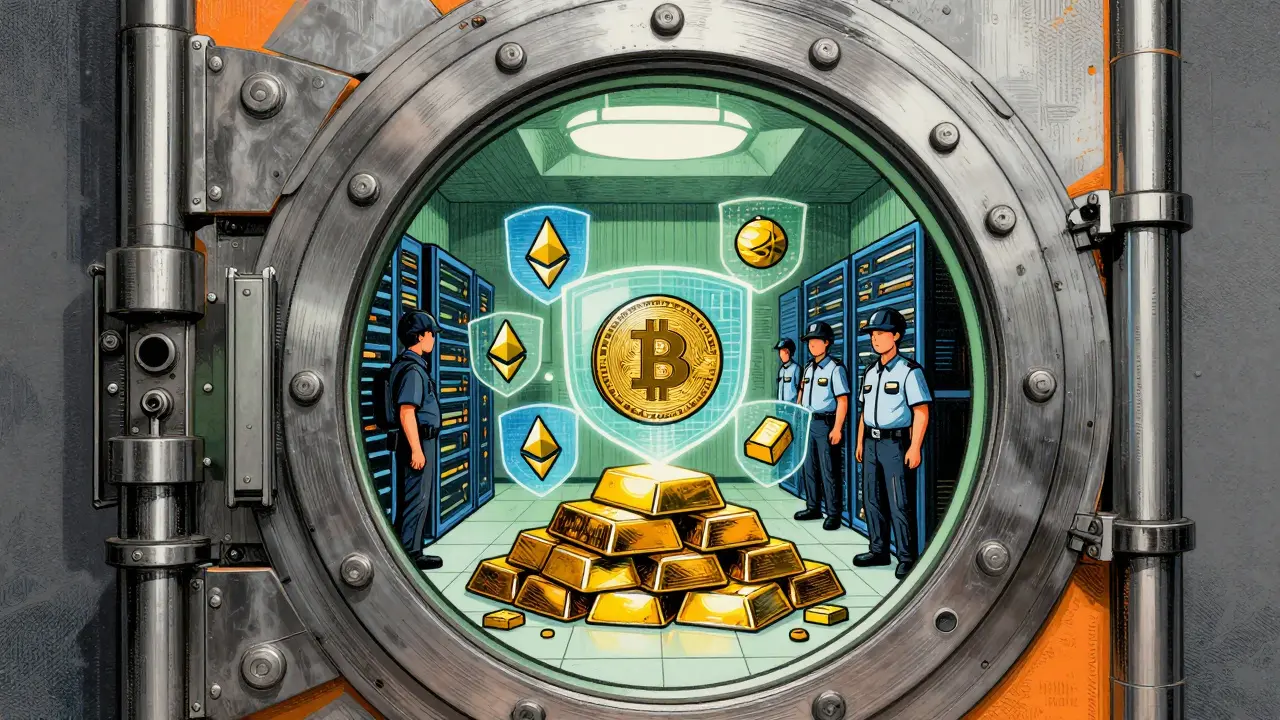
When we talk about custody, we usually think of software keys. But Bitcoin Suisse takes it further with their proprietary Bitcoin Suisse Vault. This isn't just a server room; it's a fortress. Their custody solution combines cryptographic security with extreme physical measures. They protect against cyberattacks, unauthorized payments, hardware damage, and even electromagnetic pulse interference. Crucially, the private keys never leave Switzerland. This geographical restriction ensures that the assets remain under Swiss legal jurisdiction, offering a layer of protection that cross-border exchanges cannot match.
Their Crypto Account supports over 40 blockchain protocols and hundreds of assets. They also offer staking for major blockchains like Ethereum (ETH), Solana (SOL), Cardano (ADA), and Polkadot (DOT). If you hold these assets, you can participate in network governance votes directly through the bank. This bridges the gap between passive holding and active participation in decentralized networks, all while staying within a regulated envelope.
Sygnum and Amina: Expanding into New Ecosystems
In August 2025, two major players made headlines by integrating the SUI token. Sygnum Bank expanded its offerings to include custody, trading, and lending for SUI. Around the same time, Amina Bank became the first regulated bank globally to support the Sui blockchain's native token. This wasn't just a technical update; it signaled a shift in how Swiss banks view emerging ecosystems. They are no longer waiting for Bitcoin and Ethereum to mature; they are actively vetting and integrating newer Layer-1 blockchains.
The market reaction was immediate. When these announcements dropped, trading volume for SUI doubled to 36.45 million tokens compared to the daily average of 14.31 million. The price rose 4% to $3.82. Why? Because institutional money moves slowly and cautiously. When a Swiss bank says "yes," big funds feel safe enough to enter. This demonstrates the power of the Swiss brand: it acts as a validator for risky assets.
Security Infrastructure and Compliance Costs
You might wonder, "Why use a bank when I can self-custody?" The answer lies in the complexity of security. Swiss banks invest heavily in cybersecurity infrastructure that most individuals cannot afford. They comply with the General Data Protection Regulation (GDPR) for data privacy, which is stricter than many local laws. They implement enhanced KYC and AML measures to combat financial crime. These restrictions add friction-you have to prove who you are-but they remove the risk of total loss due to user error or hack.
Bitcoin Suisse employs a team of custody experts who conduct predictive threat assessments. They don't just react to hacks; they anticipate them. This proactive stance is part of their value proposition. For corporations and startups, especially those using Amina Bank’s specialized packages, this means their treasury assets are protected by the same rigorous standards as traditional cash reserves.

How This Compares to the US and EU
If you are comparing options, the contrast with the United States is stark. In 2025, US regulators issued joint statements emphasizing that banks must only offer crypto-asset safekeeping that is "safe and sound." While this sounds reasonable, it lacked the detailed implementation guide that Swiss banks have had since 2020. US regulators were reiterating principles; Swiss regulators were enforcing a mature system. This head start allowed Swiss banks to build sophisticated products while US banks remained cautious, often refusing to touch crypto altogether.
The European Union has made strides with MiCA (Markets in Crypto-Assets regulation), but the transition period has created uncertainty. Switzerland’s technology-neutral approach allows them to adapt faster. They don't need to pass new laws for every new type of token; they classify the token based on existing definitions (payment token, utility token, asset-referenced token) and apply the corresponding rules. This agility keeps them ahead.
Future Outlook: What to Expect in 2026 and Beyond
As we move through 2026, the trend is clear: consolidation and specialization. Swiss banks are not trying to be everything to everyone. They are focusing on high-value clients who demand transparency and security. We expect to see more integration of real-world assets (RWAs) tokenized on blockchain, backed by Swiss legal frameworks. Imagine buying a fraction of a Swiss property or a corporate bond via a crypto wallet, secured by a bank like Sygnum. The infrastructure is already there.
Additionally, customer experience will improve. Banks are adopting omnichannel approaches, blending digital ease with personal service. You’ll likely see more personalized investment products driven by data analytics, helping you diversify beyond just Bitcoin. The goal is to make crypto feel as normal as checking your savings account balance, but with the added benefit of exposure to global digital markets.
Is my crypto insured in a Swiss bank?
Yes, typically. Swiss banks operate under strict deposit insurance schemes for fiat currencies. For crypto assets, while they may not fall under the same statutory insurance as cash, reputable banks like Sygnum and Bitcoin Suisse carry significant professional liability insurance and custodial insurance policies to protect against operational failures and theft. Always check the specific terms of your custody agreement.
Can individual retail investors open accounts with these banks?
It depends on the bank. Swissquote and Amina Bank cater heavily to retail and smaller corporate clients. Sygnum and Bitcoin Suisse traditionally focused on institutional clients but have increasingly opened doors to high-net-worth individuals. However, expect rigorous KYC checks and potentially higher minimum deposit requirements compared to unregulated exchanges.
What happens if a Swiss crypto bank goes bankrupt?
This is a key advantage of regulated custody. Client assets are often segregated from the bank's own balance sheet. This means that in the event of bankruptcy, your crypto should not be available to creditors of the bank. This segregation is mandated by FINMA guidelines for qualified custodians, providing a level of protection that commingled exchange wallets do not offer.
Do Swiss banks charge high fees for crypto services?
Fees are generally higher than on unregulated exchanges like Binance or Coinbase. You are paying for regulatory compliance, security infrastructure, and customer support. Expect custody fees (often annual percentages), trading spreads, and potential withdrawal fees. However, for large portfolios, the cost of security and legal protection often outweighs the fee difference.
Which cryptocurrencies are supported by Swiss banks?
Support varies by institution. Most major banks support Bitcoin (BTC) and Ethereum (ETH). As of late 2025, banks like Sygnum and Amina have expanded to include Solana (SOL), Cardano (ADA), Polkadot (DOT), Near Protocol (NEAR), and the SUI token. Stablecoins like USDC and EURC are also widely supported for transactions and savings products. Always verify the current list on the bank's website, as offerings change frequently.

Steven Jacobowitz
June 6, 2026 AT 08:17Look i get the hype around swiss banks being 'safe' but lets not pretend this is about security its about control and tax compliance you know that right? The whole point of crypto was to escape these centralized gatekeepers who decide what tokens are 'legit' based on their own risk appetite. Sygnum adding SUI doesnt make it safe it just makes it taxable and traceable for the IRS. I have been in this space since 2013 and every time a bank touches crypto they add layers of bureaucracy that kill the innovation. You think your keys are safer with Bitcoin Suisse? They are held by people who can be subpoenaed by the US government any day. That is not custody that is surrender. Stop letting traditional finance co-opt your assets because you are afraid of losing your seed phrase. Self custody is the only real freedom here everything else is just renting your money from a suit.
Caitlin Donahue
June 7, 2026 AT 23:12i mean thats a pretty harsh take steven lol. not everyone has the technical skills or the mental bandwidth to manage cold storage and hardware wallets properly. for regular folks like me who just want to hold some ETH or SOL without worrying about phishing links or losing their USB drive, having a regulated bank handle it sounds way less stressful. sure there are fees but peace of mind is worth something. also the article mentioned that client assets are segregated so if the bank goes bust your crypto isnt gone which is a big deal compared to FTX. im not saying self custody is bad but for most people it feels too risky. plus the KYC stuff is annoying but at least you know who is holding your bags.
Madhu Menon
June 8, 2026 AT 00:17The essence of trust is not in the code alone but in the social contract we form with institutions :). Switzerland offers a unique blend of neutrality and legal certainty that appeals to the institutional investor who seeks stability over radical decentralization. While purists may argue that 'not your keys, not your coins,' one must consider the philosophical shift from individual sovereignty to collective security through regulation. The integration of SUI by Amina Bank signals a maturation of the ecosystem where emerging protocols gain legitimacy through rigorous vetting processes. It is interesting to observe how the friction of compliance becomes a feature rather than a bug for high-net-worth individuals who value predictability. Perhaps the future lies not in choosing between banks and self-custody but in a hybrid model where regulatory frameworks protect the vulnerable while allowing experts to remain sovereign. The market reacts positively to such clarity as seen in the price surge of SUI. This suggests that validation by traditional financial entities still holds significant weight in shaping market sentiment. We should appreciate the diversity of approaches in securing digital assets as each serves a different psychological need among investors. Some seek adventure while others seek safety. Both are valid paths in the grand tapestry of economic evolution :).
Kelly Tenney
June 9, 2026 AT 22:08I really appreciate Madhu bringing up the psychological aspect of this. It is true that for many of us, especially those new to crypto, the anxiety of self-custody can be paralyzing. Knowing that there is a legal recourse if something goes wrong provides a sense of calm that allows us to focus on our investments rather than our security setup. Swissquote seems like a great entry point for retail investors who want that balance. The fact that they support major coins and have a user-friendly platform makes it accessible. I think it is important to remember that financial inclusion means offering options that fit different comfort levels. Not everyone needs to be a cybersecurity expert to participate in the digital economy. Having regulated options helps bridge that gap and brings more people into the fold safely. Let us keep supporting diverse solutions in the space.
Greg Lewis
June 11, 2026 AT 10:36you guys are missing the bigger picture here why do we even need banks for this anymore? the technology exists to verify transactions without intermediaries yet we keep going back to the old guard because we are scared. its like wearing a seatbelt when you are flying in a plane that has no pilot. the regulations in switzerland are good for them but bad for the network effect of true decentralization. when sygnum lends out your sui tokens are they actually yours? probably not they are rehypothecated somewhere. this is the same trick banks played with fractional reserve banking just now with blockchain. stop falling for the marketing speak about 'institutional grade safety'. it is just a fancy word for 'we will steal your value slowly through fees and inflation'. wake up people
JEVON HALL
June 11, 2026 AT 19:10hey greg chill out a bit 😅. while your passion for decentralization is understandable, dismissing regulated custody entirely ignores the reality of how capital markets work. institutional money requires audit trails and legal protections that self-custody cannot provide. the fact that bitcoin suisse uses a proprietary vault with physical redundancy shows they are taking security seriously beyond just software. also the mention of staking rewards through the bank is a huge plus for passive income seekers. yes there are risks with rehypothecation but reputable banks disclose this clearly in their terms. it is about informed choice not blind rebellion. the integration of rwas tokenized on blockchain backed by swiss law is actually super exciting for diversification 🚀. maybe instead of fighting the system we can learn to navigate it wisely. after all crypto is supposed to be inclusive not exclusive to tech wizards 👍.