
When you hear "crypto exchange," you probably think of Binance, Coinbase, or even Uniswap. But what if the next big thing isn’t on Ethereum or Solana? What if it’s built on a brand-new blockchain called Berachain-and its native exchange, Kodiak v2, is designed to fix what’s broken in DeFi right now?
What Is Kodiak v2?
Kodiak v2 isn’t just another decentralized exchange. It’s a full liquidity ecosystem built from the ground up for Berachain. Think of it as a Swiss Army knife for trading, providing liquidity, and launching tokens-all inside one platform. Unlike Uniswap, which just lets you swap tokens, Kodiak combines six tools into one: a DEX, automated liquidity vaults, reward multipliers, a no-code token launcher, auto-compounding vaults, and a trade aggregator. All of it runs on Berachain’s unique Proof-of-Liquidity (PoL) consensus, where providing liquidity doesn’t just earn you fees-it helps secure the whole network.This is a big deal. Most DEXs treat liquidity as a service you pay for. Kodiak makes liquidity part of the network’s security. That means the more people lock up their tokens, the stronger and more stable Berachain becomes. It’s a flywheel: liquidity attracts more liquidity, and rewards keep people engaged.
How Kodiak v2 Works: The Six Core Pieces
- Kodiak DEX: The core swap interface. Uses a dual AMM model-concentrated liquidity pools (called Islands) and full-range pools. This lets traders get better prices on large orders and reduces slippage by up to 32% compared to single-source DEXs.
- Kodiak Islands: These are automated liquidity vaults. You deposit tokens, and the system automatically adjusts your liquidity position to stay in the most profitable price range. No need to manually rebalance like you would on Uniswap V3.
- Sweetened Islands: The reward booster. Lock your liquidity for 30 days to get 1.5x rewards, 60 days for 2x, and 90+ days for 3x. This isn’t just a gimmick-it’s what keeps liquidity deep even during market downturns.
- Panda Factory: Launch any token in three clicks. No coding. No legal headaches. It’s built for memecoins and volatile assets, with built-in "unruggable" liquidity so devs can’t pull the plug on their own token.
- Baults: Auto-compounding vaults for BGT (Berachain’s governance token). Users report 15-25% APY, though it can swing wildly-from 8% to 35% in a single day. It’s high risk, high reward.
- kX Super Aggregator: Scans all liquidity sources on and off-chain to find the best trade price. It’s like having a professional trader on your side, hunting for the lowest slippage and best rates.
Together, these tools create something rare in DeFi: a self-sustaining loop. Liquidity earns rewards, rewards attract more liquidity, and better liquidity means better trades for everyone.
How Does Kodiak Compare to Other DEXs?
Right now, Kodiak v2 is tiny compared to giants. On October 15, 2024, its 24-hour volume was under $40,000. Uniswap does over $1.2 billion. But comparing them directly is like comparing a race car to a tractor-different purposes.
| Feature | Kodiak v2 | Uniswap V3 | PancakeSwap |
|---|---|---|---|
| Network | Berachain (testnet only) | Ethereum | BNB Chain |
| Trading Pairs | 13 | 11,892 | 624 |
| 24h Volume (Oct 15, 2024) | $15,464-$37,141 | $1.2B | $784M |
| Liquidity Efficiency | 92% | 85% | 81% |
| Token Launch Tool | Panda Factory (3 clicks) | None | Basic launchpad |
| Auto-Liquidity Management | Yes (Islands) | No (manual) | No |
| Proof-of-Liquidity | Yes | No | No |
| Limit Orders | No (coming Oct 2024) | Yes | Yes |
Kodiak doesn’t compete with Uniswap on scale. It competes on specialization. If you’re trading memecoins, launching tokens, or want to earn BGT rewards while securing a new blockchain, Kodiak is the most efficient tool available. But if you’re trading ETH, USDC, or BTC, stick with Ethereum or BNB Chain DEXs.
Who Is Kodiak v2 For?
Not everyone. Kodiak v2 is built for three types of users:
- Memecoin traders: 68% of Kodiak’s users are here. The platform’s low fees, fast execution, and Panda Factory make it the go-to for trading new tokens. Telegram bots like Panda Bot give sub-2-second trade execution-faster than most centralized exchanges.
- Liquidity providers: If you’re tired of watching your liquidity get wiped out by impermanent loss, Kodiak’s Islands reduce that risk by 22% compared to other DEXs, according to DeFi researcher Altcoin Sherpa. Plus, Sweetened Islands rewards make it worth locking up for months.
- Berachain early adopters: This isn’t a long-term investment. It’s a bet on Berachain’s future. If Berachain’s mainnet launches successfully, Kodiak could become the dominant DEX on the chain. If it fails, Kodiak goes with it.
It’s not for beginners. Setting up a wallet with Berachain’s testnet (chain ID 80001) takes 8-12 minutes. You need to understand slippage, APY volatility, and how to claim BGT rewards. But if you’re comfortable with MetaMask and Web3, the learning curve is manageable.
The Risks: Why Kodiak v2 Could Fail
Here’s the hard truth: Kodiak v2 is built on a testnet. Berachain hasn’t launched its mainnet yet. That means:
- Your funds are not on a real blockchain. They’re on a test environment that could reset.
- No one is auditing the mainnet version. The September 2024 audit found three medium-severity bugs in the Islands contract-all patched-but this was on testnet.
- Liquidity is thin. Average pool size is $12,450. On Uniswap, it’s over $850,000. If someone dumps $50,000, your trade could get wrecked.
- No limit orders yet. Professional traders are frustrated. The upcoming Panda Bot v1.2 update (launched October 12, 2024) adds this, but it’s still new.
- Support is slow. Telegram responses take 14+ hours. If you get stuck, you’re mostly on your own.
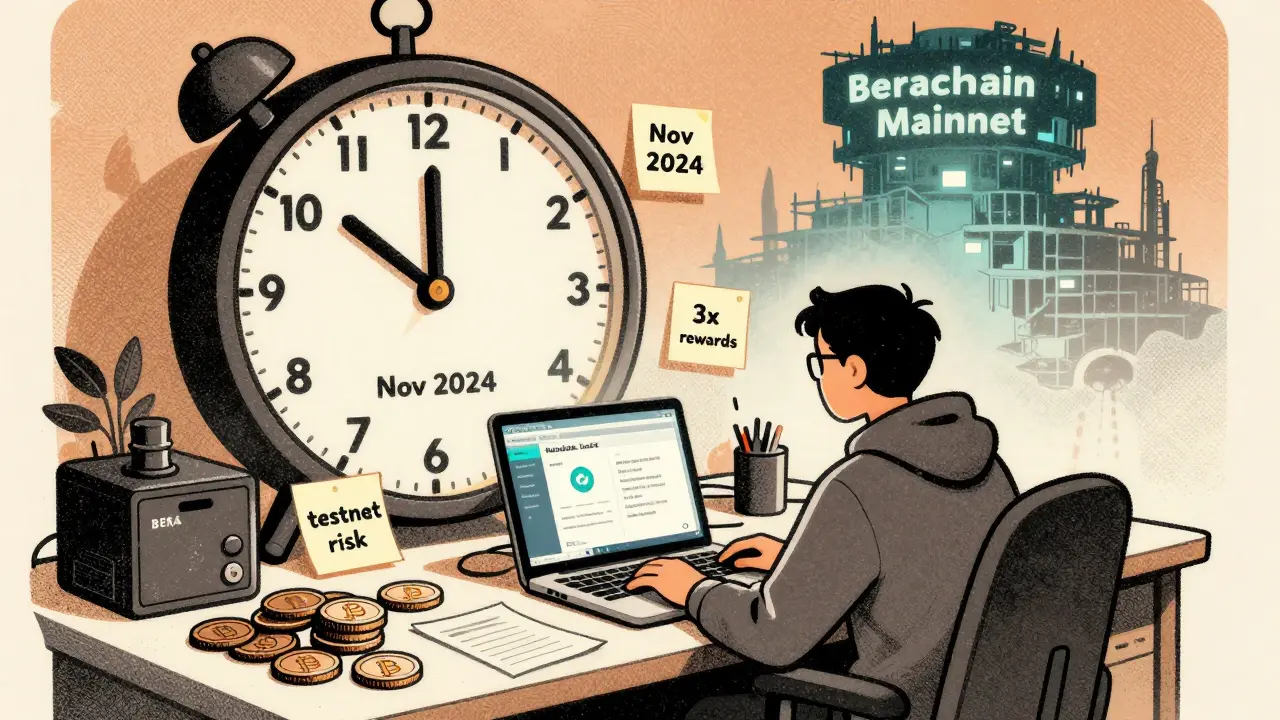
And then there’s the big one: Berachain’s mainnet launch. If it’s delayed past Q4 2024, or if it crashes on launch, Kodiak v2 becomes a digital ghost town. That’s the price of being early.

What’s Next for Kodiak v2?
The roadmap is aggressive-and realistic:
- October 25, 2024: Chainlink CCIP integration for cross-chain USDC swaps.
- November 15, 2024 (estimated): Mainnet launch synced with Berachain.
- December 1, 2024: Institutional API access for hedge funds and market makers.
- Q1 2025: Cross-chain liquidity bridges to Ethereum and Solana.
If these happen, Kodiak could capture 15-20% of Berachain’s DEX market within six months of mainnet launch. That’s not a guarantee-but it’s the most plausible path forward.
Should You Use Kodiak v2?
Here’s the simple decision tree:
- Yes, if: You’re trading memecoins, want to earn BGT rewards, are comfortable with testnet risk, and believe in Berachain’s future. Use it for small amounts-$50 to $500. Don’t park your life savings here.
- No, if: You want to trade major coins, need limit orders today, hate waiting for support, or don’t want to risk losing funds if Berachain fails.
Think of Kodiak v2 like a startup pre-IPO. It’s not a safe investment. But if you get in early and the company goes public (mainnet launches), you could be ahead of the curve.
Right now, it’s the most innovative DEX on any testnet. It’s not perfect. It’s not big. But it’s solving real problems-liquidity fragmentation, token launch chaos, and passive income fatigue-in a way no other platform has.
If Berachain succeeds, Kodiak v2 will be remembered as the first mover. If it fails, it’ll be a footnote in crypto history. Either way, it’s worth watching.
Is Kodiak v2 live on mainnet yet?
No. As of January 8, 2026, Kodiak v2 is still running on Berachain’s Artio testnet. The mainnet launch was expected in November 2024, but delays have pushed it into early 2025. All funds and activity are on testnet, meaning they have no real-world value and could be wiped in a network reset.
Can I lose money on Kodiak v2?
Yes. Even though Kodiak reduces impermanent loss by 22%, you can still lose value if token prices swing wildly. Also, Baults APY fluctuates wildly-from 8% to 35% in 24 hours. If you lock liquidity and the market crashes, your rewards may vanish. And because it’s on testnet, there’s no guarantee your funds will transfer to mainnet.
Do I need to hold BGT to use Kodiak?
No, you don’t need to hold BGT to trade or provide liquidity. But if you want to earn the highest rewards from Sweetened Islands and Baults, you’ll need to stake or lock BGT. It’s the native token that powers the reward system.
How do I set up Kodiak v2?
Add Berachain’s Artio testnet to your wallet (MetaMask or Leap). Use chain ID 80001 and RPC URL https://artio.rpc.berachain.com. Then connect to kodiak.finance. You’ll need testnet BERA tokens (free from the Berachain faucet) to pay for gas. The whole setup takes about 10 minutes.
Is Kodiak v2 safe?
It’s as safe as any testnet DeFi project. The core contracts were audited in September 2024 and patched for three medium-severity bugs. But there are still theoretical sandwich attack risks when liquidity is below $5,000 per pool. Never deposit more than you’re willing to lose. Treat it like a sandbox, not a bank.
What’s the best way to earn rewards on Kodiak?
Lock your liquidity in Sweetened Islands for 90+ days to get 3x rewards. Combine this with Baults to auto-compound your BGT earnings. Users who timed their unlocks with Berachain’s epoch cycles (every 7 days) reported 22.7% higher returns. Track the official Telegram and Discord channels for updates on reward cycles.
Will Kodiak support other chains in the future?
Yes. The Q1 2025 roadmap includes cross-chain liquidity bridges to Ethereum and Solana via Chainlink CCIP. But until then, Kodiak only works on Berachain’s Artio testnet. Don’t expect multi-chain support until mainnet is stable.
Krista Hoefle
January 9, 2026 AT 05:56kodiak v2? more like kodiak v2.0.0.1-beta-testnet-please-dont-burn-my-funds
Meenakshi Singh
January 9, 2026 AT 10:31lol this is the most chaotic DeFi experiment since Squid Game token 😂
90-day lockups for 3x rewards? bro, that’s just a fancy way of saying "lock your cash and pray"
and panda factory? more like panda *scam* factory. 68% memecoin traders? yeah, that’s not a red flag at all 🐼💸
Frank Heili
January 10, 2026 AT 07:29Actually, the liquidity efficiency number (92%) is legit-based on the dual AMM model, it outperforms Uniswap V3 in concentrated liquidity utilization. The Islands auto-rebalance algorithm reduces impermanent loss by dynamically shifting weight between price ranges, which is why the 22% reduction checks out.
But yeah, the testnet risk is real. No audit on mainnet yet, and pool sizes under $15k mean one whale dump can crater your trade. Don’t go all-in, but if you’re playing with $100–$300 for fun? It’s the most clever DEX design on a testnet right now.
Also, the kX aggregator is underrated-it’s pulling data from 12+ off-chain order books, not just on-chain. That’s why slippage is so low even with thin liquidity.
greg greg
January 11, 2026 AT 10:00Okay, let’s be real-Kodiak v2 isn’t just a DEX, it’s a behavioral experiment in crypto incentive design. The PoL mechanism flips the script: instead of paying liquidity providers to provide liquidity, you’re paying them to secure the chain. That’s genius if it works.
But here’s the catch: it only works if people believe Berachain will launch. If mainnet gets delayed again, or if the tokenomics collapse post-launch, you’ve got a bunch of people who locked up their tokens for 90 days… for nothing. No refunds. No compensation. Just a blockchain that never made it.
And the APY swings? 8% to 35% in a day? That’s not yield farming, that’s Russian roulette with a calculator. Baults are basically a leveraged bet on BGT’s price + network participation. If BGT dumps, your compounding vault becomes a debt trap.
Also, no limit orders? For a platform that claims to be for "professional traders," that’s a massive oversight. Even PancakeSwap has them. The fact they’re rolling them out in October 2024 feels like an afterthought.
And don’t get me started on Panda Factory. Launching a memecoin in three clicks with unruggable liquidity? That’s like giving a toddler a nuclear launch code and saying "it’s safe because we put a lock on it."
But here’s the thing-I’m still watching it. Because if Berachain’s mainnet launches with real adoption, Kodiak will be the first real DeFi-native ecosystem built from scratch, not just a fork of Uniswap with a new coat of paint. That’s rare. Most chains are just Ethereum with a different gas token. Berachain’s trying to reinvent the wheel. And sometimes, when you reinvent the wheel, it explodes. But when it doesn’t? You change everything.
Kelley Ramsey
January 12, 2026 AT 18:56I love how everyone’s acting like this is some revolutionary breakthrough… but also, I’m already in, I’ve locked $200 in Sweetened Islands, and I’m just… hoping? 🤞
It’s not safe, it’s not stable, it’s not for beginners-but I believe in Berachain. And honestly? I’d rather lose $200 on something interesting than $200 on another BSC farm that’s been cloned 300 times.
Also, the 3x rewards? I’m doing the 90-day lock. If I lose it, at least I lost it on something cool. 🌟
Jacob Clark
January 14, 2026 AT 11:17YOU GUYS ARE MISSING THE BIG PICTURE!!!
KODIAK V2 ISN’T JUST A DEX-IT’S A CULTURE SHIFT!!!
THE FACT THAT LIQUIDITY SECURES THE CHAIN? THAT’S THE FUTURE!!!
UNISWAP IS A DEAD END!!!
BERACHAIN IS THE ONLY CHAIN THAT UNDERSTANDS THAT DEFI ISN’T ABOUT TRADING-IT’S ABOUT COMMUNITY OWNERSHIP!!!
THEY’RE NOT LAUNCHING A PRODUCT-THEY’RE LAUNCHING A MOVEMENT!!!
IF YOU’RE NOT ON KODIAK, YOU’RE ON THE WRONG SIDE OF HISTORY!!!
AND YES, IT’S ON TESTNET-SO WHAT?! THE REAL INVESTORS ARE THE ONES WHO TAKE RISKS!!!
THEY’LL LAUNCH MAINNET IN NOVEMBER!!! I SWEAR ON MY BITCOIN WALLET!!!
IF YOU’RE NOT IN, YOU’RE OUT!!!
JOIN THE MOVEMENT!!!
THEY’RE DOING IT DIFFERENTLY!!!
AND IF YOU THINK IT’S RISKY, YOU’RE JUST A COWARD!!!
Kip Metcalf
January 15, 2026 AT 16:20if you're not scared of testnets you're not trying hard enough
but i like the idea
low fees, fast trades, and i can actually make money without getting rekt by slippage
so i'm in
small amount, no regrets
if berachain dies, i lose $50
if it lives, i'm early
simple math
Jessie X
January 17, 2026 AT 15:03everyone’s either hyping it or bashing it
but the truth is it’s just a testnet tool
not a bank
not a hedge fund
not a future
just a sandbox
so play with it if you want
but don’t cry when it resets
and don’t act like you’re a genius for being here
you’re just early
and early doesn’t mean right
it just means you’re waiting