
You send a payment on Ethereum, and it takes ten minutes. Or worse, the fee costs more than the coffee you just bought. This isn't a bug; it's a feature of how early blockchains were built. They prioritized security and decentralization over speed. But as adoption grows, that trade-off becomes a bottleneck. Blockchain scalability is the field dedicated to solving this exact problem-increasing transaction throughput without sacrificing the network's core integrity.
If you've ever felt frustrated by slow confirmations or high gas fees, you're looking at the consequences of poor scalability. The goal here is simple: process transactions faster and cheaper, ideally matching traditional systems like Visa, which handles roughly 65,000 transactions per second (TPS). Bitcoin, for comparison, manages about 7 TPS. Ethereum, even after major upgrades, sits around 15-45 TPS on its base layer. That gap is massive. But don't worry-engineers have developed several clever ways to bridge it. We'll walk through the main strategies, from changing the base protocol to building layers on top, so you can understand which solution fits your needs.
The Blockchain Trilemma: Why Scaling Is Hard
Before diving into solutions, you need to understand why scaling is difficult. Vitalik Buterin coined the term "Blockchain Trilemma," which states that a blockchain can only optimize for two of three properties at once: decentralization, security, and scalability.
Think of it like a project management triangle. If you want a system that is highly decentralized (many nodes verifying every transaction) and secure (hard to hack), you naturally lose speed because every node has to do all the work. If you want speed and security, you might centralize control, reducing decentralization. Most scalability solutions are attempts to break or bend this trilemma, usually by shifting some workload off the main chain or optimizing how data is stored.
For example, Ripple achieves 1,500 TPS but relies on a smaller set of validator nodes, making it less decentralized than Bitcoin. Conversely, Bitcoin is incredibly secure and decentralized but painfully slow. The quest for scalability is essentially the quest to get closer to having all three at once.
Layer 1 Solutions: Upgrading the Base Protocol
Layer 1 (L1) refers to the base blockchain itself, such as Bitcoin or Ethereum. Solutions here involve changing the core rules of the network. These are often called "on-chain" solutions because everything happens directly on the main ledger.
Sharding
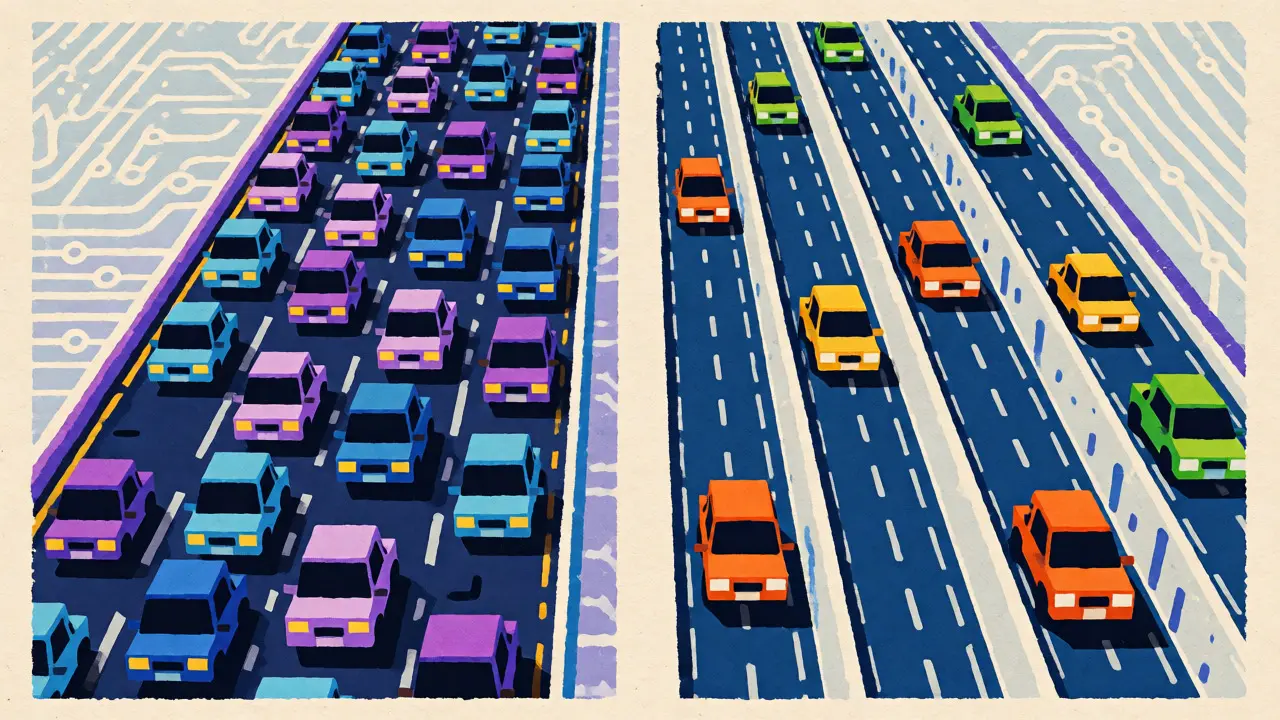
Imagine a highway with only one lane. Traffic jams are inevitable. Sharding is the process of splitting the blockchain into multiple parallel chains, called shards, each processing its own transactions. Instead of every node validating every transaction, nodes are assigned to specific shards.
Ethereum's long-term roadmap heavily features sharding. The Beacon Chain launched in December 2020 was the first step, eventually aiming for 64 shards, potentially expanding to 1,024. This allows the network to process transactions in parallel rather than sequentially. However, sharding is complex to implement. It requires significant changes to how validators operate and communicate, leading to years of development delays.
Consensus Mechanism Changes
Another L1 approach is changing how the network agrees on the state of the ledger. The most famous example is Ethereum's "Merge" in September 2022, which switched from Proof-of-Work (PoW) to Proof-of-Stake (PoS). PoS reduces energy consumption by 99.95% and stabilizes block times to a fixed 12 seconds, compared to Bitcoin's variable 10-15 minutes.
Other networks take different approaches. Avalanche uses a novel consensus protocol that achieves sub-second finality and processes around 4,500 TPS. Cardano's Ouroboros protocol aims for similar efficiency with a focus on formal verification. While these changes boost throughput, they require hard forks-major updates that split the community if not everyone agrees, as seen when Bitcoin Cash forked from Bitcoin in 2017 to increase block size.
Block Size Increases
Sometimes, the simplest fix is just making blocks bigger. Bitcoin Cash increased its block size limit to 32MB, allowing more transactions per block. Segregated Witness (SegWit), implemented on Bitcoin in 2017, didn't change the block size directly but separated signature data from transaction data, effectively increasing capacity by freeing up space. These methods are straightforward but have diminishing returns; you can't make blocks infinitely large without risking centralization, as larger blocks require more powerful hardware to run a node.
Layer 2 Solutions: Building on Top
If Layer 1 is the foundation, Layer 2 (L2) solutions are protocols built on top of the base blockchain to handle transactions off-chain. They batch many transactions together and settle them back to the main chain periodically. This drastically reduces the load on the L1 network.
Payment Channels
The Lightning Network is Bitcoin's primary L2 solution. It creates private channels between two users. You can send thousands of transactions back and forth instantly with near-zero fees. Only when you close the channel does the final balance get recorded on the Bitcoin blockchain.
This works great for small, frequent payments. Users report Lightning is excellent for transactions under $100. However, it struggles with routing failures for larger amounts and requires specialized node setup. It’s not ideal for complex smart contracts, but for peer-to-peer cash, it’s highly effective.
Rollups
Rollups are currently the dominant narrative for Ethereum scaling. They execute transactions off-chain but post compressed data back to Ethereum for security. There are two main types:
- Optimistic Rollups: Networks like Optimism and Arbitrum assume transactions are valid unless proven otherwise. This creates a 7-day "challenge period" for withdrawals, which can be annoying for users wanting instant access to funds. However, they offer high compatibility with existing Ethereum apps and achieve 2,000-4,000 TPS.
- ZK-Rollups: Networks like zkSync and StarkNet use zero-knowledge proofs to mathematically verify batches of transactions before posting them. This allows for near-instant finality and higher security guarantees, though the technology is more computationally complex.
Rollups strike a balance between security and speed. They inherit Ethereum's security model while offering significantly lower fees. For developers, moving an app to a Rollup is often easier than rewriting it for a new L1 chain.
Sidechains
Sidechains are independent blockchains that run parallel to the main chain, connected by a two-way bridge. Polygon (formerly Matic) is the most well-known example. Unlike Rollups, sidechains have their own consensus mechanism and security model, which may be less robust than Ethereum's.
Polygon's PoS chain processes 7,000 TPS with average fees of $0.001. This makes it popular for gaming and NFTs, where speed and low cost are critical. However, because sidechains rely on their own validators, they introduce additional trust assumptions. If the sidechain fails, assets bridged to it could be at risk.
Comparing Scalability Approaches
Choosing the right solution depends on what you value most. Here’s a breakdown of how different platforms stack up against key metrics.
| Solution Type | Example Platform | Throughput (TPS) | Security Model | Best For |
|---|---|---|---|---|
| Layer 1 (Sharding/PoS) | Ethereum 2.0 / Cardano | 15-250+ | Inherent Consensus | High-value DeFi, Institutional Use |
| Layer 2 (Rollups) | Arbitrum / zkSync | 2,000-4,000 | Inherited from L1 | DApps, General Purpose Scaling |
| Layer 2 (Sidechains) | Polygon | 7,000+ | Independent Validators | Gaming, NFTs, Micro-transactions |
| Layer 2 (Channels) | Lightning Network | Unlimited (within channel) | Bilateral Trust | Peer-to-Peer Payments |
| Alternative L1 | Avalanche / Solana | 4,500-65,000 | Native High-Performance | High-Frequency Trading, Speed-Critical Apps |
Notice the trade-offs. Sidechains offer the highest raw speed but lower security guarantees. Rollups offer the best balance of security and speed but still have latency issues due to settlement times. Alternative L1s like Solana push the limits of single-chain performance but have faced reliability issues during peak loads.
Real-World Implementation Challenges
It’s not enough to just pick a technology; implementation matters. Developers face real hurdles when adopting these solutions.
First, there’s the user experience friction. Moving funds from Ethereum Mainnet to a Layer 2 involves "bridging." This process can be confusing, slow, and expensive. A Reddit user noted that while Polygon reduced their dApp costs from $15 to $0.02, they experienced 4-hour delays during congestion. Bridging UX is currently the biggest barrier to mass adoption.
Second, technical complexity varies wildly. Setting up a Lightning node requires specific hardware and constant uptime. In contrast, using a ZK-Rollup might just mean changing your wallet network settings. Documentation quality also plays a huge role. Early Plasma implementations failed partly because documentation was incomplete, causing 68% of developer errors. Today, Ethereum’s L2 ecosystem benefits from a massive community and better resources.
Finally, consider liquidity fragmentation. When assets are spread across dozens of L2s and sidechains, it becomes harder to find buyers or sellers. Interoperability protocols, like those being developed by Polkadot or Cosmos, aim to solve this by allowing seamless asset transfers between different chains.
The Future: Hybrid Models and Dencun
We aren’t heading toward a single winner. Instead, the future looks multi-layered. Vitalik Buterin’s "Endgame" vision describes Ethereum as a settlement layer, with various Rollups handling execution. This means users will interact with fast, cheap L2s, while the main chain ensures security.
Recent upgrades like Ethereum’s Dencun (introducing proto-danksharding or EIP-4844) are designed to reduce Rollup fees by 10-100x. This makes L2s even more attractive. Meanwhile, Bitcoin is exploring Taproot Assets to bring scalable token issuance to its network.
Enterprise adoption is also driving change. 73% of Fortune 500 companies are experimenting with blockchain, but only 12% have gone live. They need predictable costs and regulatory clarity. Solutions that offer clear audit trails and compliance features, like permissioned variants of public chains, are gaining traction in B2B sectors.
Frequently Asked Questions
What is the difference between Layer 1 and Layer 2?
Layer 1 refers to the base blockchain (like Bitcoin or Ethereum) where transactions are settled. Layer 2 consists of secondary frameworks built on top of Layer 1 to improve speed and reduce costs. Layer 1 provides security and decentralization, while Layer 2 handles the bulk of transaction volume off-chain.
Are Layer 2 solutions safe?
Generally, yes. Rollups inherit security from the underlying Layer 1 chain. If the Layer 1 is secure, the Rollup is secure. However, sidechains have their own security models and may be vulnerable if their validator set is compromised. Always research the specific security guarantees of the L2 you are using.
Why are fees lower on Layer 2?
Layer 2 solutions batch hundreds or thousands of transactions into a single submission to the main chain. By sharing the cost of the main chain transaction among many users, the individual fee drops significantly. Additionally, L2s often use less resource-intensive consensus mechanisms.
What is Sharding?
Sharding splits the database into horizontal partitions, known as shards. Each shard contains a subset of the total data and processes transactions independently. This allows the network to scale linearly by adding more shards, increasing overall throughput.
Can I move my crypto from Ethereum to Polygon?
Yes, using a bridge. Bridges lock your tokens on the source chain and mint equivalent tokens on the destination chain. Be cautious when using bridges, as they are common targets for hacks. Always use official or reputable bridge providers.
Next Steps for Users and Developers
If you are a user, start by testing a Layer 2 network like Arbitrum or Polygon with a small amount of funds. Experience the speed and low fees firsthand. Check out aggregators that help route transactions to the cheapest network.
If you are a developer, assess your application's needs. Do you need maximum security? Stick to Ethereum Mainnet or a ZK-Rollup. Need high throughput for a game? Consider a sidechain or a high-performance L1 like Solana. Keep an eye on interoperability standards, as cross-chain communication will become increasingly important as the ecosystem matures.
Mai Wadkins
October 31, 2026 AT 09:02Oh great another article explaining why my transaction fee is higher than the item I bought. We get it Vitalik said trilemma and now we're all just waiting for sharding to actually work instead of being a roadmap meme forever.
Tom Kernan
October 31, 2026 AT 20:15Dude you have to try ZK rollups they are literally magic 🪄✨ I moved everything to zkSync last week and fees dropped from $20 to like $0.05 😱🤯 It feels illegal how cheap it is but the tech is so solid 🔒💸 Don't sleep on this guys seriously go try it right now 👇👇👇
Katy McBride
November 1, 2026 AT 09:49They tell us its about decentralization but really its about control 🕵️♀️ The L2s are just off-ramps to centralized custodians who hold your keys while you think youre sovereign 🤡 Watch out for the bridges thats where they steal the funds 🏴☠️ dont trust verify always 🧐
Ankur Gupta
November 3, 2026 AT 03:01The trilemma isn't a wall, it's more like a fluid dance between three partners trying not to step on each other's toes. While sharding sounds like splitting a highway into lanes, the real magic happens when those lanes start talking to each other without causing a traffic jam. We are seeing a beautiful evolution where security isn't sacrificed but rather redistributed across layers. It’s fascinating to watch how communities adapt, moving from the clunky brute force of PoW to the elegant efficiency of PoS. This transition allows for a greener footprint and faster confirmations, which is crucial for global adoption. However, we must remain cautious about the fragmentation that comes with multiple sidechains. Interoperability will be the bridge-pun intended-that connects these isolated islands of liquidity. If we can solve the UX friction of bridging assets, we unlock true mass usage. The future isn't one chain to rule them all, but a harmonious ecosystem of specialized networks working in tandem. Let's keep our minds open to the creative solutions emerging from every corner of the globe. Peace and prosperity to all builders pushing the boundaries of what's possible.
roger ticona nina
November 4, 2026 AT 02:30Listen up folks because I am fired up about this potential 🔥 You cannot let fear stop you from embracing these new tools 💪 Every single day engineers are crushing barriers that seemed impossible five years ago 🚀 Do not sit on the sidelines watching others succeed while you hesitate ⏳ Take the risk learn the tech and build your future on these scalable foundations 🏗️ We are witnessing history in the making and you need to be part of the solution not the problem 🌟 Stay aggressive stay curious and never stop learning because the blockchain community needs your energy right now ⚡ Go out there and make it happen today 🙌
Ridhi Sahni
November 4, 2026 AT 23:23Exactly Roger 💯 The momentum is real and we just gotta keep pushing forward no matter the noise 📈 Its inspiring to see so many people waking up to the utility aspect rather than just speculation 🌱 Lets support each other in navigating these complex layers together 🤝