
You’ve probably heard the debate raging in every crypto Discord and Twitter thread: Proof of Work (PoW) versus Proof of Stake (PoS). It’s not just a nerd fight over code; it’s a fundamental choice about how we secure digital money. Is it better to burn electricity to prove you did the work? Or should you lock up your cash to prove you have skin in the game?
There is no single "winner" here. Bitcoin has survived 17 years on PoW without being hacked. Ethereum switched to PoS to save energy and scale. Both work, but they solve different problems with different trade-offs. If you are trying to decide which mechanism underpins the best investment, or if you are building a new chain, you need to understand what actually happens under the hood.
| Feature | Proof of Work (PoW) | Proof of Stake (PoS) |
|---|---|---|
| Validation Method | Solving complex math puzzles via computing power | Selecting validators based on locked-up coins |
| Energy Use | Very High (comparable to small nations) | Low (standard server requirements) |
| Hardware Needed | ASICs, GPUs, specialized rigs | Standard computers/servers |
| Security Threat | 51% attack (needs massive hash rate) | 51% attack (needs majority of all coins) |
| Reward Source | Newly minted coins + transaction fees | Transaction fees + inflationary rewards |
| Example Chains | Bitcoin, Litecoin, Monero | Ethereum, Cardano, Solana, Polkadot |
How Proof of Work Actually Secures the Chain
Proof of Work is a consensus algorithm that requires miners to expend computational effort to validate transactions and create new blocks. Think of it like a lottery where everyone buys tickets by running their computers as fast as possible. The more powerful your computer, the more tickets you have. But unlike a normal lottery, there is no drawing. You just keep guessing numbers until you hit the right one. When you guess correctly, you get to add the next block to the blockchain and claim the reward.
This system relies on physical reality. To cheat, an attacker would need to control more than 50% of the network's total computing power, known as the hash rate. For Bitcoin, this means owning billions of dollars worth of specialized hardware called Application-Specific Integrated Circuits (ASICs) and paying for the massive electricity bills to run them. This makes attacks incredibly expensive and logistically difficult. You can’t just download more power; you have to manufacture chips, ship them, build data centers, and negotiate energy contracts.
The downside? It burns energy. A lot of it. Critics often point out that Bitcoin consumes as much electricity as countries like Argentina or Sweden. Supporters argue this energy expenditure is a feature, not a bug. It ties the value of the network to real-world resources, making it harder to manipulate with just financial capital.
The Mechanics of Proof of Stake
Proof of Stake replaces hardware competition with economic commitment. Instead of miners, you have validators. To become a validator, you must lock up-or "stake"-a certain amount of cryptocurrency. On Ethereum, for example, you need 32 ETH to run a validator node yourself. If you don’t have that, you can delegate your coins to someone who does.
Here is the key difference: you don’t race to solve a puzzle. The protocol randomly selects a validator to propose the next block. Your chance of being picked increases with the size of your stake. If you act honestly and validate transactions correctly, you earn rewards from transaction fees and newly issued tokens. If you try to cheat-say, by validating two conflicting versions of history-the protocol punishes you by slashing your stake. You lose part of your locked-up coins. This creates a strong incentive to play by the rules because cheating costs you money immediately.
PoS is vastly more energy-efficient. Since validators aren’t burning electricity to solve arbitrary math problems, the environmental footprint drops by over 99%. This accessibility also lowers the barrier to entry. You don’t need a warehouse full of ASICs; you just need a reliable internet connection and some capital. This has led to a surge in new blockchains launching with PoS mechanisms, such as Cardano, Solana, and Polkadot.

Security Models: Hardware vs. Wealth
When people ask which is safer, they are usually asking about the cost of an attack. In a PoW system like Bitcoin, a 51% attack requires buying enough mining equipment to overpower the rest of the network. Even if you had unlimited cash, you couldn’t instantly buy that much hardware. Supply chains take time. Plus, if you successfully attacked Bitcoin, the price of BTC would likely crash due to loss of confidence, devaluing the very asset you tried to steal. This economic self-preservation makes PoW highly resilient.
In PoS, the attack vector is different. To launch a 51% attack, you need to own more than half of all the circulating supply of the coin. For major assets like Ethereum, this is practically impossible because the market cap is too high. However, critics worry about "wealth concentration." In PoS, rich holders get richer through staking rewards, potentially leading to oligarchies where a few large entities control validation. While slashing penalties help mitigate this, the risk of centralization among large staking pools remains a valid concern.
Another subtle security issue in PoS is "long-range attacks," where a new validator could theoretically rewrite history from the genesis block if old keys weren’t properly discarded. Most modern PoS implementations use checkpoints to prevent this, but it highlights that PoS security models are still maturing compared to PoW’s decade-plus track record.
Decentralization and Accessibility
Decentralization isn’t just a buzzword; it’s about who controls the network. PoW tends toward geographic and industrial centralization. Mining farms cluster in places with cheap electricity, like Texas, Kazakhstan, or historically China. This means political or regulatory changes in those regions can impact the network’s health. If a country bans mining, the hash rate drops, though the network recovers as miners relocate.
PoS decentralizes differently. Because any computer can run a validator, nodes are spread globally across home servers and cloud providers. This reduces reliance on specific geographic locations for power generation. However, it introduces dependency on software clients. If most validators run the same client software (like Geth for Ethereum), a bug in that code could halt the network. Diversifying client implementations is crucial for PoS resilience.
Accessibility favors PoS for the average user. You don’t need technical expertise to set up a rig. You can simply buy coins and delegate them. This democratizes participation, allowing smaller investors to contribute to security and earn yield. In contrast, PoW mining has become an industrial-scale business dominated by professional firms, pushing hobbyists out.
Environmental Impact and Regulation
The environmental argument is perhaps the loudest driver behind the shift to PoS. Bitcoin’s energy consumption draws scrutiny from governments and ESG (Environmental, Social, and Governance) funds. Many institutional investors hesitate to touch PoW assets due to carbon footprint concerns. PoS solves this headline problem almost entirely. By removing the need for competitive hashing, it aligns blockchain technology with global sustainability goals.
Regulators are watching closely. Some jurisdictions may impose taxes or restrictions on high-energy industries, which could indirectly affect PoW networks. Conversely, PoS networks might face different regulatory hurdles regarding whether staking rewards constitute securities offerings. As laws evolve, the operational simplicity of PoS may offer compliance advantages, though legal interpretations vary by country.
Which One Should You Choose?
If you value proven security, censorship resistance, and are willing to pay the energy tax, PoW remains the gold standard. Bitcoin’s immutability is backed by physics and economics in a way that is hard to replicate. It is slow, yes, but it is robust.
If you prioritize scalability, low fees, and environmental sustainability, PoS is the clear winner. It allows for faster transaction finality and easier upgrades. Ethereum’s transition proved that even the largest networks can switch mechanisms without catastrophic failure. For new projects, starting with PoS is now the default expectation unless there is a specific reason to use PoW.
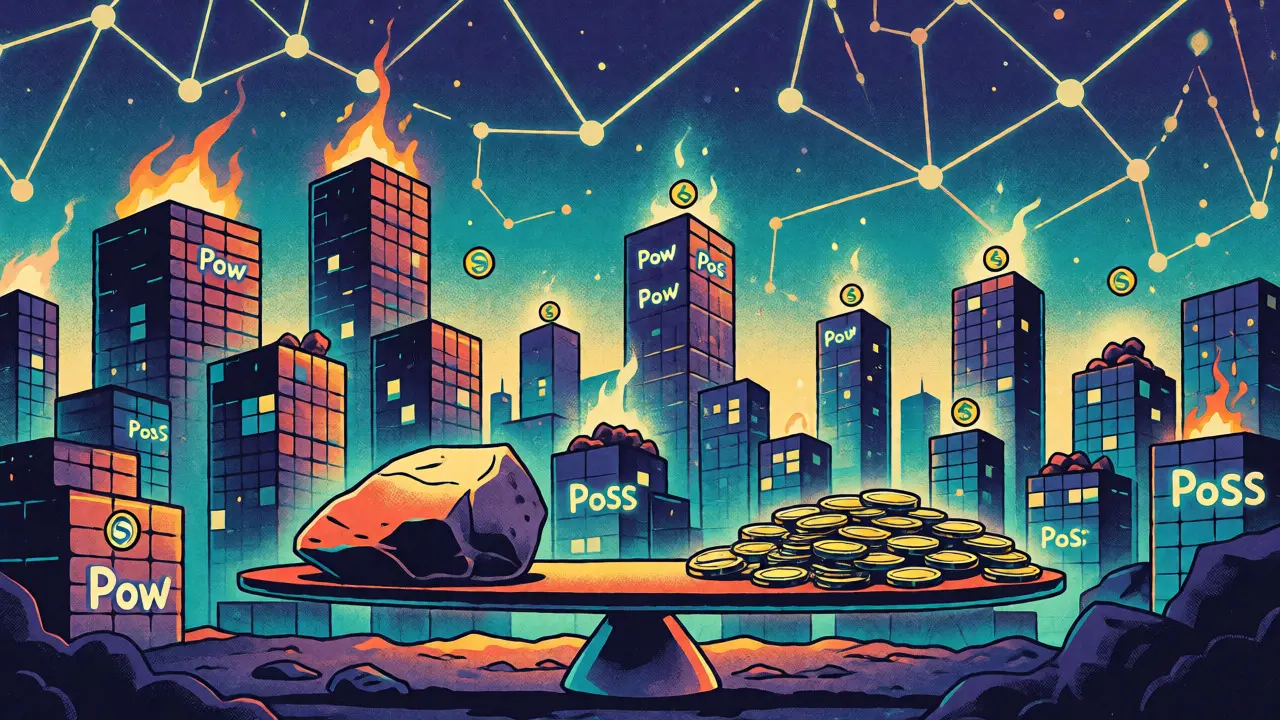
Ultimately, neither is objectively "better." They are tools for different jobs. PoW is a fortress built with stone and fire. PoS is a dynamic shield forged from trust and capital. Your choice depends on whether you care more about absolute historical proof or efficient future growth.
Is Proof of Stake safer than Proof of Work?
Not necessarily. Proof of Work has a longer track record of surviving attacks, particularly against Bitcoin since 2009. Proof of Stake is theoretically secure but relies on economic incentives and slashing penalties. For major networks, both are considered highly secure, but PoW’s link to physical hardware makes it resistant to purely financial manipulation.
Why did Ethereum switch from PoW to PoS?
Ethereum switched primarily to reduce energy consumption by 99.95%, improve scalability, and lower the barrier to entry for network participants. The move, known as "The Merge," allowed the network to process more transactions efficiently while addressing environmental concerns associated with mining.
Can I mine Bitcoin using Proof of Stake?
No. Bitcoin uses Proof of Work exclusively. You cannot mine Bitcoin by staking coins. To participate in Bitcoin’s consensus, you must provide computational power (hash rate) to solve cryptographic puzzles. Staking is a concept specific to Proof of Stake and hybrid consensus models.
What happens if I double-sign in Proof of Stake?
If a validator signs two different blocks at the same height (double-signing), the network considers this malicious behavior. The validator’s staked coins are "slashed," meaning a portion of their stake is burned or confiscated as a penalty. This deters validators from trying to fork the chain simultaneously.
Does Proof of Work use renewable energy?
Increasingly, yes. Miners seek the cheapest electricity, which often includes stranded hydroelectric power, wind, or solar. However, a significant portion still comes from fossil fuels. Estimates suggest Bitcoin’s renewable energy mix fluctuates between 40-60% depending on location and season, whereas PoS networks inherently require far less total energy regardless of source.