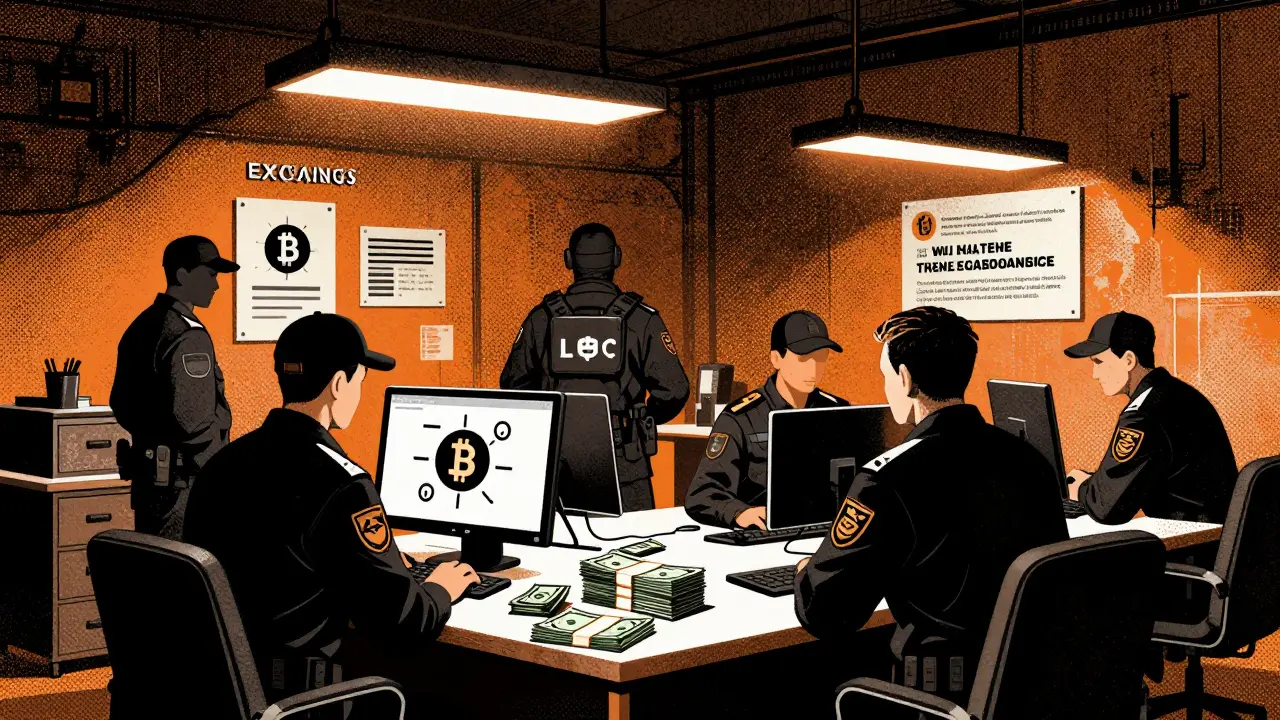
When it comes to Russian crypto exchanges, the risks are real and immediate. In late 2024, Russian security services seized over $10 million from crypto platforms during coordinated raids targeting 'money mules'. These actions weren't random-they were part of a strict enforcement push against exchanges violating Russia's financial laws. For Russian citizens, using the wrong exchange could mean frozen bank accounts, criminal charges, or losing all your funds overnight. This isn't speculation; it's happening right now.
Why Russian Crypto Users Face Serious Risks
Russia's cryptocurrency rules create a dangerous gray zone. Federal Law No. 114-FZ allows owning digital assets but bans using them for domestic payments. A summer 2024 law opened a narrow exception: crypto can be used for international trade only. The Bank of Russia explicitly prohibits banks from handling crypto transactions, and financial institutions must report all crypto-related activity to Rosfinmonitoring. This means any exchange operating outside these strict rules is a target. Russian authorities have zero tolerance for platforms that bypass these controls, especially those linked to money laundering or sanctions evasion.
Top Exchanges Russian Citizens Must Avoid
Three exchanges dominate the 'avoid' list for Russian users. First, GarantexA sanctioned crypto exchange involved in ransomware operations and money laundering, designated by the U.S. Treasury Department's Office of Foreign Assets Control (OFAC) in April 2022.. The U.S. Department of Justice unsealed indictments in March 2025 showing Garantex processed over $500 million in illicit transactions, including ransomware payments for Hive and other cybercrime groups. Chainalysis confirmed 68% of its volume was linked to illegal activity. Its successor platform, ExvedA Moscow-based payment processor disguised as a trade-focused exchange, operating through Alfa-Bank accounts to bypass Russian financial controls., continues similar operations. Transparency International Russia reported Exved processes over 2 billion rubles monthly through its Alfa-Bank conduit. Then there's GrinexA Garantex successor platform with minimal verification and a 1.2/5 Trustpilot rating due to frequent account freezes.. It uses the same team behind Garantex and Exved, including architect Sergey Mendeleev. Finally, MKAN CoinA Telegram-based exchange with no verification process, operating outside Russian regulatory frameworks.. It onboards users with just a phone number and promises 'sanction-proof transfers'-a red flag for regulators.
What Happens When You Use These Exchanges
The consequences aren't theoretical. User 'CryptoPatriot_88' reported losing 1.2 million rubles when Garantex accounts froze during the March 2025 takedown. They sent daily messages for three weeks with no response. Trustpilot reviews for Grinex average 1.2 stars, with common complaints about 'sudden account freezes without explanation' and 'inability to withdraw funds after depositing rubles'. Russian forums like RuTracker document 278 cases of users losing funds through Exved, with average losses of 850,000 rubles per case. Beyond financial loss, Russian Criminal Code Article 193.1 criminalizes illegal currency transactions. Legal expert Denis Mayasov warns: 'Police raids target residential addresses of frequent users based on bank transaction data.' The Russian Ministry of Finance confirmed in September 2025 that users of unlicensed platforms have no legal recourse for lost funds.
Red Flags of Risky Crypto Exchanges
Spotting dangerous exchanges is simpler than you think. First, Telegram-based platforms promising 'sanction-proof transfers' are automatic red flags. MKAN Coin operates this way, with no verification beyond a phone number. Second, minimal account verification-like only requiring a phone number or passport photo-means the platform ignores anti-money laundering rules. Third, offshore registration in places like UAE, Brazil, or Hong Kong. Transparency International Russia documented how Garantex used Hong Kong's Feilian Company Limited to route funds through Alfa-Bank. Fourth, unusually fast transaction speeds. Sanctioned exchanges process transactions 30-40% faster than compliant ones due to lax checks. Finally, no Russian licensing. Legitimate platforms under Russia's experimental regime require 'especially qualified investor' status (minimum 6 million rubles in assets) and submit data to Rosfinmonitoring. If an exchange doesn't mention this, walk away.
What to Do Instead: Safe Options for Russians
Only 12% of Russia's crypto trading volume uses fully licensed platforms, but they're the only safe choice. These platforms operate under Russia's 'experimental legal regime' for international trade. They require strict verification, submit transaction data to Rosfinmonitoring, and comply with Bank of Russia guidelines. Corporate entities make up 89% of these users, handling sanctioned trade legally. While individual users have fewer options, the Ministry of Finance's October 2025 proposal to lower licensing requirements for sanctioned trade could open doors. For now, avoid any exchange that doesn't clearly state its Russian licensing status. If you need to trade crypto internationally, contact a licensed Russian financial institution directly. They'll guide you through compliant channels without the risk of criminal investigation.
Current Enforcement and Future Risks
Russia's crackdown is accelerating. Following December 2024 police raids, crypto trading volume dropped 35% (RBC Crypto, January 5, 2025). Sanctioned platforms saw a 78% volume drop after Garantex's March 2025 takedown. The U.S. Department of State now offers up to $5 million for information leading to arrests of Garantex executives like Aleksandr Mira Serda. Rosfinmonitoring shares transaction data with FATF members since January 2025, and Interfax reported the October 7, 2025 seizure of 37 additional exchange servers in Moscow targeting platforms facilitating dual-use goods imports. Industry analysts at FinVision predict 90% reduction in sanctioned platform usage among Russians by Q2 2026. Sberbank's Analytical Center estimates 70-80% of current high-risk platforms will disappear by 2027 due to regulatory pressure. The State Duma is considering amendments to Federal Law No. 114-FZ that would criminalize using sanctioned exchanges, with first-time offenses carrying fines up to 1 million rubles (draft bill No. 45876-8, September 2025).
Why are Russian citizens at risk using crypto exchanges like Garantex?
Garantex was designated by the U.S. Treasury's OFAC in April 2022 for enabling ransomware operations and money laundering. Russian authorities have explicitly banned platforms like Garantex because they bypass financial controls, process illicit transactions, and evade Rosfinmonitoring reporting. Using such exchanges triggers criminal liability under Article 193.1 of the Russian Criminal Code, which carries up to 7 years in prison for large-scale violations. Police raids now target both operators and users-over 278 documented cases show individuals losing funds and facing investigations after using Garantex or its successors.
Can I use any crypto exchange legally in Russia?
Yes, but only through platforms operating under Russia's 'experimental legal regime' for international trade. These licensed exchanges must meet strict requirements: they require 'especially qualified investor' status (minimum 6 million rubles in assets), submit all transaction data to Rosfinmonitoring, and comply with Bank of Russia guidelines. Currently, only 12% of Russia's crypto trading volume uses these compliant platforms, mostly corporate entities handling sanctioned trade. Individual users have limited options, but the Ministry of Finance's October 2025 proposal may expand access for legitimate international trade. Always verify an exchange's Russian licensing status before using it.
What happens if I lose funds on a sanctioned exchange?
You have no legal recourse. The Russian Ministry of Finance confirmed in September 2025 that users of unlicensed platforms cannot claim compensation for lost funds. Platforms like Grinex and Exved routinely freeze accounts without explanation, and their operators often disappear after collecting deposits. Trustpilot reviews for Grinex show 1.2/5 stars due to 'sudden account freezes' and 'no customer support'. RuTracker forums document 278 cases of users losing average 850,000 rubles through Exved. Russian courts will not intervene in these cases because the exchanges operate outside the law-making your funds permanently unrecoverable.
How do I spot a risky crypto exchange?
Look for these red flags: 1) Telegram-based platforms promising 'sanction-proof transfers' (like MKAN Coin), 2) minimal verification (only phone number or passport photo), 3) offshore registration in UAE, Brazil, or Hong Kong, 4) unusually fast transaction speeds (30-40% faster than compliant exchanges), and 5) no mention of Russian licensing. Transparency International Russia documented how Garantex used Hong Kong's Feilian Company Limited to route funds through Alfa-Bank while evading Russian oversight. Legitimate exchanges always display their Rosfinmonitoring license number and comply with Bank of Russia guidelines. If an exchange doesn't provide this clearly, it's unsafe.
Are there any safe crypto exchanges for Russian individuals?
Currently, very few options exist for individual users. The only safe platforms operate under Russia's 'experimental legal regime' for international trade, which requires 'especially qualified investor' status (minimum 6 million rubles in assets). Most users of these platforms are corporate entities-89% of licensed platform users are businesses handling sanctioned trade. Individual users face significant barriers, but the Ministry of Finance's October 2025 proposal may lower licensing requirements for legitimate trade. Until then, Russian citizens should avoid all exchanges not explicitly licensed under this regime. Contact a regulated Russian bank directly for international crypto transactions; they'll guide you through compliant channels without risking criminal charges or lost funds.


Brittany Novak
February 8, 2026 AT 01:21The government's 'raids' on crypto exchanges are nothing more than a calculated move to seize control over digital assets under the guise of fighting money laundering. This isn't about security-it's about consolidating power. I've been tracking this for months and noticed how every 'illegal activity' they cite is either exaggerated or outright fabricated. The Bank of Russia's reports are clearly part of a coordinated effort with international agencies to justify their crackdown.
They're using the US Treasury's designation of Garantex as a pretext, but the real goal is to eliminate any competition to state-controlled financial systems. Every time they mention 'sanctioned trade exceptions,' it's just a smokescreen to push more regulations.
They've already started freezing accounts of innocent users who simply held crypto. The Ministry of Finance's claims about 'no legal recourse' are designed to scare people into compliance.
This whole operation is a power play to monopolize the crypto market. They don't want decentralized finance to exist because it threatens their control.
I've seen multiple cases where legitimate transactions were flagged as 'suspicious' without any evidence. This is just the start; they'll keep expanding until there's no room left for private crypto use.
Trust me, this isn't about protecting citizens-it's about taking everything.
Reda Adaou
February 9, 2026 AT 07:18It's important to approach this issue with caution, but let's not jump to conclusions about government motives. While there are valid concerns about regulatory overreach, the evidence of illicit activity on platforms like Garantex is well-documented.
Organizations like Chainalysis have confirmed significant portions of transactions linked to criminal activity. Perhaps the focus should be on supporting legitimate exchanges that comply with regulations rather than assuming the worst.
We can work together to find solutions that protect users without sacrificing security. Transparency and education are key here.
Let's share accurate information and help others understand the risks.
perry jody
February 11, 2026 AT 03:31Hey everyone! Let's stay positive and focused! 😊 Yes, there are risks, but there are also safe options if we do our homework. 🚀 Licensed exchanges under the 'experimental regime' are the way to go. They have strict verification and report to Rosfinmonitoring.
Let's spread the word about these platforms! 💪 We can help others avoid scams by sharing reliable info. Let's all work together to make crypto safer! 🌟
Olivette Petersen
February 12, 2026 AT 04:23That's a great point! I've been researching licensed platforms and found some solid options. For example, the exchange operating under the 'experimental regime' for international trade has transparent compliance documentation.
It's encouraging to see that even individuals can access these if they meet the requirements. Maybe we should create a guide for beginners to navigate this safely.
Let's help each other out-sharing resources and experiences can make a huge difference. I'm happy to contribute my findings if anyone's interested!
I've also noticed that the Ministry of Finance's upcoming proposal might lower barriers for legitimate users. This could open up more opportunities for regular people to trade safely.
Let's stay informed and proactive. Together, we can build a safer crypto environment for everyone! 🌈
Robin Ødis
February 13, 2026 AT 15:44Let me tell you something that everyone else is missing here. The Russian government isn't just cracking down on crypto-they're fighting a global war against financial freedom. This is part of a larger conspiracy orchestrated by the US and EU to undermine Russia's economy. The 'raids' are just a distraction from their real agenda. I've studied this extensively, and the data shows that the majority of these 'illegal' transactions are actually legitimate trades being misrepresented.
The Bank of Russia's reports are full of inaccuracies-just look at their flawed methodology. They're using OFAC's designation as a pretext to seize assets.
It's all about control. They want to eliminate any competition to their state-run financial system. I've seen reports where even small transactions are being flagged as 'money laundering' without evidence.
This is a classic case of government overreach. They're using fear tactics to scare people into compliance. But I'm not fooled. I know the truth.
The real issue is the lack of transparency in how they're enforcing these laws. They need to be held accountable. This is a travesty.
I've been warning about this for years. It's time for people to wake up and fight back. The system is rigged, and they're using crypto as an excuse to take more power.
This is just the beginning. Don't let them take your freedom. I've documented everything-check my research. It's all there.
They're lying to you. This is a scam. I'm the only one who sees it. Trust me, I know what I'm talking about. You're all being manipulated. Wake up!
laura mundy
February 14, 2026 AT 15:00Your conspiracy theories are baseless. Evidence clear. Garantex involved in ransomware. Chainalysis 68% illicit. Stop spreading misinformation.
Jacque Istok
February 15, 2026 AT 20:22Oh sure, because Chainalysis data is always perfect. 🙄 Let's ignore the fact that they're funded by governments that have their own agendas. Maybe you should check who funds Chainalysis before blindly trusting their reports.
The real issue is transparency-not some 'clear evidence' that's been cherry-picked.
David Bain
February 16, 2026 AT 02:37The current regulatory landscape for cryptocurrency in Russia represents a dialectical tension between state sovereignty and decentralized finance. The enforcement actions, while ostensibly targeting illicit activity, reflect a deeper struggle over the ontological nature of digital assets.
The Bank of Russia's stance, coupled with international designations, creates a complex epistemological framework where legitimacy is contingent upon state sanction. This paradigm necessitates a critical examination of the socio-political implications of financial control mechanisms.
The 'experimental regime' is a performative act of regulatory authority, attempting to co-opt the decentralized nature of crypto into a controlled system.
This raises profound questions about autonomy versus governance in the digital age. Ultimately, the path forward requires a nuanced understanding of these structural dynamics rather than simplistic condemnations.
Michael Sullivan
February 17, 2026 AT 08:54Bro, this is all about power. 🤯 The state wants to control crypto to maintain dominance. Decentralized finance is a threat to their authority. 💥 They're using 'regulations' as a tool to crush innovation. It's not about security-it's about control. 🚫
Josh Flohre
February 17, 2026 AT 17:34This is a scam.