
Gas fees on Ethereum mainnet used to be a joke among traders until they weren’t. By mid-2024, a simple swap could cost more than your actual trade if you timed it wrong. That reality pushed everyone toward Layer 2 solutions, and ZKsync Era is a zero-knowledge rollup scaling solution for Ethereum that uses cryptographic proofs to enable fast, low-cost transactions while maintaining security guarantees. When Uniswap v3-the industry standard for decentralized trading-landed on this network, it promised the same powerful tools without the wallet-draining fees. But does the experience actually hold up in 2026?
I’ve spent weeks testing the waters, swapping tokens, providing liquidity, and comparing the numbers against other networks like Arbitrum and Optimism. The short answer? If you want professional-grade trading tools with near-zero fees, this combination is hard to beat. But there’s a catch: liquidity depth isn’t quite there yet for massive institutional-sized trades.
What Makes This Combo Different?
To understand why Uniswap v3 is an automated market maker protocol that introduced concentrated liquidity, allowing providers to allocate capital within specific price ranges for up to 4000x efficiency gains compared to previous versions, you have to look at how it changed the game. Unlike older models where your money sat idle across an entire price curve, v3 lets you pick a lane. You choose a price range, and your capital works harder only within that band.
Now, slap that onto ZKsync Era. ZKsync doesn’t just speed things up; it uses zero-knowledge proofs (ZKPs). Think of it as a mathematical guarantee that a transaction is valid without revealing all the underlying data. This makes it faster and often more secure than optimistic rollups, which rely on fraud proofs that can take days to challenge. For us regular users, this means sub-second finality and gas costs that are typically 90% lower than Ethereum mainnet.
- Speed: Transactions confirm almost instantly on ZKsync, unlike the block-time waits on L1.
- Cost: Swapping ETH for USDC might cost you fractions of a cent here, versus dollars on mainnet during peak hours.
- Security: Inherits Ethereum’s security model through ZK-proofs, not trust assumptions.
The User Experience: Smooth or Clunky?
Let’s talk about the interface. You head to app.uniswap.org, click the network button, and select ZKsync. It sounds simple, but if you’re new to Layer 2s, bridging assets is the first hurdle. You can’t just send ETH from your MetaMask on Ethereum directly to Uniswap on ZKsync. You need to use a bridge-either the official ZKsync Bridge or a third-party option like Orbiter or Jump.
Once your funds are on ZKsync Era, the Uniswap interface feels familiar. The layout is clean, the charts are responsive, and the slippage settings are easy to adjust. However, I noticed something interesting: the liquidity pools aren’t as deep as they are on Arbitrum or Optimism. As of early 2026, total value locked (TVL) for Uniswap on ZKsync hovers around $450,000 according to ChainBroker data. Compare that to millions on other chains, and you realize that while small swaps are cheap, large orders will suffer from higher slippage.
If you’re trading less than $10,000 at a time, you probably won’t notice. But if you’re moving six figures, you might want to split your order or look at aggregators like Oku Trade, which is built specifically on top of Uniswap v3 contracts on ZKsync. Oku adds TradingView charts and limit orders, giving you a more traditional exchange feel without leaving the decentralized space.

Liquidity Provision: High Rewards, Higher Skill Requirement
This is where Uniswap v3 shines-and where most beginners lose money. Providing liquidity on ZKsync via Uniswap v3 requires active management. Because you’re concentrating your liquidity in a specific range, if the price moves out of that range, you stop earning fees and start facing impermanent loss.
Here’s the good news: the fee tiers are flexible. You can choose from 0.01%, 0.05%, 0.3%, or 1% depending on the volatility of the pair. Stablecoin pairs like USDC/USDT usually sit at 0.01%, while volatile pairs like ETH/ZK might be at 0.3%. On ZKsync, because gas is so cheap, you can rebalance your positions frequently without worrying about eating into your profits with transaction fees. On Ethereum mainnet, rebalancing might cost $20; on ZKsync, it costs pennies.
However, remember that each position is an NFT (ERC-721). This means you manage individual positions rather than holding a single LP token. It’s more precise, but it also means you need to track multiple assets if you provide liquidity to several pairs. Wallets like MetaMask and Rabby handle this well, but keep your dashboard organized.
How Does It Stack Up Against Competitors?
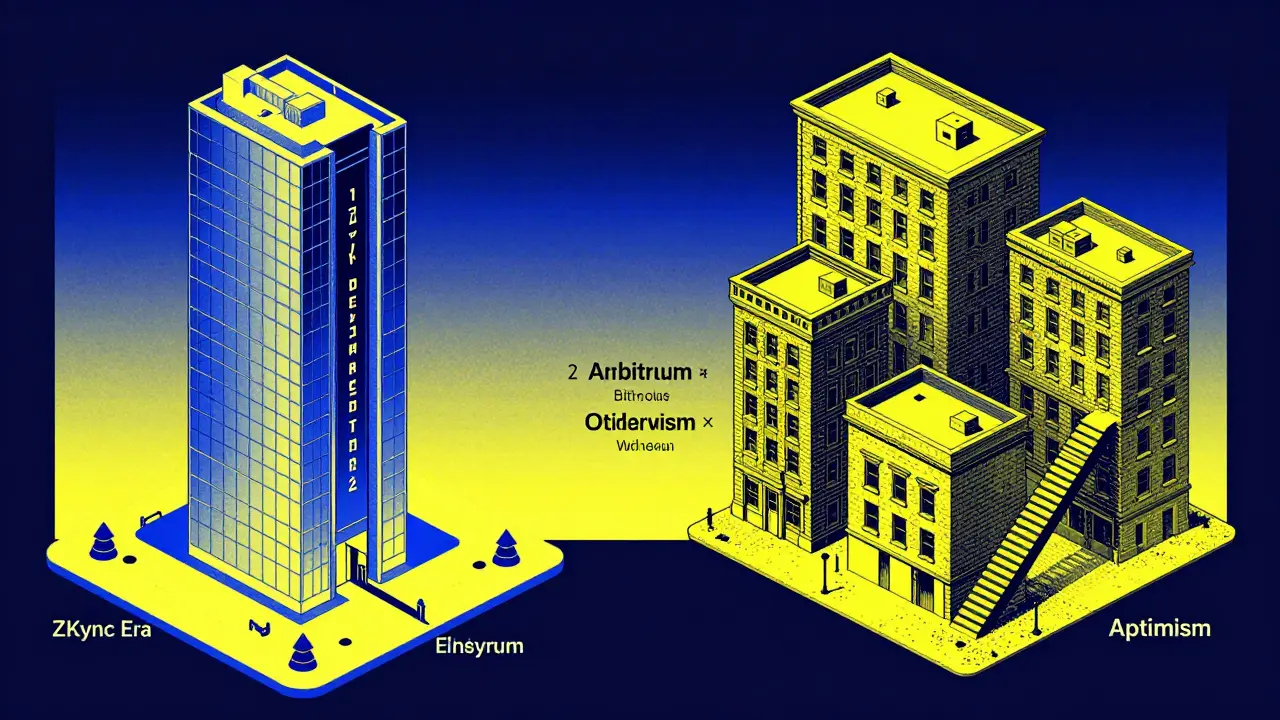
You don’t have to use ZKsync. Arbitrum One and Optimism are mature ecosystems with deeper liquidity. So why choose ZKsync? It comes down to technology preference and future-proofing. ZK-rollups are widely considered the endgame for Ethereum scaling due to their immediate finality and strong security model. Optimistic rollups (like Arbitrum and Optimism) are great now, but they require a seven-day withdrawal window for security challenges. ZKsync allows instant withdrawals back to Ethereum mainnet.
| Feature | ZKsync Era | Arbitrum One | Optimism |
|---|---|---|---|
| Technology Type | ZK-Rollup | Optimistic Rollup | Optimistic Rollup |
| Withdrawal Time to L1 | Instant (minutes) | ~7 Days | ~7 Days |
| Avg Gas Cost (Swap) | <$0.01 | $0.10 - $0.50 | $0.10 - $0.50 |
| Uniswap v3 TVL (Approx.) | $450k | $50M+ | $30M+ |
| Ecosystem Maturity | Growing | Mature | Mature |
As the table shows, ZKsync wins on cost and withdrawal speed but lags significantly in liquidity depth. If you prioritize having access to every obscure token and deepest markets, stick with Arbitrum. If you want cutting-edge tech, instant exits, and minimal fees for standard pairs, ZKsync is the smarter play.
Pitfalls to Avoid
Even with great tech, mistakes happen. Here are three common traps I’ve seen users fall into:
- Ignoring Slippage Tolerance: With thinner liquidity, prices can jump quickly. Always set a reasonable slippage tolerance (usually 0.5% to 1% for volatile pairs) to prevent failed transactions or getting ripped off.
- Over-Concentrating Liquidity: New providers often set tight ranges to maximize fees. In a volatile market, this gets you depegged instantly. Start with wider ranges until you understand the tick spacing mechanics.
- Forgetting Gas for Approvals: While swaps are cheap, the initial approval of a token contract still costs gas. Make sure you have enough ZK (the native token) in your wallet to cover these micro-transactions.
Future Outlook: What’s Next?
Uniswap Labs is already working on v4, which introduces “hooks”-customizable code that developers can attach to pools. This could revolutionize how we interact with AMMs, allowing for features like dynamic fees or custom oracle integrations right inside the pool. ZKsync’s architecture is highly compatible with these advanced features due to its smart contract flexibility.
Additionally, partnerships like the one with Layer3 offer quest programs where users earn XP and rewards for trading. These gamification elements help bootstrap liquidity and user engagement. As more DeFi protocols migrate to ZKsync, the liquidity gap will likely close. Early adopters who build their strategies now may find themselves ahead of the curve when the ecosystem matures fully.
Is Uniswap v3 on ZKsync safe to use?
Yes, it inherits Ethereum's security through zero-knowledge proofs. However, always verify contract addresses and ensure you are connecting to the official Uniswap interface to avoid phishing sites. The risk lies more in user error (like approving malicious contracts) than in the protocol itself.
How do I move my funds to ZKsync Era?
You need to bridge your assets from Ethereum mainnet or another chain. Use the official ZKsync Bridge for maximum security, or use third-party bridges like Orbiter for potentially faster transfers. Ensure you have some ETH on Ethereum to pay for the bridge transaction gas.
Why is the liquidity lower on ZKsync compared to Arbitrum?
ZKsync Era is a newer entrant in the Layer 2 space compared to Arbitrum and Optimism. It takes time for liquidity providers to migrate capital. However, the ecosystem is growing rapidly, and incentives like quest programs are helping to attract more volume.
Can I withdraw my funds instantly back to Ethereum?
Unlike optimistic rollups that require a 7-day waiting period, ZKsync allows for near-instant withdrawals to Ethereum mainnet because the validity of transactions is proven mathematically before posting to L1. You just need to pay the Ethereum gas fee for the finalization step.
What is the best strategy for providing liquidity on Uniswap v3 ZKsync?
Start with stablecoin pairs using wide ranges to minimize impermanent loss risk. As you gain experience, try volatile pairs with tighter ranges during low-volatility periods. Use the low gas costs to your advantage by rebalancing frequently rather than setting and forgetting.



Filbert Reeves
June 24, 2026 AT 10:50look i dont trust any of this zk stuff its all a scam to steal our keys and the gov is watching every tx on chain they want to kill privacy but u guys are so dumb u fall for it every time
pankaj chawla
June 24, 2026 AT 13:25I have been testing ZKsync Era for my DeFi strategies and the gas efficiency is undeniable. While the TVL is lower than Arbitrum, the cost-benefit analysis for frequent rebalancing favors ZKsync significantly. The instant withdrawal feature is also a major technical advantage over optimistic rollups.
Amit Thakur
June 24, 2026 AT 21:05The impermanent loss mechanics on v3 are brutal if you do not understand tick spacing. You need to monitor your positions constantly because the concentrated liquidity model amplifies both gains and losses exponentially compared to v2. Do not deploy capital unless you are ready to manage the risk actively or you will get rekt by volatility spikes that exit your range instantly.
Andrea Burd
June 25, 2026 AT 14:20another generic review from someone who clearly hasnt lost money yet lol
Sonya O'Brien
June 26, 2026 AT 00:04I really appreciate how detailed this breakdown is regarding the user experience hurdles, especially the bridging process which can be quite daunting for newcomers who are just starting their journey into decentralized finance. It is wonderful to see that the author took the time to explain the nuances of slippage tolerance and why it matters more on networks with thinner liquidity pools like ZKsync currently. I have found that using aggregators as mentioned can indeed smooth out the execution price significantly when dealing with larger order sizes that might otherwise fragment the pool too much. The comparison table provided is also incredibly helpful for visualizing the trade-offs between speed, cost, and liquidity depth across the different Layer 2 solutions available today. It makes me feel more confident about trying out Uniswap v3 on ZKsync for smaller trades where the fee savings are most pronounced and the impact on the pool is minimal. Thank you for sharing these insights and helping the community navigate the complex landscape of Ethereum scaling solutions in such an accessible and thorough manner.
Nick Rice
June 27, 2026 AT 00:17You must stop ignoring the technological superiority of zero-knowledge proofs. Optimistic rollups are obsolete technology relying on fraud proofs that create unnecessary friction for users. ZKsync provides mathematical finality which is the only secure way forward for Ethereum scaling. Wake up and embrace the future of blockchain architecture before you are left behind by those who understand the fundamentals of cryptographic security.
Charles Pawlikowski
June 28, 2026 AT 04:48typical globalist tech bro nonsense :/ we should stick to local currencies and real assets not these digital ponzi schemes designed to exploit working people everywhere
Eric Scheinberg
June 28, 2026 AT 10:00The assertion that ZK-rollups are the endgame is theoretically sound given the immediate finality guarantees. However one must consider the current ecosystem maturity which remains a significant barrier to widespread adoption among institutional players who require deep liquidity for large transactions without substantial slippage.
Jessica Lane
June 28, 2026 AT 11:19I am genuinely excited about the potential for hooks in Uniswap v4 to revolutionize how we interact with automated market makers. The ability to customize pool behavior through smart contracts could address many of the current limitations regarding dynamic fees and oracle integrations. This innovation seems particularly promising for networks like ZKsync that prioritize smart contract flexibility and advanced computational capabilities.
Akeem Whittaker
June 30, 2026 AT 10:08Start with stablecoin pairs to minimize impermanent loss risk while you learn the mechanics. Rebalance frequently using the low gas costs to your advantage rather than setting wide ranges and forgetting about them. Discipline and active management are key to success on Uniswap v3 regardless of the underlying network.