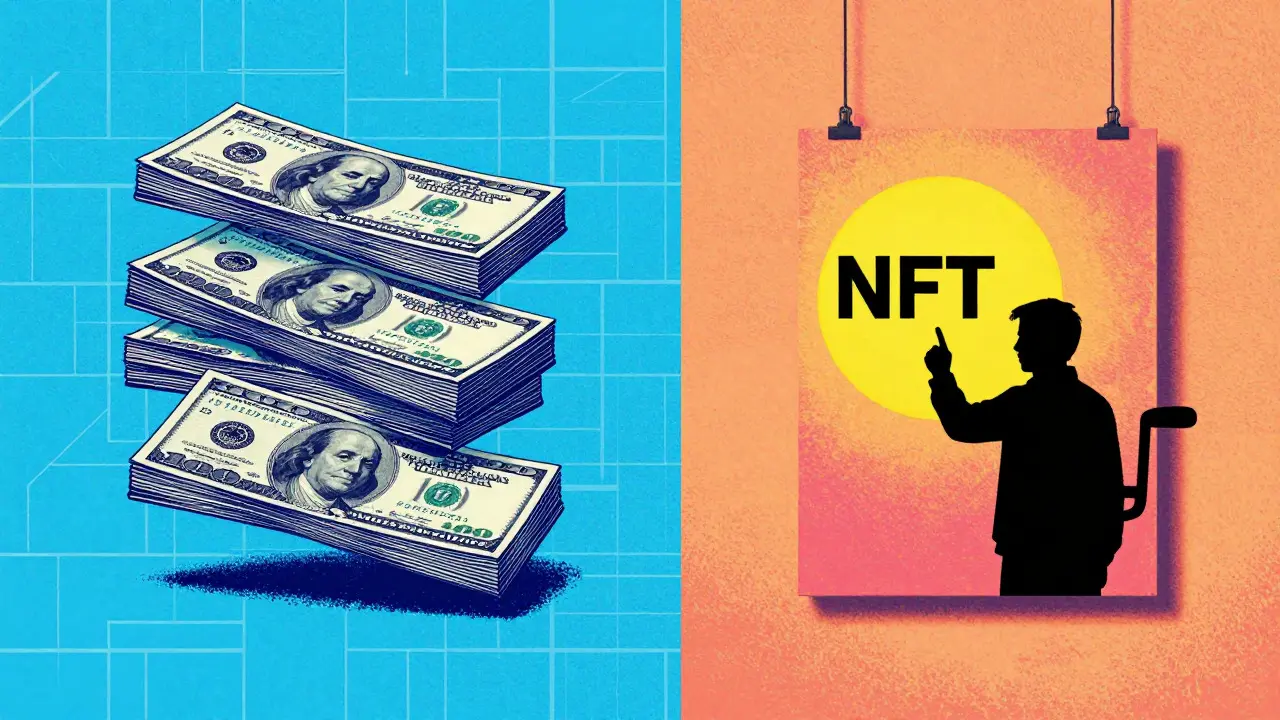
Imagine you have a dollar bill. You hand it to a friend for coffee. Does that specific piece of paper matter? No. It’s worth exactly one dollar, just like any other dollar bill in circulation. Now, imagine you own the original painting by Banksy hanging in your living room. If you swap it with another Banksy, are they truly interchangeable? Probably not. One might be signed, dated differently, or hold more historical weight.
This simple distinction-interchangeability versus uniqueness-is the entire foundation of the difference between cryptocurrency and Non-Fungible Tokens (NFTs). Both live on the same technological backbone: the blockchain. But while they share DNA, they serve completely different masters in the digital economy. Understanding this split isn't just academic; it determines how you store value, what you buy, and how you protect your assets.
The Core Concept: Fungibility vs. Uniqueness
To get these two technologies straight, you first need to understand the word "fungible." In economics, an asset is fungible if one unit is identical in value to another unit of the same type. Bitcoin is fungible. One Bitcoin equals one Bitcoin. It doesn’t matter if it was mined in 2013 or bought yesterday; its purchasing power is the same.
NFTs are the opposite. They are non-fungible. Each token has a unique identifier embedded in its code. This makes them distinct from every other token, even within the same collection. Think of NFTs as digital certificates of ownership for specific items, whereas cryptocurrencies act as digital cash.
| Feature | Cryptocurrency (e.g., Bitcoin) | NFT (Non-Fungible Token) |
|---|---|---|
| Fungibility | Fungible (Interchangeable) | Non-Fungible (Unique) |
| Primary Use Case | Medium of exchange, Store of value | Digital ownership, Collectibles, Identity |
| Divisibility | Highly divisible (e.g., Satoshis) | Indivisible (Whole token only) |
| Valuation Basis | Market supply/demand, Utility | Rarity, Creator reputation, Subjective demand |
| Token Standard (Ethereum) | ERC-20 | ERC-721, ERC-1155 |
How Value Is Determined
When you look at the price of Ethereum or Bitcoin, you’re looking at a market driven by broad economic forces. Supply and demand dictate the price. If millions of people want to use Bitcoin as a hedge against inflation, the price goes up. The value is objective in the sense that everyone agrees on the current market rate for one unit.
NFT valuation is far more subjective and complex. An NFT’s worth comes from scarcity, the reputation of the creator, and community hype. Why did Beeple’s artwork "Everydays: The First 5000 Days" sell for $69 million at Christie's in 2021? Not because the JPEG file itself cost money to produce, but because it was a unique cultural moment tied to a famous artist. Another NFT from a lesser-known artist might be worth $50, even if the image looks similar. This subjectivity creates extreme volatility. While crypto prices fluctuate based on global markets, NFT prices can swing wildly based on social media trends or collector interest.
Technical Architecture: Standards and Code
Under the hood, both rely on blockchain ledgers to record transactions immutably. However, the coding standards differ significantly, especially on the Ethereum network, which hosts the majority of both assets.
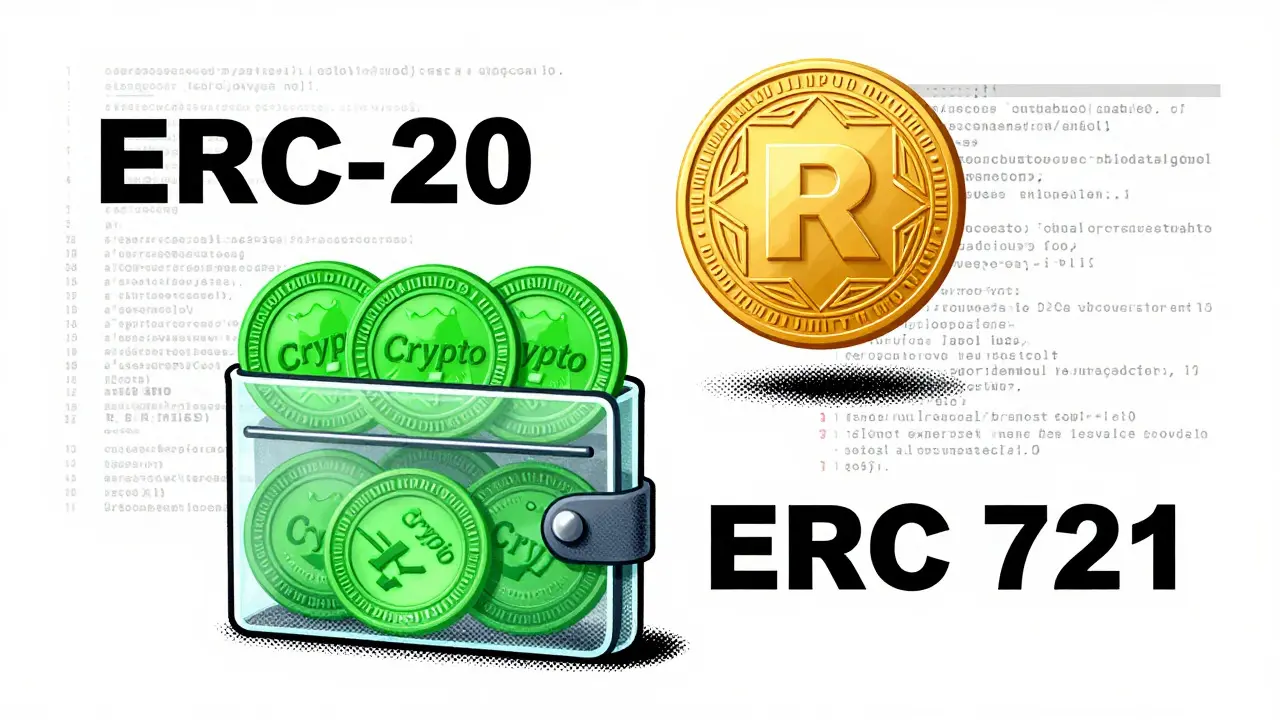
Cryptocurrencies typically follow the ERC-20 standard. This protocol ensures that tokens are uniform and easily swappable between wallets and exchanges. It allows for fractional ownership-you can send someone 0.001 Bitcoin.
NFTs usually utilize the ERC-721 or ERC-1155 standards. These codes embed metadata that distinguishes each token. For example, an ERC-721 token contains a unique ID number that links to specific data about the asset it represents. Because of this structure, you cannot split an NFT into smaller pieces. You either own the whole token or none of it. This indivisibility is crucial for maintaining the concept of exclusive ownership.
Ownership Rights and Intellectual Property
A common misconception among new buyers is that purchasing an NFT grants you copyright to the underlying work. Generally, it does not. When you buy an NFT of a digital song or image, you own the token-the receipt of ownership-but the intellectual property rights usually remain with the creator. You can display it, resell it, or trade it, but you typically can’t mass-produce t-shirts with that image without permission.
Cryptocurrency ownership is simpler. When you own Bitcoin, you own the value. There are no licensing agreements or creative rights attached to a coin. This clarity makes crypto easier to regulate as a financial instrument, whereas NFTs often sit in a legal gray area regarding commercial usage rights.
Liquidity and Market Dynamics
If you need cash quickly, selling Bitcoin is easy. You can do it on dozens of exchanges globally within minutes. Cryptocurrencies are highly liquid assets. NFTs, however, suffer from low liquidity. To sell an NFT, you must find a specific buyer interested in that exact asset. You list it on marketplaces like OpenSea or Rarible, but there is no guaranteed buyer. Some NFTs sit unsold for months or years. This illiquidity means NFTs are riskier investments for those who need quick access to funds.
Real-World Applications Beyond Art and Money
While we often associate crypto with payments and NFTs with digital art, their applications are expanding rapidly.
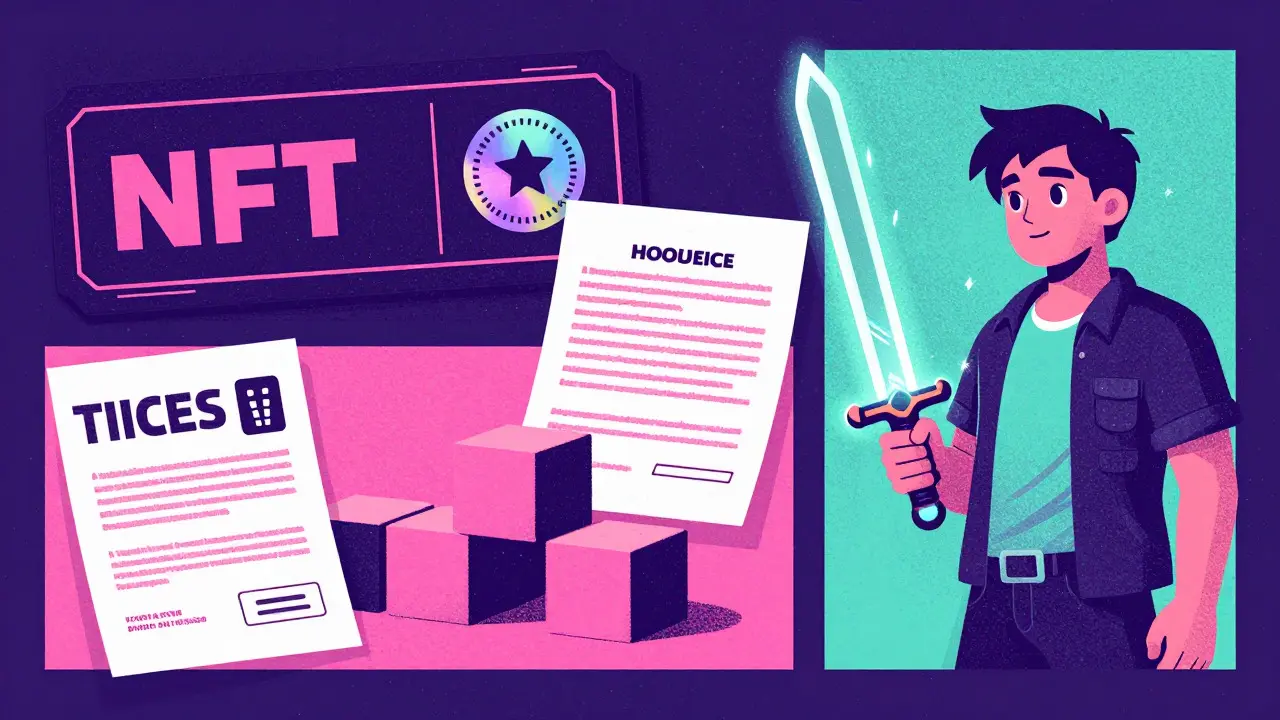
- Ticketing: Events like the FIFA World Cup have experimented with NFT tickets to prevent fraud and scalping. The ticket becomes a verifiable, transferable asset rather than a simple PDF.
- Real Estate: Platforms like Propy have facilitated property sales using NFTs to represent deed ownership, streamlining paperwork and reducing reliance on intermediaries.
- Gaming: In blockchain games, NFTs represent weapons, skins, or land that players truly own and can trade outside the game ecosystem, unlike traditional game items locked to a server.
- Identity Verification: NFTs can serve as decentralized identity credentials, proving attendance at events or completion of courses without revealing personal data.
Security Risks and User Challenges
Both spaces face security threats, but the nature of the risks differs. Crypto users primarily worry about exchange hacks or losing private keys. The Poly Network hack in 2021, where $600 million was stolen, highlights the vulnerability of centralized custodians. Users must manage their own wallets securely, a steep learning curve for beginners.
NFT collectors face different dangers. "Rug pulls," where developers abandon a project after raising funds, are common. Wash trading-inflating volume by buying and selling among oneself-was reported in 18% of NFT trading volume in 2022, according to Chainalysis. Additionally, plagiarism is rampant; artists often see their work minted as NFTs without consent. Due diligence is critical before entering either market.
Regulatory Landscape
Regulators are catching up. In the EU, the Markets in Crypto-Assets (MiCA) regulation took effect in 2024, providing a clear framework for cryptocurrencies as financial instruments. The U.S. Securities and Exchange Commission (SEC) focuses on whether certain NFTs function as investment contracts, potentially subjecting them to securities laws. Pure collectible NFTs generally escape strict securities regulation, but the line remains blurry. This regulatory uncertainty adds another layer of complexity for investors compared to the more established (though still evolving) rules for fiat-backed crypto exchanges.
Can I spend NFTs like cryptocurrency?
Generally, no. NFTs are designed as unique assets representing ownership of specific items, not as a medium of exchange. While some niche platforms allow spending certain NFTs, they lack the universal acceptance and divisibility required for everyday transactions. Cryptocurrencies like Bitcoin or Ethereum are built specifically for value transfer.
Are NFTs safer than cryptocurrencies?
Not necessarily. Both carry significant risks. Cryptocurrencies face market volatility and exchange security issues. NFTs face risks related to illiquidity, rug pulls, and copyright disputes. Security depends largely on user behavior, such as using hardware wallets and verifying contract addresses, regardless of the asset type.
Do I need cryptocurrency to buy an NFT?
Yes, typically. Most NFT marketplaces operate on blockchains like Ethereum, requiring native cryptocurrencies (like ETH) to pay for transaction fees (gas) and purchase prices. While some platforms now accept credit cards, the underlying settlement usually involves converting fiat to crypto first.
What happens if the website hosting my NFT disappears?
The token itself remains on the blockchain, but the link to the visual content (image/video) might break if it was hosted on a centralized server. To mitigate this, many serious projects use decentralized storage solutions like IPFS (InterPlanetary File System), ensuring the asset persists even if the original website shuts down.
Is Bitcoin an NFT?
No. Bitcoin is a fungible cryptocurrency. Every satoshi is identical to another. An NFT is non-fungible, meaning each token is unique. While Bitcoin Ordinals have introduced inscriptions that behave somewhat like NFTs on the Bitcoin network, standard Bitcoin remains a fungible currency.
Lisa Chong
July 24, 2026 AT 12:33They want you to beleive this is just about art and money but its clearly a surveillance tool designed to track every single transaction you make forever on an immutable ledger that the government can easily access if they really wanted to. The whole concept of 'ownership' in a digital void is a psyop to get us used to having our assets controlled by centralized exchanges that report to the IRS anyway so we might as well stick to cash under the mattress where no algorithm can see it.
Heather Austin
July 25, 2026 AT 20:15actually the fungibility point is super important here because most people dont realize that while bitcoin is technically fungible at the protocol level, some coins are considered tainted due to darknet usage which breaks that illusion slightly but generally yes crypto acts like cash and nfts act like deeds or tickets so thinking of them as interchangeable is a fundamental misunderstanding of the underlying smart contract standards like erc20 vs erc721
Ran Tao
July 27, 2026 AT 08:21Oh please 🙄 another boring explainer for people who think they understand finance after reading one blog post. You’re missing the entire cultural zeitgeist here! It’s not about the code, it’s about the *vibe* and the community status 🚀🌕 NFTs are the new high society entry ticket while crypto is just for degens who love watching charts go up and down all day. Don’t be a square, embrace the chaos! 💎🙌
Russ Fincham
July 28, 2026 AT 11:09The article completely glosses over the fact that liquidity is a myth in both sectors right now. While Bitcoin has volume, the slippage on large orders makes it less liquid than fiat in many institutional contexts. Meanwhile, NFT liquidity is essentially zero for 99% of assets, meaning your 'investment' is trapped until someone else decides to buy into the hype cycle. It’s a Ponzi structure disguised as innovation, and the regulatory crackdown is inevitable because these assets lack intrinsic cash flow generation mechanisms unlike traditional equities or bonds.
Ran Tao
July 30, 2026 AT 07:56@Russ Fincham wow such negativity 📉 you sound like a boomer trying to explain why gold is better than stocks. Liquidity is there if you know where to look, man! OpenSea is buzzing with activity every second. You’re just mad you missed the boat on Bored Apes and now you have to pretend you knew it was all going to crash 😂💸
Drew M
July 31, 2026 AT 12:14Let’s be honest, the only reason anyone cares about NFTs right now is because of the tax implications and the sheer absurdity of paying thousands for a JPEG that could be screenshotted for free. But sure, keep telling yourself it’s about 'digital ownership' when really it’s just a way for influencers to monetize their followers’ desperation to belong to an exclusive club. I’ve seen better art in my kid’s coloring book, and at least that doesn’t require a gas fee to display 😂✨
Melissa Beckwith
August 1, 2026 AT 15:45It is fascinating to consider how the ERC-721 standard fundamentally alters the relationship between creator and consumer by introducing a layer of verifiable scarcity that did not previously exist in the digital realm, thereby creating a new economic paradigm where provenance is more valuable than the utility of the asset itself, which leads to a situation where the market value becomes entirely decoupled from any tangible benefit or functional use case, resulting in a speculative bubble that is driven purely by social signaling and fear of missing out rather than any rational assessment of intrinsic worth or long-term viability in a broader financial ecosystem.
Hazel Fruitman
August 2, 2026 AT 21:33its so gross how artists get ripped off and then people still buy these things without checking if the original creator even consented to the minting process. it feels like stealing but with extra steps and blockchain jargon to make it sound fancy. we need stricter laws before this whole thing collapses under its own weight of plagiarism and rug pulls.