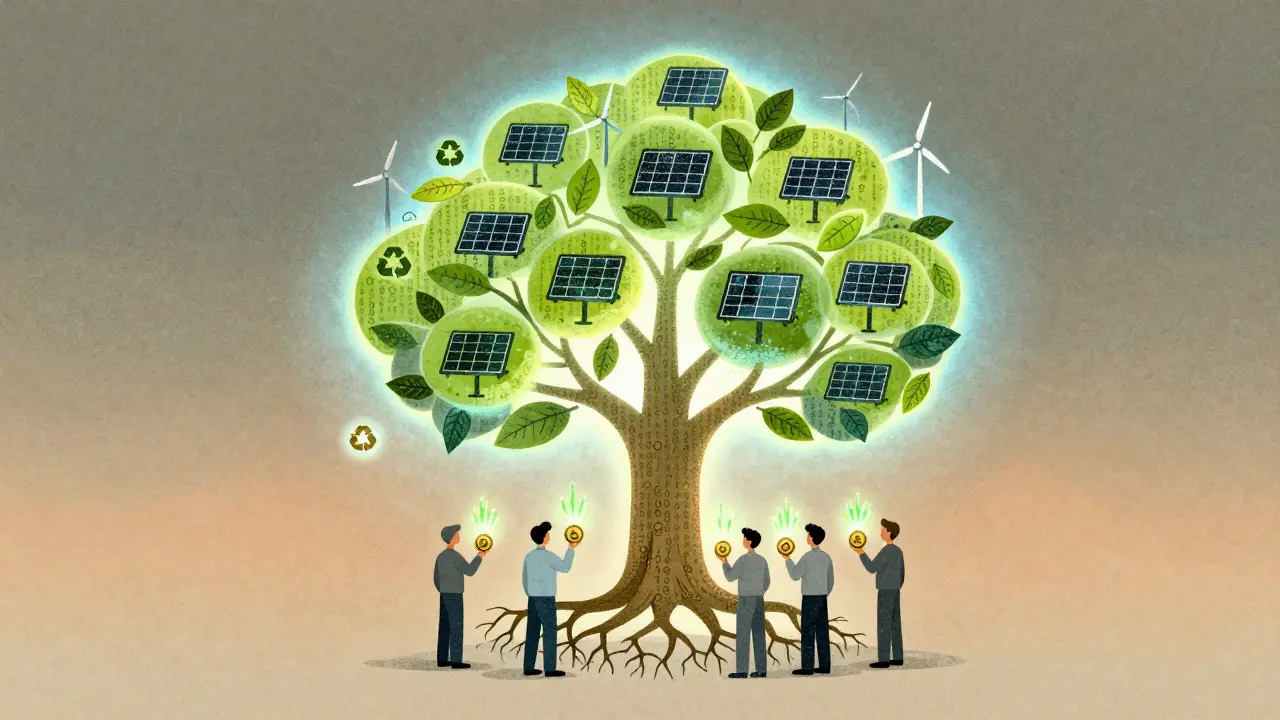
Most cryptocurrencies are built for speed, scalability, or profit. 5ire is built for something different: planet health.
If you’ve heard of 5ire (5IRE) and wondered if it’s just another crypto project with a green label, you’re not alone. But this isn’t a marketing gimmick. 5ire is a Layer 1 blockchain designed from the ground up to turn sustainability into a measurable, rewarded, and verifiable part of how the network operates. It’s not just talking about ESG-it’s building it into the code.
What makes 5ire different from other blockchains?
Unlike Ethereum or Cardano, which reduced energy use by switching to Proof of Stake, 5ire goes further. It doesn’t just save energy-it rewards validators for doing good.
The core innovation is called Sustainable Proof of Stake (SPoS). In traditional Proof of Stake, validators earn rewards based on how much crypto they stake. In 5ire’s SPoS, validators earn extra rewards based on real-world sustainability actions. Did your server run on solar power this month? Did you use recycled hardware? Did you offset your carbon footprint? These aren’t just nice-to-haves-they directly increase your token rewards.
This isn’t theoretical. During the Thunder testnet phase in mid-2023, over 250,000 wallets were created in just one month, and more than 2 million transactions were processed. That’s real activity from developers and early adopters who believe in the model.
How does 5ire actually work?
5ire runs on a dual-chain system that supports both EVM (Ethereum Virtual Machine) and WASM (WebAssembly). That means developers can build apps using familiar tools like Solidity or Rust-no need to learn an entirely new language. This flexibility is rare in sustainability-focused chains, which often sacrifice developer ease for green ideals.
The platform includes a full suite of tools: a wallet, a blockchain explorer, a validator app, a nominator app, and even a built-in IDE for coding directly on the network. These aren’t afterthoughts-they’re essential to onboarding developers who want to build real applications.
And here’s where it gets interesting: 5ire is designed to connect blockchain data with real-world sustainability reporting. Think of it as a tamper-proof ledger for carbon credits, renewable energy usage, or water conservation metrics. Companies and governments could use 5ire to prove their ESG claims aren’t just PR-they’re on-chain and verifiable.
What’s ESG as a Service (ESGaaS)?
ESG stands for Environmental, Social, and Governance. Right now, companies report ESG data manually. It’s prone to errors, delays, and outright fraud-what’s called “greenwashing.”
5ire’s ESGaaS model lets organizations upload sustainability metrics directly onto the blockchain. An enterprise might log how much electricity its data center uses, which renewable source powers it, and how much waste it recycles. That data gets timestamped, hashed, and stored permanently. Auditors, regulators, or investors can verify it instantly-without needing spreadsheets or third-party reports.
This isn’t just for big corporations. Municipalities in South Asia are already exploring partnerships with 5ire to track public infrastructure sustainability. Imagine a city proving its bus fleet reduced emissions by 40% over a year-and that proof is on a public, immutable ledger.

Tokenomics: Supply, distribution, and value
5ire has a fixed maximum supply of 1.5 billion tokens. No more will ever be created. This contrasts sharply with many crypto projects that keep minting new coins, diluting value over time.
As of late 2023, the circulating market value hovered around $1.5 billion, though the price has been volatile-ranging from under $0.0003 to over $0.001 in a single month. That volatility is typical for early-stage projects, especially ones tied to real-world outcomes that haven’t yet scaled.
Long-term projections from analysts suggest 5IRE could reach $0.25 by 2026 and possibly $2.73 by 2040. But those numbers depend entirely on one thing: adoption. If governments and Fortune 500 companies start using 5ire for ESG reporting, the token’s value could surge. If it fails to attract enterprise clients, it may remain a niche project.
Who’s using 5ire right now?
The community is growing, but it’s still early. Developers are active on GitHub and Discord, with around 15,000 members in official channels. Reddit users praise the vision but often complain about the lack of dApps and the complexity of the dual-chain setup.
One Reddit user summed it up: “The testnet performance was impressive, but I’m waiting for mainnet to see real enterprise adoption.” That’s the key phrase: mainnet launch.
As of early 2024, the 5ire mainnet is scheduled to go live. Until then, everything is on testnet. That means no real money is at stake, no enterprise contracts are signed, and no ESG data is being verified on-chain yet. The project’s credibility hinges on what happens next.
Challenges and risks
5ire’s biggest hurdle isn’t tech-it’s measurement. How do you turn “sustainability” into a number that a blockchain can verify? If a validator claims they’re using 100% renewable energy, how does the network confirm it? That’s the unanswered question.
Some experts worry that verifying real-world actions could slow down the network. Every sustainability metric needs to be cross-checked, possibly with IoT sensors, satellite data, or third-party auditors. That adds complexity. And if the system becomes too slow or expensive, enterprises won’t use it.
Regulatory risk is another concern. The EU’s SFDR and the ISSB are tightening rules on ESG reporting. If 5ire’s data doesn’t meet those standards, it could be legally useless-even if the tech works perfectly.
Finally, there’s the competition. Ethereum’s PoS is already green. Solana and Polygon are faster and cheaper. Why would a company switch to 5ire? Only if it offers something they can’t get elsewhere: trustable, auditable, blockchain-based sustainability proof.
Should you care about 5ire?
If you’re a trader looking for quick gains, 5ire is risky. Its price swings are wild, and the mainnet hasn’t launched yet. Don’t buy it hoping to flip it in a week.
If you’re a developer who wants to build apps that do good, 5ire is one of the few platforms worth exploring. The tools are there. The mission is clear. And if you’re serious about sustainability, you’re not just coding-you’re contributing to a new economic model.
If you’re an investor or policymaker, 5ire represents a potential turning point: the first blockchain designed not to replace banks, but to replace paper-based sustainability reports. That’s not just innovation-it’s a shift in how we track the health of our planet.
Right now, 5ire is a promise. The mainnet launch will turn it into a product. And if it delivers on its vision, it won’t just be another crypto coin-it could become the backbone of a new kind of green economy.
Is 5ire (5IRE) a good investment?
It depends on your goals. If you’re looking for short-term gains, 5IRE’s high volatility and unlaunched mainnet make it risky. If you believe in blockchain-based sustainability reporting and think enterprises will adopt it, then holding long-term could pay off. But treat it like an early-stage tech startup-not a stable asset.
How does 5ire’s SPoS consensus work?
In SPoS, validators earn rewards based on two things: how much 5IRE they stake, and how well they follow sustainable practices. Examples include using renewable energy to run their nodes, recycling old hardware, or offsetting carbon emissions. The better their sustainability score, the higher their rewards. This creates a direct financial incentive to act responsibly.
Can I mine 5ire coins?
No, 5ire doesn’t use mining. It uses Sustainable Proof of Stake (SPoS), which means you earn tokens by staking and proving sustainable actions-not by solving complex math problems. This makes it far more energy-efficient than Bitcoin or early Ethereum.
What’s the difference between 5ire and Ethereum after the Merge?
Ethereum switched to Proof of Stake to reduce energy use, but it doesn’t reward validators for doing good beyond staking. 5ire goes further: it ties rewards to real-world sustainability actions. So while Ethereum is greener than before, 5ire is designed to actively encourage environmental responsibility at every level of its network.
When will the 5ire mainnet launch?
The mainnet is scheduled for launch in 2024. As of early 2026, no official date has been confirmed, but the testnet has been active since mid-2023 with strong adoption metrics. Watch official 5ire channels for updates-this is the single most important milestone for the project.
Can I build apps on 5ire right now?
Yes, but only on testnet. The 5ire IDE, wallet, and developer tools are available now. You can write, test, and deploy smart contracts using EVM or WASM. But since the mainnet isn’t live, these apps don’t interact with real-world value or enterprise data yet.
Is 5ire regulated?
The blockchain itself isn’t regulated, but its use cases are. Since 5ire targets ESG reporting, it falls under financial and environmental regulations like the EU’s SFDR and the ISSB standards. If companies use 5ire to report sustainability data, that data must comply with those rules-making regulatory alignment critical to the project’s success.
Kip Metcalf
January 10, 2026 AT 08:34So basically this is crypto with a conscience? I’m in.
Natalie Kershaw
January 11, 2026 AT 21:37SPoS is the real deal-finally a blockchain that doesn’t just talk about ESG but *lives* it. The dual-chain EVM+WASM setup is genius for devs who want to build without abandoning their stack. And the 1.5B fixed supply? No inflationary garbage. This isn’t just greenwashing-it’s green coding. If mainnet delivers, we’re looking at the first blockchain that could actually *replace* corporate sustainability reports. No more PDFs full of lies. Just immutable, auditable data. I’ve already started testing the IDE on testnet. It’s clunky but functional. If you’re a dev who gives a damn about the planet, this is your playground.
Jon Martín
January 12, 2026 AT 09:25Imagine if every data center had to prove it was running on solar before getting rewarded-this is the future and it’s not coming slow it’s coming NOW. No more excuses. No more greenwash. The blockchain doesn’t lie. And if your server’s using coal? You get less tokens. That’s accountability. That’s power. This isn’t a coin it’s a movement and I’m all in. Let’s gooooo
Mujibur Rahman
January 14, 2026 AT 09:16SPoS is the only consensus mechanism that actually aligns economic incentives with planetary health. The real innovation isn’t the tech-it’s the incentive layer. But the measurement problem is real. How do you verify a validator’s renewable energy usage? IoT sensors? Satellite thermal imaging? Third-party auditors? Each adds latency. And if the network gets too slow for enterprise use cases, it dies. Also-EU SFDR compliance is non-negotiable. If 5ire’s data schema doesn’t map to ISSB standards, no Fortune 500 will touch it. This could be huge-or just another niche experiment. Watch the mainnet launch like a hawk.
Danyelle Ostrye
January 14, 2026 AT 15:35I read the whole thing and still don’t get how they verify if someone used recycled hardware. Like… what’s the proof? A receipt? A selfie with a motherboard? This feels like a trust exercise waiting to fail.
Sabbra Ziro
January 15, 2026 AT 19:54I get the skepticism-but let’s not throw the baby out with the bathwater. If we’re going to fix climate change, we need systems that reward responsibility, not just punish pollution. 5ire’s not perfect, but it’s trying to build a new language for accountability. Maybe the verification isn’t perfect yet-but what if we start with voluntary audits? Maybe cities or universities lead the way? I’ve seen small NGOs in rural India use blockchain for water usage tracking. It’s messy, but it works. This could be the same-just bigger. Let’s not dismiss it because the tech isn’t flawless yet. Let’s help make it better.
Jennah Grant
January 16, 2026 AT 19:25SPoS is the only consensus model that turns sustainability from a cost center into a profit driver. That’s the real shift. But the verification layer needs to be modular-don’t force every validator to use IoT sensors. Let them choose: self-certify with third-party audit (for low-stake nodes), or go full IoT+satellite (for high-stake validators). That way you scale without killing adoption. Also-ESGaaS needs to integrate with SAP and Oracle. If it doesn’t plug into existing enterprise systems, it’s a dead end. The dev tools are solid, but the API integrations are what’ll make or break this.
Dave Lite
January 18, 2026 AT 09:48Just deployed my first dApp on testnet-built a carbon credit tracker for local bike-share programs. It’s wild seeing the data go on-chain. No more guessing if a company’s “green” claims are real. And the wallet UI? So clean. I’m not a crypto bro-I’m just a dev who hates greenwashing. 5ire feels like the first project that actually gets it. Mainnet can’t come soon enough 😊
Tracey Grammer-Porter
January 19, 2026 AT 02:18I love the vision but I’m waiting for real enterprise partnerships before I get too excited. Who’s already signed on? Has any city or Fortune 500 company publicly said they’ll use this? If not, then it’s still just a testnet dream. I’m not against it-I’m just impatient. We need proof of adoption, not just proof of concept. Let’s see the first real ESG report verified on-chain. Then I’ll believe.