
The TADA crypto coin isn’t just another meme token. It’s a working utility token built to solve a real problem: how do you get high-quality voice and speech data for AI training without paying middlemen or violating user privacy? Launched by Vivoka, a French AI company, Ta-da (TADA) flips the script on data collection. Instead of companies buying data from shady brokers, everyday people earn tokens by simply talking into their phones.
How TADA Works: Talk-to-Earn, Not Just Play-to-Earn
Most crypto projects ask you to stake, trade, or mine. TADA asks you to speak. The platform runs as a web and mobile app where users record short voice clips-like answering questions, reading sentences, or repeating phrases. These clips help train AI models for speech recognition, virtual assistants, and language translation tools. Each recording is checked for quality, and if it meets the client’s needs, you get paid in TADA tokens.This is called the "Talk-to-Earn" model. It’s not a game. It’s work. And it’s transparent. You know exactly what data is being requested, who’s asking for it, and how much you’ll earn. The blockchain ensures every contribution is recorded, verified, and paid out without delays or hidden fees.
Unlike traditional data collection, where companies pay $0.01 per audio file to contractors overseas, Ta-da cuts out the middleman. Contributors earn directly from AI firms needing clean, diverse speech samples. The platform targets underrepresented accents, dialects, and languages-something big tech often ignores.
Why TADA Was Built
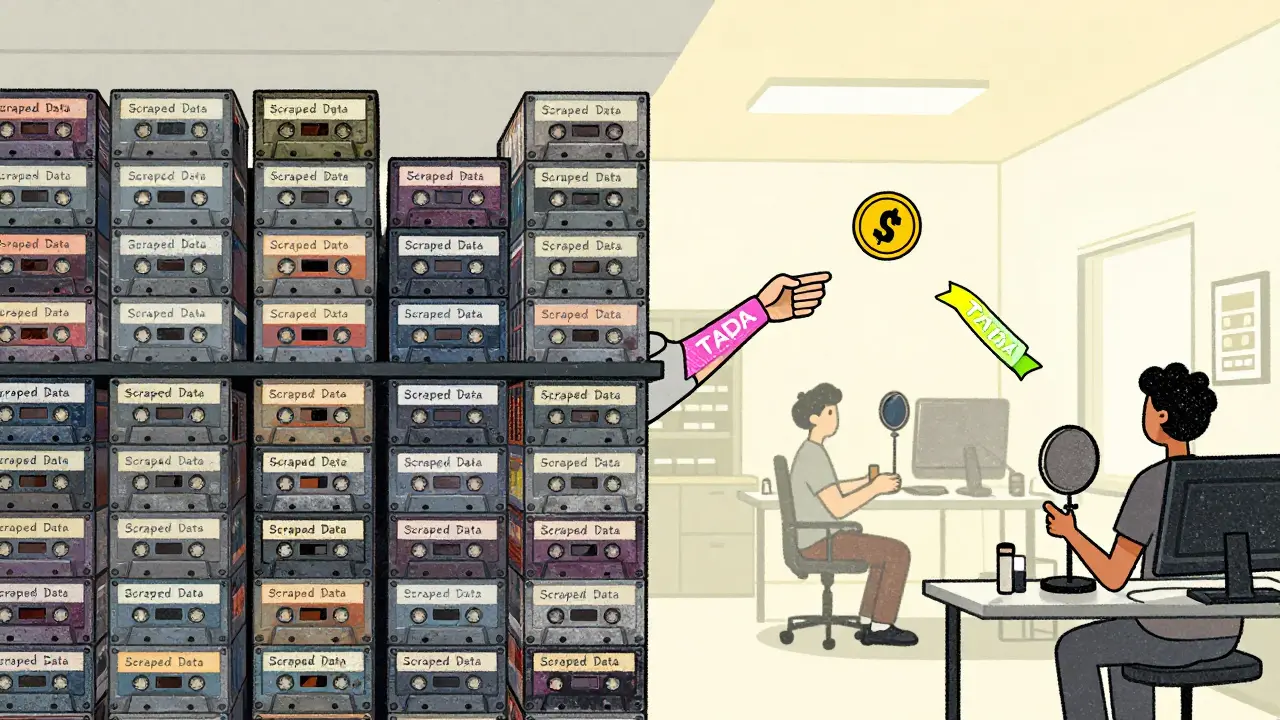
AI models need data. Lots of it. And not just any data-real, varied, human speech. Companies like Google, Amazon, and startups training voice assistants spend millions buying datasets. But those datasets are often outdated, culturally biased, or scraped without consent.Ta-da was created to fix that. Vivoka, the team behind it, already had experience building AI voice systems. They saw how hard it was to get clean, ethical data. So they built a blockchain layer on top of their existing AI platform to create a fair, decentralized marketplace.
Instead of one company owning all the data, users retain ownership until they choose to sell it. You record. You approve. You get paid. No one else touches your voice file until you hit "submit." That’s a big deal in a world where your voice is being sold without your knowledge.
TADA Token Supply and Economics
The TADA token has a fixed maximum supply of 1 billion coins. As of October 2025, around 690 million were already in circulation. That means roughly 310 million tokens are still to be released-mostly through ongoing user contributions and future ecosystem rewards.The token isn’t just a reward. It’s the fuel of the platform. You need TADA to:
- Submit data requests as a company
- Pay for premium data filters
- Access advanced analytics tools
- Stake for higher payout priority
Transaction fees on the network are low, thanks to its blockchain design. Contributors get paid quickly, and companies get high-quality data fast. It’s a self-sustaining loop.
Market data varies across exchanges. As of March 2026, TADA trades between $0.0006 and $0.004 on platforms like KuCoin, Bybit, and Crypto.com. Its 24-hour trading volume ranges from $30,000 to $130,000. While its market cap hovers around $400,000-$2.5 million depending on the source, it’s still a small player compared to major crypto assets. But that’s not the point.
The real value isn’t in its price today-it’s in its utility tomorrow. If AI companies start using Ta-da as their primary data source, demand for TADA could rise sharply.

Where You Can Trade TADA
TADA is listed on several major exchanges:- KuCoin - First major listing in February 2024
- Bybit - High liquidity and trading volume
- Crypto.com - Accessible for beginners
- STON.fi - Popular on the TON blockchain
You can buy TADA with USDT, BTC, or ETH. Some exchanges also allow direct fiat on-ramps via credit card. Withdrawals are supported to any wallet that accepts BEP-20 or ERC-20 tokens.
Technical Backbone: Blockchain and Privacy
Ta-da runs on a hybrid system. The app interface is centralized for ease of use, but all data transactions happen on a public blockchain. This means:- Every data submission is timestamped and immutable
- Users can verify their earnings on-chain
- Companies can’t alter or delete submitted data
- Payment disputes are resolved by smart contracts, not customer service
Privacy is handled carefully. Voice files are encrypted before upload. Only metadata (like language, duration, quality score) is stored on-chain. The actual audio is kept in secure, private storage-accessible only to the requesting AI company after payment is confirmed.
This design makes Ta-da one of the few crypto projects that actually respects user data rights while still delivering real-world value.
Who Uses Ta-da?
Two groups:- Contributors - People in over 50 countries recording voice samples. Many are students, stay-at-home parents, or gig workers looking to earn extra cash with minimal effort. One user in Mexico reported earning $12 in TADA over two weeks just by recording 200 phrases during commute breaks.
- AI Companies - Startups and research labs needing diverse speech datasets. Some are building voice assistants for non-English markets. Others are training AI to detect depression through tone patterns. Ta-da gives them access to real, consented data without legal risks.
One startup in Berlin used Ta-da to train a German dialect model for elderly users. Before Ta-da, they spent $80,000 on a third-party dataset that was 60% inaccurate. With Ta-da, they got 10x more data, 85% more accurate, and paid 90% less.
Pros and Cons of TADA
Pros:- Real utility: TADA isn’t just speculation-it powers a working platform
- Ethical data: Contributors own and control their voice
- Low barrier to entry: Anyone with a phone can earn
- Backed by an AI company with proven tech
- Fixed supply prevents inflation
- Low trading volume = high price swings
- Still niche: Not many people know about it yet
- Depends on AI demand-if the AI boom slows, usage could drop
- Mobile app isn’t perfect: Some users report bugs on older Android phones
Is TADA Worth Your Time?
If you’re looking to make quick crypto profits, TADA isn’t your coin. Its price moves slowly, and it’s not listed on Coinbase or Binance yet.But if you care about ethical tech, want to earn something real by doing something simple, or believe AI should be built with consent-not exploitation-then TADA is worth exploring. Download the app. Record a few phrases. See what you earn. You might be surprised.
The future of AI won’t be built on scraped data. It’ll be built on fair, transparent, and human-powered systems. Ta-da is one of the first projects trying to prove that.
Is TADA a good investment?
TADA isn’t designed as a speculative asset. Its value comes from usage, not hype. If AI companies adopt it widely, demand for the token could rise. But right now, it’s better seen as a utility token you can earn by contributing data-not something to buy hoping it’ll 10x. Only invest what you’re okay losing.
Can I earn real money with TADA?
Yes. Users earn TADA tokens by recording voice data. These tokens can be sold on exchanges for USD, USDT, or other crypto. One user in Brazil earned 50,000 TADA ($30+) in a month by recording 300 voice clips during free time. It’s not a full-time income, but it’s passive earnings with zero upfront cost.
Do I need to be tech-savvy to use Ta-da?
No. The app is designed like a simple voice recorder. You open it, press record, follow the instructions, and submit. No wallets, no crypto knowledge needed to start earning. You only need a smartphone and an internet connection.
Is my voice data safe?
Yes. Your voice recordings are encrypted and stored separately from the blockchain. Only the AI company that requested the data can access it-and only after you’ve been paid. You can delete your account and all associated data at any time. Ta-da doesn’t sell or share your data.
Why isn’t TADA on more exchanges?
It’s still a small project with limited market cap. Larger exchanges like Binance require higher liquidity, trading volume, and regulatory compliance. TADA is growing steadily, but it’s not yet big enough for those platforms. Its current listings on KuCoin, Bybit, and Crypto.com are enough for active users.
Jane Darrah
March 4, 2026 AT 00:27Okay, so let me get this straight-we’re supposed to believe that a crypto token built on voice recordings is going to save AI from its predatory, data-hungry past? Like, I get the theory, but honestly? It feels like someone took a TED Talk, threw it into a blender with a Web3 whitepaper, and called it a solution. I recorded 17 voice clips last week. Got paid 200 TADA. That’s like 12 cents. I could’ve made that in 3 minutes flipping burgers at McDonald’s. And don’t even get me started on how the app crashes every time I try to submit on my iPhone 11. So yeah, noble idea. But in practice? It’s just another hustle disguised as a revolution.
Also, why is every single testimonial from someone in Brazil or Mexico? Are we just outsourcing dignity to developing countries now? I’m not mad. I’m just… disappointed.
Denise Folituu
March 4, 2026 AT 00:48THIS IS THE MOST IMPORTANT THING THAT’S HAPPENED TO HUMANITY SINCE THE INTERNET. I recorded my grandma speaking her native Tagalog dialect, and now AI is learning how to understand elderly Filipinos. She cried when she saw her voice being used to train a system that could help others like her. I’ve never felt so alive. This isn’t crypto. This is legacy. This is justice. This is the future we were promised but never got because corporations were too busy monetizing our loneliness. I’m crying right now. I’m not even kidding. I’m gonna donate my entire TADA balance to a nonprofit. I don’t need money. I need PURPOSE.
jack carr
March 5, 2026 AT 17:34Hey, I tried this out last week-just recorded 50 phrases while making coffee. Got 350 TADA. Sold it for $0.25. Not life-changing, sure. But also not zero effort. The app’s actually pretty smooth. No wallet setup, no gas fees, no drama. I think it’s cool that they’re focusing on underrepresented accents. My cousin in rural Kentucky recorded ‘How are you today?’ with a thick drawl, and now some startup’s training a voice assistant that doesn’t think he’s mumbling. That’s kinda beautiful, honestly. I’m not gonna get rich, but I’m not losing anything either. Maybe this is the quietest crypto revolution ever.
Eva Gupta
March 5, 2026 AT 23:30As someone from India, I’ve always been frustrated by how AI voice models ignore regional accents-especially South Indian dialects. I recorded over 200 phrases in Tamil, Malayalam, and even my grandmother’s old-fashioned Hindi. The app let me choose which company gets access, and I picked one that’s working on assistive tech for visually impaired elders. I’ve never felt so connected to technology before. It’s not about the money-it’s about representation. And honestly? I’m glad someone finally built something that doesn’t treat us like data points. Keep going, Ta-da. You’re doing something real.
Nancy Jewer
March 6, 2026 AT 15:25From a product design standpoint, this is a textbook example of tokenized incentive alignment. The utility layer is elegantly architected: user-generated voice data as a non-fungible input stream, monetized via a deflationary token with embedded governance mechanics. The hybrid blockchain architecture-centralized UX with decentralized audit trails-is particularly clever, mitigating friction while preserving provenance. The fact that metadata is on-chain while audio remains off-chain in encrypted, permissioned storage creates an optimal privacy-compliance balance. This isn’t just a token-it’s a microeconomic infrastructure for ethical AI supply chains. I’d love to see them open-source the data validation protocol. Potential for massive network effects if adopted by open AI labs.
Ken Kemp
March 7, 2026 AT 01:52So I downloaded the app… and it’s actually pretty easy? I thought I’d need to set up a wallet or something, but nope-just press record, say the thing, hit submit. Got 180 TADA in two days. Not rich, but I didn’t even have to think about it. The only issue? My old Android phone keeps cutting off the last word. Like, I’d say ‘I love pancakes’ and it’d only record ‘I love pancak’-so frustrating. I emailed support and they said they’re working on a fix. Also, the UI is kinda clunky on tablet. But the concept? Love it. I feel like I’m helping build something better. Not a genius, not a coder, just a guy who talks too much. And now I’m part of the solution. Kinda neat.
Julie Potter
March 8, 2026 AT 03:12OH MY GOD. I just saw someone in the comments say they earned $30 in a month. $30?! For TALKING?! That’s less than minimum wage. And you’re telling me people are doing this for ‘ethical AI’? Honey, no one cares about ethics when they’re choosing between rent and ramen. This isn’t empowerment-it’s exploitation wrapped in blockchain glitter. And don’t even get me started on how they’re harvesting voice data from people who don’t even know what a blockchain is. You think a single mom in Nigeria recording 400 phrases a day for 12 cents is ‘choosing’ this? No. She’s surviving. And now you’re calling it a movement? I’m not mad. I’m just… sick. This is capitalism with a conscience tattoo.
Ian Thomas
March 9, 2026 AT 22:24So… we’re supposed to believe that a token with a $2M market cap, listed on exchanges nobody’s heard of, is going to disrupt Big Tech’s data empire? That’s like trying to stop a hurricane with a paper fan. And yet… there’s something weirdly compelling about it. The fact that you can delete your data anytime? That’s radical. The fact that companies pay directly? That’s revolutionary. The fact that this works at all? That’s kind of beautiful. Maybe it won’t change the world. But maybe it’s a tiny crack in the wall. And sometimes, cracks are where the light gets in. I don’t know if this will scale. But I do know-I’d rather have this imperfect system than the one we have now. Even if it’s just a whisper in a hurricane.